
talk-data.com talk-data.com

J

Speaker

Jacob Tomlinson

4

talks

Frequent Collaborators

Filter by Event / Source

Talks & appearances

4 activities · Newest first

Search activities →
Accelerating Geospatial Analysis with GPUs

Geospatial analysis often relies on raster data, n‑dimensional arrays where each cell holds a spatial measurement. Many raster operations, such as computing indices, statistical analysis, and classification, are naturally parallelizable and ideal for GPU acceleration.

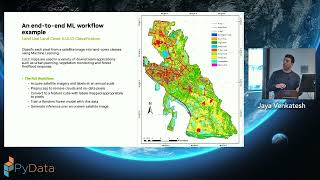
This talk demonstrates an end‑to‑end GPU‑accelerated semantic segmentation pipeline for classifying satellite imagery into multiple land cover types. Starting with cloud-hosted imagery, we will process data in chunks, compute features, train a machine learning model, and run large-scale predictions. This process is accelerated with the open-source RAPIDS ecosystem, including Xarray, cuML, and Dask, often requiring only minor changes to familiar data science workflows.

Attendees who work with raster data or other parallelizable, computationally intensive workflows will benefit most from this talk, which focuses on GPU acceleration techniques. While the talk draws from geospatial analysis, key geospatial concepts will be introduced for beginners. The methods demonstrated can be applied broadly across domains to accelerate large-scale data processing.
In today’s world of ever-growing data and AI, learning about GPUs has become an essential part of software carpentry, professional development and the education curriculum. However, teaching with GPUs can be challenging, from resource accessibility to managing dependencies and varying knowledge levels.

During this talk we will address these issues by offering practical strategies to promote active learning with GPUs and share our experiences from running numerous Python conference tutorials that leveraged GPUs. Attendees will learn different options to how to provide GPU access, tailor content for different expertise levels, and simplify package management when possible.

If you are an educator, researcher, and/or developer who is interested in teaching or learning about GPU computing with Python, this talk will give you the confidence to teach topics that require GPU acceleration and quickly get your audience up and running.

Many notable PyData projects including Jupyter Hub, Matplotlib and JAX follow a versioning scheme called EffVer, where instead of making promises around backward compatibility they communicate the likelihood and magnitude of the work required to adopt a new version.

In this talk we will dive into EffVer, what it is and what it means for developers and users. We will discuss how to apply EffVer to your own projects and how to depend on projects that use it.

GPU Accelerated Python

Accelerating Python using the GPU is much easier than you might think. We will explore the powerful CUDA-enabled Python ecosystem in this tutorial through hands-on examples using some of the most popular accelerated scientific computing libraries.

Topics include: - Introduction to General Purpose GPU Computing - GPU vs CPU - Which processor is best for which tasks - Introduction to CUDA - How to use CUDA with Python - Using Numba to write kernel functions - CuPy - cuDF

No prior experience with GPU's is necessary, but attendees should be familiar with Python.