talk-data.com talk-data.com

Topic

integration-solutions

9

tagged

Activity Trend

1 peak/qtr
2020-Q1 2026-Q1

Activities

9 activities · Newest first

Building Data Integration Solutions

Are you struggling to manage and make sense of the vast streams of data flowing into your organization? In today's data-driven world, the ability to effectively unify and organize disparate data sources is not just an advantage—it's a necessity. The challenge lies in navigating the complexities of data diversity, volume, and regulatory demands, which can overwhelm even the most seasoned data professionals. In this essential book, Jay Borthen offers a comprehensive guide to understanding the art of data integration. This book dives deep into the processes and strategies necessary for creating effective data pipelines that ensure consistency, accuracy, and accessibility of your data. Whether you're a novice looking to understand the basics or an experienced professional aiming to refine your skills, Borthen's insights and practical advice, grounded in real-world case studies, will empower you to transform your organization's data handling capabilities. Understand various data integration solutions and how different technologies can be employed Gain insights into the relationship between data integration and the overall data life cycle Learn to effectively design, set up, and manage data integration components within pipelines Acquire the knowledge to configure pipelines, perform data migrations, transformations, and more

Mastering Complexity

The author covers fourteen tools to help you find the information you need and offers step-by-step instructions for constructing each one. He shows you how these tools can be combined with a set of simple problem-solving steps that can act as a powerful change agent to help reduce or eliminate process problems. Five-Step Problem-Solving Process Identify the problem: Clearly state what needs improvement. Analyze: Determine what causes the problem to occur. Evaluate Alternatives: Identify and select actions to reduce or eliminate the problem. Test Implement: Implement these actions on a trial basis to determine their effectiveness. Standardize: Ensure that useful actions are preserved.

Talend Open Studio Cookbook

Talend Open Studio Cookbook is a comprehensive guide for both beginners and intermediate users of Talend Open Studio, the leading open-source data integration software. Through practical recipes, this book covers all aspects of Talend development, from schemas and data mapping to advanced debugging and deployment techniques. What this Book will help me do Master the use of schemas for forming solid data structures. Effectively utilize tMap for data transformation and integration. Develop skills to manage and manipulate various file formats. Understand how to test and debug Talend jobs to ensure robust solutions. Learn to deploy, schedule, and manage Talend integrations in production environments. Author(s) None Barton is an experienced developer and a passionate advocate for open-source data tools. With years of hands-on experience in data integration and Talend development, they bring a practical and results-driven perspective to their writing, aiming to empower developers with actionable insights and real-world expertise. Who is it for? Ideal readers for this book are beginner and intermediate developers seeking to enhance their understanding of Talend Open Studio. Whether you've used the software for basic tasks or are completely new to it, this cookbook format is structured to guide you through practical challenges and deeper concepts. If your goal is to build confidence and efficiency in data integration tasks, this book is designed for you.

Getting Started with Talend Open Studio for Data Integration

Discover how to leverage Talend Open Studio for Data Integration to manage and optimize your data workflow. This book provides a hands-on introduction to creating integration jobs and automating data processes using Talend's drag-and-drop interface. Explore practical examples, and realize how powerful and approachable data integration can be. What this Book will help me do Develop and deploy scalable data integration pipelines using Talend Open Studio. Master common data operations like filtering, sorting, transforming, and aggregating. Gain expertise in connecting various data sources, both relational and non-relational. Implement complex flow logic, including conditional processing and dependencies. Learn to package and manage production-ready integration jobs for real-world scenarios. Author(s) Jonathan Bowen is an experienced technologist and author specializing in data integration and software tools. With years of hands-on experience, Jonathan has guided many organizations in adopting efficient data workflows. He conveys technical concepts with clarity and provides practical, actionable content to help readers succeed. Who is it for? This book is perfect for developers, business analysts, and IT professionals tasked with integration projects. Whether you're a novice to data integration or looking to deepen your hands-on experience with Talend, this guide will support your journey. Some prior familiarity with SQL and a data management background are advantageous. Choose this book if you aim to become a proficient data integrator.

Patterns: SOA Client - Access Integration Solutions

The Patterns for e-business are a group of proven, reusable assets that can be used to accelerate the design and development of e-business applications. This IBM Redbooks publication focuses on how to reuse the SOA Client - Access Integration patterns to extend enterprise applications to a wide range of client devices such as laptops, PDAs, and mobile phones. Part 1 presents the client access solution domain and benefits of using patterns. We introduce key technologies to serve as a foundation for understanding the Access Integration patterns. Part 2 guides the reader through the process of reusing the patterns assets within the context of the RUP to accelerate the solution design. We include selection criteria to navigate from the Business and IT drivers to the appropriate Application pattern or patterns, and supporting Runtime pattern, component model, and Product mapping instantiated by IBM software products. Part 3 demonstrates how to reuse the patterns for a fictitious ITSO Insurance scenario. The scenario highlights the Distributed Rich Client application pattern, which is used to extend the existing SOA enterprise application. The solution provides mobile adjusters with the capability to work on-site with the customer in a disconnectable mode and sync data with the enterprise when connected to the network. The Runtime pattern is instantiated by IBM WebSphere Everyplace Deployment V6.0. Please note that the additional material referenced in the text is not available from IBM.

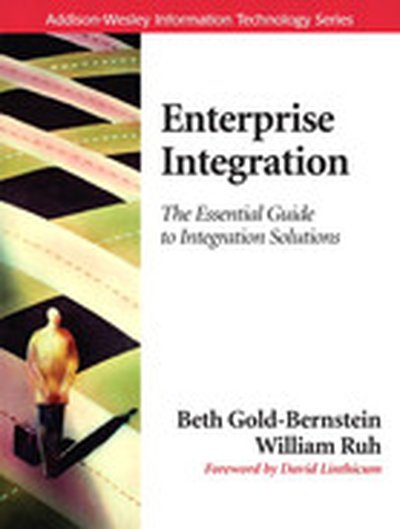
Enterprise Integration: The Essential Guide to Integration Solutions

“The book’s use of real-world case study vignettes really does go to the heart of the subject matter. This stuff is real, it has real applicability to real problems, and, as with most things in life, it shows how it all comes down to real money in the final analysis. This book shows you what your peers are doing to drive costs out of integration projects and to build new applications without re-inventing the entire wheel—just a few new spokes and off you go. This is a good book. Read it.” — Peter Rhys Jenkins, Complex Systems Architect, Candle Corporation “When you get two long-term, acknowledged experts on integration and interoperability together to lay out the current state of the IT universe you expect an immediate return on investment—and this book delivers. It’s common knowledge that 90% of total software lifecycle cost is in maintenance and integration, and that needs to drive IT decision-making. With comprehensive coverage of the integration technology landscape, and clear case studies presented at every turn, this book belongs on every IT manager’s, every system architect’s, and every software developer’s bookshelf.” — Richard Mark Soley, chairman and CEO, Object Management Group “Today’s myriad of integration technologies and alternatives can be daunting. This book presents a framework and process for the evaluation, design, and selection of the appropriate integration technologies to meet your strategic business needs. You will find the templates a particularly useful mechanism to jump-start documentation and drive your decision-making process.” — Ron Zahavi, CIO, Global Business Transformation, Unisys Global Transformation Team; author of Enterprise Application Integration with CORBA “It is refreshing to read a book that presents a good business approach to the integration challenge facing most business leaders today, while at the same time educating them about the major components of the required technologies and management practices changes required. The narrative, examples, and templates establish a common reference point between the business and the technology organizations. A must-read for senior business leaders challenged with the complexities of business integration, as well as Senior IT Leaders challenged with shrinking budgets and lower tolerances for failures.” — Chuck Papageorgiou, managing partner, Ideasphere “Integration has, and will continue to be, one of the success indicators of any enterprise project. Failing to understand the nuances of integration is a critical mistake managers cannot afford to make.” — Marcia Robinson, author of Services Blueprint: Roadmap for Execution “A much-needed book; it ties together the business and technology aspects of information system implementation, emphasizing best practices for really getting things done. I believe that both the technical and business communities will benefit from the in-depth material provided in this book.” — Dr. Barry Horowitz, professor of systems and information engineering, University of Virginia (former CEO, Mitre Corporation) Integration of applications, information, and business process has become today’s #1 IT investment priority. Most enterprise integration books simply explain the technology. This one shows exactly how to apply it. It’s a step-by-step roadmap for your entire project—from the earliest exploratory stages through analysis, design, architecture, and implementation. Renowned enterprise integration experts Beth Gold-Bernstein and William Ruh present best practices and case studies that bring their methodology to life. They address every stage from the decision-maker’s and implementer’s point of view—showing how to align business requirements to specific solutions, systematically reduce risk, and maximize ROI throughout the entire lifecycle. Coverage includes: Supporting strategies, tactics, and business planning: enterprise integration from the business perspective Defining realistic project success indicators and metrics Establishing integration architectures: supporting near-term needs while building reusable infrastructure services for the long-term Adopting metadata architecture and standards Implementing four essential implementation patterns: application, information, composite, and process integration Understanding service integration and implementing service-oriented architectures Providing organizational structure and governance to support effective integration The authors provide detailed plans and specification templates for application integration projects—both in the book and on the CD-ROM. These projects include identifying business drivers and requirements; establishing strategy; and integrating services, information, process, and applications. was written for every member of the integration team: business and IT leaders, strategists, architects, project managers, and technical staff. Regardless of your role, you’ll discover Enterprise Integration where you fit, what to do, and how to drive maximum business value from your next integration project.