With o1, OpenAI ushered a new era: LLMs with reasoning capabilities. This new breed of models broadened the concept of scaling laws, shifting focus from train-time to inference-time compute. But how do these models work? What does "inference-time compute" exactly mean? What data do we use to train these new models? And finally - and perhaps more importantly: how expensive can they get, and what can we use them for?
 talk-data.com
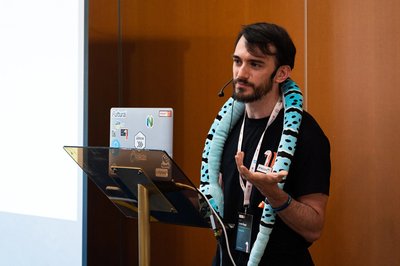
Speaker
Luca Baggi
3
talks
AI Engineer
xtream
AI Engineer @xtream
Bio from: PyData Roma Capitale + PyRoma Meetup @ The Social Hub
Filter by Event / Source
Talks & appearances
3 activities · Newest first
Have you ever asked yourself how parameters for an LLM are counted, or wondered why Gemma 2B is actually closer to a 3B model? You have no clue about what a KV-Cache is? (And, before you ask: no, it's not a Redis fork.) Do you want to find out how much GPU VRAM you need to run your model smoothly?
If your answer to any of these questions was "yes", or you have another doubt about inference with LLMs - such as batching, or time-to-first-token - this talk is for you. Well, except for the Redis part.
Transformers are everywhere: NLP, Computer Vision, sound generation and even protein-folding. Why not in forecasting? After all, what ChatGPT does is predicting the next word. Why this architecture isn't state-of-the-art in the time series domain?
In this talk, you will understand how Amazon Chronos and Salesforece's Moirai transformer-based forecasting models work, the datasets used to train them and how to evaluate them to see if they are a good fit for your use-case.