talk-data.com talk-data.com

Topic

Microsoft

technology software cloud

407

tagged

Activity Trend

556 peak/qtr
2020-Q1 2026-Q1

Activities

Showing filtered results

Filtering by: O'Reilly Data Engineering Books ×
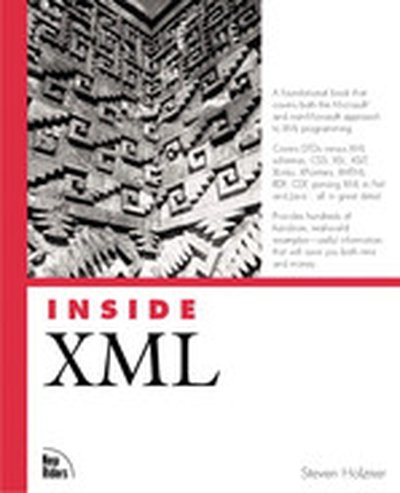
Inside XML

The XML explosion hardly needs any introduction-it's everywhere and there just seems to be no end to what can be done with XML. While writing to the W3C standards, and keeping up with the pace for corporate implementation, you, the programmer or web developer, will need a comprehensive guide to get you started and show you what XML and its related technologies can do. A thorough guide is imperative to success because you will need to know and understand the full scope of XML from day one in order to work with it successfully. With your time constraints and impossible project schedules, you need a comprehensive guide that fulfills your needs in one complete book. Inside XML is an anchor book that covers both the Microsoft and non-Microsoft approach to XML programming. It covers in detail the hot aspects of XML; such as, DTD's vs. XML Schemas, CSS, XSL, XSLT, Xlinks, Xpointers, XHTML, RDF, CDF, parsing XML in Perl and Java, and much more.

Writing Stored Procedures for Microsoft SQL Server

Writing Stored Procedures for Microsoft SQL Server focuses on teaching you not only how to build effective stored procedures, but also how to optimize and streamline them for long term use. Get an understanding of how SQL Server interprets stored procedures verses direct access via SQL queries. This is followed by detailed instructions on creating and maintaining a repository of stored procedures. Once you know how stored procedures are created and built, you are taught how to determine which logic within an application makes sense to be put into this scheme. Additionally, you're provided with guidance on making stored procedures that are portable across applications.

The Guru's Guide to Transact-SQL

Since its introduction over a decade ago, the Microsoft SQL Server query language, Transact-SQL, has become increasingly popular and more powerful. The current version sports such advanced features as OLE Automation support, cross-platform querying facilities, and full-text search management. This book is the consummate guide to Microsoft Transact-SQL. From data type nuances to complex statistical computations to the bevy of undocumented features in the language, imparts the knowledge you need to become a virtuoso of the language as quickly as possible. The Guru's Guide to Transact-SQL In this book, you will find the information, explanations, and advice you need to master Transact-SQL and develop the best possible Transact-SQL code. Some 600 code examples not only illustrate important concepts and best practices, but also provide working Transact-SQL code that can be incorporated into your own real-world DBMS applications. Your journey begins with an introduction explaining language fundamentals such as database and table creation, inserting and updating data, queries, joins, data presentation, and managing transactions. Moving on to more advanced topics, the journey continues with in-depth coverage of: Transact-SQL performance tuning using tools such as Query Analyzer and Performance Monitor Nuances of the various T-SQL data types Complex statistical calculations such as medians, modes, and sliding aggregates Run, sequence, and series identification and interrogation Advanced Data Definition Language (DDL) and Data Management Language (DML) techniques Stored procedure and trigger best practices and coding methods Transaction management Optimal cursor use and caveats to look out for Full-text search Hierarchies and arrays Administrative Transact-SQL OLE Automation More than 100 undocumented commands and language features, including numerous unpublished DBCC command verbs, trace flags, stored procedures, and functions Comprehensive, written in understandable terms, and full of practical information and examples, is an indispensable reference for anyone working with this database development language. The accompanying CD-ROM includes the complete set of code examples found in the book as well as a SQL programming environment that will speed the development of your own top-notch Transact-SQL code. The Guru's Guide to Transact-SQL

Access Database Design and Programming, Second Edition

When using software products with graphical interfaces, we frequently focus so much on the details of how to use the interface that we forget about the more general concepts that allow us to understand and put the software to effective use. This is particularly true of a powerful database product like Microsoft Access. Novice, and sometimes even experienced, programmers are so concerned with how something is done in Access that they often lose sight of the general principles that underlie their database applications. Access Database Design & Programming, 2nd Edition, an update to the bestselling first edition, features: A discussion of Access' new VBA Integrated Development Environment, which, for the first time, is the one used by Word, Excel, and PowerPoint An expansion of the discussion of the VBA language itself, in response to reader requests A discussion of Microsoft's latest data access technology, called Active Data Objects (or ADO), along with a discussion of Open Database Connectivity(ODBC), which is intimately connected with ADO Unlike other Access books that take the long, detailed approach to every topic of concern to Access programmers, this book focuses instead on the core concepts, enabling programmers to develop solid, effective database applications. As a result, important topics such as designing forms and reports, database security, database replication, and programming for multiuser applications are simply not discussed. This book is a kind of "second course" in Access that provides a relatively experienced Access user who is new to programming with the frequently overlooked techniques necessary to successfully develop in the Microsoft Access environment. Anyone interested in learning Access in-depth, rather than just scraping the surface, will enjoy and immensely benefit from reading this book. Although this book is really an introduction directed to intermediate Microsoft Access users who are novice programmers, it should appeal to all levels of Access developers. For novice programmers, it focuses on a key body of knowledge that is typically neglected, but is nevertheless essential for developing effective database applications. For intermediate and advanced developers, its treatment of database design and queries provides a handy treatment that otherwise has to be gleaned from relatively uninteresting textbooks, while its programming chapters constitute a handy reference to some basic operations that can be performed using DAO or the Access object model.

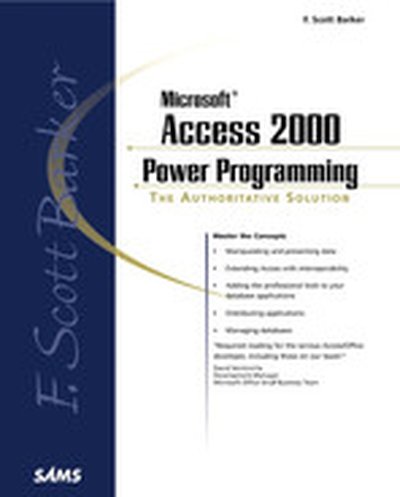
F. Scott Barker's Microsoft® Access 2000 Power Programming

Access 2000 Power Programming gives many practical techniques for the corporate and independent developer. New features of Access 2000 are covered thoroughly and useful examples which will be implemented by programmers in their everyday applications. New topics include a chapter devoted to Data Pages, Microsoft's way of bringing the Web interface into everyday office solutions. Also, a new chapter clarifies the confusion over ADP/MDB and DAO/ADO, including when and where to use each. The book covers a number of new additions to VBA which developers will need good exposure to in order to take advantage of them.

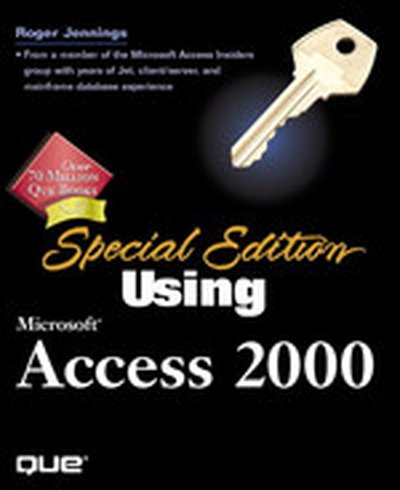
Special Edition Using Microsoft® Access 2000

Special Edition Using Access 2000 is your authoritative guide to mastering the essentials of this powerful 32-bit database development platform. Get started quickly by using the Database Wizard to create a working Access 2000 application in less than 30 minutes. Detailed, step-by-step instructions guide you through the process of designing and using Access tables, queries, forms, and reports. Chapters on VBA techniques pave your way to Access programming. Make the Access-Internet connection by exporting table, queries, and reports to static Web pages, then move into work with Data Access Pages and Active Server pages.