Feature tour: entities, keys, mappers, middleware
 talk-data.com
Topic
Java
programming_language
object_oriented
enterprise
392
tagged
Activity Trend
25
peak/qtr
2020-Q1
2026-Q2
Top Events
O'Reilly Data Engineering Books
243
Data Engineering Podcast
39
O'Reilly Data Science Books
23
ADSP: Algorithms + Data Structures = Programs
11
Google Cloud Next '25
7
Microsoft Ignite 2025
6
Databricks DATA + AI Summit 2023
6
Data + AI Summit 2025
5
Introducing Hypernate: Data Mapper Framework for Hyperledger Fabric Chaincode
4
Google Cloud Next '24
4
DataTalks.Club
4
Introducing Hypernate: Data Mapper Framework for Hyperledger Fabric Chaincode
3
Deep dive into core features: entities, primary/composite keys, value mappers, and the plug-in middleware pipeline for logging, tracing, and caching.
Overview of Hypernate features, including entities, key design (primary/composite), value mappers, and the plug‑and‑play middleware pipeline for logging, tracing, and caching.
Intro: overview of why Hypernate was built and what it aims to simplify in JVM Fabric chaincode.
Live coding: refactor a basic Fabric contract with Hypernate
Live coding session refactoring a basic Fabric smart contract using Hypernate.
Live coding session demonstrating how to refactor a basic Fabric contract using Hypernate.
Hands-on run-through of the provided Hypernate samples with practical tips and best practices.
Run the samples & pro tips
Run the samples locally and learn practical tips for getting started with Hypernate.
Richard Fichtner discusses Java modernization and how to update codebases responsibly.
by
Olga Shonova
Java Backend Developer
by
Oliver Fischer
(Apache Software Foundation)
,
Sandra Ahlgrimm
(Microsoft)
,
Benjamin Nothdurft
,
Vaughn Vernon
,
Chris Richardson
,
Adrian Kodja
(softgarden)
,
Pasha Finkelshteyn
(Bellsoft)
,
Timmo Freudl-Gierke
(Oliver Wyman)
on the State and Future of AI, Microservices, DDD, Flow, Spring and Java
Learn how to seamlessly modernize a Linux application stack in Azure. Participants will be able to step through the migration process with a Linux/Postgres/Java application and utilize infrastructure as a code (IaC) for scale migrations.
Please RSVP and arrive at least 5 minutes before the start time, at which point remaining spaces are open to standby attendees.
Learn how to seamlessly modernize a Linux application stack in Azure. Participants will be able to step through the migration process with a Linux/Postgres/Java application and utilize infrastructure as a code (IaC) for scale migrations.
Please RSVP and arrive at least 5 minutes before the start time, at which point remaining spaces are open to standby attendees.
Learn how to seamlessly modernize a Linux application stack in Azure. Participants will be able to step through the migration process with a Linux/Postgres/Java application and utilize infrastructure as a code (IaC) for scale migrations.
Please RSVP and arrive at least 5 minutes before the start time, at which point remaining spaces are open to standby attendees.
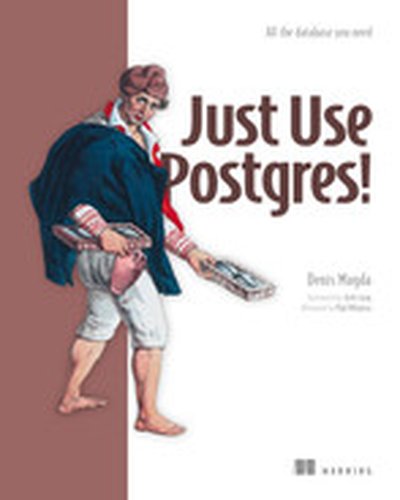
You probably don’t need a collection of specialty databases. Just use Postgres instead! Written for application developers and database pros, Just Use Postgres! shows you how to get the most out of the powerful Postgres database. In Just Use Postgres! you’ll learn how to: Use Postgres as an RDBMS for transactional workloads Develop generative AI, geospatial, and time-series applications Take advantage of modern SQL including window functions and CTEs Perform full-text search and process JSON documents Use Postgres as a message queue Optimize performance with various index types including B-trees, GIN, GiST, HNSW, and more Over the decades, PostgreSQL, aka Postgres, has grown into the most powerful general-purpose database and has become the de facto standard for developers worldwide. Just Use Postgres! takes a modern look at Postgres, exploring the database’s most up-to-date features for AI, time-series, full-text search, geospatial, and other application workloads. About the Technology You know that PostgreSQL is a fast, reliable, SQL compliant RDBMS. You may not know that it’s also great for geospatial systems, time series, full-text search, JSON documents, AI vector embeddings, and many other specialty database functions. For almost any data task you can imagine, you can use Postgres. About the Book Just Use Postgres! covers recipes for using Postgres in dozens of applications normally reserved for single-purpose databases. Written for busy application developers, each chapter explores a different use case illuminating the breadth and depth of Postgres’s capabilities. Along the way, you’ll also meet an incredible ecosystem of Postgres extensions like pgvector, PostGIS, pgmq, and TimescaleDB. You’ll be amazed at everything you can accomplish with Postgres! What's Inside Generative AI, geospatial, and time-series applications Modern SQL including window functions and CTEs Full-text search and JSON B-trees, GIN, GiST, HNSW, and more About the Reader For application developers, software engineers, and architects who know the basics of SQL. About the Author Denis Magda is a recognized Postgres expert and software engineer who worked on Java at Sun Microsystems and Oracle before focusing on databases and large-scale distributed systems. Quotes I was pleasantly surprised to learn many new things from this book. - From the Afterword by Vlad Mihalcea An excellent guide covering everything from basics to cutting-edge features. - Dave Cramer, PostgreSQL JDBC Maintainer Pleasant, easy to read with tonnes of great code. - Mike McQuillan, McQTech Ltd Well-organized and easy to search. - Edward Pollack, Microsoft Data Platform MVP The missing guide to understanding and using Postgres. - Mehboob Alam, POSTGRESNX, Inc.
Discover how you can make the most of your IT estate migrations and modernizations with the newest AI capabilities. This session guides IT teams through assessing current environments, setting goals, and creating a business case with Azure Migrate for all of your workload types like Windows Server, SQL Server, .NET, Linux, PostgreSQL, Java, and more. We’ll explore tools to inventory workloads, map dependencies, and create actionable migration roadmaps.
See how GitHub Copilot streamlines app modernization for .NET and Java—using AI to assist upgrades, then containerize and deploy to AKS Automatic with ease. Accelerate development and reduce complexity with intelligent guidance.
Learn to build production-ready AI agents using Spring AI, Java, and Amazon Bedrock.