This talk demonstrates a fashion app that leverages the power of AlloyDB, Google Cloud’s fully managed PostgreSQL-compatible database, to provide users with intelligent recommendations for matching outfits. User-uploaded data of their clothes triggers a styling insight on how to pair the outfit with matching real-time fashion advice. This is enabled through an intuitive contextual search (vector search) powered by AlloyDB and Google’s ScaNN index to deliver faster vector search results, low-latency querying, and response times. While we’re at it, we’ll showcase the power of the AlloyDB columnar engine on joins required by the application to generate style recommendations. To complete the experience, we’ll engage the Vertex AI Gemini API package from Spring and LangChain4j integrations for generative recommendations and a visual representation of the personalized style. This entire application is built on a Java Spring Boot framework and deployed serverlessly on Cloud Run, ensuring scalability and cost efficiency. This talk explores how these technologies work together to create a dynamic and engaging fashion experience.
 talk-data.com
Topic
Java
392
tagged
Activity Trend
Top Events
Java developers, join us to connect with your peers and explore best practices for building robust GenAI Java applications. We'll walk through sample apps as we discuss topics including cost reduction, efficient embedding generation, entity management, and testing. Then we'll dive deeper into the topics most relevant to you.
Level up your Java apps with the power of Gemini. This session explores how Java developers can easily integrate generative AI features into their applications using LangChain4j. We’ll cover everything from building chatbots and implementing in-context learning to creating agentic workflows and using advanced techniques like unstructured data extraction. Learn best practices and build smart, AI-powered Java applications with ease. No Python experience required.
In this podcast episode, we talked with Bartosz Mikulski about Data Intensive AI.
About the Speaker: Bartosz is an AI and data engineer. He specializes in moving AI projects from the good-enough-for-a-demo phase to production by building a testing infrastructure and fixing the issues detected by tests. On top of that, he teaches programmers and non-programmers how to use AI. He contributed one chapter to the book 97 Things Every Data Engineer Should Know, and he was a speaker at several conferences, including Data Natives, Berlin Buzzwords, and Global AI Developer Days.
In this episode, we discuss Bartosz’s career journey, the importance of testing in data pipelines, and how AI tools like ChatGPT and Cursor are transforming development workflows. From prompt engineering to building Chrome extensions with AI, we dive into practical use cases, tools, and insights for anyone working in data-intensive AI projects. Whether you’re a data engineer, AI enthusiast, or just curious about the future of AI in tech, this episode offers valuable takeaways and real-world experiences.
0:00 Introduction to Bartosz and his background 4:00 Bartosz’s career journey from Java development to AI engineering 9:05 The importance of testing in data engineering 11:19 How to create tests for data pipelines 13:14 Tools and approaches for testing data pipelines 17:10 Choosing Spark for data engineering projects 19:05 The connection between data engineering and AI tools 21:39 Use cases of AI in data engineering and MLOps 25:13 Prompt engineering techniques and best practices 31:45 Prompt compression and caching in AI models 33:35 Thoughts on DeepSeek and open-source AI models 35:54 Using AI for lead classification and LinkedIn automation 41:04 Building Chrome extensions with AI integration 43:51 Comparing Cursor and GitHub Copilot for coding 47:11 Using ChatGPT and Perplexity for AI-assisted tasks 52:09 Hosting static websites and using AI for development 54:27 How blogging helps attract clients and share knowledge 58:15 Using AI to assist with writing and content creation
🔗 CONNECT WITH Bartosz LinkedIn: https://www.linkedin.com/in/mikulskibartosz/ Github: https://github.com/mikulskibartosz Website: https://mikulskibartosz.name/blog/
🔗 CONNECT WITH DataTalksClub Join the community - https://datatalks.club/slack.html Subscribe to our Google calendar to have all our events in your calendar - https://calendar.google.com/calendar/r?cid=ZjhxaWRqbnEwamhzY3A4ODA5azFlZ2hzNjBAZ3JvdXAuY2FsZW5kYXIuZ29vZ2xlLmNvbQ Check other upcoming events - https://lu.ma/dtc-events LinkedIn - https://www.linkedin.com/company/datatalks-club/ Twitter - https://twitter.com/DataTalksClub Website - https://datatalks.club/
Supported by Our Partners • Sentry — Error and performance monitoring for developers. • The Software Engineer’s Guidebook: Written by me (Gergely) – now out in audio form as well. — In today’s episode of The Pragmatic Engineer, I am joined by former Uber colleague, Gautam Korlam. Gautam is the Co-Founder of Gitar, an agentic AI startup that automates code maintenance. Gautam was mobile engineer no. 9 at Uber and founding engineer for the mobile platform team – and so he learned a few things about scaling up engineering teams. We talk about: • How Gautam accidentally deleted Uber’s Java monorepo – really! • Uber's unique engineering stack and why custom solutions like SubmitQueue were built in-house • Monorepo: the benefits and downsides of this approach • From Engineer II to Principal Engineer at Uber: Gautam’s career trajectory • Practical strategies for building trust and gaining social capital • How the platform team at Uber operated with a product-focused mindset • Vibe coding: why it helps with quick prototyping • How AI tools are changing developer experience and productivity • Important skills for devs to pick up to remain valuable as AI tools spread • And more! — Timestamps (00:00) Intro (02:11) How Gautam accidentally deleted Uber’s Java Monorepo (05:40) The impact of Gautam’s mistake (06:35) Uber’s unique engineering stack (10:15) Uber’s SubmitQueue (12:44) Why Uber moved to a monorepo (16:30) The downsides of a monorepo (18:35) Measurement products built in-house (20:20) Measuring developer productivity and happiness (22:52) How Devpods improved developer productivity (27:37) The challenges with cloud development environments (29:10) Gautam’s journey from Eng II to Principal Engineer (32:00) Building trust and gaining social capital (36:17) An explanation of Principal Engineer at Uber—and the archetypes at Uber (45:07) The platform and program split at Uber (48:15) How Gautam and his team supported their internal users (52:50) Gautam’s thoughts on developer productivity (59:10) How AI enhances productivity, its limitations, and the rise of agentic AI (1:04:00) An explanation of Vibe coding (1:07:34) An overview of Gitar and all it can help developers with (1:10:44) Top skills to cultivate to add value and stay relevant (1:17:00) Rapid fire round — The Pragmatic Engineer deepdives relevant for this episode: • The Platform and Program split at Uber • How Uber is measuring engineering productivity • Inside Uber’s move to the Cloud • How Uber built its observability platform • Software Architect Archetypes — See the transcript and other references from the episode at https://newsletter.pragmaticengineer.com/podcast — Production and marketing by https://penname.co/. For inquiries about sponsoring the podcast, email [email protected].
Get full access to The Pragmatic Engineer at newsletter.pragmaticengineer.com/subscribe
Conférence sur les Builds Reproductibles, présentant les pratiques éprouvées, les outils pour améliorer les builds Maven et vérifier leur reproductibilité, et les implications pour la sécurité de la chaîne d'approvisionnement logicielle.
Technical excellence is a major part of establishing your reputation in AI development. In this talk, Charles Dubois & Alexander Dümont will share how contributing to open-source projects and mastering SAP Cloud SDK for AI can boost your career. Topics include: ✅ Building Intelligent Java Applications with AI – Enhancing AI capabilities using SAP Cloud SDK. ✅ Contributing to Open Source & GitHub Visibility – How developers can showcase their expertise and build a strong reputation. ✅ Optimising AI Workflows – Best practices for integrating AI into business applications. ✅ SAP Cloud Ecosystem & Career Growth – How mastering SAP tools can open doors to new opportunities. This session is perfect for AI developers looking to level up their technical skills and gain industry recognition.
Modern systems need to manage an increasing amount of data. Amazon’s Simple Storage Service (S3) is an important building block for large data applications. In this talk, we will share our experiences and lessons learned from using S3 in Java-based systems. We'll cover technical challenges that Java developers face when writing S3 code with the AWS SDK. We will discuss design decisions, application dependencies, and error handling. We'll share mistakes that we made and bugs that we encountered.
In our choice of application platforms in the Java community, we seem to be ready to sacrifice elegance for convenience and are content with slow startup times, bloated jars, and “magical” annotations. The Bootique project (https://bootique.io) strives to push the envelope against this trend and give both elegance and convenience. It is a faster, simpler, lightweight app platform with a minimal “weirdness factor”, and yet with rich functionality including dependency injection, interoperable modules, centralized configuration, built-in CLI and more. Bootique can be used for all kinds of apps: web services, scheduled jobs, DB migrations, serverless, command line tools, etc. This presentation will show how all these pieces fit together and will do some SpringBoot comparisons.
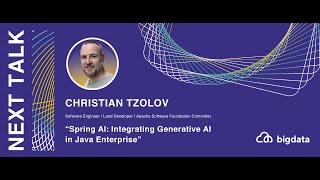
🌟 Session Overview 🌟
Session Name: Spring AI: Integrating Generative AI in Java Enterprise Speaker: Christian Tzolov Session Description: This session explores Spring AI, a new framework enabling Java developers to integrate AI seamlessly into enterprise applications. Spring AI was born from the realization that using Generative AI is primarily an integration problem that boils down to integrating your enterprise data and APIs with the AI models.
In this talk, the Spring AI project lead will introduce you to the essential GenAI concepts and provide a hands-on guide to kick-start your AI application development journey. Spring AI offers a comprehensive suite of components required for building an AI software stack, upholding Spring's renowned design principles, such as portability and modular design.
This session will introduce many Spring AI features, starting with a portable client API to interact with AI models. You will learn how to create effective AI prompts, convert AI responses into POJOs, and use function calling to integrate your existing APIs with the AI model.
Use cases like “query over your docs” are demonstrated by showcasing Spring AI features such as creating embeddings and storing them in a vector database. The popular RAG pattern and ways you can effectively evaluate how your AI application is performing are discussed.
🚀 About Big Data and RPA 2024 🚀
Unlock the future of innovation and automation at Big Data & RPA Conference Europe 2024! 🌟 This unique event brings together the brightest minds in big data, machine learning, AI, and robotic process automation to explore cutting-edge solutions and trends shaping the tech landscape. Perfect for data engineers, analysts, RPA developers, and business leaders, the conference offers dual insights into the power of data-driven strategies and intelligent automation. 🚀 Gain practical knowledge on topics like hyperautomation, AI integration, advanced analytics, and workflow optimization while networking with global experts. Don’t miss this exclusive opportunity to expand your expertise and revolutionize your processes—all from the comfort of your home! 📊🤖✨
📅 Yearly Conferences: Curious about the evolution of QA? Check out our archive of past Big Data & RPA sessions. Watch the strategies and technologies evolve in our videos! 🚀 🔗 Find Other Years' Videos: 2023 Big Data Conference Europe https://www.youtube.com/playlist?list=PLqYhGsQ9iSEpb_oyAsg67PhpbrkCC59_g 2022 Big Data Conference Europe Online https://www.youtube.com/playlist?list=PLqYhGsQ9iSEryAOjmvdiaXTfjCg5j3HhT 2021 Big Data Conference Europe Online https://www.youtube.com/playlist?list=PLqYhGsQ9iSEqHwbQoWEXEJALFLKVDRXiP
💡 Stay Connected & Updated 💡
Don’t miss out on any updates or upcoming event information from Big Data & RPA Conference Europe. Follow us on our social media channels and visit our website to stay in the loop!
🌐 Website: https://bigdataconference.eu/, https://rpaconference.eu/ 👤 Facebook: https://www.facebook.com/bigdataconf, https://www.facebook.com/rpaeurope/ 🐦 Twitter: @BigDataConfEU, @europe_rpa 🔗 LinkedIn: https://www.linkedin.com/company/73234449/admin/dashboard/, https://www.linkedin.com/company/75464753/admin/dashboard/ 🎥 YouTube: http://www.youtube.com/@DATAMINERLT
We talked about:
00:00 DataTalks.Club intro
00:00 DataTalks.Club anniversary "Ask Me Anything" event with Alexey Grigorev
02:29 The founding of DataTalks .Club
03:52 Alexey's transition from Java work to DataTalks.Club
04:58 Growth and success of DataTalks.Club courses
12:04 Motivation behind creating a free-to-learn community
24:03 Staying updated in data science through pet projects
26 :37 Hosting a second podcast and maintaining programming skills
28:56 Skepticism about LLMs and their relevance
31:53 Transitioning to DataTalks.Club and personal reflections
33:32 Memorable moments and the first event's success
36:19 Community building during the pandemic
38:31 AI's impact on data analysts and future roles
42:24 Discussion on AI in healthcare
44:37 Age and reflections on personal milestones
47:54 Building communities and personal connections
49:34 Future goals for the community and courses
51:18 Community involvement and engagement strategies
53:46 Ideas for competitions and hackathons
54:20 Inviting guests to the podcast
55:29 Course updates and future workshops
56:27 Podcast preparation and research process
58:30 Career opportunities in data science and transitioning fields
1:01 :10 Book recommendations and personal reading experiences
About the speaker:
Alexey Grigorev is the founder of DataTalks.Club.
Join our slack: https://datatalks.club/slack.html
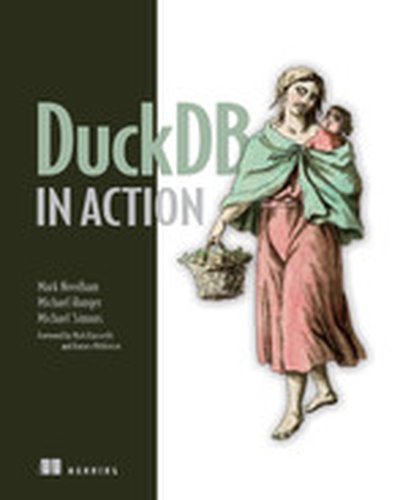
Dive into DuckDB and start processing gigabytes of data with ease—all with no data warehouse. DuckDB is a cutting-edge SQL database that makes it incredibly easy to analyze big data sets right from your laptop. In DuckDB in Action you’ll learn everything you need to know to get the most out of this awesome tool, keep your data secure on prem, and save you hundreds on your cloud bill. From data ingestion to advanced data pipelines, you’ll learn everything you need to get the most out of DuckDB—all through hands-on examples. Open up DuckDB in Action and learn how to: Read and process data from CSV, JSON and Parquet sources both locally and remote Write analytical SQL queries, including aggregations, common table expressions, window functions, special types of joins, and pivot tables Use DuckDB from Python, both with SQL and its "Relational"-API, interacting with databases but also data frames Prepare, ingest and query large datasets Build cloud data pipelines Extend DuckDB with custom functionality Pragmatic and comprehensive, DuckDB in Action introduces the DuckDB database and shows you how to use it to solve common data workflow problems. You won’t need to read through pages of documentation—you’ll learn as you work. Get to grips with DuckDB's unique SQL dialect, learning to seamlessly load, prepare, and analyze data using SQL queries. Extend DuckDB with both Python and built-in tools such as MotherDuck, and gain practical insights into building robust and automated data pipelines. About the Technology DuckDB makes data analytics fast and fun! You don’t need to set up a Spark or run a cloud data warehouse just to process a few hundred gigabytes of data. DuckDB is easily embeddable in any data analytics application, runs on a laptop, and processes data from almost any source, including JSON, CSV, Parquet, SQLite and Postgres. About the Book DuckDB in Action guides you example-by-example from setup, through your first SQL query, to advanced topics like building data pipelines and embedding DuckDB as a local data store for a Streamlit web app. You’ll explore DuckDB’s handy SQL extensions, get to grips with aggregation, analysis, and data without persistence, and use Python to customize DuckDB. A hands-on project accompanies each new topic, so you can see DuckDB in action. What's Inside Prepare, ingest and query large datasets Build cloud data pipelines Extend DuckDB with custom functionality Fast-paced SQL recap: From simple queries to advanced analytics About the Reader For data pros comfortable with Python and CLI tools. About the Authors Mark Needham is a blogger and video creator at @LearnDataWithMark. Michael Hunger leads product innovation for the Neo4j graph database. Michael Simons is a Java Champion, author, and Engineer at Neo4j. Quotes I use DuckDB every day, and I still learned a lot about how DuckDB makes things that are hard in most databases easy! - Jordan Tigani, Founder, MotherDuck An excellent resource! Unlocks possibilities for storing, processing, analyzing, and summarizing data at the edge using DuckDB. - Pramod Sadalage, Director, Thoughtworks Clear and accessible. A comprehensive resource for harnessing the power of DuckDB for both novices and experienced professionals. - Qiusheng Wu, Associate Professor, University of Tennessee Excellent! The book all we ducklings have been waiting for! - Gunnar Morling, Decodable
0:00
hi everyone Welcome to our event this event is brought to you by data dos club which is a community of people who love
0:06
data and we have weekly events and today one is one of such events and I guess we
0:12
are also a community of people who like to wake up early if you're from the states right Christopher or maybe not so
0:19
much because this is the time we usually have uh uh our events uh for our guests
0:27
and presenters from the states we usually do it in the evening of Berlin time but yes unfortunately it kind of
0:34
slipped my mind but anyways we have a lot of events you can check them in the
0:41
description like there's a link um I don't think there are a lot of them right now on that link but we will be
0:48
adding more and more I think we have like five or six uh interviews scheduled so um keep an eye on that do not forget
0:56
to subscribe to our YouTube channel this way you will get notified about all our future streams that will be as awesome
1:02
as the one today and of course very important do not forget to join our community where you can hang out with
1:09
other data enthusiasts during today's interview you can ask any question there's a pin Link in live chat so click
1:18
on that link ask your question and we will be covering these questions during the interview now I will stop sharing my
1:27
screen and uh there is there's a a message in uh and Christopher is from
1:34
you so we actually have this on YouTube but so they have not seen what you wrote
1:39
but there is a message from to anyone who's watching this right now from Christopher saying hello everyone can I
1:46
call you Chris or you okay I should go I should uh I should look on YouTube then okay yeah but anyways I'll you don't
1:53
need like you we'll need to focus on answering questions and I'll keep an eye
1:58
I'll be keeping an eye on all the question questions so um
2:04
yeah if you're ready we can start I'm ready yeah and you prefer Christopher
2:10
not Chris right Chris is fine Chris is fine it's a bit shorter um
2:18
okay so this week we'll talk about data Ops again maybe it's a tradition that we talk about data Ops every like once per
2:25
year but we actually skipped one year so because we did not have we haven't had
2:31
Chris for some time so today we have a very special guest Christopher Christopher is the co-founder CEO and
2:37
head chef or hat cook at data kitchen with 25 years of experience maybe this
2:43
is outdated uh cuz probably now you have more and maybe you stopped counting I
2:48
don't know but like with tons of years of experience in analytics and software engineering Christopher is known as the
2:55
co-author of the data Ops cookbook and data Ops Manifesto and it's not the
3:00
first time we have Christopher here on the podcast we interviewed him two years ago also about data Ops and this one
3:07
will be about data hops so we'll catch up and see what actually changed in in
3:13
these two years and yeah so welcome to the interview well thank you for having
3:19
me I'm I'm happy to be here and talking all things related to data Ops and why
3:24
why why bother with data Ops and happy to talk about the company or or what's changed
3:30
excited yeah so let's dive in so the questions for today's interview are prepared by Johanna berer as always
3:37
thanks Johanna for your help so before we start with our main topic for today
3:42
data Ops uh let's start with your ground can you tell us about your career Journey so far and also for those who
3:50
have not heard have not listened to the previous podcast maybe you can um talk
3:55
about yourself and also for those who did listen to the previous you can also maybe give a summary of what has changed
4:03
in the last two years so we'll do yeah so um my name is Chris so I guess I'm
4:09
a sort of an engineer so I spent about the first 15 years of my career in
4:15
software sort of working and building some AI systems some non- AI systems uh
4:21
at uh Us's NASA and MIT linol lab and then some startups and then um
4:30
Microsoft and then about 2005 I got I got the data bug uh I think you know my
4:35
kids were small and I thought oh this data thing was easy and I'd be able to go home uh for dinner at 5 and life
4:41
would be fine um because I was a big you started your own company right and uh it didn't work out that way
4:50
and um and what was interesting is is for me it the problem wasn't doing the
4:57
data like I we had smart people who did data science and data engineering the act of creating things it was like the
5:04
systems around the data that were hard um things it was really hard to not have
5:11
errors in production and I would sort of driving to work and I had a Blackberry at the time and I would not look at my
5:18
Blackberry all all morning I had this long drive to work and I'd sit in the parking lot and take a deep breath and
5:24
look at my Blackberry and go uh oh is there going to be any problems today and I'd be and if there wasn't I'd walk and
5:30
very happy um and if there was I'd have to like rce myself um and you know and
5:36
then the second problem is the team I worked for we just couldn't go fast enough the customers were super
5:42
demanding they didn't care they all they always thought things should be faster and we are always behind and so um how
5:50
do you you know how do you live in that world where things are breaking left and right you're terrified of making errors
5:57
um and then second you just can't go fast enough um and it's preh Hadoop era
6:02
right it's like before all this big data Tech yeah before this was we were using
6:08
uh SQL Server um and we actually you know we had smart people so we we we
6:14
built an engine in SQL Server that made SQL Server a column or
6:20
database so we built a column or database inside of SQL Server um so uh
6:26
in order to make certain things fast and and uh yeah it was it was really uh it's not
6:33
bad I mean the principles are the same right before Hadoop it's it's still a database there's still indexes there's
6:38
still queries um things like that we we uh at the time uh you would use olap
6:43
engines we didn't use those but you those reports you know are for models it's it's not that different um you know
6:50
we had a rack of servers instead of the cloud um so yeah and I think so what what I
6:57
took from that was uh it's just hard to run a team of people to do do data and analytics and it's not
7:05
really I I took it from a manager perspective I started to read Deming and
7:11
think about the work that we do as a factory you know and in a factory that produces insight and not automobiles um
7:18
and so how do you run that factory so it produces things that are good of good
7:24
quality and then second since I had come from software I've been very influenced
7:29
by by the devops movement how you automate deployment how you run in an agile way how you
7:35
produce um how you how you change things quickly and how you innovate and so
7:41
those two things of like running you know running a really good solid production line that has very low errors
7:47
um and then second changing that production line at at very very often they're kind of opposite right um and so
7:55
how do you how do you as a manager how do you technically approach that and
8:00
then um 10 years ago when we started data kitchen um we've always been a profitable company and so we started off
8:07
uh with some customers we started building some software and realized that we couldn't work any other way and that
8:13
the way we work wasn't understood by a lot of people so we had to write a book and a Manifesto to kind of share our our
8:21
methods and then so yeah we've been in so we've been in business now about a little over 10
8:28
years oh that's cool and uh like what
8:33
uh so let's talk about dat offs and you mentioned devops and how you were inspired by that and by the way like do
8:41
you remember roughly when devops as I think started to appear like when did people start calling these principles
8:49
and like tools around them as de yeah so agile Manifesto well first of all the I
8:57
mean I had a boss in 1990 at Nasa who had this idea build a
9:03
little test a little learn a lot right that was his Mantra and then which made
9:09
made a lot of sense um and so and then the sort of agile software Manifesto
9:14
came out which is very similar in 2001 and then um the sort of first real
9:22
devops was a guy at Twitter started to do automat automated deployment you know
9:27
push a button and that was like 200 Nish and so the first I think devops
9:33
Meetup was around then so it's it's it's been 15 years I guess 6 like I was
9:39
trying to so I started my career in 2010 so I my first job was a Java
9:44
developer and like I remember for some things like we would just uh SFTP to the
9:52
machine and then put the jar archive there and then like keep our fingers crossed that it doesn't break uh uh like
10:00
it was not really the I wouldn't call it this way right you were deploying you
10:06
had a Dey process I put it yeah
10:11
right was that so that was documented too it was like put the jar on production cross your
10:17
fingers I think there was uh like a page on uh some internal Viki uh yeah that
10:25
describes like with passwords and don't like what you should do yeah that was and and I think what's interesting is
10:33
why that changed right and and we laugh at it now but that was why didn't you
10:38
invest in automating deployment or a whole bunch of automated regression
10:44
tests right that would run because I think in software now that would be rare
10:49
that people wouldn't use C CD they wouldn't have some automated tests you know functional
10:56
regression tests that would be the
In this episode, Conor and Bryce chat with Kevlin Henney about the top recommendation from 97 Things Every Programmer Should Know. Link to Episode 194 on WebsiteDiscuss this episode, leave a comment, or ask a question (on GitHub)Twitter ADSP: The PodcastConor HoekstraBryce Adelstein LelbachAbout the Guest Kevlin Henney is an independent consultant, speaker, writer and trainer. His software development interests are in programming, practice and people. He has been a columnist for various magazines and websites. He is the co-author of A Pattern Language for Distributed Computing and On Patterns and Pattern Languages, two volumes in the Pattern-Oriented Software Architecture series, and editor of 97 Things Every Programmer Should Know and co-editor of 97 Things Every Java Programmer Should Know. Show Notes Date Recorded: 2024-07-11 Date Released: 2024-08-09 97 Things Every Programmer Should Know (GitHub)97 Things Every Programmer Should KnowPattern-Oriented Software Architecture: A Pattern Language for Distributed Computing, 4th VolumePattern Oriented Software Architecture Volume 5: On Patterns and Pattern LanguagesEffective C++ Series by Scott MeyersBeautiful C++: 30 Core Guidelines for Writing Clean, Safe, and Fast CodeIntro Song Info Miss You by Sarah Jansen https://soundcloud.com/sarahjansenmusic Creative Commons — Attribution 3.0 Unported — CC BY 3.0 Free Download / Stream: http://bit.ly/l-miss-you Music promoted by Audio Library https://youtu.be/iYYxnasvfx8
In this episode, Bryce chats with Kevlin Henney about Kevlin Henneys. Link to Episode 193 on WebsiteDiscuss this episode, leave a comment, or ask a question (on GitHub)Twitter ADSP: The PodcastConor HoekstraBryce Adelstein LelbachAbout the Guest Kevlin Henney is an independent consultant, speaker, writer and trainer. His software development interests are in programming, practice and people. He has been a columnist for various magazines and websites. He is the co-author of A Pattern Language for Distributed Computing and On Patterns and Pattern Languages, two volumes in the Pattern-Oriented Software Architecture series, and editor of 97 Things Every Programmer Should Know and co-editor of 97 Things Every Java Programmer Should Know. Show Notes Date Recorded: 2024-07-11 Date Released: 2024-08-02 HPXIntro Song Info Miss You by Sarah Jansen https://soundcloud.com/sarahjansenmusic Creative Commons — Attribution 3.0 Unported — CC BY 3.0 Free Download / Stream: http://bit.ly/l-miss-you Music promoted by Audio Library https://youtu.be/iYYxnasvfx8
In this episode, Bryce chats with Kevlin Henney about systems programming and more. Link to Episode 192 on WebsiteDiscuss this episode, leave a comment, or ask a question (on GitHub)Twitter ADSP: The PodcastConor HoekstraBryce Adelstein LelbachAbout the Guest Kevlin Henney is an independent consultant, speaker, writer and trainer. His software development interests are in programming, practice and people. He has been a columnist for various magazines and websites. He is the co-author of A Pattern Language for Distributed Computing and On Patterns and Pattern Languages, two volumes in the Pattern-Oriented Software Architecture series, and editor of 97 Things Every Programmer Should Know and co-editor of 97 Things Every Java Programmer Should Know. Show Notes Date Recorded: 2024-07-11 Date Released: 2024-07-26 Kevlin Henney ACCU 2024 TalkIntro Song Info Miss You by Sarah Jansen https://soundcloud.com/sarahjansenmusic Creative Commons — Attribution 3.0 Unported — CC BY 3.0 Free Download / Stream: http://bit.ly/l-miss-you Music promoted by Audio Library https://youtu.be/iYYxnasvfx8
In this episode, Conor and Bryce chat with Kevlin Henney about algorithms, libraries and many programming languages! Link to Episode 191 on WebsiteDiscuss this episode, leave a comment, or ask a question (on GitHub)Twitter ADSP: The PodcastConor HoekstraBryce Adelstein LelbachAbout the Guest Kevlin Henney is an independent consultant, speaker, writer and trainer. His software development interests are in programming, practice and people. He has been a columnist for various magazines and websites. He is the co-author of A Pattern Language for Distributed Computing and On Patterns and Pattern Languages, two volumes in the Pattern-Oriented Software Architecture series, and editor of 97 Things Every Programmer Should Know and co-editor of 97 Things Every Java Programmer Should Know. Show Notes Date Recorded: 2024-07-11 Date Released: 2024-07-19 FortranCoarray FortranPascal LanguagepytestNumPyPython pipRust cargoRust crates.ioIntro Song Info Miss You by Sarah Jansen https://soundcloud.com/sarahjansenmusic Creative Commons — Attribution 3.0 Unported — CC BY 3.0 Free Download / Stream: http://bit.ly/l-miss-you Music promoted by Audio Library https://youtu.be/iYYxnasvfx8
In this episode, Conor and Bryce chat with Kevlin Henney about C++, Python and more! Link to Episode 190 on WebsiteDiscuss this episode, leave a comment, or ask a question (on GitHub)Twitter ADSP: The PodcastConor HoekstraBryce Adelstein LelbachAbout the Guest Kevlin Henney is an independent consultant, speaker, writer and trainer. His software development interests are in programming, practice and people. He has been a columnist for various magazines and websites. He is the co-author of A Pattern Language for Distributed Computing and On Patterns and Pattern Languages, two volumes in the Pattern-Oriented Software Architecture series, and editor of 97 Things Every Programmer Should Know and co-editor of 97 Things Every Java Programmer Should Know. Show Notes Date Recorded: 2024-07-11 Date Released: 2024-07-12 When zombies attack! Bristol city council ready for undead invasionACCU Conference97 Things Every Programmer Should Know (GitHub)97 Things Every Programmer Should Know97 Things Every Java Programmer Should KnowC++Now 2018: Ben Deane “Easy to Use, Hard to Misuse: Declarative Style in C++”When to Use a List Comprehension in PythonIntro Song Info Miss You by Sarah Jansen https://soundcloud.com/sarahjansenmusic Creative Commons — Attribution 3.0 Unported — CC BY 3.0 Free Download / Stream: http://bit.ly/l-miss-you Music promoted by Audio Library https://youtu.be/iYYxnasvfx8
Finding that traditional data structures just aren't cutting it? The Java Collections Framework and tools like Eclipse Collections are useful but can fall short in complex scenarios. Defining domain classes can help, but frequent data and business logic changes make refactoring a constant hassle. Alternatives like map-oriented programming often result in cumbersome and hard-to-read code.
Enter data frames. They combine the efficiency of collection frameworks with the ease of grouping and transforming data. Join me for a talk and code demo to see how data frames can simplify tasks like data transformation, enrichment, validation, and reconciliation in your Java projects. You'll learn how to streamline your workflows and handle data more effectively.
Join us for an informative presentation on the evolution and future of Jakarta EE. Since its inception in 2018, Jakarta EE has grown from an open-source continuation of Java EE 8 into a robust platform with significant updates and new features. We’ll explore the major milestones from Jakarta EE 8 to the transformative Jakarta EE 9, and the introduction of the Core Profile in Jakarta EE 10.
As Jakarta EE 11 prepares for its GA release in the first half of 2024, we'll dive into its new and updated specifications, including its alignment with Java 21, the latest LTS release. Our session will offer a concise history of Java EE/Jakarta EE, highlight the exciting changes in Jakarta EE 11, and provide practical insights with code examples.