Gartner research shows that technical excellence alone rarely shifts mindsets or drives cultural change. If you want your business to truly think differently about data, you need to stop “selling” capabilities and start “marketing” value, using the same tactics as world-class consumer brands. This session unveils a new playbook for D&A leaders to build and execute a marketing plan that transforms culture and boosts adoption, with Gartner insights and real-world examples. Learn why most D&A strategies fail, how to apply proven marketing principles, and spark enthusiasm for data across your organization.
 talk-data.com
Topic
Marketing
advertising
branding
customer_acquisition
743
tagged
Activity Trend
49
peak/qtr
2020-Q1
2026-Q2
Top Events
O'Reilly Data Science Books
103
O'Reilly Data Engineering Books
57
The Pragmatic Engineer
46
Making Data Simple
35
DataFramed
32
How Music Charts
31
Data Engineering Podcast
30
Data + AI Summit 2025
29
The Analytics Power Hour
28
Google Cloud Next '24
23
Databricks DATA + AI Summit 2023
23
The Future of Data Podcast | conversation with leaders, influencers, and change makers in the World of Data & Analytics
18
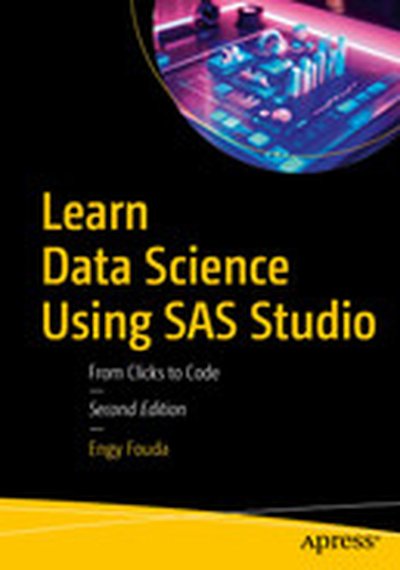
Do you want to create data analysis reports without writing a line of code? This book introduces SAS Studio, a free, web-based data science product for educational and non-commercial purposes. The power of SAS Studio lies in its visual, point-and-click user interface, which generates SAS code. It is easier to learn SAS Studio than to learn R and Python to accomplish data cleaning, statistics, and visualization tasks. The book includes a case study analyzing the data required to predict the results of presidential elections in the state of Maine for 2016 and 2020. In addition to the presidential elections, the book provides real-life examples, including analyses of stock, oil, and gold prices, crime, marketing, and healthcare. You will see data science in action and how easily it can be performed using complicated tasks and visualizations in SAS Studio. You will learn, step by step, how to perform visualizations, including creating maps. In most cases, you will not need a line of code as you work with the SAS Studio graphical user interface. The book includes explanations of the code that SAS Studio generates automatically. You will learn how to edit this code to perform more complicated advanced tasks. What You Will Learn Become familiar with the SAS Studio IDE. How to create essential visualizations. Know the fundamental statistical analysis required in most data science and analytics reports. Clean the most common dataset problems Learn linear and logistic regression for data prediction and analysis. Write programs in SAS. How to analyze data and get insights from it for decision-making. Learn character, numeric, date, time, and datetime functions and typecasting. Who This Book Is For A general audience of people who are new to data science, students, and data analysts and scientists who are new to SAS. No prior programming or statistical knowledge is required.
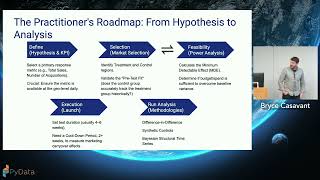
Measuring the true incremental impact of media spend remains one of the toughest problems in marketing, especially in an era where privacy limits user-level tracking. This talk examines how geo-lift incrementality testing can be utilized to accurately measure the true causal impact of marketing and media channels. Attendees will learn what design decisions matter, how to analyze results, and common pitfalls to avoid when running marketing incrementality tests. The goal is to bring causal inference theory into real-world measurement, enabling practitioners to make informed, data-driven decisions with confidence.
Your Marketing Mix Model is only as good as the library you build it on. But how do you choose between PyMC-Marketing and Google Meridian when the feature lists look so similar? You need hard evidence, not marketing claims. Which library is actually faster on multi-geo data? Do their different statistical approaches (splines vs. Fourier series) lead to different budget decisions?
This talk delivers that evidence. We present a rigorous, open-source benchmark that stress-tests both libraries on the metrics that matter in production. Using a synthetic dataset that replicates real-world ad spend patterns, we measure:
- Speed: Effective sample size per second (ESS/s) across different data scales.
- Accuracy: How well each model recovers both sales figures and true channel contributions.
- Reliability: A deep dive into convergence diagnostics and residual analysis.
- Resources: The real memory cost of fitting these models.
You'll walk away from this session with a clear, data-driven verdict, ready to choose the right tool and defend that choice to your team.
Companies today are hungry for external data to stay competitive, but actually getting and making sense of that data isn’t easy. Standard web scraping often produces messy or incomplete results, and modern anti-bot systems make reliable collection even tougher.
In this talk, I’ll share how pairing Python’s scraping frameworks (like Scrapy, Playwright, and Selenium) with AI/ML can turn raw, unstructured data into clear, actionable insights.
We’ll look at:
1) How to build scrapers that still work in 2025.
2) Ways to use AI to automatically clean, enrich, and classify data.
3) Real-world applications of sentiment analysis for reviews and social media.
4) Case studies showing how SMEs have used these pipelines to sharpen marketing and product strategies.
By the end, you’ll see how to design pipelines that don’t just gather data, but deliver real strategic value. The session will focus on practical Python tools, scalable deployment (Airflow, Kubernetes, cloud platforms), and key lessons learned from hands-on projects at the intersection of scraping and AI.
Ad and marketing teams are racing to harness text-to-image models, but creating high-quality, on-brand visuals at production scale has remained unsolved. Until now. Generating marketing images isn’t just about automation; it’s about balancing speed, creative fidelity, and brand alignment—which has never before been explored in a scalable, production-ready workflow with agents. In this breakout session, discover the challenges of bringing text-to-image into real-world campaigns and the breakthrough that makes it possible. Join this session to learn how to create scalable, robust, and brand-aligned agentic workflows using Nova Canvas and Nova Pro, and see how AI can supercharge your creative pipeline.
Learn more: More AWS events: https://go.aws/3kss9CP
Subscribe: More AWS videos: http://bit.ly/2O3zS75 More AWS events videos: http://bit.ly/316g9t4
ABOUT AWS: Amazon Web Services (AWS) hosts events, both online and in-person, bringing the cloud computing community together to connect, collaborate, and learn from AWS experts. AWS is the world's most comprehensive and broadly adopted cloud platform, offering over 200 fully featured services from data centers globally. Millions of customers—including the fastest-growing startups, largest enterprises, and leading government agencies—are using AWS to lower costs, become more agile, and innovate faster.
AWSreInvent #AWSreInvent2025 #AWS
In this lightning talk we show practical approaches for integrating AI agents and tools into your existing workflows, helping you boost productivity and innovation. We review real-world examples from engineering, marketing, and other key business functions. You'll gain insights into how you can find and leverage ready-to-use third-party tools and agents to accelerate and streamline your AI initiatives.
Learn more: More AWS events: https://go.aws/3kss9CP
Subscribe: More AWS videos: http://bit.ly/2O3zS75 More AWS events videos: http://bit.ly/316g9t4
ABOUT AWS: Amazon Web Services (AWS) hosts events, both online and in-person, bringing the cloud computing community together to connect, collaborate, and learn from AWS experts. AWS is the world's most comprehensive and broadly adopted cloud platform, offering over 200 fully featured services from data centers globally. Millions of customers—including the fastest-growing startups, largest enterprises, and leading government agencies—are using AWS to lower costs, become more agile, and innovate faster.
AWSreInvent #AWSreInvent2025 #AWS
Shantanu Narayen shares how Adobe works with AWS to transform digital experiences with innovative AI capabilities for business professionals and consumers, creators and creative professionals, and marketing professionals and IT professionals.
Learn more about AWS events: https://go.aws/events
Subscribe: More AWS videos: http://bit.ly/2O3zS75 More AWS events videos: http://bit.ly/316g9t4
ABOUT AWS Amazon Web Services (AWS) hosts events, both online and in-person, bringing the cloud computing community together to connect, collaborate, and learn from AWS experts. AWS is the world’s most comprehensive and broadly adopted cloud platform, offering over 200 fully featured services from data centers globally. Millions of customers—including the fastest-growing startups, largest enterprises, and leading government agencies—are using AWS to lower costs, become more agile, and innovate faster.
AWSreInvent #AWSEvents
Brought to You By: • Statsig — The unified platform for flags, analytics, experiments, and more. • Linear — The system for modern product development. — Michelle Lim joined Warp as engineer number one and is now building her own startup, Flint. She brings a strong product-first mindset shaped by her time at Facebook, Slack, Robinhood, and Warp. Michelle shares why she chose Warp over safer offers, how she evaluates early-stage opportunities, and what she believes distinguishes great founding engineers. Together, we cover how product-first engineers create value, why negotiating equity at early-stage startups requires a different approach, and why asking founders for references is a smart move. Michelle also shares lessons from building consumer and infrastructure products, how she thinks about tech stack choices, and how engineers can increase their impact by taking on work outside their job descriptions. If you want to understand what founders look for in early engineers or how to grow into a founding-engineer role, this episode is full of practical advice backed by real examples — Timestamps (00:00) Intro (01:32) How Michelle got into software engineering (03:30) Michelle’s internships (06:19) Learnings from Slack (08:48) Product learnings at Robinhood (12:47) Joining Warp as engineer #1 (22:01) Negotiating equity (26:04) Asking founders for references (27:36) The top reference questions to ask (32:53) The evolution of Warp’s tech stack (35:38) Product-first engineering vs. code-first (38:27) Hiring product-first engineers (41:49) Different types of founding engineers (44:42) How Flint uses AI tools (45:31) Avoiding getting burned in founder exits (49:26) Hiring top talent (50:15) An overview of Flint (56:08) Advice for aspiring founding engineers (1:01:05) Rapid fire round — The Pragmatic Engineer deepdives relevant for this episode: • Thriving as a founding engineer: lessons from the trenches • From software engineer to AI engineer • AI Engineering in the real world • The AI Engineering stack — Production and marketing by https://penname.co/. For inquiries about sponsoring the podcast, email [email protected].
Get full access to The Pragmatic Engineer at newsletter.pragmaticengineer.com/subscribe
Marketing teams require AI agents capable of orchestrating complex campaigns with enterprise controls. This session explores Epsilon's production-ready multi-agent system built with Amazon Bedrock AgentCore for intelligent marketing campaigns. Learn to implement secure agent collaboration using AgentCore Runtime for parallel execution, Gateway for controlled data access, and Identity for granular permissions. We'll cover architectural patterns for asynchronous workflows, demonstrate personalized content generation with brand consistency, and explore real-time campaign monitoring through AgentCore Observability. You'll gain proven patterns for building autonomous marketing agents that execute multistep workflows, scale to thousands of concurrent campaigns, and maintain complete auditability.
Learn more: More AWS events: https://go.aws/3kss9CP
Subscribe: More AWS videos: http://bit.ly/2O3zS75 More AWS events videos: http://bit.ly/316g9t4
ABOUT AWS: Amazon Web Services (AWS) hosts events, both online and in-person, bringing the cloud computing community together to connect, collaborate, and learn from AWS experts. AWS is the world's most comprehensive and broadly adopted cloud platform, offering over 200 fully featured services from data centers globally. Millions of customers—including the fastest-growing startups, largest enterprises, and leading government agencies—are using AWS to lower costs, become more agile, and innovate faster.
AWSreInvent #AWSreInvent2025 #AWS
Brought to You By: • Statsig — The unified platform for flags, analytics, experiments, and more. Statsig are helping make the first-ever Pragmatic Summit a reality. Join me and 400 other top engineers and leaders on 11 February, in San Francisco for a special one-day event. Reserve your spot here. • Linear — The system for modern product development. Engineering teams today move much faster, thanks to AI. Because of this, coordination increasingly becomes a problem. This is where Linear helps fast-moving teams stay focused. Check out Linear. — As software engineers, what should we know about writing secure code? Johannes Dahse is the VP of Code Security at Sonar and a security expert with 20 years of industry experience. In today’s episode of The Pragmatic Engineer, he joins me to talk about what security teams actually do, what developers should own, and where real-world risk enters modern codebases. We cover dependency risk, software composition analysis, CVEs, dynamic testing, and how everyday development practices affect security outcomes. Johannes also explains where AI meaningfully helps, where it introduces new failure modes, and why understanding the code you write and ship remains the most reliable defense. If you build and ship software, this episode is a practical guide to thinking about code security under real-world engineering constraints. — Timestamps (00:00) Intro (02:31) What is penetration testing? (06:23) Who owns code security: devs or security teams? (14:42) What is code security? (17:10) Code security basics for devs (21:35) Advanced security challenges (24:36) SCA testing (25:26) The CVE Program (29:39) The State of Code Security report (32:02) Code quality vs security (35:20) Dev machines as a security vulnerability (37:29) Common security tools (42:50) Dynamic security tools (45:01) AI security reviews: what are the limits? (47:51) AI-generated code risks (49:21) More code: more vulnerabilities (51:44) AI’s impact on code security (58:32) Common misconceptions of the security industry (1:03:05) When is security “good enough?” (1:05:40) Johannes’s favorite programming language — The Pragmatic Engineer deepdives relevant for this episode: • What is Security Engineering? • Mishandled security vulnerability in Next.js • Okta Schooled on Its Security Practices — Production and marketing by https://penname.co/. For inquiries about sponsoring the podcast, email [email protected].
Get full access to The Pragmatic Engineer at newsletter.pragmaticengineer.com/subscribe
Did you know the Microsoft benefits packages for partners were expanded this year to include more ways to save money and accelerate growth? These bundled offers include special pricing to help partners save at least $15,000* and up to $500K+ on Microsoft solutions. Plus, get one-on-one consulting with a MAICPP expert, joint marketing and presales support, and expert technical assistance - all designed to help partners save, innovate faster, and increase time to market.
Small and medium businesses need to be able to scale rapidly in this era of viral marketing moments, and AI agents are key to unlocking success at scale. With agents, SMBs can add capacity to their workforce, standardize business processes, and launch new business models with ease. In this session we will share how agents in Business Central are helping businesses thrive from sales order taking to making sure vendors are paid on time.
Did you know the Microsoft benefits packages for partners were expanded this year to include more ways to save money and accelerate growth? These bundled offers include special pricing to help partners save at least $15,000* and up to $500K+ on Microsoft solutions. Plus, get one-on-one consulting with a MAICPP expert, joint marketing and presales support, and expert technical assistance - all designed to help partners save, innovate faster, and increase time to market.
Connection Pods accommodate up to 15 people. Please RSVP and arrive at least 5 minutes before the start time, at which point remaining spaces are open to standby attendees.
Discover how agentic experiences transform marketing by embedding intelligent agents into existing workflows in M365 Copilot. This session uses industry examples to explore Adobe and Microsoft technical integrations for secure, brand-compliant, and personalized customer journeys. Learn how AI-driven segmentation, targeting, and measurement reduce overhead, optimize customer journey creation and orchestration, and drive loyalty, all illustrated through real-life industry examples
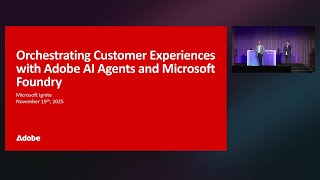
Discover Adobe's AI-first strategy to get ahead of the challenges of surging content demands, evolving discovery and engagement, and disconnected technologies. Explore examples in this session that show how teams working on marketing specific use cases can leverage Adobe and Microsoft’s interoperable AI tools with Microsoft Foundry to connect workflows, expand team capacity, deliver personalization at scale with enterprise-grade trust and controls.
Brought to You By: • Statsig — The unified platform for flags, analytics, experiments, and more. AI-accelerated development isn’t just about shipping faster: it’s about measuring whether, what you ship, actually delivers value. This is where modern experimentation with Statsig comes in. Check it out. • Linear — The system for modern product development. I had a jaw-dropping experience when I dropped in for the weekly “Quality Wednesdays” meeting at Linear. Every week, every dev fixes at least one quality isse, large or small. Even if it’s one pixel misalignment, like this one. I’ve yet to see a team obsess this much about quality. Read more about how Linear does Quality Wednesdays – it’s fascinating! — Martin Fowler is one of the most influential people within software architecture, and the broader tech industry. He is the Chief Scientist at Thoughtworks and the author of Refactoring and Patterns of Enterprise Application Architecture, and several other books. He has spent decades shaping how engineers think about design, architecture, and process, and regularly publishes on his blog, MartinFowler.com. In this episode, we discuss how AI is changing software development: the shift from deterministic to non-deterministic coding; where generative models help with legacy code; and the narrow but useful cases for vibe coding. Martin explains why LLM output must be tested rigorously, why refactoring is more important than ever, and how combining AI tools with deterministic techniques may be what engineering teams need. We also revisit the origins of the Agile Manifesto and talk about why, despite rapid changes in tooling and workflows, the skills that make a great engineer remain largely unchanged. — Timestamps (00:00) Intro (01:50) How Martin got into software engineering (07:48) Joining Thoughtworks (10:07) The Thoughtworks Technology Radar (16:45) From Assembly to high-level languages (25:08) Non-determinism (33:38) Vibe coding (39:22) StackOverflow vs. coding with AI (43:25) Importance of testing with LLMs (50:45) LLMs for enterprise software (56:38) Why Martin wrote Refactoring (1:02:15) Why refactoring is so relevant today (1:06:10) Using LLMs with deterministic tools (1:07:36) Patterns of Enterprise Application Architecture (1:18:26) The Agile Manifesto (1:28:35) How Martin learns about AI (1:34:58) Advice for junior engineers (1:37:44) The state of the tech industry today (1:42:40) Rapid fire round — The Pragmatic Engineer deepdives relevant for this episode: • Vibe coding as a software engineer • The AI Engineering stack • AI Engineering in the real world • What changed in 50 years of computing — Production and marketing by https://penname.co/. For inquiries about sponsoring the podcast, email [email protected].
Get full access to The Pragmatic Engineer at newsletter.pragmaticengineer.com/subscribe
You don’t need more noise, you need results. Join this 45-minute Connection Pod to learn how to use communities and marketplaces to grow faster. We’ll cover co-marketing with trusted partners, turning Marketplace into a revenue engine, and building collaborations that drive real results. Walk away with playbooks and ideas you can apply immediately to multiply your visibility, leads, and profits.
Connection Pods accommodate up to 15 people. Please RSVP and arrive at least 5 minutes before the start time, at which point remaining spaces are open to standby attendees.

by
Kathleen Mitford
(Microsoft)
,
Oliver Ganschar
(The KraftHeinz Company)
,
Rajeesh Ramachandran
(Microsoft)
,
Nallan Sriraman (Sri)
(Mass General Brigham)
,
Mark Austin
(AT&T)
,
Jason Gowans
(Levi Strauss & Co.)
What does it take to turn AI innovation into measurable business impact?
Join Kathleen Mitford, Corporate Vice President of Industry Marketing at Microsoft, for a conversation with industry leaders transforming their organizations with agentic AI.
Hear how they started, what’s driving results, and how ideas and learnings from one industry can inspire another—helping you move from experimentation to impact and become Frontier with AI.
Delivered in a silent stage breakout.
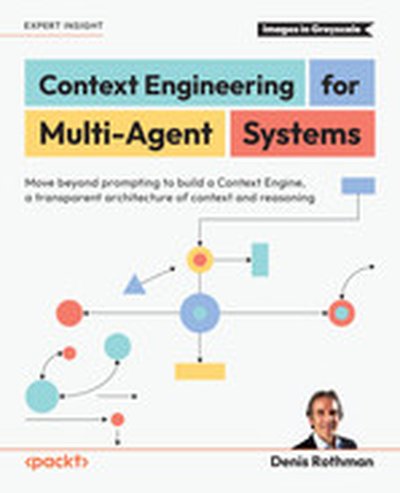
Build AI that thinks in context using semantic blueprints, multi-agent orchestration, memory, RAG pipelines, and safeguards to create your own Context Engine Free with your book: DRM-free PDF version + access to Packt's next-gen Reader Key Features Design semantic blueprints to give AI structured, goal-driven contextual awareness Orchestrate multi-agent workflows with MCP for adaptable, context-rich reasoning Engineer a glass-box Context Engine with high-fidelity RAG, trust, and safeguards Book Description Generative AI is powerful, yet often unpredictable. This guide shows you how to turn that unpredictability into reliability by thinking beyond prompts and approaching AI like an architect. At its core is the Context Engine, a glass-box, multi-agent system you’ll learn to design and apply across real-world scenarios. Written by an AI guru and author of various cutting-edge AI books, this book takes you on a hands-on journey from the foundations of context design to building a fully operational Context Engine. Instead of relying on brittle prompts that give only simple instructions, you’ll begin with semantic blueprints that map goals and roles with precision, then orchestrate specialized agents using the Model Context Protocol. As the engine evolves, you’ll integrate memory and high-fidelity retrieval with citations, implement safeguards against data poisoning and prompt injection, and enforce moderation to keep outputs aligned with policy. You’ll also harden the system into a resilient architecture, then see it pivot across domains, from legal compliance to strategic marketing, proving its domain independence. By the end of this book, you’ll be equipped with the skills to engineer an adaptable, verifiable architecture you can repurpose across domains and deploy with confidence. Email sign-up and proof of purchase required What you will learn Develop memory models to retain short-term and cross-session context Craft semantic blueprints and drive multi-agent orchestration with MCP Implement high-fidelity RAG pipelines with verifiable citations Apply safeguards against prompt injection and data poisoning Enforce moderation and policy-driven control in AI workflows Repurpose the Context Engine across legal, marketing, and beyond Deploy a scalable, observable Context Engine in production Who this book is for This book is for AI engineers, software developers, system architects, and data scientists who want to move beyond ad hoc prompting and learn how to design structured, transparent, and context-aware AI systems. It will also appeal to ML engineers and solutions architects with basic familiarity with LLMs who are eager to understand how to orchestrate agents, integrate memory and retrieval, and enforce safeguards.