talk-data.com talk-data.com

Topic

Kubernetes

container_orchestration devops microservices

560

tagged

Activity Trend

40 peak/qtr
2020-Q1 2026-Q1

Activities

560 activities · Newest first

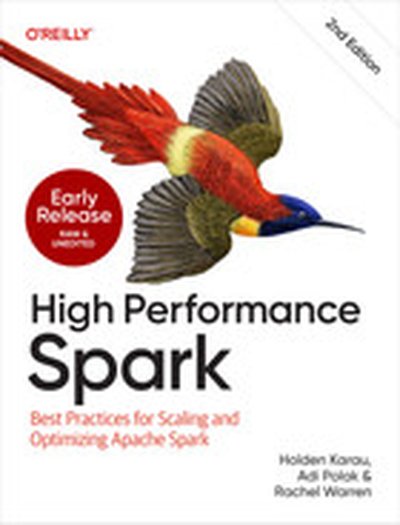
High Performance Spark, 2nd Edition

Apache Spark is amazing when everything clicks. But if you haven't seen the performance improvements you expected or still don't feel confident enough to use Spark in production, this practical book is for you. Authors Holden Karau, Rachel Warren, and Anya Bida walk you through the secrets of the Spark code base, and demonstrate performance optimizations that will help your data pipelines run faster, scale to larger datasets, and avoid costly antipatterns. Ideal for data engineers, software engineers, data scientists, and system administrators, the second edition of High Performance Spark presents new use cases, code examples, and best practices for Spark 3.x and beyond. This book gives you a fresh perspective on this continually evolving framework and shows you how to work around bumps on your Spark and PySpark journey. With this book, you'll learn how to: Accelerate your ML workflows with integrations including PyTorch Handle key skew and take advantage of Spark's new dynamic partitioning Make your code reliable with scalable testing and validation techniques Make Spark high performance Deploy Spark on Kubernetes and similar environments Take advantage of GPU acceleration with RAPIDS and resource profiles Get your Spark jobs to run faster Use Spark to productionize exploratory data science projects Handle even larger datasets with Spark Gain faster insights by reducing pipeline running times
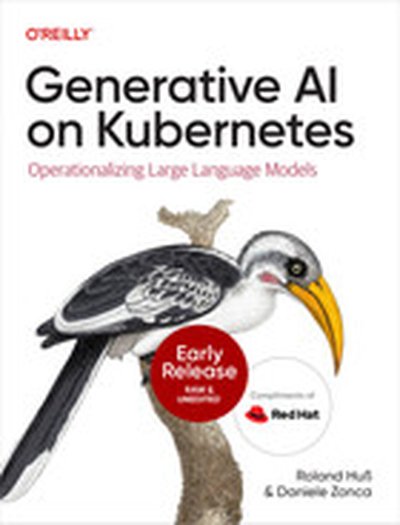
Generative AI on Kubernetes

Generative AI is revolutionizing industries, and Kubernetes has fast become the backbone for deploying and managing these resource-intensive workloads. This book serves as a practical, hands-on guide for MLOps engineers, software developers, Kubernetes administrators, and AI professionals ready to unlock AI innovation with the power of cloud native infrastructure. Authors Roland Huß and Daniele Zonca provide a clear road map for training, fine-tuning, deploying, and scaling GenAI models on Kubernetes, addressing challenges like resource optimization, automation, and security along the way. With actionable insights with real-world examples, readers will learn to tackle the opportunities and complexities of managing GenAI applications in production environments. Whether you're experimenting with large-scale language models or facing the nuances of AI deployment at scale, you'll uncover expertise you need to operationalize this exciting technology effectively. Learn to run GenAI models on Kubernetes for efficient scalability Get techniques to train and fine-tune LLMs within Kubernetes environments See how to deploy production-ready AI systems with automation and resource optimization Discover how to monitor and scale GenAI applications to handle real-world demand Uncover the best tools to operationalize your GenAI workloads Learn how to run agent-based and AI-driven applications

Kubernetes gives us abstraction and power—but with great YAML comes great responsibility. In this talk, we’ll walk through live demos of real-world misconfigurations that allow attackers to escape containers and tamper with the host. You’ll see exactly what happens when Pods run in privileged mode, use hostPath volumes carelessly, or retain excess Linux capabilities. We’ll also show how to detect these attacks in real time using Falco, and enforce safety nets with Pod Security Admission. If you’ve ever wondered "what’s the worst that could happen?"—this session answers that with receipts.

Companies today are hungry for external data to stay competitive, but actually getting and making sense of that data isn’t easy. Standard web scraping often produces messy or incomplete results, and modern anti-bot systems make reliable collection even tougher.

In this talk, I’ll share how pairing Python’s scraping frameworks (like Scrapy, Playwright, and Selenium) with AI/ML can turn raw, unstructured data into clear, actionable insights.

We’ll look at:

1) How to build scrapers that still work in 2025.

2) Ways to use AI to automatically clean, enrich, and classify data.

3) Real-world applications of sentiment analysis for reviews and social media.

4) Case studies showing how SMEs have used these pipelines to sharpen marketing and product strategies.

By the end, you’ll see how to design pipelines that don’t just gather data, but deliver real strategic value. The session will focus on practical Python tools, scalable deployment (Airflow, Kubernetes, cloud platforms), and key lessons learned from hands-on projects at the intersection of scraping and AI.

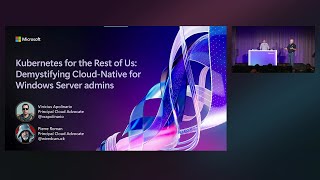
Kubernetes for the Rest of Us: Demystifying Cloud-Native for Windows Server admins

You know AKS—but environment variables, secrets, and ingress controllers still feel like dev-speak? This demo-heavy session unpacks cloud-native development from an IT/Ops lens. Learn how app design impacts operations, what Day 2 AKS management really looks like, and how to confidently architect alongside your developer peers.

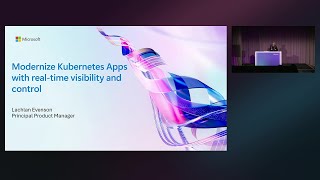
Modernize Kubernetes with real-time visibility and control

Managing modern Kubernetes environments requires you to act as soon as events take place. In this session, see how open source projects Drasi, Inspektor Gadget, and Headlamp simplify monitoring and management of Azure Kubernetes Service (AKS) clusters. Learn how to surface live state changes, deep runtime insights and leverage an intuitive management interface. Demonstrated on Azure Kubernetes Service (AKS) and applicable to any Kubernetes setup, this session shows how to bring a universal, cloud-agnostic approach to your cluster monitoring and management.

Build confidence in managing AKS at scale with next‑gen ops tools. In this hands‑on lab, you’ll simulate a production service hit by traffic spikes, discover how AI‑driven alerts surface hidden bottlenecks, and deploy agents that self‑heal nodes. Using open‑source tools and the aks‑mcp server, you can automate cluster scaling, patch management, and real‑time troubleshooting—letting the AI orchestrate Kubernetes and Azure resources with natural‑language commands and pre‑built MCP integrations.

Please RSVP and arrive at least 5 minutes before the start time, at which point remaining spaces are open to standby attendees.

Deploying AI workloads on Kubernetes is now a necessity. But when those workloads are stateful, the complexity multiplies. We’ll dive into the real-world journey of going from zero to production with AI on K8s, focusing on managing stateful services. We'll unpack architectural patterns, storage strategies, and challenges when running persistent, data-heavy AI workloads in a cloud-native environment. Join us to share learnings and hear how others are navigating the stateful side of AI on K8s.

Connection Pods accommodate up to 15 people. Please RSVP and arrive at least 5 minutes before the start time, at which point remaining spaces are open to standby attendees.

Scaling Kubernetes securely and reliably with AKS

As Kubernetes and AI adoption grow, managing your clusters at scale becomes a strategic imperative. We'll share practical lessons from operating large clusters with AKS, including how to keep things reliable, efficient & secure. Learn about tools like Azure Kubernetes Fleet Manager, smart scheduling for AI, and ways to simplify multi-cluster ops. Whether you are scaling to thousands of nodes or fine-tuning for performance, you'll leave with practical tips to improve cluster ops.

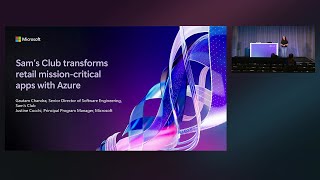
Sam’s Club transforms retail mission-critical apps with Azure

Learn practical strategies from Sam’s Club for modernizing mission-critical apps to Azure. Dive into technical strategies, get hands-on guidance to implement key resilience patterns and how to operationalize them in Azure Kubernetes Service (AKS), Azure SQL, Cosmos DB, and other critical Azure services. By the end of this session, developers and cloud practitioners will walk away with tools to modernize legacy monolithic apps for resilience, performance, and scale in Azure.

To meet growing customer demand for faster, more intuitive troubleshooting of Azure Kubernetes Service (AKS) networking, Azure supports deep pod level metrics, logs and visualization for AKS clusters which enables users to understand their network architecture. This session introduces how advanced container networking services with Hubble enhances AKS troubleshooting workflows, helping teams identify and resolve issues efficiently. Attendees will learn how to leverage these capabilities to streamline diagnostics, reduce operational overhead, and improve the overall reliability of their AKS deployments.

Connection Pods accommodate up to 15 people. Please RSVP and arrive at least 5 minutes before the start time, at which point remaining spaces are open to standby attendees.

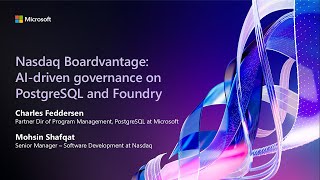
Nasdaq Boardvantage: AI-driven governance on PostgreSQL and Microsoft Foundry

Trusted by nearly half of Fortune 100 companies, Nasdaq Boardvantage powers secure, intelligent board operations. In this deep dive session, explore how Azure Database for PostgreSQL and MySQL, Microsoft Foundry, Azure Kubernetes Service (AKS), and API Management create a resilient architecture that safeguards confidential data while unlocking new agentic AI capabilities.

This hands-on workshop teaches how to build and deploy intelligent AI agents for enterprise research using AI-Q NVIDIA Blueprint and NVIDIA Nemotron on Azure Kubernetes Service (AKS). Learn to leverage AI reasoning, multimodal data extraction, and retrieval-augmented generation to uncover actionable insights from enterprise data. Ideal for developers aiming to accelerate AI-driven knowledge discovery and decision-making.

Please RSVP and arrive at least 5 minutes before the start time, at which point remaining spaces are open to standby attendees.

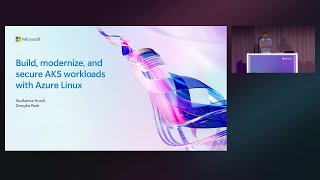
Build, modernize, and secure AKS workloads with Azure Linux

Azure Linux Container Host is an operating system image that's optimized for running container workloads on Azure Kubernetes Service (AKS). Learn how it improves performance, simplifies node lifecycle management, and enables innovations like pod sandboxing and OS Guard. See how customers use Azure Linux for workload isolation and hardened security with features like Integrity Policy Enforcement, SELinux, and dm-verity—helping enterprises modernize and scale with confidence.