
talk-data.com talk-data.com

Topic

Kubernetes

container_orchestration devops microservices

7

tagged

Activity Trend

40 peak/qtr
2020-Q1 2026-Q1

Activities

Showing filtered results

Filtering by: Databricks DATA + AI Summit 2023 ×
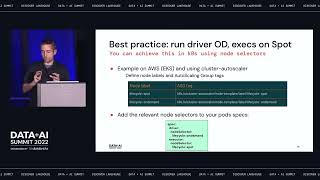
How To Make Apache Spark on Kubernetes Run Reliably on Spot Instances

Since the general availability of Apache Spark’s native support for running on Kubernetes with Spark 3.1 in March 2021, the Spark community is increasingly choosing to run on k8s to benefit of containerization, efficient resource-sharing, and the tools from the cloud-native ecosystem.

Data teams are faced with complexities in this transition, including how to leverage spot VMs. These instances enable up to 90% cost savings but are not guaranteed to be available and face the risk of termination. This session will cover concrete guidelines on how to make Spark run reliably on spot instances, with code examples from real-world use cases.

Main topics: • Using spot nodes for Spark executors • Mixing instance types & sizes to reduce risk of spot interruptions - cluster autoscaling • Spark 3.0: Graceful Decommissioning - preserve shuffle files on executor shutdown • Spark 3.1: PVC reuse on executor restart - disaggregate compute & shuffle storage • What to look for in future Spark releases

Connect with us: Website: https://databricks.com Facebook: https://www.facebook.com/databricksinc Twitter: https://twitter.com/databricks LinkedIn: https://www.linkedin.com/company/data... Instagram: https://www.instagram.com/databricksinc/
Managing Straggler Executors at Apache Spark 3.3

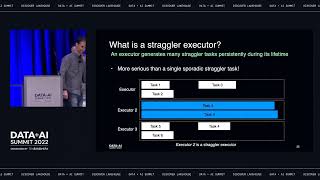
Tuning high-performance Apache Spark applications to handle mis-behaving executors is at best challenging and at worst impossible. Apache Spark does provide some built-in support to kill and recreate new executors under certain conditions such as long GC delays or due to application errors. However this still leaves-open various scenarios where slow-running executors can impact the overall performance of your application even when you enable features such as task speculation. In this talk, we are going to describe Apache Spark 3.3’s new feature, Executor Rolling. Apache Spark 3.3 (SPARK-37810) provides a built-in executor rolling driver plugin with three configurations.

spark.kubernetes.executor.rollInterval (default: '0s' which means being disabled.) spark.kubernetes.executor.rollPolicy (default: OUTLIER) spark.kubernetes.executor.minTasksPerExecutorBeforeRolling (default: 0)

This driver plugin tries to choose and decommission a single executor at every interval with the given policy. The followings are the built-in policies and their targets.

  • ID: An executor with the smallest executor ID
  • ADD_TIME: An executor with the smallest add-time
  • TOTAL_GC_TIME: An executor with the biggest GC time
  • TOTAL_DURATION: An executor with the biggest total task time
  • AVERAGE_DURATION: An executor with the biggest average task duration
  • FAILED_TASKS: An executor with the largest number of failed tasks
  • OUTLIER: An outlier executor or the biggest total task time

In short, Apache Spark 3.3 maintains the set of live executors literally freshly and reduces much engineering burdens to handle executors’ JVM misbehavior at diverse production jobs by utilizing the proposed built-in executor rolling policies in advance.

Connect with us: Website: https://databricks.com Facebook: https://www.facebook.com/databricksinc Twitter: https://twitter.com/databricks LinkedIn: https://www.linkedin.com/company/data... Instagram: https://www.instagram.com/databricksinc/
Apache Spark on Kubernetes—Lessons Learned from Launching Millions of Spark Executors

At Apple, data scientists and engineers are running enormous Spark workloads to deliver amazing cloud services. Apple Cloud Service supports the ever-increasing scale of Spark workloads and resource requirements with great user experience: from code to deployment management, one interface for all compute backends.

In this talk, Aaruna and Zhou would walk through the lessons we learnt and pitfalls encountered for supporting the service at Apple scale - we would share how Apple Cloud Services effectively orchestrate Spark applications, as well as the seamless switchover among different resource managers - be it in Mesos or Kubernetes, private or on-premise infrastructure. We will also cover the monitoring system and how it helps tuning Spark resource requirements with actual execution analysis.

Connect with us: Website: https://databricks.com Facebook: https://www.facebook.com/databricksinc Twitter: https://twitter.com/databricks LinkedIn: https://www.linkedin.com/company/data... Instagram: https://www.instagram.com/databricksinc/
Building Metadata and Lineage Driven Pipelines on Kubernetes

Machine Learning becomes a critical role in every industry amid its widespread adoption. Composing an ML pipeline at a rapid pace is an inevitable way for success. However, an ML pipeline consists of several components and needs various efforts of different teams, including data engineers, data scientists, ML engineers, etc. A typical cooperation strategy is to define a sequence of tasks, coordinate the integration, test, apply fixes and enhancements, and repeat. ML pipeline components produced by task-driven approach lack reusability only maintenance efforts. Kubeflow Pipelines, a platform making deployments of ML pipeline on Kubernetes straightforward and scalable, provides metadata and lineage-driven approach to develop platform-independent and portable ML pipelines. Data linkage and propagation become crystal clear within ML pipelines. It also nourishes ML pipeline composition.

Connect with us: Website: https://databricks.com Facebook: https://www.facebook.com/databricksinc Twitter: https://twitter.com/databricks LinkedIn: https://www.linkedin.com/company/data... Instagram: https://www.instagram.com/databricksinc/
Distributed Machine Learning at Lyft

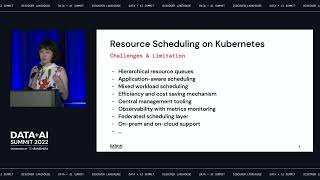
Data collection, preprocessing, feature engineering are the fundamental steps in any Machine Learning Pipeline. After feature engineering, being able to parallelize training on multiple low cost machines helps to reduce cost and time both. And, then being able to train models in a distributed manner speeds up Hyperparameter Tuning. How can we unify these stages of ML Pipeline in one unified distributed training platform together? And that too on Kubernetes?

Our ML platform is completely based on Kubernetes because of its scalability and rapid bootstrapping time of resources. In this talk we will demonstrate how Lyft uses Spark on Kubernetes, Fugue (our home grown unifying compute abstraction layer) to design a holistic end to end ML Pipeline system for distributed feature engineering, training & prediction experience for our customers on our ML Platform on top of Spark on K8s. We will also do a deep dive to show how we are abstracting and hiding infrastructure complexities so that our Data Scientists and Research Scientist can focus only on the business logic for their models through simple pythonic APIs and SQL. We let the users focus on ''what to do'' and the platform takes care of ''how to do''. We will share our challenges, learning and the fun we had while implementing. Using Spark on K8s have helped us achieve large scale data processing with 90% less cost and at times bringing down processing time from 2 hours to less than 20 mins.

Connect with us: Website: https://databricks.com Facebook: https://www.facebook.com/databricksinc Twitter: https://twitter.com/databricks LinkedIn: https://www.linkedin.com/company/data... Instagram: https://www.instagram.com/databricksinc/
Efficient and Multi-Tenant Scheduling of Big Data and AI Workloads

Many ML and big data teams in the open source community are looking to run their workloads in the cloud and they invariably face a common set of challenges such as multi-tenant cluster management, resource fairness and sharing, gang scheduling and cost-effective infrastructure operations. Kubernetes is the de-facto standard platform for running containerized applications in the cloud. However, the default resource scheduler in Kubernetes leaves more to be desired for AI scenarios when running ML/DL training workloads or large-scale data processing jobs for feature engineering.

In this talk, we will share how the community leverage and build upon Apache YuniKorn to address the unique resource scheduling needs for ML and big data teams.

Connect with us: Website: https://databricks.com Facebook: https://www.facebook.com/databricksinc Twitter: https://twitter.com/databricks LinkedIn: https://www.linkedin.com/company/data... Instagram: https://www.instagram.com/databricksinc/

How socat and UNIX Pipes Can Help Data Integration

Nearly every developer is familiar with creating a CLI. Containerized CLIs provide a flexible, cross-language standard with a low barrier to entry for open-source contributors. The ETL process can be reduced to two CLIs: one that reads data and one that writes data. While this interface is simple enough to implement from the contributor’s side, Kubernetes’ distributed nature means orchestrating data transfer between the CLIs on Kubernetes presents an unsolved problem.

This talk describes a novel approach to reliably orchestrate CLIs on Kubernetes for data integration. Through this lens, we go through the evaluation of strategies and describe the pros and cons of each architecture for horizontally scaling containerised data integration workflows on Kubernetes. We also cover the journey of implementing a TCP-based “process” abstraction over CLIs using socat and UNIX pipes. This same approach powers all of Airbyte’s Kubernetes deployments and helps sync TBs of data daily.

Connect with us: Website: https://databricks.com Facebook: https://www.facebook.com/databricksinc Twitter: https://twitter.com/databricks LinkedIn: https://www.linkedin.com/company/data... Instagram: https://www.instagram.com/databricksinc/