talk-data.com talk-data.com

Topic

PySpark

big_data distributed_computing python

69

tagged

Activity Trend

14 peak/qtr
2020-Q1 2026-Q1

Activities

69 activities · Newest first

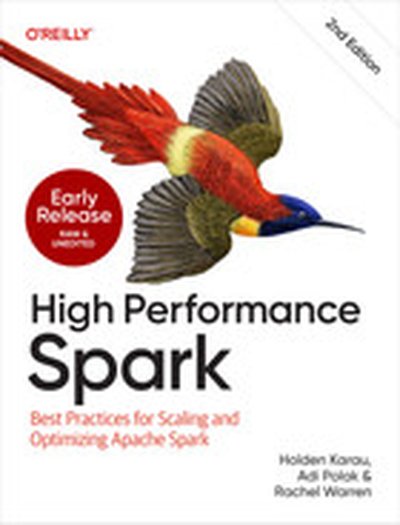
High Performance Spark, 2nd Edition

Apache Spark is amazing when everything clicks. But if you haven't seen the performance improvements you expected or still don't feel confident enough to use Spark in production, this practical book is for you. Authors Holden Karau, Rachel Warren, and Anya Bida walk you through the secrets of the Spark code base, and demonstrate performance optimizations that will help your data pipelines run faster, scale to larger datasets, and avoid costly antipatterns. Ideal for data engineers, software engineers, data scientists, and system administrators, the second edition of High Performance Spark presents new use cases, code examples, and best practices for Spark 3.x and beyond. This book gives you a fresh perspective on this continually evolving framework and shows you how to work around bumps on your Spark and PySpark journey. With this book, you'll learn how to: Accelerate your ML workflows with integrations including PyTorch Handle key skew and take advantage of Spark's new dynamic partitioning Make your code reliable with scalable testing and validation techniques Make Spark high performance Deploy Spark on Kubernetes and similar environments Take advantage of GPU acceleration with RAPIDS and resource profiles Get your Spark jobs to run faster Use Spark to productionize exploratory data science projects Handle even larger datasets with Spark Gain faster insights by reducing pipeline running times
From Data Lake Entanglement to Data Mesh Decoupling: Scaling a Self-Service Data Platform

Our data platform journey started with a classic data lake — easy to ingest, hard to evolve. As domains scaled, tight coupling across source systems, pipelines, and data products slowed everything down. In this talk, we share how we re-architected toward a domain-oriented data mesh using PySpark, Delta Lake and DQX to achieve true decoupling. Expect practical lessons on designing independent data products, managing lineage and governance, and scaling self-service without chaos.

PySpark’s Arrow-based Python UDFs open the door to dramatically faster data processing by avoiding expensive serialization overhead. At the same time, Polars, a high-performance DataFrame library built on Rust, offers zero-copy interoperability with Apache Arrow. This talk shows how combining these two technologies unlocks new performance gains: writing Arrow UDFs with Polars in PySpark can deliver performance speedups compared to Python UDFs. Attendees will learn how Arrow UDFs work in PySpark, how it can be used with other data processing libraries, and how to apply this approach to real-world Spark pipelines for faster, more efficient workloads.

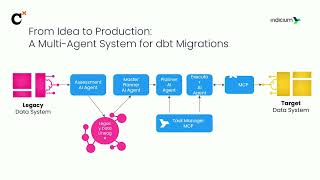
How Aura Minerals used AI to migrate from PySpark to dbt 7x faster

Aura Minerals cut pipeline migration time by 87%, transforming a 45-hour manual process into a 6-hour lift with relatively little manual oversight. In this session, learn how the team used AI tools to accelerate their shift from a complex PySpark environment to a streamlined, modern dbt workflow. You’ll walk away with a clear view of the strategy, the tools they used, and what it looks like to modernize your data stack with AI as a force multiplier.

Many developers, including myself, advocate for a code-first approach to development, an approach that can offer significant advantages to no-code/low code development in numerous scenarios. If you're unfamiliar with this concept, don’t worry; I’ll start with a quick introduction to explain why it matters. From there, we’ll dive deeper into the capabilities of notebooks in Microsoft Fabric. A notebook is far more than just a code file; It is a powerful development tool that enables efficient problem-solving, streamlines workflows, and enhances maintainability. I’ll demonstrate lesser-known tricks to make your development process smoother and your maintenance efforts more intuitive. And if you or your crew is new to pySpark, don't worry: I'll give you an insight on how to get on board for this in a relatively short time. Agenda: 12.45 - 13:00 : Speaker Setup and Join 13:00 - 13:05 : Open Lobby to guests and Introductions 13:05 - 14:00 : Microsoft Fabrics Notebook Deep Dive with Kay Sauter

From Manual to LLMs: Scaling Product Categorization

How to use LLMs to categorize hundreds of thousands of products into 1,000 categories at scale? Learn about our journey from manual/rule-based methods, via fine-tuned semantic models, to a robust multi-step process which uses embeddings and LLMs via the OpenAI APIs. This talk offers data scientists and AI practitioners learnings and best practices for putting such a complex LLM-based system into production. This includes prompt development, balancing cost vs. accuracy via model selection, testing mult-case vs. single-case prompts, and saving costs by using the OpenAI Batch API and a smart early-stopping approach. We also describe our automation and monitoring in a PySpark environment.

Narwhals: enabling universal dataframe support

Ever tried passing a Polars Dataframe to a data science library and found that it...just works? No errors, no panics, no noticeable overhead, just...results? This is becoming increasingly common in 2025, yet only 2 years ago, it was mostly unheard of. So, what changed? A large part of the answer is: Narwhals.

Narwhals is a lightweight compatibility layer between dataframe libraries which lets your code work seamlessly across Polars, pandas, PySpark, DuckDB, and more! And it's not just a theoretical possibility: with ~30 million monthly downloads and set as a required dependency of Altair, Bokeh, Marimo, Plotly, Shiny, and more, it's clear that it's reshaping the data science landscape. By the end of the talk, you'll understand why writing generic dataframe code was such a headache (and why it isn't anymore), how Narwhals works and how its community operates, and how you can use it in your projects today. The talk will be technical yet accessible and light-hearted.

The presentation will introduce the “Stile eco-system” developed at ING Analytics to speed up the time to market of machine learning models for the instant lending domain. The main issue to solve is the duality between Spark and Pandas for feature generation. Spark is used for development while dealing with the billions of transactions stored in the data warehouse. Pandas is used in production when applications are scored one by one in a real-time situation. During the presentation, Gilles will explain how the template for model development works, with a specific focus on feature creation. Additionally, Gilles will highlight how Pandas and PySpark are integrated in common functionalities, and the user-friendly testing framework developed to ensure consistency between the two worlds, and, finally, how to easily trim the code to only produce the features required for the final model. Gilles Verbockhaven is Chapter Lead at ING Retail Banking Analytics and manages a team of five Data Scientists. He has been working at ING for 20 years now and has experience in various domains, ranging from market risk to modelling. Since 2017, he has been working in the Machine Learning area and has specialized in designing analytic solutions for collections and pricing. In his free time, he spends his energy running and biking.

Ontologies provide a powerful way to structure knowledge, enable reasoning, and support more meaningful queries compared to traditional data models. Recently, interest in ontologies has resurged, driven by advancements in language models, reasoning capabilities, and the growing adoption of platforms like Palantir Foundry.

In this hands-on tutorial, participants will explore ontology development across multiple domains using a variety of Python-based tools such as rdflib, Owlready2, PySpark, Pandas, and SciPy. They will learn how ontologies facilitate semantic reasoning, improve data interoperability, and enhance query capabilities.
Additionally, attendees will build a rudimentary reasoning engine to better understand inference mechanisms.
The tutorial emphasizes practical applications and comparisons with conventional data representations, making it ideal for researchers, data engineers, and developers interested in knowledge representation and reasoning.

In the rapidly evolving field of data engineering and data science, efficiency and ease of use are crucial. Our innovative solution offers a user-friendly interface to manage and schedule custom PySpark, PySQL, Python, and SQL code, streamlining the process from development to production. Using Airflow at the backend, this tool eliminates the complexities of infrastructure management, version control, CI/CD processes, and workflow orchestration.The intuitive UI allows users to upload code, configure job parameters, and set schedules effortlessly, without the need for additional scripting or coding. Additionally, users have the flexibility to bring their own custom artifactory solution and run their code. In summary, our solution significantly enhances the orchestration and scheduling of custom code, breaking down traditional barriers and empowering organizations to maximize their data’s potential and drive innovation efficiently. Whether you are an individual data scientist or part of a large data engineering team, this tool provides the resources needed to streamline your workflow and achieve your goals faster than ever before.

Creating a Custom PySpark Stream Reader with PySpark 4.0

PySpark supports many data sources out of the box, such as Apache Kafka, JDBC, ODBC, Delta Lake, etc. However, some older systems, such as systems that use JMS protocol, are not supported by default and require considerable extra work for developers to read from them. One such example is ActiveMQ for streaming. Traditionally, users of ActiveMQ have to use a middle-man in order to read the stream with Spark (such as writing to a MySQL DB using Java code and reading that table with Spark JDBC). With PySpark 4.0’s custom data sources (supported in DBR 15.3+) we are able to cut out the middle-man processing using batch or Spark Streaming and consume the queues directly from PySpark, saving developers considerable time and complexity in getting source data into your Delta Lake and governed by Unity Catalog and orchestrated with Databricks Workflows.

How to Migrate From Oracle to Databricks SQL

Migrating your legacy Oracle data warehouse to the Databricks Data Intelligence Platform can accelerate your data modernization journey. In this session, learn the top strategies for completing this data migration. We will cover data type conversion, basic to complex code conversions, validation and reconciliation best practices. Discover the pros and cons of using CSV files to PySpark or using pipelines to Databricks tables. See before-and-after architectures of customers who have migrated, and learn about the benefits they realized.

Transforming Bio-Pharma Manufacturing: Eli Lilly's Data-Driven Journey With Databricks

Eli Lilly and Company, a leading bio-pharma company, is revolutionizing manufacturing with next-gen fully digital sites. Lilly and Tredence have partnered to establish a Databricks-powered Global Manufacturing Data Fabric (GMDF), laying the groundwork for transformative data products used by various personas at sites and globally. By integrating data from various manufacturing systems into a unified data model, GMDF has delivered actionable insights across several use cases such as batch release by exception, predictive maintenance, anomaly detection, process optimization and more. Our serverless architecture leverages Databricks Auto Loader for real-time data streaming, PySpark for automation and Unity Catalog for governance, ensuring seamless data processing and optimization. This platform is the foundation for data driven processes, self-service analytics, AI and more. This session will provide details on the data architecture and strategy and share a few use cases delivered.

The Upcoming Apache Spark 4.1: The Next Chapter in Unified Analytics

Apache Spark has long been recognized as the leading open-source unified analytics engine, combining a simple yet powerful API with a rich ecosystem and top-notch performance. In the upcoming Spark 4.1 release, the community reimagines Spark to excel at both massive cluster deployments and local laptop development. We’ll start with new single-node optimizations that make PySpark even more efficient for smaller datasets. Next, we’ll delve into a major “Pythonizing” overhaul — simpler installation, clearer error messages and Pythonic APIs. On the ETL side, we’ll explore greater data source flexibility (including the simplified Python Data Source API) and a thriving UDF ecosystem. We’ll also highlight enhanced support for real-time use cases, built-in data quality checks and the expanding Spark Connect ecosystem — bridging local workflows with fully distributed execution. Don’t miss this chance to see Spark’s next chapter!

Bridging Big Data and AI: Empowering PySpark With Lance Format for Multi-Modal AI Data Pipelines

PySpark has long been a cornerstone of big data processing, excelling in data preparation, analytics and machine learning tasks within traditional data lakes. However, the rise of multimodal AI and vector search introduces challenges beyond its capabilities. Spark’s new Python data source API enables integration with emerging AI data lakes built on the multi-modal Lance format. Lance delivers unparalleled value with its zero-copy schema evolution capability and robust support for large record-size data (e.g., images, tensors, embeddings, etc), simplifying multimodal data storage. Its advanced indexing for semantic and full-text search, combined with rapid random access, enables high-performance AI data analytics to the level of SQL. By unifying PySpark's robust processing capabilities with Lance's AI-optimized storage, data engineers and scientists can efficiently manage and analyze the diverse data types required for cutting-edge AI applications within a familiar big data framework.

Scaling Real-Time Fraud Detection With Databricks: Lessons From DraftKings

At DraftKings, ensuring secure, fair gaming requires detecting fraud in real time with both speed and precision. In this talk, we’ll share how Databricks powers our fraud detection pipeline, integrating real-time streaming, machine learning and rule-based detection within a PySpark framework. Our system enables rapid model training, real-time inference and seamless feature transformation across historical and live data. We use shadow mode to test models and rules in live environments before deployment. Collaborating with Databricks, we push online feature store performance and enhance real-time PySpark capabilities. We'll cover PySpark-based feature transformations, real-time inference, scaling challenges and our migration from a homegrown system to Databricks. This session is for data engineers and ML practitioners optimizing real-time AI workloads, featuring a deep dive, code snippets and lessons from building and scaling fraud detection.

What’s New in PySpark: TVFs, Subqueries, Plots, and Profilers

PySpark’s DataFrame API is evolving to support more expressive and modular workflows. In this session, we’ll introduce two powerful additions: table-valued functions (TVFs) and the new subquery API. You’ll learn how to define custom TVFs using Python User-Defined Table Functions (UDTFs), including support for polymorphism, and how subqueries can simplify complex logic. We’ll also explore how lateral joins connect these features, followed by practical tools for the PySpark developer experience—such as plotting, profiling, and a preview of upcoming capabilities like UDF logging and a Python-native data source API. Whether you're building production pipelines or extending PySpark itself, this talk will help you take full advantage of the latest features in the PySpark ecosystem.

From Imperative to Declarative Paradigm: Rebuilding a CI/CD Infrastructure Using Hatch and DABs

Building and deploying Pyspark pipelines to Databricks should be effortless. However, our team at FreeWheel has, for the longest time, struggled with a convoluted and hard-to-maintain CI/CD infrastructure. It followed an imperative paradigm, demanding that every project implement custom scripts to build artifacts and deploy resources, and resulting in redundant boilerplate code and awkward interactions with the Databricks REST API. We set our mind on rebuilding it from scratch, following a declarative paradigm instead. We will share how we were able to eliminate thousands of lines of code from our repository, create a fully configuration-driven infrastructure where projects can be easily onboarded, and improve the quality of our codebase using Hatch and Databricks Asset Bundles as our tools of choice. In particular, DAB has made deploying across our 3 environments a breeze, and has allowed us to quickly adopt new features as soon as they are released by Databricks.

Elevating Data Quality Standards With Databricks DQX

Join us for an introductory session on Databricks DQX, a Python-based framework designed to validate the quality of PySpark DataFrames. Discover how DQX can empower you to proactively tackle data quality challenges, enhance pipeline reliability and make more informed business decisions with confidence. Traditional data quality tools often fall short by providing limited, actionable insights, relying heavily on post-factum monitoring, and being restricted to batch processing. DQX overcomes these limitations by enabling real-time quality checks at the point of data entry, supporting both batch and streaming data validation and delivering granular insights at the row and column level. If you’re seeking a simple yet powerful data quality framework that integrates seamlessly with Databricks, this session is for you.