talk-data.com talk-data.com

Topic

PySpark

big_data distributed_computing python

69

tagged

Activity Trend

14 peak/qtr
2020-Q1 2026-Q1

Activities

69 activities · Newest first

Learn to Efficiently Test ETL Pipelines

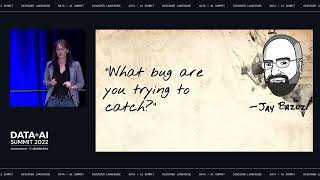
This talk is a story, using examples in Python and pySpark, about testing ETL pipelines efficiently. I won’t try to convince you that you need unit tests or automated tests – that’s up to you. If you do have unit tests for your ETL pipelines, or if you want them, it can be useful to make sure you aren’t testing more than you need.

I’ll be describing how a practical (non-pyramid shaped) heuristic helps me efficiently cover edge cases and unexpected bugs in my code by ensuring I test only the code needed for the feature I’m building.

Connect with us: Website: https://databricks.com Facebook: https://www.facebook.com/databricksinc Twitter: https://twitter.com/databricks LinkedIn: https://www.linkedin.com/company/data... Instagram: https://www.instagram.com/databricksinc/

Mosaic: A Framework for Geospatial Analytics at Scale

In this session we’ll present Mosaic, a new Databricks Labs project with a geospatial flavour.

Mosaic provides users of Spark and Databricks with a unified framework for distributing geospatial analytics. Users can choose to employ existing Java-based tools such as JTS or Esri's Geometry API for Java and Mosaic will handle the task of parallelizing these tools' operations: e.g. efficiently reading and writing geospatial data and performing spatial functions on geometries. Mosaic helps users scale these operations by providing spatial indexing capabilities (using, for example, Uber's H3 library) and advanced techniques for optimising common point-in-polygon and polygon-polygon intersection operations.

The development of Mosaic builds upon techniques developed with Ordnance Survey (the central hub for geospatial data across UK Government) and described in this blog post: https://databricks.com/blog/2021/10/11/efficient-point-in-polygon-joins-via-pyspark-and-bng-geospatial-indexing.html

Connect with us: Website: https://databricks.com Facebook: https://www.facebook.com/databricksinc Twitter: https://twitter.com/databricks LinkedIn: https://www.linkedin.com/company/data... Instagram: https://www.instagram.com/databricksinc/

PySpark in Apache Spark 3.3 and Beyond

PySpark has rapidly evolved with the momentum of Project Zen introduced in Apache Spark 3.0. We improved error messages, added type hints for autocompletion, implemented visualization, etc. Most importantly, Pandas API on Spark was introduced from Apache Spark 3.2 which exposes the pandas API that runs on Apache Spark, and the Pandas API on Spark has gained a lot of popularity.

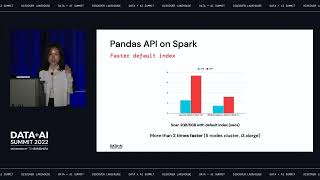
In Apache Spark 3.3, the effort of Project Zen continued and PySpark has many cool changes such as more API coverage & faster default index in Pandas API on Spark, datetime.timedelta support, new PyArrow batch interface, better autocompletion, Python & Pandas UDF profiler and new error classification.

In this talk, we will introduce what is new in PySpark at Apache Spark 3.3, and what is next beyond Apache Spark 3.3 with the current effort and roadmap in PySpark.

Connect with us: Website: https://databricks.com Facebook: https://www.facebook.com/databricksinc Twitter: https://twitter.com/databricks LinkedIn: https://www.linkedin.com/company/data... Instagram: https://www.instagram.com/databricksinc/

X-FIPE: eXtended Feature Impact for Prediction Explanation

Many enterprises have built their own machine learning platforms in the cloud using Databricks, e.g. Humana FlorenceAI. In order to effectively drive the adoption of predictive models in daily business operations, data scientists and business teams need to work closely to make sure they serve the consumer needs in compliance with regulatory rules. Model interpretability is key. In this talk, we would like to share an explainable AI algorithm developed at Humana, X-FIPE, eXtended Feature Impact for Prediction Explanation.

X-FIPE is a top-driver algorithm to calculate feature importance for any machine learning predictive models, whether it is Python or PySpark, at a local level. Instead of showing the feature importance on a population level, it can find the top drivers for each observation or member. These top drivers could differ widely from one member to another member in the population. it not only helps explain the predictive model, but also offer users actionable insights.

Compared with widely used algorithms, e.g. LIME, SHAP, and FIPE, X-FIPE improves the time complexity from linear O(n) to logarithmic O(log(n)), where n is the number of used model features. Also, we discovered the connection between X-FIPE value and Shapley value -- X-FIPE a first order approximation of Shapley value. Our observation shows that the most contribution of Shapley value of a feature comes from the marginal contribution when it is first added and when it is last removed from the full features. This is why the X-FIPE keeps enough accuracy and also reduces the computation.

Hopefully this talk will provide you a path forward to include explainable AI into your machine learning workflows, you are encouraged to try out and contribute to our open source Python package xfipe soon to come.

Connect with us: Website: https://databricks.com Facebook: https://www.facebook.com/databricksinc Twitter: https://twitter.com/databricks LinkedIn: https://www.linkedin.com/company/data... Instagram: https://www.instagram.com/databricksinc/

ÀLaSpark: Gousto's Recipe for Building Scalable PySpark Pipelines

Find out how Gousto is developing its data pipelines at scale in a repeatable manner. At Gousto, we’ve developed Goustospark - a wrapper around pyspark that allows us to quickly and easily build data pipelines that are deployed into our Databricks environment.

This wrapper abstracts repetitive components of all data pipelines such as spark configurations and metastore interactions. This allows a developer to simply specify the blueprints of the pipeline before turning their attention to more pressing issues, such as data quality and data governance, whilst enjoying a high level of performance and reliability.

In this session we will deep dive into the design patterns we followed, some unique approaches we’ve taken on how we structure pipelines and show a live demo of implementing a new spark streaming pipeline in Databricks from scratch. We will even share some example python code and snippets to help you build your own.

Connect with us: Website: https://databricks.com Facebook: https://www.facebook.com/databricksinc Twitter: https://twitter.com/databricks LinkedIn: https://www.linkedin.com/company/data... Instagram: https://www.instagram.com/databricksinc/

How to Automate the Modernization and Migration of Your Data Warehousing Workloads to Databricks

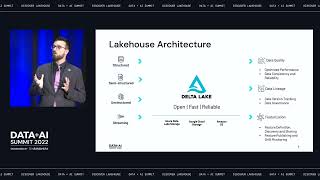
The logic in your data is the heartbeat of your organization’s reports, analytics, dashboards and applications. But that logic is often trapped in antiquated technologies that can’t take advantage of the massive scalability in the Databricks Lakehouse.

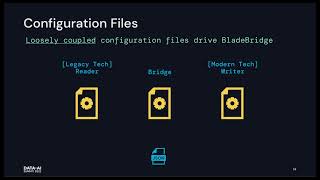
In this session BladeBridge will show how to automate the conversion of this metadata and code into Databricks PySpark and DBSQL. BladeBridge will demonstrate the flexibility of configuring for N legacy technologies to facilitate an automated path for not just a single modernization project but a factory approach for corporate wide modernization.

BladeBridge will also present how you can empirically size your migration project to determine the level of effort required.

In this session you will learn: What BladeBridge Converter is What BladeBridge Analyzer is How BladeBridge configures Readers and Writers How to size a conversion effort How to accelerate adoption of Databricks

Connect with us: Website: https://databricks.com Facebook: https://www.facebook.com/databricksinc Twitter: https://twitter.com/databricks LinkedIn: https://www.linkedin.com/company/data... Instagram: https://www.instagram.com/databricksinc/

GIS Pipeline Acceleration with Apache Sedona

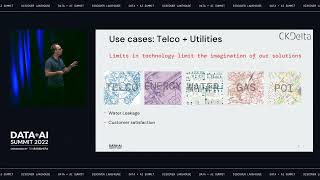
In CKDelta, we ingest and process a massive amount of geospatial data. Using Apache Sedona together with Databricks have accelerated our data pipelines many times.

In this talk, we'll talk about migrating the existing pipelines to Sedona + PySpark and the pitfalls we encountered along the way.

Connect with us: Website: https://databricks.com Facebook: https://www.facebook.com/databricksinc Twitter: https://twitter.com/databricks LinkedIn: https://www.linkedin.com/company/data... Instagram: https://www.instagram.com/databricksinc/

Privacy Preserving Machine Learning and Big Data Analytics Using Apache Spark

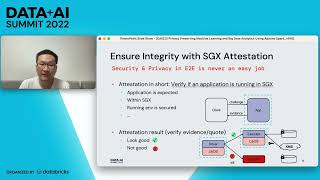
In recent years, latest privacy laws & regulations bring a fundamental shift in the protection of data and privacy, placing new challenges to data applications. To resolve these privacy & security challenges in big data ecosystem without impacting existing applications, several hardware TEE (Trusted Execution Environment) solutions have been proposed for Apache Spark, e.g., PySpark with Scone and Opaque etc. However, to the best of our knowledge, none of them provide full protection to data pipelines in Spark applications. An adversary may still get sensitive information from unprotected components and stages. Furthermore, some of them greatly narrowed supported applications, e.g., only support SparkSQL. In this presentation, we will present a new PPMLA (privacy preserving machine learning and analytics) solution built on top of Apache Spark, BigDL, Occlum and Intel SGX. It ensures all spark components and pipelines are fully protected by Intel SGX, and existing Spark applications written in Scala, Java or Python can be migrated into our platform without any code change. We will demonstrate how to build distributed end-to-end SparkML/SparkSQL workloads with our solution on untrusted cloud environment and share real-world use cases for PPMLA.

Connect with us: Website: https://databricks.com Facebook: https://www.facebook.com/databricksinc Twitter: https://twitter.com/databricks LinkedIn: https://www.linkedin.com/company/data... Instagram: https://www.instagram.com/databricksinc/

The Azure Data Lakehouse Toolkit: Building and Scaling Data Lakehouses on Azure with Delta Lake, Apache Spark, Databricks, Synapse Analytics, and Snowflake

Design and implement a modern data lakehouse on the Azure Data Platform using Delta Lake, Apache Spark, Azure Databricks, Azure Synapse Analytics, and Snowflake. This book teaches you the intricate details of the Data Lakehouse Paradigm and how to efficiently design a cloud-based data lakehouse using highly performant and cutting-edge Apache Spark capabilities using Azure Databricks, Azure Synapse Analytics, and Snowflake. You will learn to write efficient PySpark code for batch and streaming ELT jobs on Azure. And you will follow along with practical, scenario-based examples showing how to apply the capabilities of Delta Lake and Apache Spark to optimize performance, and secure, share, and manage a high volume, high velocity, and high variety of data in your lakehouse with ease. The patterns of success that you acquire from reading this book will help you hone your skills to build high-performing and scalable ACID-compliant lakehouses using flexible and cost-efficient decoupled storage and compute capabilities. Extensive coverage of Delta Lake ensures that you are aware of and can benefit from all that this new, open source storage layer can offer. In addition to the deep examples on Databricks in the book, there is coverage of alternative platforms such as Synapse Analytics and Snowflake so that you can make the right platform choice for your needs. After reading this book, you will be able to implement Delta Lake capabilities, including Schema Evolution, Change Feed, Live Tables, Sharing, and Clones to enable better business intelligence and advanced analytics on your data within the Azure Data Platform. What You Will Learn Implement the Data Lakehouse Paradigm on Microsoft’s Azure cloud platform Benefit from the new Delta Lake open-source storage layer for data lakehouses Take advantage of schema evolution, change feeds, live tables, and more Writefunctional PySpark code for data lakehouse ELT jobs Optimize Apache Spark performance through partitioning, indexing, and other tuning options Choose between alternatives such as Databricks, Synapse Analytics, and Snowflake Who This Book Is For Data, analytics, and AI professionals at all levels, including data architect and data engineer practitioners. Also for data professionals seeking patterns of success by which to remain relevant as they learn to build scalable data lakehouses for their organizations and customers who are migrating into the modern Azure Data Platform.

Advanced Analytics with PySpark

The amount of data being generated today is staggering and growing. Apache Spark has emerged as the de facto tool to analyze big data and is now a critical part of the data science toolbox. Updated for Spark 3.0, this practical guide brings together Spark, statistical methods, and real-world datasets to teach you how to approach analytics problems using PySpark, Spark's Python API, and other best practices in Spark programming. Data scientists Akash Tandon, Sandy Ryza, Uri Laserson, Sean Owen, and Josh Wills offer an introduction to the Spark ecosystem, then dive into patterns that apply common techniques-including classification, clustering, collaborative filtering, and anomaly detection, to fields such as genomics, security, and finance. This updated edition also covers NLP and image processing. If you have a basic understanding of machine learning and statistics and you program in Python, this book will get you started with large-scale data analysis. Familiarize yourself with Spark's programming model and ecosystem Learn general approaches in data science Examine complete implementations that analyze large public datasets Discover which machine learning tools make sense for particular problems Explore code that can be adapted to many uses

Data Algorithms with Spark

Apache Spark's speed, ease of use, sophisticated analytics, and multilanguage support makes practical knowledge of this cluster-computing framework a required skill for data engineers and data scientists. With this hands-on guide, anyone looking for an introduction to Spark will learn practical algorithms and examples using PySpark. In each chapter, author Mahmoud Parsian shows you how to solve a data problem with a set of Spark transformations and algorithms. You'll learn how to tackle problems involving ETL, design patterns, machine learning algorithms, data partitioning, and genomics analysis. Each detailed recipe includes PySpark algorithms using the PySpark driver and shell script. With this book, you will: Learn how to select Spark transformations for optimized solutions Explore powerful transformations and reductions including reduceByKey(), combineByKey(), and mapPartitions() Understand data partitioning for optimized queries Build and apply a model using PySpark design patterns Apply motif-finding algorithms to graph data Analyze graph data by using the GraphFrames API Apply PySpark algorithms to clinical and genomics data Learn how to use and apply feature engineering in ML algorithms Understand and use practical and pragmatic data design patterns

Data Analysis with Python and PySpark

Think big about your data! PySpark brings the powerful Spark big data processing engine to the Python ecosystem, letting you seamlessly scale up your data tasks and create lightning-fast pipelines. In Data Analysis with Python and PySpark you will learn how to: Manage your data as it scales across multiple machines Scale up your data programs with full confidence Read and write data to and from a variety of sources and formats Deal with messy data with PySpark’s data manipulation functionality Discover new data sets and perform exploratory data analysis Build automated data pipelines that transform, summarize, and get insights from data Troubleshoot common PySpark errors Creating reliable long-running jobs Data Analysis with Python and PySpark is your guide to delivering successful Python-driven data projects. Packed with relevant examples and essential techniques, this practical book teaches you to build pipelines for reporting, machine learning, and other data-centric tasks. Quick exercises in every chapter help you practice what you’ve learned, and rapidly start implementing PySpark into your data systems. No previous knowledge of Spark is required. About the Technology The Spark data processing engine is an amazing analytics factory: raw data comes in, insight comes out. PySpark wraps Spark’s core engine with a Python-based API. It helps simplify Spark’s steep learning curve and makes this powerful tool available to anyone working in the Python data ecosystem. About the Book Data Analysis with Python and PySpark helps you solve the daily challenges of data science with PySpark. You’ll learn how to scale your processing capabilities across multiple machines while ingesting data from any source—whether that’s Hadoop clusters, cloud data storage, or local data files. Once you’ve covered the fundamentals, you’ll explore the full versatility of PySpark by building machine learning pipelines, and blending Python, pandas, and PySpark code. What's Inside Organizing your PySpark code Managing your data, no matter the size Scale up your data programs with full confidence Troubleshooting common data pipeline problems Creating reliable long-running jobs About the Reader Written for data scientists and data engineers comfortable with Python. About the Author As a ML director for a data-driven software company, Jonathan Rioux uses PySpark daily. He teaches the software to data scientists, engineers, and data-savvy business analysts. Quotes A clear and in-depth introduction for truly tackling big data with Python. - Gustavo Patino, Oakland University William Beaumont School of Medicine The perfect way to learn how to analyze and master huge datasets. - Gary Bake, Brambles Covers both basic and more advanced topics of PySpark, with a good balance between theory and hands-on. - Philippe Van Bergenl, P² Consulting For beginner to pro, a well-written book to help understand PySpark. - Raushan Kumar Jha, Microsoft

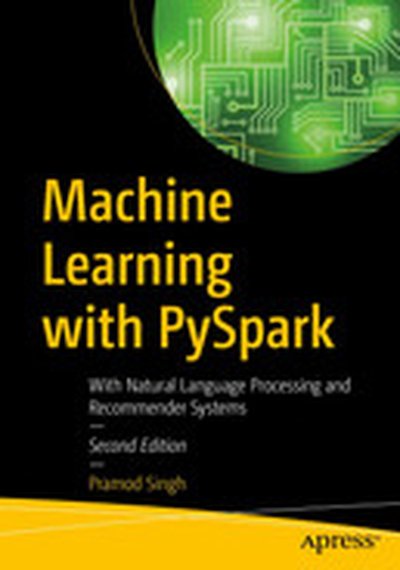
Machine Learning with PySpark: With Natural Language Processing and Recommender Systems

Master the new features in PySpark 3.1 to develop data-driven, intelligent applications. This updated edition covers topics ranging from building scalable machine learning models, to natural language processing, to recommender systems. Machine Learning with PySpark, Second Edition begins with the fundamentals of Apache Spark, including the latest updates to the framework. Next, you will learn the full spectrum of traditional machine learning algorithm implementations, along with natural language processing and recommender systems. You’ll gain familiarity with the critical process of selecting machine learning algorithms, data ingestion, and data processing to solve business problems. You’ll see a demonstration of how to build supervised machine learning models such as linear regression, logistic regression, decision trees, and random forests. You’ll also learn how to automate the steps using Spark pipelines, followed by unsupervised models such as K-means and hierarchical clustering. A section on Natural Language Processing (NLP) covers text processing, text mining, and embeddings for classification. This new edition also introduces Koalas in Spark and how to automate data workflow using Airflow and PySpark’s latest ML library. After completing this book, you will understand how to use PySpark’s machine learning library to build and train various machine learning models, along with related components such as data ingestion, processing and visualization to develop data-driven intelligent applications What you will learn: Build a spectrum of supervised and unsupervised machine learning algorithms Use PySpark's machine learning library to implement machine learning and recommender systems Leverage the new features in PySpark’s machine learning library Understand data processing using Koalas in Spark Handle issues around feature engineering, class balance, bias andvariance, and cross validation to build optimally fit models Who This Book Is For Data science and machine learning professionals.

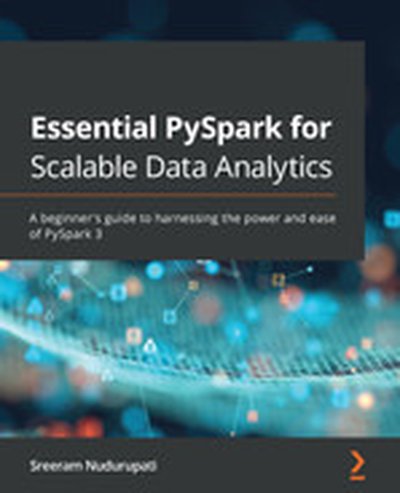
Essential PySpark for Scalable Data Analytics

Dive into the world of scalable data processing with 'Essential PySpark for Scalable Data Analytics'. This book is a comprehensive guide that helps beginners understand and utilize PySpark to process, analyze, and draw insights from large datasets effectively. With hands-on tutorials and clear explanations, you will gain the confidence to tackle big data analytics challenges. What this Book will help me do Understand and apply the distributed computing paradigm for big data. Learn to perform scalable data ingestion, cleansing, and preparation using PySpark. Create and utilize data lakes and the Lakehouse paradigm for efficient data storage and access. Develop and deploy machine learning models with scalability in mind. Master real-time analytics pipelines and create impactful data visualizations. Author(s) None Nudurupati is an experienced data engineer and educator, specializing in distributed systems and big data technologies. With years of practical experience in the field, None brings a clear and approachable teaching style to technical topics. Passionate about empowering readers, the author has designed this book to be both practical and inspirational for aspiring data practitioners. Who is it for? This book is ideal for data professionals including data scientists, engineers, and analysts looking to scale their data analytics processes. It assumes familiarity with basic data science concepts and Python, as well as some experience with SQL-like data analysis. This is particularly suitable for individuals aiming to expand their knowledge in distributed computing and PySpark to handle big data challenges. Achieving scalable and efficient data solutions is at the core of this guide.

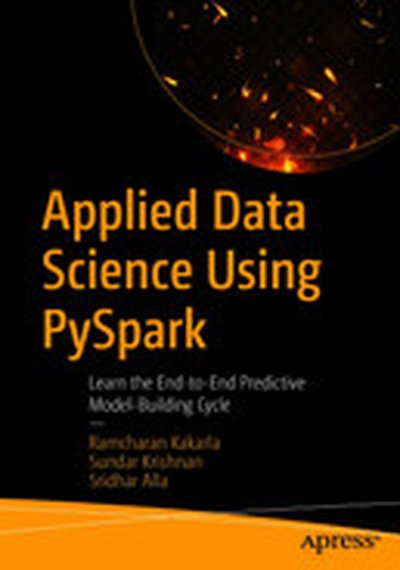
Applied Data Science Using PySpark: Learn the End-to-End Predictive Model-Building Cycle

Discover the capabilities of PySpark and its application in the realm of data science. This comprehensive guide with hand-picked examples of daily use cases will walk you through the end-to-end predictive model-building cycle with the latest techniques and tricks of the trade. Applied Data Science Using PySpark is divided unto six sections which walk you through the book. In section 1, you start with the basics of PySpark focusing on data manipulation. We make you comfortable with the language and then build upon it to introduce you to the mathematical functions available off the shelf. In section 2, you will dive into the art of variable selection where we demonstrate various selection techniques available in PySpark. In section 3, we take you on a journey through machine learning algorithms, implementations, and fine-tuning techniques. We will also talk about different validation metrics and how to use them for picking the best models. Sections 4 and 5 go through machine learning pipelines and various methods available to operationalize the model and serve it through Docker/an API. In the final section, you will cover reusable objects for easy experimentation and learn some tricks that can help you optimize your programs and machine learning pipelines. By the end of this book, you will have seen the flexibility and advantages of PySpark in data science applications. This book is recommended to those who want to unleash the power of parallel computing by simultaneously working with big datasets. What You Will Learn Build an end-to-end predictive model Implement multiple variable selection techniques Operationalize models Master multiple algorithms and implementations Who This Book is For Data scientists and machine learning and deep learning engineers who want to learn and use PySpark for real-time analysis of streamingdata.

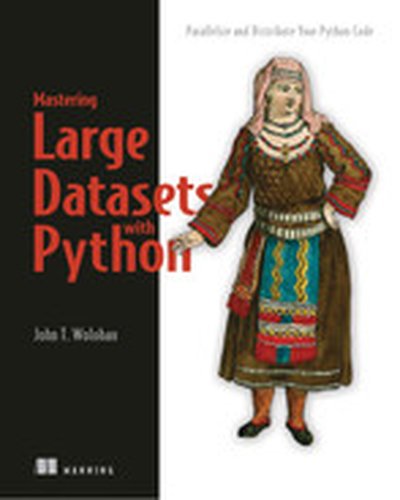
Mastering Large Datasets with Python

Modern data science solutions need to be clean, easy to read, and scalable. In Mastering Large Datasets with Python, author J.T. Wolohan teaches you how to take a small project and scale it up using a functionally influenced approach to Python coding. You’ll explore methods and built-in Python tools that lend themselves to clarity and scalability, like the high-performing parallelism method, as well as distributed technologies that allow for high data throughput. The abundant hands-on exercises in this practical tutorial will lock in these essential skills for any large-scale data science project. About the Technology Programming techniques that work well on laptop-sized data can slow to a crawl—or fail altogether—when applied to massive files or distributed datasets. By mastering the powerful map and reduce paradigm, along with the Python-based tools that support it, you can write data-centric applications that scale efficiently without requiring codebase rewrites as your requirements change. About the Book Mastering Large Datasets with Python teaches you to write code that can handle datasets of any size. You’ll start with laptop-sized datasets that teach you to parallelize data analysis by breaking large tasks into smaller ones that can run simultaneously. You’ll then scale those same programs to industrial-sized datasets on a cluster of cloud servers. With the map and reduce paradigm firmly in place, you’ll explore tools like Hadoop and PySpark to efficiently process massive distributed datasets, speed up decision-making with machine learning, and simplify your data storage with AWS S3. What's Inside An introduction to the map and reduce paradigm Parallelization with the multiprocessing module and pathos framework Hadoop and Spark for distributed computing Running AWS jobs to process large datasets About the Reader For Python programmers who need to work faster with more data. About the Author J. T. Wolohan is a lead data scientist at Booz Allen Hamilton, and a PhD researcher at Indiana University, Bloomington. Quotes A clear and efficient path to mastery of the map and reduce paradigm for developers of all levels. - Justin Fister, GrammarBot An amazing book for anybody looking to add parallel processing and the map/reduce pattern to their toolkit. - Gary Bake, Radius Payment Solutions Learn fundamentals of MapReduce and other core concepts and save money on expensive hardware! - Al Krinker, USPTO A comprehensive guide to the fundamentals of efficient Python data processing. - Craig Pfeifer, MITRE Corporation

Summary The scale and complexity of the systems that we build to satisfy business requirements is increasing as the available tools become more sophisticated. In order to bridge the gap between legacy infrastructure and evolving use cases it is necessary to create a unifying set of components. In this episode Dipti Borkar explains how the emerging category of data orchestration tools fills this need, some of the existing projects that fit in this space, and some of the ways that they can work together to simplify projects such as cloud migration and hybrid cloud environments. It is always useful to get a broad view of new trends in the industry and this was a helpful perspective on the need to provide mechanisms to decouple physical storage from computing capacity.

Announcements

Hello and welcome to the Data Engineering Podcast, the show about modern data management When you’re ready to build your next pipeline, or want to test out the projects you hear about on the show, you’ll need somewhere to deploy it, so check out our friends at Linode. With 200Gbit private networking, scalable shared block storage, and a 40Gbit public network, you’ve got everything you need to run a fast, reliable, and bullet-proof data platform. If you need global distribution, they’ve got that covered too with world-wide datacenters including new ones in Toronto and Mumbai. And for your machine learning workloads, they just announced dedicated CPU instances. Go to dataengineeringpodcast.com/linode today to get a $20 credit and launch a new server in under a minute. And don’t forget to thank them for their continued support of this show! This week’s episode is also sponsored by Datacoral, an AWS-native, serverless, data infrastructure that installs in your VPC. Datacoral helps data engineers build and manage the flow of data pipelines without having to manage any infrastructure, meaning you can spend your time invested in data transformations and business needs, rather than pipeline maintenance. Raghu Murthy, founder and CEO of Datacoral built data infrastructures at Yahoo! and Facebook, scaling from terabytes to petabytes of analytic data. He started Datacoral with the goal to make SQL the universal data programming language. Visit dataengineeringpodcast.com/datacoral today to find out more. You listen to this show to learn and stay up to date with what’s happening in databases, streaming platforms, big data, and everything else you need to know about modern data management. For even more opportunities to meet, listen, and learn from your peers you don’t want to miss out on this year’s conference season. We have partnered with organizations such as O’Reilly Media, Dataversity, Corinium Global Intelligence, Alluxio, and Data Council. Upcoming events include the combined events of the Data Architecture Summit and Graphorum, the Data Orchestration Summit, and Data Council in NYC. Go to dataengineeringpodcast.com/conferences to learn more about these and other events, and take advantage of our partner discounts to save money when you register today. Your host is Tobias Macey and today I’m interviewing Dipti Borkark about data orchestration and how it helps in migrating data workloads to the cloud

Interview

Introduction How did you get involved in the area of data management? Can you start by describing what you mean by the term "Data Orchestration"?

How does it compare to the concept of "Data Virtualization"? What are some of the tools and platforms that fit under that umbrella?

What are some of the motivations for organizations to use the cloud for their data oriented workloads?

What are they giving up by using cloud resources in place of on-premises compute?

For businesses that have invested heavily in their own datacenters, what are some ways that they can begin to replicate some of the benefits of cloud environments? What are some of the common patterns for cloud migration projects and what challenges do they present?

Do you have advice on useful metrics to track for determining project completion or success criteria?

How do businesses approach employee education for designing and implementing effective systems for achieving their migration goals? Can you talk through some of the ways that different data orchestration tools can be composed together for a cloud migration effort?

What are some of the common pain points that organizations encounter when working on hybrid implementations?

What are some of the missing pieces in the data orchestration landscape?

Are there any efforts that you are aware of that are aiming to fill those gaps?

Where is the data orchestration market heading, and what are some industry trends that are driving it?

What projects are you most interested in or excited by?

For someone who wants to learn more about data orchestration and the benefits the technologies can provide, what are some resources that you would recommend?

Contact Info

LinkedIn @dborkar on Twitter

Parting Question

From your perspective, what is the biggest gap in the tooling or technology for data management today?

Closing Announcements

Thank you for listening! Don’t forget to check out our other show, Podcast.init to learn about the Python language, its community, and the innovative ways it is being used. Visit the site to subscribe to the show, sign up for the mailing list, and read the show notes. If you’ve learned something or tried out a project from the show then tell us about it! Email [email protected]) with your story. To help other people find the show please leave a review on iTunes and tell your friends and co-workers Join the community in the new Zulip chat workspace at dataengineeringpodcast.com/chat

Links

Alluxio

Podcast Episode

UC San Diego Couchbase Presto

Podcast Episode

Spark SQL Data Orchestration Data Virtualization PyTorch

Podcast.init Episode

Rook storage orchestration PySpark MinIO

Podcast Episode

Kubernetes Openstack Hadoop HDFS Parquet Files

Podcast Episode

ORC Files Hive Metastore Iceberg Table Format

Podcast Episode

Data Orchestration Summit Star Schema Snowflake Schema Data Warehouse Data Lake Teradata

The intro and outro music is from The Hug by The Freak Fandango Orchestra / CC BY-SA

Support Data Engineering Podcast

Learn PySpark: Build Python-based Machine Learning and Deep Learning Models

Leverage machine and deep learning models to build applications on real-time data using PySpark. This book is perfect for those who want to learn to use this language to perform exploratory data analysis and solve an array of business challenges. You'll start by reviewing PySpark fundamentals, such as Spark’s core architecture, and see how to use PySpark for big data processing like data ingestion, cleaning, and transformations techniques. This is followed by building workflows for analyzing streaming data using PySpark and a comparison of various streaming platforms. You'll then see how to schedule different spark jobs using Airflow with PySpark and book examine tuning machine and deep learning models for real-time predictions. This book concludes with a discussion on graph frames and performing network analysis using graph algorithms in PySpark. All the code presented in the book will be available in Python scripts on Github. What You'll Learn Develop pipelines for streaming data processing using PySpark Build Machine Learning & Deep Learning models using PySpark latest offerings Use graph analytics using PySpark Create Sequence Embeddings from Text data Who This Book is For Data Scientists, machine learning and deep learning engineers who want to learn and use PySpark for real time analysis on streaming data.

Data Science with Python and Dask

Dask is a native parallel analytics tool designed to integrate seamlessly with the libraries you’re already using, including Pandas, NumPy, and Scikit-Learn. With Dask you can crunch and work with huge datasets, using the tools you already have. And Data Science with Python and Dask is your guide to using Dask for your data projects without changing the way you work! About the Technology An efficient data pipeline means everything for the success of a data science project. Dask is a flexible library for parallel computing in Python that makes it easy to build intuitive workflows for ingesting and analyzing large, distributed datasets. Dask provides dynamic task scheduling and parallel collections that extend the functionality of NumPy, Pandas, and Scikit-learn, enabling users to scale their code from a single laptop to a cluster of hundreds of machines with ease. About the Book Data Science with Python and Dask teaches you to build scalable projects that can handle massive datasets. After meeting the Dask framework, you’ll analyze data in the NYC Parking Ticket database and use DataFrames to streamline your process. Then, you’ll create machine learning models using Dask-ML, build interactive visualizations, and build clusters using AWS and Docker. What's Inside Working with large, structured and unstructured datasets Visualization with Seaborn and Datashader Implementing your own algorithms Building distributed apps with Dask Distributed Packaging and deploying Dask apps About the Reader For data scientists and developers with experience using Python and the PyData stack. About the Author Jesse Daniel is an experienced Python developer. He taught Python for Data Science at the University of Denver and leads a team of data scientists at a Denver-based media technology company. We interviewed Jesse as a part of our Six Questions series. Check it out here. Quotes The most comprehensive coverage of Dask to date, with real-world examples that made a difference in my daily work. - Al Krinker, United States Patent and Trademark Office An excellent alternative to PySpark for those who are not on a cloud platform. The author introduces Dask in a way that speaks directly to an analyst. - Jeremy Loscheider, Panera Bread A greatly paced introduction to Dask with real-world datasets. - George Thomas, R&D Architecture Manhattan Associates The ultimate resource to quickly get up and running with Dask and parallel processing in Python. - Gustavo Patino, Oakland University William Beaumont School of Medicine

Hands-On Big Data Analytics with PySpark

Dive into the exciting world of big data analytics with 'Hands-On Big Data Analytics with PySpark'. This practical guide offers you the tools and knowledge to tackle massive datasets using PySpark. By exploring real-world examples, you'll learn to unleash the power of distributed systems to analyze and manipulate data at scale. What this Book will help me do Master using PySpark to handle large and complex datasets efficiently and effectively. Develop skills to optimize Spark programs using best practices like reducing shuffle operations. Learn to set up a PySpark environment, process data from platforms like HDFS, Hive, and S3. Enhance your data analytics capabilities by implementing powerful SQL queries and data visualizations. Understand testing and debugging techniques to build reliable, production-quality data pipelines. Author(s) Authored by Rudy Lai and Bartłomiej Potaczek, both seasoned data engineers and authors in the big data field. Rudy and Bartłomiej bring their extensive experience working with distributed systems and scalable data architectures into this book. Their approach is hands-on, focusing on real-world applications and best practices. Who is it for? This book is tailored for data scientists, engineers, and developers eager to advance their big data analytics capabilities. Whether you're new to big data or experienced with other analytics frameworks, this book will equip you with practical knowledge to utilize PySpark for scalable data solutions.