
talk-data.com talk-data.com

Topic

HTML

HyperText Markup Language (HTML)

web_development markup_language front_end

370

tagged

Activity Trend

15 peak/qtr
2020-Q1 2026-Q1

Activities

370 activities · Newest first

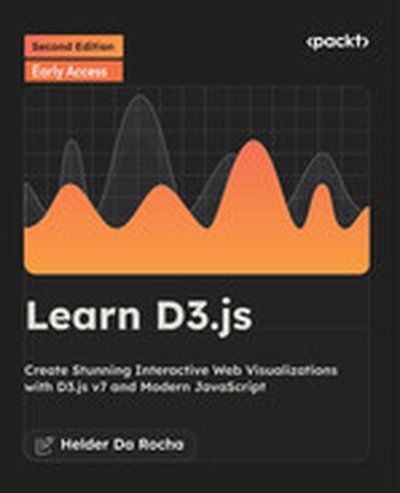
Learn D3.js - Second Edition

Master data visualization with D3.js v7 using modern web standards and real-world projects to build interactive charts, maps, and visual narratives Key Features Build dynamic, data-driven visualizations using D3.js v7 and ES2015+ Create bar, scatter, and network charts, geographic maps, and more Learn through step-by-step tutorials backed by hundreds of downloadable examples Purchase of the print or Kindle book includes a free PDF eBook Book Description Learn D3.js, Second Edition, is a fully updated guide to building interactive, standards-compliant web visualizations using D3.js v7 and modern JavaScript. Whether you're a developer, designer, data journalist, or analyst, this book will help you master the core techniques for transforming data into compelling, meaningful visuals. Starting with fundamentals like selections, data binding, and SVG, the book progressively covers scales, axes, animations, hierarchical data, and geographical maps. Each chapter includes short examples and a full hands-on project with downloadable code you can run, modify, and use in your own work. This new edition introduces improved chapter structure, updated code samples using ES2015 standards, and better formatting for readability. There’s also a dedicated chapter that focuses on integrating D3 with modern frameworks like React and Vue, along with performance, accessibility, and deployment strategies. For those migrating from older versions of D3, a detailed appendix is included at the end. With thoughtful pedagogy and a practical approach, this book remains one of the most thorough and respected resources for learning D3.js and help you truly leverage data visualisation. What you will learn Bind data to DOM elements and apply transitions and styles Build bar, line, pie, scatter, tree, and network charts Create animated, interactive behaviours with zoom, drag, and tooltips Visualize hierarchical data, flows, and maps using D3 layouts and projections Use D3 with HTML5 Canvas for high-performance rendering Develop accessible and responsive D3 apps for all screen sizes Integrate D3 with frameworks like React and Vue Migrate older D3 codebases to version 7 Who this book is for This book is for web developers, data journalists, designers, analysts, and anyone who wants to create interactive, web-based data visualizations. A basic understanding of HTML, CSS, and JavaScript is recommended. No prior knowledge of SVG or D3 is required.
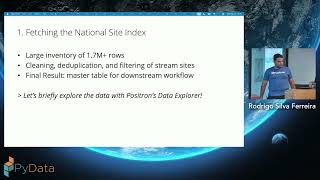
When Rivers Speak: Analyzing Massive Water Quality Datasets using USGS API and Remote SSH in Positron

Rivers have long been storytellers of human history. From the Nile to the Yangtze, they have shaped trade, migration, settlement, and the rise of civilizations. They reveal the traces of human ambition... and the costs of it. Today, from the Charles to the Golden Gate, US rivers continue to tell stories, especially through data.

Over the past decades, extensive water quality monitoring efforts have generated vast public datasets: millions of measurements of pH, dissolved oxygen, temperature, and conductivity collected across the country. These records are more than environmental snapshots; they are archives of political priorities, regulatory choices, and ecological disruptions. Ultimately, they are evidence of how societies interact with their environments, often unevenly.

In this talk, I’ll explore how Python and modern data workflows can help us "listen" to these stories at scale. Using the United States Geological Survey (USGS) Water Data APIs and Remote SSH in Positron, I’ll process terabytes of sensor data spanning several years and regions. I’ll demonstrate that, while Parquet and DuckDB enable scalable exploration of historical records, using Remote SSH is paramount in order to enable large-scale data analysis. By doing so, I hope to answer some analytical questions that can surface patterns linked to industrial growth, regulatory shifts, and climate change.

By treating rivers as both ecological systems and social mirrors, we can begin to see how environmental data encodes histories of inequality, resilience, and transformation.

Whether your interest lies in data engineering, environmental analytics, or the human dimensions of climate and infrastructure, this talk will explore topics at the intersection of environmental science, will offer both technical methods and sociological lenses to understand the stories rivers continue to tell.

In this talk, Xia He-Bleinagel, Head of Data & Cloud at NOW GmbH, shares her remarkable journey from studying automotive engineering across Europe to leading modern data, cloud, and engineering teams in Germany. We dive into her transition from hands-on engineering to leadership, how she balanced family with career growth, and what it really takes to succeed in today’s cloud, data, and AI job market.

TIMECODES: 00:00 Studying Automotive Engineering Across Europe 08:15 How Andrew Ng Sparked a Machine Learning Journey 11:45 Import–Export Work as an Unexpected Career Boos t17:05 Balancing Family Life with Data Engineering Studies 20:50 From Data Engineer to Head of Data & Cloud 27:46 Building Data Teams & Tackling Tech Debt 30:56 Learning Leadership Through Coaching & Observation 34:17 Management vs. IC: Finding Your Best Fit 38:52 Boosting Developer Productivity with AI Tools 42:47 Succeeding in Germany’s Competitive Data Job Market 46:03 Fast-Track Your Cloud & Data Career 50:03 Mentorship & Supporting Working Moms in Tech 53:03 Cultural & Economic Factors Shaping Women’s Careers 57:13 Top Networking Groups for Women in Data 1:00:13 Turning Domain Expertise into a Data Career Advantage

Connect with Xia- Linkedin - https://www.linkedin.com/in/xia-he-bleinagel-51773585/ - Github - https://github.com/Data-Think-2021 - Website - https://datathinker.de/

Connect with DataTalks.Club: - Join the community - https://datatalks.club/slack.html - Subscribe to our Google calendar to have all our events in your calendar - https://calendar.google.com/calendar/r?cid=ZjhxaWRqbnEwamhzY3A4ODA5azFlZ2hzNjBAZ3JvdXAuY2FsZW5kYXIuZ29vZ2xlLmNvbQ - Check other upcoming events - https://lu.ma/dtc-events - GitHub: https://github.com/DataTalksClub - LinkedIn - https://www.linkedin.com/company/datatalks-club/ - Twitter - https://twitter.com/DataTalksClub - Website - https://datatalks.club/

In this talk, Anusha Akkina, co-founder of Auralytix, shares her journey from working as a Chartered Accountant and Auditor at Deloitte to building an AI-powered finance intelligence platform designed to augment, not replace, human decision-making. Together with host Alexey from DataTalks.Club, she explores how AI is transforming finance operations beyond spreadsheets—from tackling ERP limitations to creating real-time insights that drive strategic business outcomes.

TIMECODES: 00:00 Building trust in AI finance and introducing Auralytix 02:22 From accounting roots to auditing at Deloitte and Paraxel 08:20 Moving to Germany and pivoting into corporate finance 11:50 The data struggle in strategic finance and the need for change 13:23 How Auralytix was born: bridging AI and financial compliance 17:15 Why ERP systems fail finance teams and how spreadsheets fill the gap 24:31 The real cost of ERP rigidity and lessons from failed transformations 29:10 The hidden risks of spreadsheet dependency and knowledge loss 37:30 Experimenting with ChatGPT and coding the first AI finance prototype 43:34 Identifying finance’s biggest pain points through user research 47:24 Empowering finance teams with AI-driven, real-time decision insights 50:59 Developing an entrepreneurial mindset through strategy and learning 54:31 Essential resources and finding the right AI co-founder

Connect with Anusha - Linkedin - https://www.linkedin.com/in/anusha-akkina-acma-cgma-56154547/ - Website - https://aurelytix.com/

Connect with DataTalks.Club: - Join the community - https://datatalks.club/slack.html - Subscribe to our Google calendar to have all our events in your calendar - https://calendar.google.com/calendar/r?cid=ZjhxaWRqbnEwamhzY3A4ODA5azFlZ2hzNjBAZ3JvdXAuY2FsZW5kYXIuZ29vZ2xlLmNvbQ - Check other upcoming events - https://lu.ma/dtc-events - GitHub: https://github.com/DataTalksClub - LinkedIn - https://www.linkedin.com/company/datatalks-club/ - Twitter - https://twitter.com/DataTalksClub - Website - https://datatalks.club/

Every sprint consumed by fixing parsers is a sprint spent not shipping product- brittle parsing kills velocity. This workshop is about retiring that cycle so you can move from messy, unstructured inputs to production-ready data in seconds. bem ingests and transforms any unstructured input at any volume — PDFs, emails, Excel, Word, CSV, text, JSON, images (PNG, JPEG, HEIC, HEIF, WebP), HTML, and audio (WAV, MP3, M4A) — into clean JSON instantly via API. With primitives like Transform, Join, Split, Route, and Analyze, you define the exact workflow your product needs. Built-in Evals measure + enforce accuracy automatically so quality doesn’t drop as you scale. Flow outputs straight into MotherDuck so you can go from chaos to query without manual cleanup — and your team can focus on shipping, not scraping.

In this episode, we talked with Aishwarya Jadhav, a machine learning engineer whose career has spanned Morgan Stanley, Tesla, and now Waymo. Aishwarya shares her journey from big data in finance to applied AI in self-driving, gesture understanding, and computer vision. She discusses building an AI guide dog for the visually impaired, contributing to malaria mapping in Africa, and the challenges of deploying safe autonomous systems. We also explore the intersection of computer vision, NLP, and LLMs, and what it takes to break into the self-driving AI industry.TIMECODES00:51 Aishwarya’s career journey from finance to self-driving AI05:45 Building AI guide dog for the visually impaired12:03 Exploring LiDAR, radar, and Tesla’s camera-based approach16:24 Trust, regulation, and challenges in self-driving adoption19:39 Waymo, ride-hailing, and gesture recognition for traffic control24:18 Malaria mapping in Africa and AI for social good29:40 Deployment, safety, and testing in self-driving systems37:00 Transition from NLP to computer vision and deep learning43:37 Reinforcement learning, robotics, and self-driving constraints51:28 Testing processes, evaluations, and staged rollouts for autonomous driving52:53 Can multimodal LLMs be applied to self-driving?55:33 How to get started in self-driving AI careersConnect with Aishwarya- Linkedin - https://www.linkedin.com/in/aishwaryajadhav8/Connect with DataTalks.Club:- Join the community - https://datatalks.club/slack.html- Subscribe to our Google calendar to have all our events in your calendar - https://calendar.google.com/calendar/r?cid=ZjhxaWRqbnEwamhzY3A4ODA5azFlZ2hzNjBAZ3JvdXAuY2FsZW5kYXIuZ29vZ2xlLmNvbQ- Check other upcoming events - https://lu.ma/dtc-events- GitHub: https://github.com/DataTalksClub- LinkedIn - https://www.linkedin.com/company/datatalks-club/ - Twitter - https://twitter.com/DataTalksClub - Website - https://datatalks.club/

In this episode, we talked with Ranjitha Kulkarni, a machine learning engineer with a rich career spanning Microsoft, Dropbox, and now NeuBird AI. Ranjitha shares her journey into ML and NLP, her work building recommendation systems, early AI agents, and cutting-edge LLM-powered products. She offers insights into designing reliable AI systems in the new era of generative AI and agents, and how context engineering and dynamic planning shape the future of AI products.TIMECODES00:00 Career journey and early curiosity04:25 Speech recognition at Microsoft05:52 Recommendation systems and early agents at Dropbox07:44 Joining NewBird AI12:01 Defining agents and LLM orchestration16:11 Agent planning strategies18:23 Agent implementation approaches22:50 Context engineering essentials30:27 RAG evolution in agent systems37:39 RAG vs agent use cases40:30 Dynamic planning in AI assistants43:00 AI productivity tools at Dropbox46:00 Evaluating AI agents53:20 Reliable tool usage challenges58:17 Future of agents in engineering Connect with Ranjitha- Linkedin - https://www.linkedin.com/in/ranjitha-gurunath-kulkarniConnect with DataTalks.Club:- Join the community - https://datatalks.club/slack.html- Subscribe to our Google calendar to have all our events in your calendar - https://calendar.google.com/calendar/r?cid=ZjhxaWRqbnEwamhzY3A4ODA5azFlZ2hzNjBAZ3JvdXAuY2FsZW5kYXIuZ29vZ2xlLmNvbQ- Check other upcoming events - https://lu.ma/dtc-events- GitHub: https://github.com/DataTalksClub- LinkedIn - https://www.linkedin.com/company/datatalks-club/ - Twitter - https://twitter.com/DataTalksClub - Website - https://datatalks.club/

Face To Face
by Hugo Lu , Jon Cooke (Dataception) , Parmar , Chris Freestone , David Richardson , Paul Rankin (Paul Rankin IT) , Jesse Anderson (Big Data Institute) , Taylor McGrath (Boomi) , Karl Ivo 🎧 Sokolov , Nick White , Chris Tabb (LEIT DATA) , Kelsey Hammock , Jean-Georges Perrin (Actian) , Mehdi Ouazza (MotherDuck) , Adi Polak (Treeverse) , Eevamaija Virtanen

https://www.bigdataldn.com/en-gb/conference/session-details.4500.251781.the-high-performance-data-and-ai-debate.html

Paywalls are the critical part of mobile apps monetization. Adapty serves thousands of paywalls to millions of users. In this talk, I'll share:\n\n1. How we built the paywall rendering on the SDK\n2. Why we went native over HTML\n3. How we managed to deliver sub-second paywall loading time for the 97th percentile across 100m+ requests per day without spending hundreds of thousands on the infrastructure\n\nWe'll also share paywall insights that help increase conversion.

Struggling with data trust issues, dashboard drama, or constant pipeline firefighting? In this deep‑dive interview, Lior Barak shows you how to shift from a reactive “fix‑it” culture to a mindful, impact‑driven practice rooted in Zen/Wabi‑Sabi principles. You’ll learn: Why 97 % of CEOs say they use data, but only 24 % call themselves data‑driven The traffic‑light dashboard pattern (green / yellow / red) that instantly tells execs whether numbers are safe to use A practical rule for balancing maintenance, rollout, and innovation—and avoiding team burnout How to quantify ROI on data products, kill failing legacy systems, and handle ad‑hoc exec requests without derailing roadmaps Turning “imperfect” data into business value with mindful communication, root‑cause logs, and automated incident review loops

🕒 TIMECODES 00:00 Community and mindful data strategy 04:06 Career journey and product management insights 08:03 Wabi-sabi data and the trust crisis 11:47 AI, data imperfection, and trust challenges 20:05 Trust crisis examples and root cause analysis 25:06 Regaining trust through mindful data management 30:47 Traffic light system and effective communication 37:41 Communication gaps and team workload balance 39:58 Maintenance stress and embracing Zen mindset 49:29 Accepting imperfection and measuring impact 56:19 Legacy systems and managing executive requests 01:00:23 Role guidance and closing reflections

🔗 Connect with Lior LinkedIn - https://www.linkedin.com/in/liorbarak Website - https://cookingdata.substack.com/ Cooking Data newsletter: https://cookingdata.substack.com/ Product product lifecycle manager: https://app--data-product-lifecycle-manager-c81b10bb.base44.app/

🔗 Connect with DataTalks.Club Join the community - https://datatalks.club/slack.html Subscribe to our Google calendar to have all our events in your calendar - https://calendar.google.com/calendar/u/0/r?cid=ZjhxaWRqbnEwamhzY3A4ODA5azFlZ2hzNjBAZ3JvdXAuY2FsZW5kYXIuZ29vZ2xlLmNvbQ Check other upcoming events - https://lu.ma/dtc-events GitHub: https://github.com/DataTalksClub LinkedIn - https://www.linkedin.com/company/datatalks-club/ Twitter - https://x.com/DataTalksClub Website - https://datatalks.club/

🔗 Connect with Alexey Twitter - https://x.com/Al_Grigor Linkedin - https://www.linkedin.com/in/agrigorev/

In this episode, we talk with Orell about his journey from electrical engineering to freelancing in data engineering. Exploring lessons from startup life, working with messy industrial data, the realities of freelancing, and how to stay up to date with new tools.

Topics covered: Why Orel left a PhD and a simulation‑focused start‑up after Covid hitWhat he learned trying (and failing) to commercialise medical‑imaging simulationsThe first freelance project and the long, quiet months that followedHow he now finds clients, keeps projects small and delivers value quicklyTypical work he does for industrial companies: parsing messy machine logs, building simple pipelines, adding structure laterFavorite everyday tools (Python, DuckDB, a bit of C++) and the habit of blocking time for learningAdvice for anyone thinking about freelancing: cash runway, networking, and focusing on problems rather than “perfect” tech choices A practical conversation for listeners who are curious about moving from research or permanent roles into freelance data engineering.

🕒 TIMECODES 0:00 Orel’s career and move to freelancing 9:04 Startup experience and data engineering lessons 16:05 Academia vs. startups and starting freelancing 25:33 Early freelancing challenges and networking 34:22 Freelance data engineering and messy industrial data 43:27 Staying practical, learning tools, and growth 50:33 Freelancing challenges and client acquisition 58:37 Tools, problem-solving, and manual work

🔗 CONNECT WITH ORELL Twitter - https://bsky.app/profile/orgarten.bsk... LinkedIn - / ogarten
Github - https://github.com/orgarten Website - https://orellgarten.com

🔗 CONNECT WITH DataTalksClub Join the community - https://datatalks.club/slack.html Subscribe to our Google calendar to have all our events in your calendar - https://calendar.google.com/calendar/... Check other upcoming events - https://lu.ma/dtc-events GitHub: https://github.com/DataTalksClub LinkedIn - / datatalks-club
Twitter - / datatalksclub
Website - https://datatalks.club/

🔗 CONNECT WITH ALEXEY Connect with Alexey Twitter - / al_grigor
Linkedin - / agrigorev

Thinking about swapping your 9‑to‑5 for client work, but worried that a long German–style notice period will kill your chances?  In this live interview, seven‑year data‑freelance veteran Dimitri walks through his experience of taking his freelance career to the next level.

About the Speaker: Dimitri Visnadi is an independent data consultant with a focus on data strategy. He has been consulting companies leading the marketing data space such as Unilever, Ferrero, Heineken, and Red Bull.

He has lived and worked in 6 countries across Europe in both corporate and startup organizations. He was part of data departments at Hewlett-Packard (HP) and a Google partnered consulting firm where he was working on data products and strategy.

Having received a Masters in Business Analytics with Computer Science from University College London and a Bachelor in Business Administration from John Cabot University, Dimitri still has close ties to academia and holds a mentor position in entrepreneurship at both institutions. 🕒 TIMECODES00:00 Dimitri’s journey from corporate to freelance data specialist05:41 Job tenure trends, tech career shifts, and freelance types10:50 Freelancing challenges, success, and finding clients17:33 Freelance market trends and Dimitri’s job board23:51 Starting points, top freelance skills, and market insights32:48 Building a lifestyle business: scaling and work-life balance45:30 Data Freelancer course and marketing for freelancers48:33 Subscription services and managing client relationships56:47 Pricing models and transitioning advice1:01:02 Notice periods, networking, and risks in freelancing transition 🔗 CONNECT WITH DataTalksClub Join the community - https://datatalks.club/slack.html Subscribe to our Google calendar to have all our events in your calendar - https://calendar.google.com/calendar/... Check other upcoming events - https://lu.ma/dtc-events LinkedIn - / datatalks-club
Twitter - / datatalksclub
Website - https://datatalks.club/ 🔗 CONNECT WITH DIMITRI Linkedin - https://www.linkedin.com/in/visnadi/

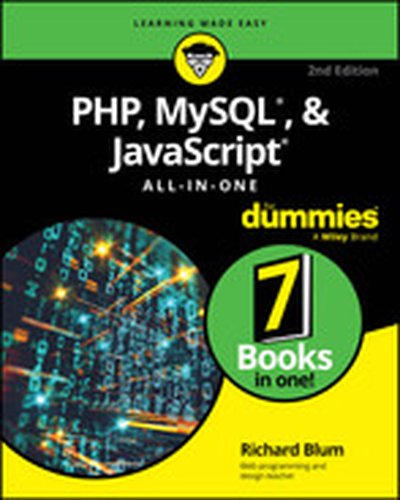
PHP, MySQL, & JavaScript All-In-One For Dummies, 2nd Edition

Learn the essentials of creating web apps with some of the most popular programming languages PHP, MySQL, & JavaScript All-in-One For Dummies bundles the essentials of coding in some of the most in-demand web development languages. You'll learn to create your own data-driven web applications and interactive web content. The three powerful languages covered in this book form the backbone of top online apps like Wikipedia and Etsy. Paired with the basics of HTML and CSS—also covered in this All-in-One Dummies guide—you can make dynamic websites with a variety of elements. This book makes it easy to get started. You'll also find coverage of advanced skills, as well as resources you'll appreciate when you're ready to level up. Get beginner-friendly instructions and clear explanations of how to program websites in common languages Understand the basics of object-oriented programming, interacting with databases, and connecting front- and back-end code Learn how to work according to popular DevOps principles, including containers and microservices Troubleshoot problems in your code and avoid common web development mistakes This All-in-One is a great value for new programmers looking to pick up web development skills, as well as those with more experience who want to expand to building web apps.

Block-based programming divides inputs into local arrays that are processed concurrently by groups of threads. Users write sequential array-centric code, and the framework handles parallelization, synchronization, and data movement behind the scenes. This approach aligns well with SciPy's array-centric ethos and has roots in older HPC libraries, such as NWChem’s TCE, BLIS, and ATLAS.

In recent years, many block-based Python programming models for GPUs have emerged, like Triton, JAX/Pallas, and Warp, aiming to make parallelism more accessible for scientists and increase portability.

In this talk, we'll present cuTile and Tile IR, a new Pythonic tile-based programming model and compiler recently announced by NVIDIA. We'll explore cuTile examples from a variety of domains, including a new LLAMA3-based reference app and a port of miniWeather. You'll learn the best practices for writing and debugging block-based Python GPU code, gain insight into how such code performs, and learn how it differs from traditional SIMT programming.

By the end of the session, you'll understand how block-based GPU programming enables more intuitive, portable, and efficient development of high-performance, data-parallel Python applications for HPC, data science, and machine learning.

PyVista is a general purpose 3D visualization library used for over 2000+ open source projects for the visualization of everything from computer aided engineering and geophysics to volcanoes and digital artwork.

PyVista exposes a Pythonic API to the Visualization Toolkit (VTK) to provide tooling that is immediately usable without any prior knowledge of VTK and is being built as the 3D equivalent of Matplotlib, with plugins to Jupyter to enable visualization of 3D data using both server- and client-side rendering.