talk-data.com talk-data.com

Event

O'Reilly Data Science Books

2013-08-09 – 2026-02-25 Oreilly Visit website ↗

Activities tracked

2118

Collection of O'Reilly books on Data Science.

Sessions & talks

Showing 1–25 of 2118 · Newest first

Search within this event →
Head First Statistics for Data Analysis

What will you learn from this book? Do you need to analyze data but feel lost in a sea of numbers? Your guide is here—without the dry, academic jargon. This hands-on, visually rich book introduces key statistical concepts and shows you how to apply them using Excel. Whether you're a data analyst, a business professional, or just someone who wants to make better decisions with data, you'll gain the practical skills needed to extract meaningful insights. From probability and confidence intervals to regression and forecasting, this book makes statistics approachable, relevant, and—even better—understandable. What's so special about this book? If you've read a Head First book before, you know what to expect: a uniquely engaging, brain-friendly approach that helps you truly learn instead of struggling through dense theory. Through clear explanations, hands-on exercises, and interactive visuals, you'll develop the skills to confidently analyze data and make informed decisions. No more guesswork—just real statistical insights at your fingertips.

Analytics Engineering with Microsoft Fabric and Power BI

While Microsoft Power BI has dominated the business intelligence market for years and is a go-to tool for creating visually appealing, interactive reports and dashboards, it's now an integral part of Microsoft Fabric, the end-to-end analytics platform that offers unprecedented flexibility and scalability for building enterprise-grade data analytics solutions. This book covers everything analytics engineers need to know to design and implement robust and efficient analytics solutions using Microsoft Fabric and Power BI. You'll learn the core components of Fabric, such as lakehouses, warehouses, and eventhouses, and how to work with semantic models, ensuring that data is structured and ready for analysis. You'll also discover essential techniques in both Microsoft Fabric and Power BI that you can apply in your day-to-day work. Explore the core components of Microsoft Fabric Implement, manage, and optimize Power BI semantic models Discover numerous architectural solutions with Microsoft Fabric and Power BI Build Fabric items such as lakehouses, warehouses, semantic models, and more, and share them within your organization Identify when to use a particular Fabric item or implement a particular design pattern Implement the analytics development lifecycle Optimize and fine-tune existing analytics solutions

Causal Inference with Bayesian Networks

Leverage the power of graphical models for probabilistic and causal inference to build knowledge-based system applications and to address causal effect queries with observational data for decision aiding and policy making. Key Features Gain a firm understanding of Bayesian networks and structured algorithms for probabilistic inference Acquire a comprehensive understanding of graphical models and their applications in causal inference Gain insights into real-world applications of causal models in multiple domains Enhance your coding skills in R and Python through hands-on examples of causal inference Book Description This is a practical guide that explores the theory and application of Bayesian networks (BN) for probabilistic and causal inference. The book provides step-by-step explanations of graphical models of BN and their structural properties; the causal interpretations of BN and the notion of conditioning by intervention; and the mathematical model of structural equations and the representation in structured causal models (SCM). For probabilistic inference in Bayesian networks, you will learn methods of variable elimination and tree clustering. For causal inference you will learn the computational framework of Pearl's do-calculus for the identification and estimation of causal effects with causal models. In the context of causal inference with observational data, you will be introduced to the potential outcomes framework and explore various classes of meta-learning algorithms that are used to estimate the conditional average treatment effect in causal inference. The book includes practical exercises using R and Python for you to engage in and solidify your understanding of different approaches to probabilistic and causal inference. By the end of this book, you will be able to build and deploy your own causal inference application. You will learn from causal inference sample use cases for diagnosis, epidemiology, social sciences, economics, and finance. What you will learn Representation of knowledge with Bayesian networks Interpretation of conditional independence assumptions Interpretation of causality assumptions in graphical models Probabilistic inference with Bayesian networks Causal effect identification and estimation Machine learning methods for causal inference Coding in R and Python for probabilistic and causal inference Who this book is for This book will serve as a valuable resource for a wide range of professionals including data scientists, software engineers, policy analysts, decision-makers, information technology professionals involved in developing expert systems or knowledge-based applications that deal with uncertainty, as well as researchers across diverse disciplines seeking insights into causal analysis and estimating treatment effects in randomized studies. The book will enable readers to leverage libraries in R and Python and build software prototypes for their own applications.

Learn D3.js - Second Edition

Master data visualization with D3.js v7 using modern web standards and real-world projects to build interactive charts, maps, and visual narratives Key Features Build dynamic, data-driven visualizations using D3.js v7 and ES2015+ Create bar, scatter, and network charts, geographic maps, and more Learn through step-by-step tutorials backed by hundreds of downloadable examples Purchase of the print or Kindle book includes a free PDF eBook Book Description Learn D3.js, Second Edition, is a fully updated guide to building interactive, standards-compliant web visualizations using D3.js v7 and modern JavaScript. Whether you're a developer, designer, data journalist, or analyst, this book will help you master the core techniques for transforming data into compelling, meaningful visuals. Starting with fundamentals like selections, data binding, and SVG, the book progressively covers scales, axes, animations, hierarchical data, and geographical maps. Each chapter includes short examples and a full hands-on project with downloadable code you can run, modify, and use in your own work. This new edition introduces improved chapter structure, updated code samples using ES2015 standards, and better formatting for readability. There’s also a dedicated chapter that focuses on integrating D3 with modern frameworks like React and Vue, along with performance, accessibility, and deployment strategies. For those migrating from older versions of D3, a detailed appendix is included at the end. With thoughtful pedagogy and a practical approach, this book remains one of the most thorough and respected resources for learning D3.js and help you truly leverage data visualisation. What you will learn Bind data to DOM elements and apply transitions and styles Build bar, line, pie, scatter, tree, and network charts Create animated, interactive behaviours with zoom, drag, and tooltips Visualize hierarchical data, flows, and maps using D3 layouts and projections Use D3 with HTML5 Canvas for high-performance rendering Develop accessible and responsive D3 apps for all screen sizes Integrate D3 with frameworks like React and Vue Migrate older D3 codebases to version 7 Who this book is for This book is for web developers, data journalists, designers, analysts, and anyone who wants to create interactive, web-based data visualizations. A basic understanding of HTML, CSS, and JavaScript is recommended. No prior knowledge of SVG or D3 is required.

Microsoft Power BI Quick Start Guide - Fourth Edition

Bring your data to life with the ultimate beginner's guide to Power BI, now featuring Microsoft Fabric, Copilot, and full-color visuals to make learning data modeling, storytelling, and dashboards easier and faster than ever Key Features Build data literacy and gain confidence using Power BI through real-world, beginner-friendly examples Learn to shape, clean, and model data using Power BI Desktop and Power Query, with zero experience required Build vibrant, accurate reports and dashboards with real-world modeling examples Book Description Updated with the latest innovations in Power BI, including integration with Microsoft Fabric for seamless data unification and Copilot for AI-powered guidance. This comprehensive guide empowers you to build compelling reports and dashboards from the ground up. Whether you're new to Power BI or stepping into a data role, this book provides a friendly, approachable introduction to business intelligence and data storytelling You'll start with the Power BI Desktop interface and its core functionality, then move into shaping and cleaning your data using the Power Query Editor. From designing intuitive data models to writing your first DAX formulas, you’ll develop practical skills that apply directly to real-world scenarios. he book emphasizes how to use visualizations and narrative techniques to turn numbers into meaningful insights The chapters focus on hands-on, real-world examples—like analyzing sales trends, tracking KPIs, and cleaning messy data. You'll learn to build and refresh reports, scale your Power BI setup, and enhance your solutions using Microsoft Fabric and Copilot. Fabric unifies analytics across your organization, while Copilot speeds up your workflow with AI-driven insights and report suggestions By the end of the book, you’ll have the confidence and experience to turn raw data into insightful, impactful dashboards What you will learn Understand why data literacy matters in decision-making and careers Connect to data using import, DirectQuery, and live connection modes Clean and transform data using Power Query Editor and dataflows Design reports with visuals that support clear data storytelling Apply row-level security to enforce access and data protection Manage and monitor Power BI cloud for scalability and teamwork Use AI tools like Copilot to speed up prep and generate insights Learn Microsoft Fabric basics to enable unified data experiences Who this book is for This book is ideal for anyone looking to build a solid foundation in Power BI, regardless of prior experience. Whether you're just starting out or stepping into a new role that involves data, you'll find clear, approachable guidance throughout. The step-by-step tutorials and real-world examples make it easy to follow along—even if it’s your first time working with business intelligence tools

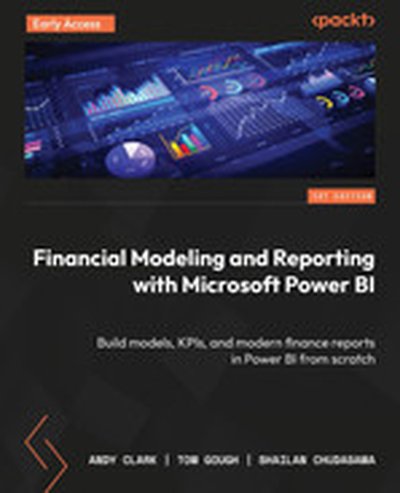
Financial Modeling and Reporting with Microsoft Power BI

Design powerful financial reports in Power BI by building models, measures, and dashboards tailored for real-world accounting and analytics Key Features Build a complete financial data model from ledgers, journals, and budgets Master DAX for income statements, KPIs, and performance analysis Learn Power BI Paginated and AI tools for printable and predictive reporting Purchase of the print or Kindle book includes a free PDF eBook Book Description Power BI for Financial Reporting is the definitive guide to designing high-performance, flexible, and insightful financial reports using Power BI. This book empowers finance and BI professionals to create everything from trial balances to enterprise-wide performance dashboards with ease and precision. The book starts by helping you define your reporting goals and data sources, mapping these needs to Power BI’s capabilities. You’ll then build a core financial data model—covering ledger transactions, charts of accounts, and multi-company support. As you proceed, you’ll integrate complex DAX measures, handle foreign exchange and journal entries, and extend your model with budgeting and inventory data. Each chapter builds toward a comprehensive suite of reports, complete with visual best practices and tested metrics. You’ll learn to streamline datasets using Power Query, test for data integrity, and generate printable reports via Power BI Paginated. The final chapters dive into using AI, predictive analytics, and Microsoft Fabric to future-proof your reporting. Whether you're consolidating data across systems or evolving your reports for changing business needs, this hands-on guide ensures you’re prepared to meet the demands of modern finance. What you will learn Build core financial models from ledgers and accounts Create Trial Balance and Income Statements using DAX Optimize Power BI with Power Query and data transformation Add budgets, targets, and KPIs to performance dashboards Integrate inventory data for nuanced stock reporting Produce printable reports using Power BI Paginated Apply AI for report generation and predictive analytics Test, tune, and evolve reports for secure, scalable use Who this book is for This book is for finance professionals, accountants, financial analysts, and BI developers who want to leverage Power BI to improve, automate, and future-proof their financial reporting. Whether consolidating data from ERPs, building reports across entities, or exploring advanced Power BI features, this book equips readers with practical skills and strategic insight.

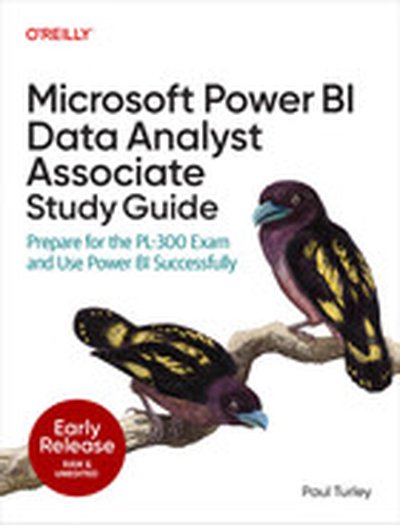
Microsoft Power BI Data Analyst Associate Study Guide

Passing the PL-300 exam with 2025 revisions isn't just about memorization—you need to thoroughly know the basic features of Power BI. However, data professionals must also apply best practices that make Power BI solutions scalable and future-proof. The first half of this go-to companion by Paul Turley provides complete coverage of the PL-300 exam objectives for desktop and self-service users, while the second half equips you with necessary best practices and practical skills for real-world success after the exam. Immerse yourself in exam prep, practice questions, and hands-on references for applying time-tested design patterns in Power BI. You'll learn how to transform raw data into actionable insights using Power Query, DAX, and dimensional modeling. Perfect for data analysts and business intelligence developers, this guide shows how Power BI fits into modern data platforms like Azure and Microsoft Fabric, preparing you for the exam and for the evolving world of data engineering. Understand PL-300 exam topics and key prep strategies Discover scalable, enterprise-grade Power BI solutions using best practices Learn how to correctly apply Power Query, DAX, and visualizations in real-world scenarios, with real business data Uncover how to build for scale See how Power BI fits into modern architectures like Azure and Microsoft Fabric

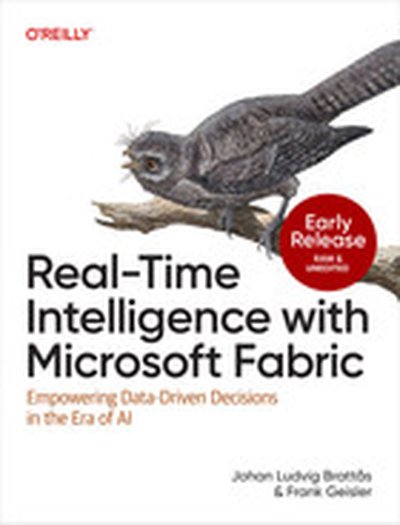
Real-Time Intelligence with Microsoft Fabric

In today's hyper-connected world, many organizations are overwhelmed by the volume of data generated every second. Making timely decisions using this information remains a challenge for many. Real-time intelligence has transformed from a luxury to a necessity for businesses striving to stay ahead in a rapidly evolving marketplace. Enter Microsoft Fabric's Real-Time Intelligence: a new tool that not only analyzes data but also acts upon the results. If you're ready to unlock the power of immediate insights, this comprehensive primer offers an exploration into the capabilities of Real-Time Intelligence with Microsoft Fabric. Authors Johan Ludvig Brattås and Frank Geisler explain AI-driven insights and how to use them to drive business success. Whether you're a seasoned professional or an enthusiast, this guide is the key to understanding an exciting new platform. You'll discover: The core concepts of Real-Time Intelligence within Microsoft Fabric Challenges that can be solved with Real-Time Intelligence, enhancing efficiency Techniques for using KQL queries, including SQL knowledge to optimize these queries Practical applications including data analytic solutions, event streams, and more How to automatically trigger actions based on data conditions

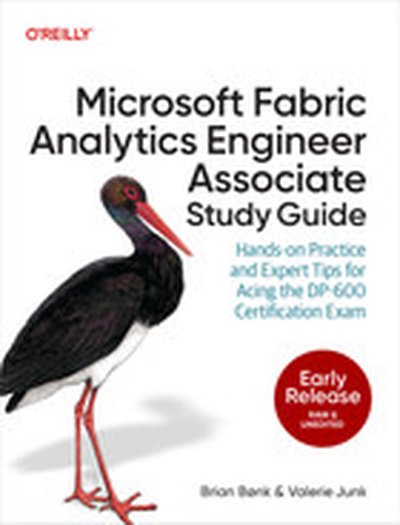
Microsoft Fabric Analytics Engineer Associate Study Guide

Data is the heartbeat of business. Microsoft's Fabric Analytics Engineer Associate (DP-600) certification proves you understand the tools and technologies to make use of it. This comprehensive guide covers everything you need to know to design and implement enterprise-grade analytics solutions—and ace your certification exam. Drawing on their extensive experience working with Microsoft Fabric and Power BI, Brian Bønk and Valerie Junk take you through preparing and transforming data, securing and managing analytics assets, and building and optimizing semantic models. You'll learn to work with data warehouses and lakehouses, ensuring data is structured and ready for analysis. You will also discover how to query and analyze data using SQL, KQL, and DAX, which are essential skills for anyone working with Fabric. Whether you're preparing for the exam or just looking to expand your Fabric expertise, this book gives you the foundation to succeed. Prepare and enrich data for analysis Work with, secure, and maintain analytics assets Implement and manage semantic models Utilize data warehouses and lakehouses Handle workspace access control and item-level access control Optimize enterprise-scale semantic models

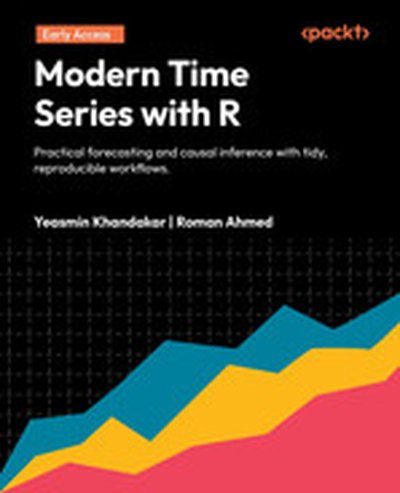
Modern Time Series with R

Gain expertise in modern time series forecasting and causal inference in R to solve real-world business problems with reproducible, high-quality code Key Features Explore forecasting and causal inference with practical R examples Build reproducible, high-quality time series workflows using tidyverse and modern R packages Apply models to real-world business scenarios with step-by-step guidance Purchase of the print or Kindle book includes a free PDF eBook Book Description Modern Time Series Analysis with R is a comprehensive, hands-on guide to mastering the art of time series analysis using the R programming language. Written by leading experts in applied statistics and econometrics, this book helps data scientists, analysts, and developers bridge the gap between traditional statistical theory and practical business applications. Starting with the foundations of R and tidyverse, you’ll explore the core components of time series data, data wrangling, and visualization techniques. The chapters then guide you through key modeling approaches, ranging from classical methods like ARIMA and exponential smoothing to advanced computational techniques, such as machine learning, deep learning, and ensemble forecasting. Beyond forecasting, you’ll discover how time series can be applied to causal inference, anomaly detection, change point analysis, and multiple time series modeling. Practical examples and reproducible code will empower you to assess business problems, choose optimal solutions, and communicate results effectively through dynamic R-based reporting. By the end of this book, you’ll be confident in applying modern time series methods to real-world data, delivering actionable insights for strategic decision-making in business, finance, technology, and beyond. What you will learn Understand core concepts and components of time series data Wrangle and visualize time series with tidyverse and R packages Apply ARIMA, exponential smoothing, and machine learning methods Explore deep learning and ensemble forecasting approaches Conduct causal inference with interrupted time series analysis Detect anomalies, structural changes, and perform change point analysis Analyze multiple time series using hierarchical and grouped models Automate reproducible reporting with RStudio and dynamic documents Who this book is for This book is for data scientists, analysts, and developers who want to master time series analysis using R. It is ideal for professionals in finance, retail, technology, and research, as well as students seeking practical, business-oriented approaches to forecasting and causal inference. Basic knowledge of R is assumed, but no advanced mathematics is required.

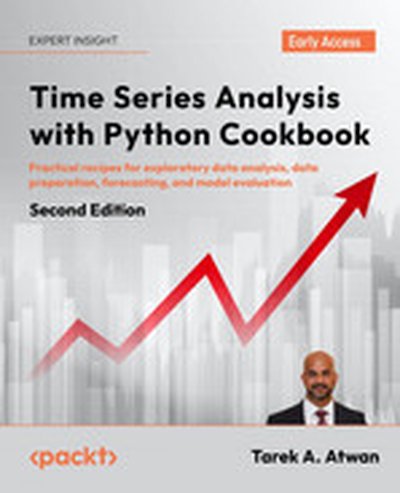
Time Series Analysis with Python Cookbook - Second Edition

Perform time series analysis and forecasting confidently with this Python code bank and reference manual Purchase of the print or Kindle book includes a free PDF eBook Key Features Explore up-to-date forecasting and anomaly detection techniques using statistical, machine learning, and deep learning algorithms Learn different techniques for evaluating, diagnosing, and optimizing your models Work with a variety of complex data with trends, multiple seasonal patterns, and irregularities Book Description To use time series data to your advantage, you need to be well-versed in data preparation, analysis, and forecasting. This fully updated second edition includes chapters on probabilistic models and signal processing techniques, as well as new content on transformers. Additionally, you will leverage popular libraries and their latest releases covering Pandas, Polars, Sktime, stats models, stats forecast, Darts, and Prophet for time series with new and relevant examples. You'll start by ingesting time series data from various sources and formats, and learn strategies for handling missing data, dealing with time zones and custom business days, and detecting anomalies using intuitive statistical methods. Further, you'll explore forecasting using classical statistical models (Holt-Winters, SARIMA, and VAR). Learn practical techniques for handling non-stationary data, using power transforms, ACF and PACF plots, and decomposing time series data with multiple seasonal patterns. Then we will move into more advanced topics such as building ML and DL models using TensorFlow and PyTorch, and explore probabilistic modeling techniques. In this part, you’ll also learn how to evaluate, compare, and optimize models, making sure that you finish this book well-versed in wrangling data with Python. What you will learn Understand what makes time series data different from other data Apply imputation and interpolation strategies to handle missing data Implement an array of models for univariate and multivariate time series Plot interactive time series visualizations using hvPlot Explore state-space models and the unobserved components model (UCM) Detect anomalies using statistical and machine learning methods Forecast complex time series with multiple seasonal patterns Use conformal prediction for constructing prediction intervals for time series Who this book is for This book is for data analysts, business analysts, data scientists, data engineers, and Python developers who want practical Python recipes for time series analysis and forecasting techniques. Fundamental knowledge of Python programming is a prerequisite. Prior experience working with time series data to solve business problems will also help you to better utilize and apply the different recipes in this book.

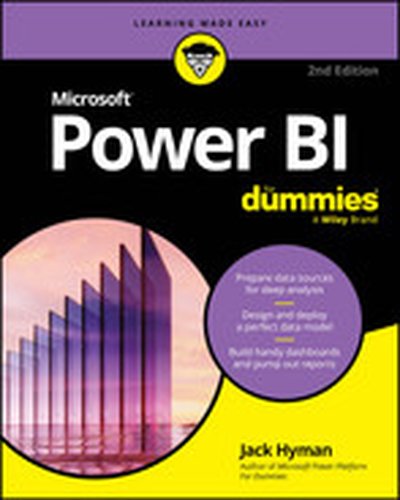
Microsoft Power BI For Dummies, 2nd Edition

Make smarter business decisions with Microsoft PowerBI Microsoft PowerBI For Dummies gives you the foundation you need to use this powerful software platform to manage your data and gather insight for making better decisions. With PowerBI, you can visualize, model, and interpret large datasets, quickly revealing insights that once took weeks to dig out. This book takes you through the basics of getting your data ready, preparing your analysis, and creating reports. Then, you'll dig into more advanced features using DAX—the PowerBI programming language—even if you have no prior programming experience. This edition covers the latest updates to the software, including AI integration, enhanced customization, and improved real-time collaboration tools. Transform raw data into meaningful information and make data-driven decisions Import datasets and create dashboards, visualizations, and reports Use the Copilot AI assistant to speed up workflows and simplify tasks Integrate PowerBI with other Microsoft services like Excel and Azure Businesses of all sizes can use PowerBI to manage their data. With Microsoft PowerBI For Dummies, you can quickly and easily set up PowerBI, learn the fundamentals, and handle complex reporting.

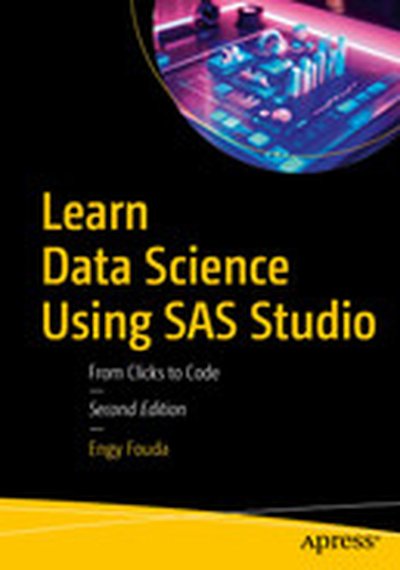
Learn Data Science Using SAS Studio : From Clicks to Code

Do you want to create data analysis reports without writing a line of code? This book introduces SAS Studio, a free, web-based data science product for educational and non-commercial purposes. The power of SAS Studio lies in its visual, point-and-click user interface, which generates SAS code. It is easier to learn SAS Studio than to learn R and Python to accomplish data cleaning, statistics, and visualization tasks. The book includes a case study analyzing the data required to predict the results of presidential elections in the state of Maine for 2016 and 2020. In addition to the presidential elections, the book provides real-life examples, including analyses of stock, oil, and gold prices, crime, marketing, and healthcare. You will see data science in action and how easily it can be performed using complicated tasks and visualizations in SAS Studio. You will learn, step by step, how to perform visualizations, including creating maps. In most cases, you will not need a line of code as you work with the SAS Studio graphical user interface. The book includes explanations of the code that SAS Studio generates automatically. You will learn how to edit this code to perform more complicated advanced tasks. What You Will Learn Become familiar with the SAS Studio IDE. How to create essential visualizations. Know the fundamental statistical analysis required in most data science and analytics reports. Clean the most common dataset problems Learn linear and logistic regression for data prediction and analysis. Write programs in SAS. How to analyze data and get insights from it for decision-making. Learn character, numeric, date, time, and datetime functions and typecasting. Who This Book Is For A general audience of people who are new to data science, students, and data analysts and scientists who are new to SAS. No prior programming or statistical knowledge is required.

The Data Flow Map: A Practical Guide to Clear and Creative Analytics in Any Data Environment

Unlock the secrets of practical data analysis with the Data Flow Map framework—a game-changing approach that transcends tools and platforms. This book isn’t just another programming manual; it’s a guide to thinking and communicating about data at a higher level. Whether you're working with spreadsheets, databases, or AI-driven models, you'll learn how to express your analytics in clear, common language that anyone can understand. In today’s data-rich world, clarity is the real challenge. Technical details often obscure insights that could drive real impact. The Data Flow Map framework simplifies complexity into three core motions: source, focus, and build. The first half of the book explores these concepts through illustrations and stories. The second half applies them to real-world datasets using tools like Excel, SQL, and Python, showing how the framework works across platforms and use cases. A vital resource for analysts at any level, this book offers a practical, tool-agnostic approach to data analysis. With hands-on examples and a universal mental model, you’ll gain the confidence to tackle any dataset, align your team, and deliver insights that matter. Whether you're a beginner or a seasoned pro, the Data Flow Map framework will transform how you approach data analytics. What You Will Learn Grasp essential elements applicable to every data analysis workflow Adapt quickly to any dataset, tool, or platform Master analytic thinking at a higher level Use analytics patterns to better understand the world Break complex analysis into manageable, repeatable steps Iterate faster to uncover deeper insights and better solutions Communicate findings clearly for better decision-making Who This Book Is For Aspiring data professionals and experienced analysts, from beginners to seasoned data engineers, focused on data collection, analysis, and decision making

Microsoft Power BI Step by Step

Are you ready to turn your data into powerful insights and make smarter business decisions? Microsoft Power BI Step by Step is your hands-on guide to mastering one of todays most in-demand business intelligence tools. Written by certified Power BI experts Nuric Ugarte and José Rafael Escalanteleaders in the Power BI community, with years of real-world consulting and teaching experiencethis book takes you from your very first steps in Power BI all the way to advanced data modeling, DAX calculations, and sharing interactive reports with your team. Whether youre a business analyst, data professional, Excel power user, or IT decision-maker, youll find clear, step-by-step instructions and practical exercises that make learning Power BI approachable and effective. Youll learn how to connect to a wide range of data sources, clean and transform your data, create stunning visualizations, and collaborate securely in the Power BI Service. Plus, youll discover how to use the latest features, including Copilot, to streamline your workflow and get answers faster. If you want to build your data skills, impress your organization, and unlock the full potential of Power BI, this is the book you need to get thereone step at a time.

Bioinformatics with Python Cookbook - Fourth Edition

Bioinformatics with Python Cookbook provides a practical, hands-on approach to solving computational biology challenges with Python, enabling readers to analyze sequencing data, leverage AI for bioinformatics applications, and design robust computational pipelines. What this Book will help me do Perform comprehensive sequence analysis using Python libraries for refined data interpretation. Configure and run bioinformatics workflows on cloud environments for scalable solutions. Apply advanced data science practices to analyze and visualize bioinformatics data. Explore the integration of AI tools in processing multimodal biological datasets. Understand and utilize bioinformatics databases for research and development. Author(s) Shane Brubaker is an experienced computational biologist and software developer with a strong background in bioinformatics and Python programming. With years of experience in data analysis and software engineering, Shane has authored numerous solutions for real-world bioinformatics issues. He brings a practical, example-driven teaching approach, aimed at empowering readers to apply techniques effectively in their work. Who is it for? This book is suitable for bioinformatics professionals, data scientists, and software engineers with moderate experience seeking to expand their computational biology knowledge. Readers should have basic understanding of biology, programming, and cloud tools. By engaging with this book, learners can advance their skills in Python and bioinformatics to address complex biological data challenges effectively.

The Definitive Guide to DAX: Mastering the semantic model expression language for Microsoft Power BI, Fabric, and Excel, 3rd Edition

Seasoned Experts Alberto Ferrari and Marco Russo Help You Master DAX for Superior Business Intelligence Solutions The Definitive Guide to DAX is an authoritative resource for mastering the DAX language, which is pivotal for creating measures for semantic models in Microsoft Power BI, Fabric, Analysis Services, and Excel. With years of experience since the inception of Power Pivot, the authors offer a comprehensive reference that navigates through the unique and complex concepts of DAX, making it an essential tool for BI professionals. This third edition updates you with the latest features and provides a framework for writing efficient DAX code, enhancing your ability to customize calculations in data models. You will gain the skills necessary to understand and apply advanced DAX concepts, structure code in user-defined functions, and leverage new calendars for time intelligence calculations. By reading this book, you will: Understand the foundational concepts of DAX and its unique language structure Master the use of evaluation contexts to enhance data analysis Utilize CALCULATE and CALCULATETABLE functions effectively Implement variables to simplify complex DAX expressions Leverage classic and new calendar based time intelligence functions Work with iterators to perform advanced calculations Apply visual calculations to improve report interactivity Create and manage calculation groups for dynamic reporting Handle complex hierarchies and relationships in data models Author DAX queries for testing and troubleshooting About This Book For BI professionals and Excel power users eager to deepen their understanding of DAX and enhance their data modeling capabilities with advanced techniques For data analysts and IT specialists seeking to optimize their use of Microsoft Power BI, Fabric, Analysis Services, and Excel for more efficient and insightful data analysis

Workflow Automation with Microsoft Power Automate - Third Edition

This book serves as a comprehensive guide to mastering Microsoft Power Automate, offering step-by-step instructions for creating and managing low-code workflows. From beginner to advanced techniques, it covers cloud and RPA functionalities, enhanced by AI features like Co-pilot. You'll gain the skills to build, analyze, and optimize powerful automations tailored to your organization's needs. What this Book will help me do Understand and implement workflows using Power Automate's connectors and triggers for seamless integration. Utilize AI Builder and the Co-pilot feature to design intelligent workflows with generative AI capabilities. Master robotic process automation to bridge digital and legacy systems effectively. Learn to monitor and troubleshoot workflows while ensuring security and compliance in automation. Scale and govern enterprise-level workflows with best practices for maintainability. Author(s) Aaron Guilmette is a seasoned expert in the field of workflow automation with extensive experience in the Microsoft ecosystem. As the author of multiple books on Power Automate, Aaron combines technical depth with practical know-how. He brings a hands-on approach to guiding readers through advanced features, making automation accessible and effective. Who is it for? This book is ideal for power users, information workers, and citizen developers looking to integrate automation into their work. Whether you're new to automation or expanding your skills, this book provides actionable insights. Familiarity with the Microsoft 365 platform is recommended but not required, as the book covers foundational as well as advanced topics. It is perfect for anyone aiming to streamline workflows and drive efficiency in their projects or organization.

Applied Time Series Analysis for the Social Sciences

EXPLORE THIS INDISPENSABLE AND COMPREHENSIVE GUIDE TO TIME SERIES ANALYSIS FOR STUDENTS AND PRACTITIONERS IN A WIDE VARIETY OF DISCIPLINES Applied Time Series Analysis for the Social Sciences: Specification, Estimation, and Inference delivers an accessible guide to time series analysis that includes both theory and practice. The coverage spans developments from ARIMA intervention models and generalized least squares to the London School of Economics (LSE) approach and vector autoregression. Designed to break difficult concepts into manageable pieces while offering plenty of examples and exercises, the author demonstrates the use of lag operator algebra throughout to provide a better understanding of dynamic specification and the connections between model specifications that appear to be more different than they are. The book is ideal for those with minimal mathematical experience, intended to follow a course in multiple regression, and includes exercises designed to build general skills such as mathematical expectation calculations to derive means and variances. Readers will also benefit from the inclusion of: A focus on social science applications and a mix of theory and detailed examples provided throughout An accompanying website with data sets and examples in Stata, SAS and R A simplified unit root testing strategy based on recent developments An examination of various uses and interpretations of lagged dependent variables and the common pitfalls students and researchers face in this area An introduction to LSE methodology such as the COMFAC critique, general-to-specific modeling, and the use of forecasting to evaluate and test models Perfect for students and professional researchers in the political sciences, public policy, sociology, and economics, Applied Time Series Analysis for the Social Sciences: Specification, Estimation, and Inference will also earn a place in the libraries of post graduate students and researchers in public health, public administration and policy, and education.

Graph Theory for Computer Science

This book is a vital resource for anyone looking to understand the essential role of graph theory as the unifying thread that connects and provides innovative solutions across a wide spectrum of modern computer science disciplines. Graph theory is a traditional mathematical discipline that has evolved as a basic tool for modeling and analyzing the complex relationships between different technological landscapes. Graph theory helps explain the semantic and syntactic relationships in natural language processing, a technology behind many businesses. Disciplinary and industry developments are seeing a major transition towards more interconnected and data-driven decision-making, and the application of graph theory will facilitate this transition. Disciplines such as parallel and distributive computing will gain insights into how graph theory can help with resource optimization and job scheduling, creating considerable change in the design and development of scalable systems. This book provides comprehensive coverage of how graph theory acts as the thread that connects different areas of computer science to create innovative solutions to modern technological problems. Using a multi-faceted approach, the book explores the fundamentals and role of graph theory in molding complex computational processes across a wide spectrum of computer science.

Practical Signals Theory with MATLAB Applications, 2nd Edition

A hands-on resource designed to teach the mathematics of signals and systems with MATLAB™ In this newly revised second edition of Practical Signals Theory with MATLAB™ Applications, Richard Tervo delivers an articulate presentation of the mathematics underlying real world engineering applications and everyday electronic devices. The new edition provides extended coverage of communication systems—including digital and spread spectrum communications—as well as a new introductory chapter on using MATLAB™ as a tool to visualize the mathematics of signals and systems. The text contains numerous hands-on examples and expanded end-of-chapter exercises. It is a one-stop reference for signals and systems, explaining aspects of commonplace signal types, orthogonality and signal decomposition, transformations, and the graphical presentation of calculations and results. Readers will also find: A solid introduction to the mathematics of continuous and discrete signals represented in time and frequency domains Thorough coverage of the classic Fourier, Laplace and z-transforms, and their many applications New end-of-chapter worked exercises, a variety of in-line study questions with answers and easily reproducible MATLAB™ code demonstrations Bonus material on related applications in different fields of study and a companion website designed to support additional learning Perfect for undergraduate and graduate students of signals and systems, signals theory, and related areas of electrical engineering, Practical Signals Theory with MATLAB™ Applications will also benefit researchers and professors in the field of system design and signal processing.

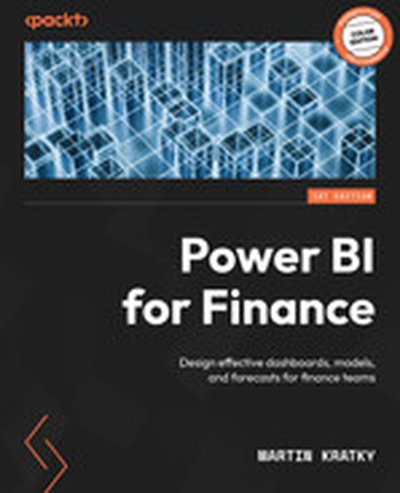
Power BI for Finance

Build effective data models and reports in Power BI for financial planning, budgeting, and valuations with practical templates, logic, and step-by-step guidance. Free with your book: DRM-free PDF version + access to Packt's next-gen Reader Key Features Engineer optimal star schema data models for financial planning and analysis Implement common financial logic, calendars, and variance calculations Create dynamic, formatted reports for income statements, balance sheets, and cash flow Purchase of the print or Kindle book includes a free PDF eBook Book Description Martin Kratky brings his global experience of over 20 years as co-founder of Managility and creator of Acterys to empower CFOs and accountants with Power BI for Finance through this hands-on guide to streamlining and enhancing financial processes. Starting with the foundation of every effective BI solution, a well-designed data model, the book shows you how to structure star schemas and integrate common financial data sources like ERP and accounting systems. You’ll then learn to implement key financial logic using DAX and M, covering calendars, KPIs, and variance calculations. The book offers practical advice on creating clear and compliant financial reports, such as income statements, balance sheets, and cash flows with visual design and formatting best practices. With dedicated chapters on advanced workflows, you’ll learn how to handle multi-currency setups, perform group consolidations, and implement planning models like rolling forecasts, annual budgets, and sales and operations planning (S&OP). As you advance, you’ll gain insights from real-world case studies covering company valuations, Excel integration, and the use of write-back methods with Dynamics Business Performance Planning and Acterys. The concluding chapters highlight how AI and Copilot enhance financial analytics. Email sign-up and proof of purchase required What you will learn Apply multi-currency handling and group consolidation techniques in Power BI Model discounted cash flow and company valuation scenarios Design and manage write-back workflows with Dynamics BPP and Acterys Integrate Excel and Power BI using live connections and cube formulas Utilize AI, Copilot, and LLMs to enhance automation and insight generation Create complete finance-focused dashboards for sales and operations planning Who this book is for This book is for finance professionals including CFOs, FP&A managers, controllers, and certified accountants who want to enhance reporting, planning, and forecasting using Power BI. Basic familiarity with Power BI and financial concepts is recommended to get the most out of this hands-on guide.

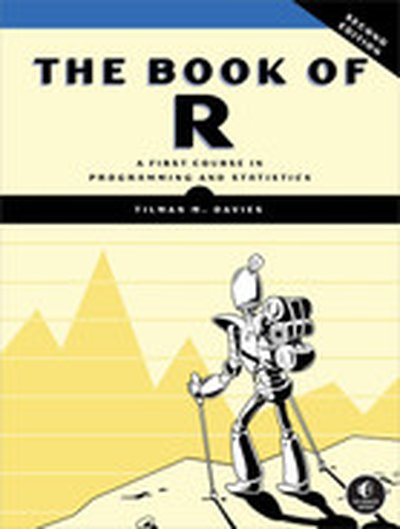
The Book of R, 2nd Edition

The Book of R is a comprehensive, beginner-friendly guide to R, the world’s most popular programming language for statistical analysis. Even if you have no programming experience and little more than a grounding in the basics of mathematics, you’ll find everything you need to begin writing programs in R. You’ll start with the basics, like how to handle data and write simple programs, before moving on to more advanced topics, like producing statistical summaries of your data and performing tests and modeling. You’ll even learn how to create impressive data visualizations with R’s graphics tools and contributed packages, like ggplot2, ggvis, and rgl. Dozens of hands-on exercises take you from theory to practice as you learn: The fundamentals of programming in R, including how to write data frames, create functions, and use variables, statements, and loops Statistical concepts like exploratory data analysis, probabilities, hypothesis tests, and regression modeling and how to execute them in R How to access R’s thousands of functions, libraries, and datasets How to draw valid and useful conclusions from your data and create publication-quality graphics of your results The Book of R brings both statistics and R to life. With clear explanations, practical examples, and hands-on exercises, this book opens the door to the evolving world of data analysis. New to this edition: The entire book has been revised and expanded, with nearly 100 pages of new content and exercises. You’ll find greater coverage of data plots and R graphics, guidance on using pipes to string together commands, and new ways to read and write external files, among many other lessons.

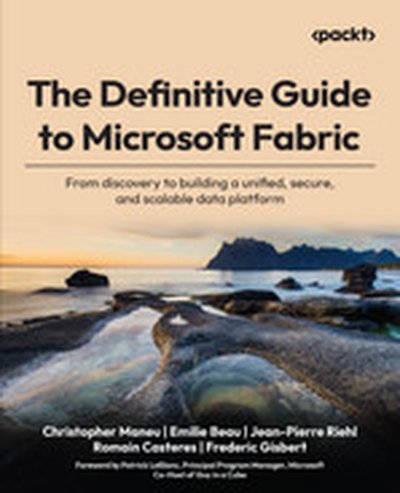
The Definitive Guide to Microsoft Fabric

Master Microsoft Fabric from basics to advanced architectures with expert guidance to unify, secure, and scale analytics on real-world data platforms Key Features Build a complete data analytics platform with Microsoft Fabric Apply proven architectures, governance, and security strategies Gain real-world insights from five seasoned data experts Purchase of the print or Kindle book includes a free PDF eBook Book Description Microsoft Fabric is reshaping how organizations manage, analyze, and act on data by unifying ingestion, storage, transformation, analytics, AI, and visualization in a single platform. The Definitive Guide to Microsoft Fabric takes you from your very first workspace to building a secure, scalable, and future-proof analytics environment. You’ll learn how to unify data in OneLake, design data meshes, transform and model data, implement real-time analytics, and integrate AI capabilities. The book also covers advanced topics, such as governance, security, cost optimization, and team collaboration using DevOps and DataOps principles. Drawing on the real-world expertise of five seasoned professionals who have built and advised on platforms for startups, SMEs, and Europe’s largest enterprises, this book blends strategic insight with practical guidance. By the end of this book, you’ll have gained the knowledge and skills to design, deploy, and operate a Microsoft Fabric platform that delivers sustainable business value. What you will learn Understand Microsoft Fabric architecture and concepts Unify data storage and data governance with OneLake Ingest and transform data using multiple Fabric tools Implement real-time analytics and event processing Design effective semantic models and reports Integrate AI and machine learning into data workflows Apply governance, security, and compliance controls Optimize performance and costs at scale Who this book is for This book is for data engineers, analytics engineers, architects, and data analysts moving into platform design roles. It’s also valuable for technical leaders seeking to unify analytics in their organizations. You’ll need only a basic grasp of databases, SQL, and Python.

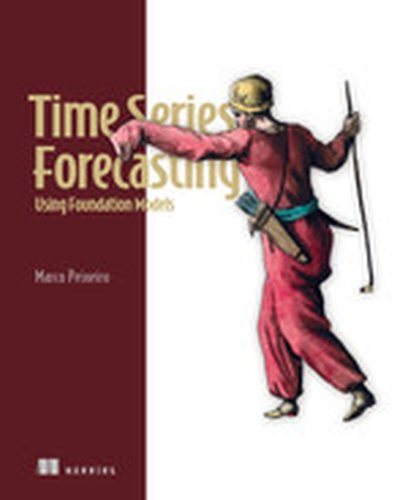
Time Series Forecasting Using Foundation Models

Make accurate time series predictions with powerful pretrained foundation models! You don’t need to spend weeks—or even months—coding and training your own models for time series forecasting. Time Series Forecasting Using Foundation Models shows you how to make accurate predictions using flexible pretrained models. In Time Series Forecasting Using Foundation Models you will discover: The inner workings of large time models Zero-shot forecasting on custom datasets Fine-tuning foundation forecasting models Evaluating large time models Time Series Forecasting Using Foundation Models teaches you how to do efficient forecasting using powerful time series models that have already been pretrained on billions of data points. You’ll appreciate the hands-on examples that show you what you can accomplish with these amazing models. Along the way, you’ll learn how time series foundation models work, how to fine-tune them, and how to use them with your own data. About the Technology Time-series forecasting is the art of analyzing historical, time-stamped data to predict future outcomes. Foundational time series models like TimeGPT and Chronos, pre-trained on billions of data points, can now effectively augment or replace painstakingly-built custom time-series models. About the Book Time Series Forecasting Using Foundation Models explores the architecture of large time models and shows you how to use them to generate fast, accurate predictions. You’ll learn to fine-tune time models on your own data, execute zero-shot probabilistic forecasting, point forecasting, and more. You’ll even find out how to reprogram an LLM into a time series forecaster—all following examples that will run on an ordinary laptop. What's Inside How large time models work Zero-shot forecasting on custom datasets Fine-tuning and evaluating foundation models About the Reader For data scientists and machine learning engineers familiar with the basics of time series forecasting theory. Examples in Python. About the Author Marco Peixeiro builds cutting-edge open-source forecasting Python libraries at Nixtla. He is the author of Time Series Forecasting in Python. Quotes Clear and hands-on, featuring both theory and easy-to-follow examples. - Eryk Lewinson, Author of Python for Finance Cookbook Bridges the gap between classical forecasting methods and the new developments in the foundational models. A fantastic resource. - Juan Orduz, PyMC Labs A foundational guide to forecasting’s next chapter. - Tyler Blume, daybreak An immensely practical introduction to forecasting using foundation models. - Stephan Kolassa, SAP Switzerland