talk-data.com talk-data.com

Event

O'Reilly Data Science Books

2013-08-09 – 2026-02-25 Oreilly Visit website ↗

Activities tracked

170

Collection of O'Reilly books on Data Science.

Filtering by: DataViz ×

Sessions & talks

Showing 1–25 of 170 · Newest first

Search within this event →
Learn D3.js - Second Edition

Master data visualization with D3.js v7 using modern web standards and real-world projects to build interactive charts, maps, and visual narratives Key Features Build dynamic, data-driven visualizations using D3.js v7 and ES2015+ Create bar, scatter, and network charts, geographic maps, and more Learn through step-by-step tutorials backed by hundreds of downloadable examples Purchase of the print or Kindle book includes a free PDF eBook Book Description Learn D3.js, Second Edition, is a fully updated guide to building interactive, standards-compliant web visualizations using D3.js v7 and modern JavaScript. Whether you're a developer, designer, data journalist, or analyst, this book will help you master the core techniques for transforming data into compelling, meaningful visuals. Starting with fundamentals like selections, data binding, and SVG, the book progressively covers scales, axes, animations, hierarchical data, and geographical maps. Each chapter includes short examples and a full hands-on project with downloadable code you can run, modify, and use in your own work. This new edition introduces improved chapter structure, updated code samples using ES2015 standards, and better formatting for readability. There’s also a dedicated chapter that focuses on integrating D3 with modern frameworks like React and Vue, along with performance, accessibility, and deployment strategies. For those migrating from older versions of D3, a detailed appendix is included at the end. With thoughtful pedagogy and a practical approach, this book remains one of the most thorough and respected resources for learning D3.js and help you truly leverage data visualisation. What you will learn Bind data to DOM elements and apply transitions and styles Build bar, line, pie, scatter, tree, and network charts Create animated, interactive behaviours with zoom, drag, and tooltips Visualize hierarchical data, flows, and maps using D3 layouts and projections Use D3 with HTML5 Canvas for high-performance rendering Develop accessible and responsive D3 apps for all screen sizes Integrate D3 with frameworks like React and Vue Migrate older D3 codebases to version 7 Who this book is for This book is for web developers, data journalists, designers, analysts, and anyone who wants to create interactive, web-based data visualizations. A basic understanding of HTML, CSS, and JavaScript is recommended. No prior knowledge of SVG or D3 is required.
CompTIA Data+ Study Guide, 2nd Edition

Prepare for the CompTIA Data+ exam, as well as a new career in data science, with this effective study guide In the newly revised second edition of CompTIA Data+ Study Guide: Exam DA0-002, veteran IT professionals Mike Chapple and Sharif Nijim provide a powerful, one-stop resource for anyone planning to pursue the CompTIA Data+ certification and go on to an exciting new career in data science. The authors walk you through the info you need to succeed on the exam and in your first day at a data science-focused job. Complete with two online practice tests, this book comprehensively covers every objective tested by the updated DA0-002 exam, including databases and data acquisition, data quality, data analysis and statistics, data visualization, and data governance. You'll also find: Efficient and comprehensive content, helping you get up-to-speed as quickly as possible Bite-size chapters that break down essential topics into manageable and accessible lessons Complimentary access to Sybex' famous online learning environment, with practice questions, a complete glossary of common industry terminology, hundreds of flashcards, and more A practical and hands-on pathway to the CompTIA Data+ certification, as well as a new career in data science, the CompTIA Data+ Study Guide, Second Edition, offers the foundational knowledge, skills, and abilities you need to get started in an exciting and rewarding new career.

Learn Microsoft Power BI - Third Edition

This comprehensive guide provides the perfect introduction to Microsoft Power BI, offering practical examples to help you learn the key tools and concepts of data visualization and analytics. By exploring real-world use cases, you'll gain the skills necessary to manage data, build interactive dashboards, and unlock valuable business insights. What this Book will help me do Learn the fundamentals of Power BI and business intelligence. Understand advanced features like Microsoft Fabric and Copilot. Transform raw data into meaningful visualizations and reports. Design professional dashboards to convey data insights clearly. Deploy and share reports effectively within your organization. Author(s) Greg Deckler is a recognized authority in Microsoft Power BI, holding the title of a 7-time Microsoft MVP. With extensive experience in business intelligence, Greg is known for his ability to distill complex concepts into clear and practical advice. His approachable teaching style makes technical learning accessible and engaging. Who is it for? This book is ideal for aspiring data analysts or IT professionals looking to gain a solid foundation in Power BI. Beginners with no prior experience in Power BI or business intelligence will find it especially useful. It's also suitable for professionals transitioning from other BI tools. Whether you're looking to enhance your current career or start a new one, this book is for you.

Learning Tableau 2025 - Sixth Edition

"Learning Tableau 2025" provides a comprehensive guide to mastering Tableau's latest features, including advanced AI capabilities like Tableau Pulse and Agent. This book, authored by Tableau expert Joshua N. Milligan, will equip you with the tools to transform complex data into actionable insights and interactive dashboards. What this Book will help me do Learn to use Tableau's advanced AI features, including Tableau Agent and Pulse, to streamline data analysis and automate insights. Develop skills to create and customize dynamic dashboards tailored to interactive data storytelling. Understand and utilize new geospatial functions within Tableau for advanced mapping and analytics. Master Tableau Prep's enhanced data preparation capabilities for efficient data modeling and structuring. Learn to effectively integrate and analyze data from multiple sources, enhancing your ability to extract meaningful insights. Author(s) Joshua N. Milligan, a Tableau Zen Master and Visionary, has years of experience in the field of data visualization and analytics. With a hands-on approach, Joshua combines his expertise and passion for Tableau to make complex topics accessible and engaging. His teaching method ensures that readers gain practical, actionable knowledge. Who is it for? This book is ideal for aspiring business intelligence developers, data analysts, data scientists, and professionals seeking to enhance their data visualization skills. It's suitable for both beginners looking to get started with Tableau and experienced users eager to explore its new features. A Tableau license or access to a 14-day trial is recommended.

From Chaos to Clarity

A radical wake up call for world overloaded with data and how data visualisation could be the answer In From Chaos to Clarity: How Data Visualisation Can Save the World, celebrated data visualisation creator James Eagle reveals how our data-saturated age harbours hidden dangers that places humanity in peril. He looks at how masterful visual storytelling might be our salvation. Through vivid examples and profound insights, James Eagle exposes the data pollution clouding modern life, whilst demonstrating how thoughtful, human-centred data visuals can cut through the noise, sharpen our collective understanding and light the path toward a more discerning future. Inside the book: How to unlock the human side of data visualisation by using empathy and storytelling Understanding our brain's deep connection to pictures and stories, and why this matters in this digital age Ways data visualisation can restore our human understanding of this world and tackle misinformation This is a must-read urgent message on how data visualisation is needed to confront data overload and misuse. From Chaos to Clarity is perfect for professionals in finance, engineering, science, mathematics and health, as well as journalists, writers, data scientists, and anyone interested in visual storytelling, reclaiming truth and sharpening our collective thinking to tackling some of the biggest challenges we face in this world.

Tableau Cookbook for Experienced Professionals

This book takes an advanced dive into using Tableau for professional data visualization and analytics. You will learn techniques for crafting highly interactive dashboards, optimizing their performance, and leveraging Tableau's APIs and server features. With a focus on real-world applications, this resource serves as a guide for professionals aiming to master advanced Tableau skills. What this Book will help me do Build robust, high-performing Tableau data models for enterprise analytics. Use advanced geospatial techniques to create dynamic, data-rich mapping visualizations. Leverage APIs and developer tools to integrate Tableau with other platforms. Optimize Tableau dashboards for performance and interactivity. Apply best practices for content management and data security in Tableau implementations. Author(s) Pablo Sáenz de Tejada and Daria Kirilenko are seasoned Tableau experts with vast professional experience in implementing advanced analytics solutions. Pablo specializes in enterprise-level dashboard design and has trained numerous professionals globally. Daria focuses on integrating Tableau into complex data ecosystems, bringing a practical and innovative approach to analytics. Who is it for? This book is tailored for professionals such as Tableau developers, data analysts, and BI consultants who already have a foundational knowledge of Tableau. It is ideal for those seeking to deepen their skills and gain expertise in tackling advanced data visualization challenges. Whether you work in corporate analytics or enjoy exploring data in your own projects, this book will enhance your Tableau proficiency.

Think Stats, 3rd Edition

If you know how to program, you have the skills to turn data into knowledge. This thoroughly revised edition presents statistical concepts computationally, rather than mathematically, using programs written in Python. Through practical examples and exercises based on real-world datasets, you'll learn the entire process of exploratory data analysis—from wrangling data and generating statistics to identifying patterns and testing hypotheses. Whether you're a data scientist, software engineer, or data enthusiast, you'll get up to speed on commonly used tools including NumPy, SciPy, and Pandas. You'll explore distributions, relationships between variables, visualization, and many other concepts. And all chapters are available as Jupyter notebooks, so you can read the text, run the code, and work on exercises all in one place. Analyze data distributions and visualize patterns using Python libraries Improve predictions and insights with regression models Dive into specialized topics like time series analysis and survival analysis Integrate statistical techniques and tools for validation, inference, and more Communicate findings with effective data visualization Troubleshoot common data analysis challenges Boost reproducibility and collaboration in data analysis projects with interactive notebooks

Data Insight Foundations: Step-by-Step Data Analysis with R

This book is an essential guide designed to equip you with the vital tools and knowledge needed to excel in data science. Master the end-to-end process of data collection, processing, validation, and imputation using R, and understand fundamental theories to achieve transparency with literate programming, renv, and Git--and much more. Each chapter is concise and focused, rendering complex topics accessible and easy to understand. Data Insight Foundations caters to a diverse audience, including web developers, mathematicians, data analysts, and economists, and its flexible structure allows enables you to explore chapters in sequence or navigate directly to the topics most relevant to you. While examples are primarily in R, a basic understanding of the language is advantageous but not essential. Many chapters, especially those focusing on theory, require no programming knowledge at all. Dive in and discover how to manipulate data, ensure reproducibility, conduct thorough literature reviews, collect data effectively, and present your findings with clarity. What You Will Learn Data Management: Master the end-to-end process of data collection, processing, validation, and imputation using R. Reproducible Research: Understand fundamental theories and achieve transparency with literate programming, renv, and Git. Academic Writing: Conduct scientific literature reviews and write structured papers and reports with Quarto. Survey Design: Design well-structured surveys and manage data collection effectively. Data Visualization: Understand data visualization theory and create well-designed and captivating graphics using ggplot2. Who this Book is For Career professionals such as research and data analysts transitioning from academia to a professional setting where production quality significantly impacts career progression. Some familiarity with data analytics processes and an interest in learning R or Python are ideal.

Just Enough Data Science and Machine Learning: Essential Tools and Techniques

An accessible introduction to applied data science and machine learning, with minimal math and code required to master the foundational and technical aspects of data science. In Just Enough Data Science and Machine Learning, authors Mark Levene and Martyn Harris present a comprehensive and accessible introduction to data science. It allows the readers to develop an intuition behind the methods adopted in both data science and machine learning, which is the algorithmic component of data science involving the discovery of patterns from input data. This book looks at data science from an applied perspective, where emphasis is placed on the algorithmic aspects of data science and on the fundamental statistical concepts necessary to understand the subject. The book begins by exploring the nature of data science and its origins in basic statistics. The authors then guide readers through the essential steps of data science, starting with exploratory data analysis using visualisation tools. They explain the process of forming hypotheses, building statistical models, and utilising algorithmic methods to discover patterns in the data. Finally, the authors discuss general issues and preliminary concepts that are needed to understand machine learning, which is central to the discipline of data science. The book is packed with practical examples and real-world data sets throughout to reinforce the concepts. All examples are supported by Python code external to the reading material to keep the book timeless. Notable features of this book: Clear explanations of fundamental statistical notions and concepts Coverage of various types of data and techniques for analysis In-depth exploration of popular machine learning tools and methods Insight into specific data science topics, such as social networks and sentiment analysis Practical examples and case studies for real-world application Recommended further reading for deeper exploration of specific topics. ....

Data Storytelling with Altair and AI

Great data presentations tell a story. Learn how to organize, visualize, and present data using Python, generative AI, and the cutting-edge Altair data visualization toolkit. Take the fast track to amazing data presentations! Data Storytelling with Altair and AI introduces a stack of useful tools and tried-and-tested methodologies that will rapidly increase your productivity, streamline the visualization process, and leave your audience inspired. In Data Storytelling with Altair and AI you’ll discover: Using Python Altair for data visualization Using Generative AI tools for data storytelling The main concepts of data storytelling Building data stories with the DIKW pyramid approach Transforming raw data into a data story Data Storytelling with Altair and AI teaches you how to turn raw data into effective, insightful data stories. You’ll learn exactly what goes into an effective data story, then combine your Python data skills with the Altair library and AI tools to rapidly create amazing visualizations. Your bosses and decision-makers will love your new presentations—and you’ll love how quick Generative AI makes the whole process! About the Technology Every dataset tells a story. After you’ve cleaned, crunched, and organized the raw data, it’s your job to share its story in a way that connects with your audience. Python’s Altair data visualization library, combined with generative AI tools like Copilot and ChatGPT, provide an amazing toolbox for transforming numbers, code, text, and graphics into intuitive data presentations. About the Book Data Storytelling with Altair and AI teaches you how to build enhanced data visualizations using these tools. The book uses hands-on examples to build powerful narratives that can inform, inspire, and motivate. It covers the Altair data visualization library, along with AI techniques like generating text with ChatGPT, creating images with DALL-E, and Python coding with Copilot. You’ll learn by practicing with each interesting data story, from tourist arrivals in Portugal to population growth in the USA to fake news, salmon aquaculture, and more. What's Inside The Data-Information-Knowledge-Wisdom (DIKW) pyramid Publish data stories using Streamlit, Tableau, and Comet Vega and Vega-Lite visualization grammar About the Reader For data analysts and data scientists experienced with Python. No previous knowledge of Altair or Generative AI required. About the Author Angelica Lo Duca is a researcher at the Institute of Informatics and Telematics of the National Research Council, Italy. The technical editor on this book was Ninoslav Cerkez. Quotes This book’s step-by-step approach, illustrated through real-world examples, makes complex data accessible and actionable. - Alexey Grigorev, DataTalks.Club A clear and concise guide to data storytelling. Highly recommended. - Andrew Madson, Insights x Design Data storytelling in a way that anyone can do! This book feels ahead of its time. - Avery Smith, Data Career Jumpstart Excellent hands-on exercises that combine two of my favorite tools: AI and the Altair library. - Jose Berengueres, Author of DataViz and Storytelling

D3.js in Action, Third Edition

Create stunning web-based data visualizations with D3.js. This totally-revised new edition of D3.js in Action guides you from simple charts to powerful interactive graphics. Chapter-by-chapter you’ll assemble an impressive portfolio of visualizations—including intricate networks, maps, and even a complete customized visualization layout. Plus, you'll learn best practices for building interactive graphics, animations, and integrating your work into frontend development frameworks like React and Svelte. In D3.js in Action, Third Edition you will learn how to: Set up a local development environment for D3 Include D3 in web development projects, including Node-based web apps Select and append DOM elements Size and position elements on screen Assemble components and layouts into creative data visualizations D3.js in Action, Third Edition has been extensively revised for D3.js version 7, and modern best practices for web visualizations. Its brand new chapters dive into interactive visualizations, cover responsiveness for dataviz, and show you how you can improve accessibility. About the Technology With D3.js, you can create sophisticated infographics, charts, and interactive data visualizations using standard frontend tools like JavaScript, HTML, and CSS. Granting D3 its VIS Test of Time award, the IEEE credited this powerful library for bringing data visualization to the mainstream. You’ll be blown away by how beautiful your results can be! About the Book D3.js in Action, Third Edition is a roadmap for creating brilliant and beautiful visualizations with D3.js. Like a gentle mentor, it guides you from basic charts all the way to advanced interactive visualizations like networks and maps. You’ll learn to build graphics, create animations, and set up mobile-friendly responsiveness. Each chapter contains a complete data visualization project to put your new skills into action. What's Inside Fully revised for D3.js v7 Includes 12 complete projects Create data visualizations with SVG and canvas Combine D3 with React, Svelte, and Angular About the Reader For web developers with HTML, CSS, and JavaScript skills. About the Authors Elijah Meeks was a data visualization pioneer at Stanford and the first Senior Data Visualization Engineer at Netflix. Anne-Marie Dufour is a Data Visualization Engineer. The technical editor on this book was Jon Borgman. Quotes Guides readers through the intricate world of D3 with clarity and practical insight. Whether you’re a seasoned expert or just starting, this book will be invaluable. - Connor Rothschild, Data Visualization Engineer, Moksha Data Studio Amazing job of explaining the core concepts of D3 while providing all you need to learn other fundamental concepts. - Lindsey Poulter, Visualization Engineer, New York Mets A navigation tool to explore all possible paths in the world of D3. Clear schematics and nicely selected examples guide the readers through D3’s possibilities. - Matthias Stahl, Head Data & Visualizations, Der SPIEGEL

Financial Data Science with SAS

Explore financial data science using SAS. Financial Data Science with SAS provides readers with a comprehensive explanation of the theoretical and practical implementation of the various types of analytical techniques and quantitative tools that are used in the financial services industry. This book shows readers how to implement data visualization, simulation, statistical predictive models, machine learning models, and financial optimizations using real-world examples in the SAS Analytics environment. Each chapter ends with practice exercises that include use case scenarios to allow readers to test their knowledge. Designed for university students and financial professionals interested in boosting their data science skills, Financial Data Science with SAS is an essential reference guide for understanding how data science is used in the financial services industry and for learning how to use SAS to solve complex business problems.

Visual Analytics for Dashboards: A Step-by-Step Guide to Principles and Practical Techniques

This book covers the key principles, best practices, and practical techniques for designing and implementing visually compelling dashboards. It explores the various stages of the dashboard development process, from understanding user needs and defining goals, to selecting appropriate visual encodings, designing effective layouts, and employing interactive elements. It also addresses the critical aspect of data storytelling, examining how narratives and context can be woven into dashboards to deliver impactful insights and engage audiences. Visual Analytics for Dashboards is designed to cater to a wide range of readers, from beginners looking to grasp the fundamentals of visual analytics, to seasoned professionals seeking to enhance their dashboard design skills. For different types of readers, such as a data analyst, BI professional, data scientist, or simply someone interested in data visualization, this book aims to equip them with the knowledge and tools necessary to create impactful dashboards. What you’ll learn The principles of data visualization How to create effective dashboards Meet all the requirements for visual analytics/data visualization/dashboard courses Deepen understanding of data presentation and analysis How to use different kinds of tools for data analysis, such as scorecards and key performance indicators Who This Book Is For Business analysts, data analysts, BI professionals, end-users, executives, developers, as well as students in dashboards, data visualizations, and visual analytics courses.

Visualize This, 2nd Edition

One of the most influential data visualization books—updated with new techniques, technologies, and examples Visualize This demonstrates how to explain data visually, so that you can present and communicate information in a way that is appealing and easy to understand. Today, there is a continuous flow of data available to answer almost any question. Thoughtful charts, maps, and analysis can help us make sense of this data. But the data does not speak for itself. As leading data expert Nathan Yau explains in this book, graphics provide little value unless they are built upon a firm understanding of the data behind them. Visualize This teaches you a data-first approach from a practical point of view. You'll start by exploring what your data has to say, and then you'll design visualizations that are both remarkable and meaningful. With this book, you'll discover what tools are available to you without becoming overwhelmed with options. You'll be exposed to a variety of software and code and jump right into real-world datasets so that you can learn visualization by doing. You'll learn to ask and answer questions with data, so that you can make charts that are both beautiful and useful. Visualize This also provides you with opportunities to apply what you learn to your own data. This completely updated, full-color second edition: Presents a unique approach to visualizing and telling stories with data, from data visualization expert Nathan Yau Offers step-by-step tutorials and practical design tips for creating statistical graphics, geographical maps, and information design Details tools that can be used to visualize data graphics for reports, presentations, and stories, for the web or for print, with major updates for the latest R packages, Python libraries, JavaScript libraries, illustration software, and point-and-click applications Contains numerous examples and descriptions of patterns and outliers and explains how to show them Information designers, analysts, journalists, statisticians, data scientists—as well as anyone studying for careers in these fields—will gain a valuable background in the concepts and techniques of data visualization, thanks to this legendary book.

Programming in MATLAB ®: A Problem-Solving Approach by Pearson

MATLAB provides an interactive programming interface for numerical computation and data visualization making it the default framework used for analysis, design and research in many domains of science and industry. Programming in MATLAB is intended as an aid to engineers and scientists with no prior programming expertise. The book focuses on the systematic development of practical programming skills through MATLAB language constructs, backed by several well-designed examples and exercises. Designed to be as much a MATLAB reference tool for researchers in varied fields as it is a guide for undergraduate readers, the book builds on the concepts sequentially as it progresses through the chapters. Each chapter is complete, independent of the book's remaining contents. Thus, for teaching purposes, one can suitably the relevant portions.

About The Authors –

Ramnarayan Patel did his Ph.D. in the area of power systems from Indian Institute of Technology Delhi, in 2003. He received his M.Tech. from IIT Delhi and a graduate degree in electrical engineering from SGSITS, Indore. His manifold fields of interest include power system stability, optimization in electric power systems, application of artificial intelligence techniques, design of intelligent controllers and renewable energy systems. He has over 14 years of hands-on experience working with MATLAB and Simulink, as an instructor, researcher and trainer.

Dr Patel has served as faculty in the electrical engineering department at IIT Roorkee and at the Birla Institute of Technology and Science, Pilani. Currently, he is Professorin the Department of Electrical and Electronics Engineering, Shri Shankaracharya Technical Campus (SSGI), Bhilai, and has many publications to his credit in various international journals of repute. He has presented his research at various international conferences and organized many workshops and conferences within the country. He is a recipient of the prestigious ‘Career Award for Young Teachers’ from All India Council for Technical Education (AICTE), New Delhi. Dr Patel has successfully handled many research projects funded by AICTE, New Delhi, and Department of Science and Technology, Government of India, New Delhi.

Ankush Mittal received his B.Tech. in computer science and engineering from Indian Institute of Technology Delhi in 1996, and later, his Master’s degree in 1998 from the same institute. He received his Ph.D. degree in electrical and computer engineering from the National University of Singapore in 2001 and was a faculty member in the Department of Computer Science, National University of Singapore, for two years. He has also served as Associate Professor at IIT Roorkee. Currently, he is Director (Research) at Graphic Era University, Dehradun.

Dr Mittal has contributed more than 250 research papers in journals and conferences of high repute with significant impact in academic circles. A dedicated teacher and active researcher, he is a recipient of the IIT Roorkee Outstanding Teacher Award and the IBM Faculty Award. He has taught more than 20 courses and worked on MATLAB extensively since his Ph.D.

Book Contents –

  1. Introduction to MATLAB® Desktop
  2. Matrix Operations and Applications
  3. MATLAB® Graphics and Plotting
  4. Control Structures, Loops, and File Handling
  5. Scripts and Functions
  6. Numerical Methods, Calculus, and Statistics
  7. Using Memory Efficiently
  8. Using the MATLAB® Debugger and Profiler
  9. Efficient Coding Using Vectorization Technique
  10. Precision and Errors
  11. Advanced Concepts in MATLAB®
  12. Modeling with Simulink®
  13. Digital Image Processing Index
Learn Grafana 10.x - Second Edition

Learn Grafana 10.x is your essential guide to mastering the art of data visualization and monitoring through interactive dashboards. Whether you're starting from scratch or updating your knowledge to Grafana 10.x, this book walks you through installation, implementation, data transformation, and effective visualization techniques. What this Book will help me do Install and configure Grafana 10.x for real-time data visualization and analytics. Create and manage insightful dashboards with Grafana's enhanced features. Integrate Grafana with diverse data sources such as Prometheus, InfluxDB, and Elasticsearch. Set up dynamic templated dashboards and alerting systems for proactive monitoring. Implement Grafana's user authentication mechanisms for enhanced security. Author(s) None Salituro is a seasoned expert in data analytics and observability platforms with extensive experience working with time-series data using Grafana. Their practical teaching approach and passion for sharing insights make this book an invaluable resource for both newcomers and experienced users. Who is it for? This book is perfect for business analysts, data visualization enthusiasts, and developers interested in analyzing and monitoring time-series data. Whether you're a newcomer or have some background knowledge, this book offers accessible guidance and advanced tips suitable for all levels. If you're aiming to efficiently build and utilize Grafana dashboards, this is the book for you.

Google Cloud Platform for Data Science: A Crash Course on Big Data, Machine Learning, and Data Analytics Services

This book is your practical and comprehensive guide to learning Google Cloud Platform (GCP) for data science, using only the free tier services offered by the platform. Data science and machine learning are increasingly becoming critical to businesses of all sizes, and the cloud provides a powerful platform for these applications. GCP offers a range of data science services that can be used to store, process, and analyze large datasets, and train and deploy machine learning models. The book is organized into seven chapters covering various topics such as GCP account setup, Google Colaboratory, Big Data and Machine Learning, Data Visualization and Business Intelligence, Data Processing and Transformation, Data Analytics and Storage, and Advanced Topics. Each chapter provides step-by-step instructions and examples illustrating how to use GCP services for data science and big data projects. Readers will learn how to set up a Google Colaboratory account and run Jupyternotebooks, access GCP services and data from Colaboratory, use BigQuery for data analytics, and deploy machine learning models using Vertex AI. The book also covers how to visualize data using Looker Data Studio, run data processing pipelines using Google Cloud Dataflow and Dataprep, and store data using Google Cloud Storage and SQL. What You Will Learn Set up a GCP account and project Explore BigQuery and its use cases, including machine learning Understand Google Cloud AI Platform and its capabilities Use Vertex AI for training and deploying machine learning models Explore Google Cloud Dataproc and its use cases for big data processing Create and share data visualizations and reports with Looker Data Studio Explore Google Cloud Dataflow and its use cases for batch and stream data processing Run data processing pipelines on Cloud Dataflow Explore Google Cloud Storageand its use cases for data storage Get an introduction to Google Cloud SQL and its use cases for relational databases Get an introduction to Google Cloud Pub/Sub and its use cases for real-time data streaming Who This Book Is For Data scientists, machine learning engineers, and analysts who want to learn how to use Google Cloud Platform (GCP) for their data science and big data projects

R Bioinformatics Cookbook - Second Edition

R Bioinformatics Cookbook is your guide to leveraging the power of R for advanced bioinformatics tasks. This updated second edition uses a recipe-based method to teach data analysis, visualization, and machine learning tailored for biological datasets. You'll gain hands-on experience with popular tools like Bioconductor, ggplot2, and tidyverse to solve real-world genomics problems. What this Book will help me do Set up a reproducible bioinformatics analysis environment using R. Clean, analyze, and visualize biological data with R's powerful packages. Apply RNA-seq and ChIP-seq workflows to study genetic information effectively. Incorporate machine learning techniques into bioinformatics pipelines using R. Automate tasks and create professional-grade reports using functional programming and reporting tools. Author(s) The author, None MacLean, brings years of expertise in bioinformatics and computational biology. Known for clear explanations and practical approaches, they ensure the material is accessible yet challenging. With a strong focus on real-world applications, this book reflects their commitment to bridging bioinformatics and modern data science. Who is it for? This book is perfect for bioinformaticians, researchers, and data scientists with prior R experience. It's tailored for those looking to delve deeper into genomics, data visualization, and bioinformatics techniques. Intermediate knowledge of bioinformatics concepts and familiarity with R programming are assumed for readers to fully benefit from the content.

Streamlit for Data Science - Second Edition

Streamlit for Data Science is your complete guide to mastering the creation of powerful, interactive data-driven applications using Python and Streamlit. With this comprehensive resource, you'll learn everything from foundational Streamlit skills to advanced techniques like integrating machine learning models and deploying apps to cloud platforms, enabling you to significantly enhance your data science toolkit. What this Book will help me do Master building interactive applications using Streamlit, including techniques for user interfaces and integrations. Develop visually appealing and functional data visualizations using Python libraries in Streamlit. Learn to integrate Streamlit applications with machine learning frameworks and tools like Hugging Face and OpenAI. Understand and apply best practices to deploy Streamlit apps to cloud platforms such as Streamlit Community Cloud and Heroku. Improve practical Python skills through implementing end-to-end data applications and prototyping data workflows. Author(s) Tyler Richards, the author of Streamlit for Data Science, is a senior data scientist with in-depth practical experience in building data-driven applications. With a passion for Python and data visualization, Tyler leverages his knowledge to help data professionals craft effective and compelling tools. His teaching approach combines clarity, hands-on exercises, and practical relevance. Who is it for? This book is written for data scientists, engineers, and enthusiasts who use Python and want to create dynamic data-driven applications. With a focus on those who have some familiarity with Python and libraries like Pandas or NumPy, it assists readers in building on their knowledge by offering tailored guidance. Perfect for those looking to prototype data projects or enhance their programming toolkit.

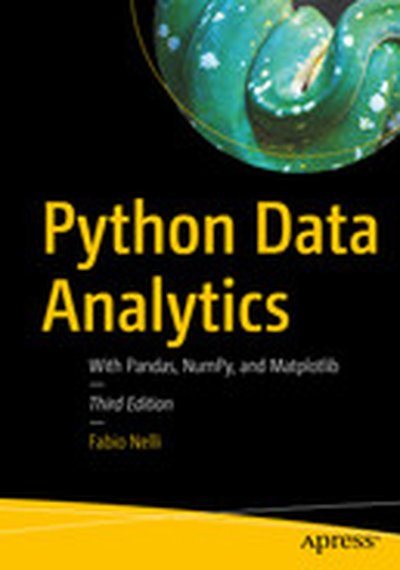
Python Data Analytics: With Pandas, NumPy, and Matplotlib

Explore the latest Python tools and techniques to help you tackle the world of data acquisition and analysis. You'll review scientific computing with NumPy, visualization with matplotlib, and machine learning with scikit-learn. This third edition is fully updated for the latest version of Python and its related libraries, and includes coverage of social media data analysis, image analysis with OpenCV, and deep learning libraries. Each chapter includes multiple examples demonstrating how to work with each library. At its heart lies the coverage of pandas, for high-performance, easy-to-use data structures and tools for data manipulation Author Fabio Nelli expertly demonstrates using Python for data processing, management, and information retrieval. Later chapters apply what you've learned to handwriting recognition and extending graphical capabilities with the JavaScript D3 library. Whether you are dealing with sales data, investment data, medical data, web page usage, or other data sets, Python Data Analytics, Third Edition is an invaluable reference with its examples of storing, accessing, and analyzing data. What You'll Learn Understand the core concepts of data analysis and the Python ecosystem Go in depth with pandas for reading, writing, and processing data Use tools and techniques for data visualization and image analysis Examine popular deep learning libraries Keras, Theano,TensorFlow, and PyTorch Who This Book Is For Experienced Python developers who need to learn about Pythonic tools for data analysis

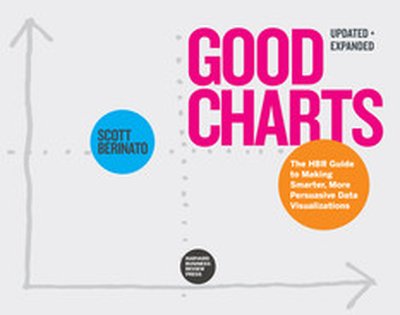
Good Charts, Updated and Expanded

The ultimate guide to data visualization and information design for business. Making good charts is a must-have skill for managers today. The vast amount of data that drives business isn't useful if you can't communicate the valuable ideas contained in that data—the threats, the opportunities, the hidden trends, the future possibilities. But many think that data visualization is too difficult—a specialist skill that's either the province of data scientists and complex software packages or the domain of professional designers and their visual creativity. Not so. Anyone can learn to produce quality "dataviz" and, more broadly, clear and effective information design. Good Charts will show you how to do it. In this updated and expanded edition, dataviz expert Scott Berinato provides all you need for turning those ordinary charts kicked out of a spreadsheet program into extraordinary visuals that captivate and persuade your audience and for transforming presentations that seem like a mishmash of charts and bullet points into clear, effective, persuasive storytelling experiences. Good Charts shows how anyone who invests a little time getting better at visual communication can create an outsized impact—both in their career and in their organization. You will learn: A framework for getting to better charts in just a few minutes Design techniques that immediately make your visuals clearer and more persuasive The building blocks of storytelling with your data How to build teams to bring visual communication skills into your organization and culture This new edition of Good Charts not only provides new visuals and updated concepts but adds an entirely new chapter on building teams around the visualization part of a data science operation and creating workflows to integrate visualization into everything you do. Graphics that merely present information won't cut it anymore. Make Good Charts your go-to resource for turning plain, uninspiring charts and presentations into smart, effective visualizations and stories that powerfully convey ideas.

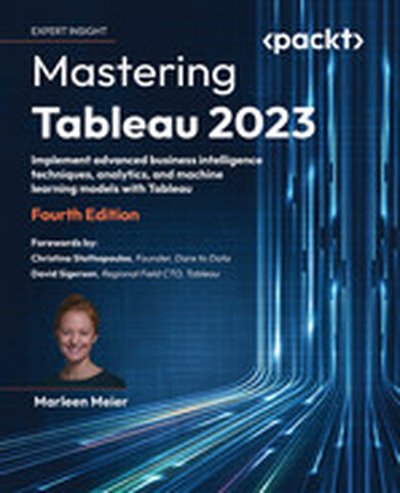
Mastering Tableau 2023 - Fourth Edition

This comprehensive book on Tableau 2023 is your practical guide to mastering data visualization and business intelligence techniques. You will explore the latest features of Tableau, learn how to create insightful dashboards, and gain proficiency in integrating analytics and machine learning workflows. By the end, you'll have the skills to address a variety of analytics challenges using Tableau. What this Book will help me do Master the latest Tableau 2023 features and use cases to tackle analytics challenges. Develop and implement ETL workflows using Tableau Prep Builder for optimized data preparation. Integrate Tableau with programming languages such as Python and R to enhance analytics. Create engaging, visually impactful dashboards for effective data storytelling. Understand and apply data governance to ensure data quality and compliance. Author(s) Marleen Meier is an experienced data visualization expert and Tableau consultant with over a decade of experience helping organizations transform data into actionable insights. Her approach integrates her technical expertise and a keen eye for design to make analytics accessible rather than overwhelming. Her passion for teaching others to use visualization tools effectively shines through in her writing. Who is it for? This book is ideal for business analysts, BI professionals, or data analysts looking to enhance their Tableau expertise. It caters to both newcomers seeking to understand the foundations of Tableau and experienced users aiming to refine their skills in advanced analytics and data visualization. If your goal is to leverage Tableau as a strategic tool in your organization's BI projects, this book is for you.

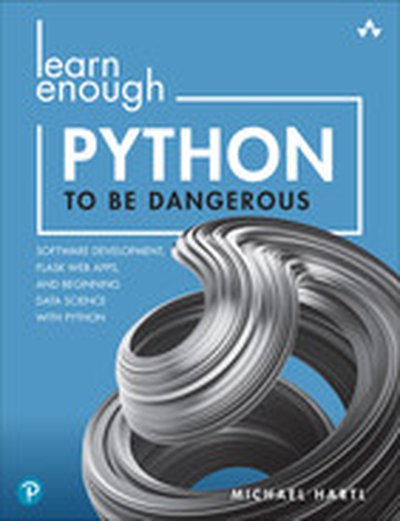
Learn Enough Python to Be Dangerous: Software Development, Flask Web Apps, and Beginning Data Science with Python

All You Need to Know, and Nothing You Don't, to Solve Real Problems with Python Python is one of the most popular programming languages in the world, used for everything from shell scripts to web development to data science. As a result, Python is a great language to learn, but you don't need to learn "everything" to get started, just how to use it efficiently to solve real problems. In Learn Enough Python to Be Dangerous, renowned instructor Michael Hartl teaches the specific concepts, skills, and approaches you need to be professionally productive. Even if you've never programmed before, Hartl helps you quickly build technical sophistication and master the lore you need to succeed. Hartl introduces Python both as a general-purpose language and as a specialist tool for web development and data science, presenting focused examples and exercises that help you internalize what matters, without wasting time on details pros don't care about. Soon, it'll be like you were born knowing this stuff--and you'll be suddenly, seriously dangerous. Learn enough about . . . Applying core Python concepts with the interactive interpreter and command line Writing object-oriented code with Python's native objects Developing and publishing self-contained Python packages Using elegant, powerful functional programming techniques, including Python comprehensions Building new objects, and extending them via Test-Driven Development (TDD) Leveraging Python's exceptional shell scripting capabilities Creating and deploying a full web app, using routes, layouts, templates, and forms Getting started with data-science tools for numerical computations, data visualization, data analysis, and machine learning Mastering concrete and informal skills every developer needs Michael Hartl's Learn Enough Series includes books and video courses that focus on the most important parts of each subject, so you don't have to learn everything to get started--you just have to learn enough to be dangerous and solve technical problems yourself. Like this book? Don't miss Michael Hartl's companion video tutorial, Learn Enough Python to Be Dangerous LiveLessons. Register your book for convenient access to downloads, updates, and/or corrections as they become available. See inside book for details.

Power BI Machine Learning and OpenAI

Microsoft Power BI Machine Learning and OpenAI offers a comprehensive exploration into advanced data analytics and artificial intelligence using Microsoft Power BI. Through hands-on, workshop-style examples, readers will discover the integration of machine learning models and OpenAI features to enhance business intelligence. This book provides practical examples, real-world scenarios, and step-by-step guidance. What this Book will help me do Learn to apply machine learning capabilities within Power BI to create predictive analytics Understand how to integrate OpenAI services to build enhanced analytics workflows Gain hands-on experience in using R and Python for advanced data visualization in Power BI Master the skills needed to build and deploy SaaS auto ML models within Power BI Leverage Power BI's AI visuals and features to elevate data storytelling Author(s) Greg Beaumont, an expert in data science and business intelligence, brings years of experience in Power BI and analytics to this book. With a focus on practical applications, Greg empowers readers to harness the power of AI and machine learning to elevate their data solutions. As a consultant and trainer, he shares his deep knowledge to help readers unlock the full potential of their tools. Who is it for? This book is ideal for data analysts, BI professionals, and data scientists who aim to integrate machine learning and OpenAI into their workflows. If you're familiar with Power BI's fundamentals and are eager to explore its advanced capabilities, this guide is tailored for you. Perfect for professionals looking to elevate their analytics to a new level, combining data science concepts with Power BI's features.

Embedded Analytics

Over the past 10 years, data analytics and data visualization have become essential components of an enterprise information strategy. And yet, the adoption of data analytics has remained remarkably static, reaching no more than 30% of potential users. This book explores the most important techniques for taking that adoption further: embedding analytics into the workflow of our everyday operations. Authors Donald Farmer and Jim Horbury show business users how to improve decision making without becoming analytics specialists. You'll explore different techniques for exchanging data, insights, and events between analytics platforms and hosting applications. You'll also examine issues including data governance and regulatory compliance and learn best practices for deploying and managing embedded analytics at scale. Learn how data analytics improves business decision making and performance Explore advantages and disadvantages of different embedded analytics platforms Develop a strategy for embedded analytics in an organization or product Define the architecture of an embedded solution Select vendors, platforms, and tools to implement your architecture Hire or train developers and architects to build the embedded solutions you need Understand how embedded analytics interacts with traditional analytics