In this course, you’ll learn how to apply patterns to securely store and delete personal information for data governance and compliance on the Data Intelligence Platform. We’ll cover topics like storing sensitive data appropriately to simplify granting access and processing deletes, processing deletes to ensure compliance with the right to be forgotten, performing data masking, and configuring fine-grained access control to configure appropriate privileges to sensitive data.Pre-requisites: Ability to perform basic code development tasks using the Databricks workspace (create clusters, run code in notebooks, use basic notebook operations, import repos from git, etc), intermediate programming experience with SQL and PySpark (extract data from a variety of file formats and data sources, apply a number of common transformations to clean data, reshape and manipulate complex data using advanced built-in functions), intermediate programming experience with Delta Lake (create tables, perform complete and incremental updates, compact files, restore previous versions etc.). Beginner experience with Lakeflow Declarative Pipelines and streaming workloads.Labs: YesCertification Path: Databricks Certified Data Engineer Professional
 talk-data.com
Topic
PySpark
69
tagged
Activity Trend
Top Events
In this course, you’ll learn how to optimize workloads and physical layout with Spark and Delta Lake and and analyze the Spark UI to assess performance and debug applications. We’ll cover topics like streaming, liquid clustering, data skipping, caching, photons, and more. Pre-requisites: Ability to perform basic code development tasks using the Databricks workspace (create clusters, run code in notebooks, use basic notebook operations, import repos from git, etc), intermediate programming experience with SQL and PySpark (extract data from a variety of file formats and data sources, apply a number of common transformations to clean data, reshape and manipulate complex data using advanced built-in functions), intermediate programming experience with Delta Lake (create tables, perform complete and incremental updates, compact files, restore previous versions etc.). Labs: Yes Certification Path: Databricks Certified Data Engineer Professional
In this course, you’ll learn how to Incrementally process data to power analytic insights with Structured Streaming and Auto Loader, and how to apply design patterns for designing workloads to perform ETL on the Data Intelligence Platform with Lakeflow Declarative Pipelines. First, we’ll cover topics including ingesting raw streaming data, enforcing data quality, implementing CDC, and exploring and tuning state information. Then, we’ll cover options to perform a streaming read on a source, requirements for end-to-end fault tolerance, options to perform a streaming write to a sink, and creating an aggregation and watermark on a streaming dataset. Pre-requisites: Ability to perform basic code development tasks using the Databricks workspace (create clusters, run code in notebooks, use basic notebook operations, import repos from git, etc.), intermediate programming experience with SQL and PySpark (extract data from a variety of file formats and data sources, apply a number of common transformations to clean data, reshape and manipulate complex data using advanced built-in functions), intermediate programming experience with Delta Lake (create tables, perform complete and incremental updates, compact files, restore previous versions etc.). Beginner experience with streaming workloads and familiarity with Lakeflow Declarative Pipelines. Labs: No Certification Path: Databricks Certified Data Engineer Professional
In this course, you’ll learn the fundamentals of preparing data for machine learning using Databricks. We’ll cover topics like exploring, cleaning, and organizing data tailored for traditional machine learning applications. We’ll also cover data visualization, feature engineering, and optimal feature storage strategies. By building a strong foundation in data preparation, this course equips you with the essential skills to create high-quality datasets that can power accurate and reliable machine learning and AI models. Whether you're developing predictive models or enabling downstream AI applications, these capabilities are critical for delivering impactful, data-driven solutions. Pre-requisites: Familiarity with Databricks workspace, notebooks, as well as Unity Catalog. An intermediate level knowledge of Python (scikit-learn, Matplotlib), Pandas, and PySpark. As well as with concepts of exploratory data analysis, feature engineering, standardization, and imputation methods). Labs: Yes Certification Path: Databricks Certified Machine Learning Associate
Suppose you want to write a data science tool to do feature engineering. Your experience may go like this: - Expectation: you can focus on state-of-the art techniques for feature engineering. - Reality: you keep having to make you codebase more complex because a new dataframe library has come out and users are demanding support for it.
Or rather, it might have gone like that in the pre-Narwhals era. Because now, you can focus on solving the problems which your tool set out to do, and let Narwhals handle the subtle differences between different kinds of dataframe inputs!
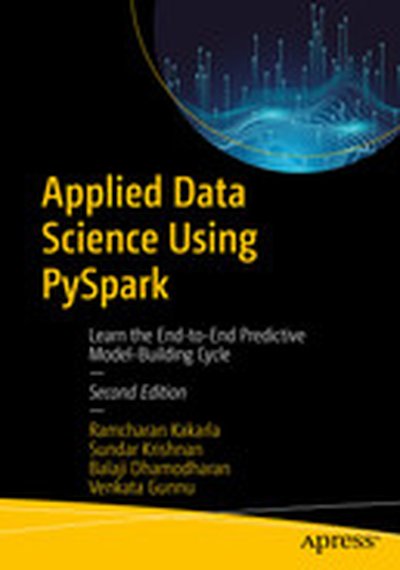
This comprehensive guide, featuring hand-picked examples of daily use cases, will walk you through the end-to-end predictive model-building cycle using the latest techniques and industry tricks. In Chapters 1, 2, and 3, we will begin by setting up the environment and covering the basics of PySpark, focusing on data manipulation. Chapter 4 delves into the art of variable selection, demonstrating various techniques available in PySpark. In Chapters 5, 6, and 7, we explore machine learning algorithms, their implementations, and fine-tuning techniques. Chapters 8 and 9 will guide you through machine learning pipelines and various methods to operationalize and serve models using Docker/API. Chapter 10 will demonstrate how to unlock the power of predictive models to create a meaningful impact on your business. Chapter 11 introduces some of the most widely used and powerful modeling frameworks to unlock real value from data. In this new edition, you will learn predictive modeling frameworks that can quantify customer lifetime values and estimate the return on your predictive modeling investments. This edition also includes methods to measure engagement and identify actionable populations for effective churn treatments. Additionally, a dedicated chapter on experimentation design has been added, covering steps to efficiently design, conduct, test, and measure the results of your models. All code examples have been updated to reflect the latest stable version of Spark. You will: Gain an overview of end-to-end predictive model building Understand multiple variable selection techniques and their implementations Learn how to operationalize models Perform data science experiments and learn useful tips
Reynold Xin explains the evolution of Apache Spark™, outlining several historical challenges and how the Spark community worked to make improvements, including the addition of PySpark.
Speaker: Reynold Xin, Co-founder and Chief Architect at Databricks
Send us a text Welcome to the cozy corner of the tech world where ones and zeros mingle with casual chit-chat. Datatopics Unplugged is your go-to spot for relaxed discussions around tech, news, data, and society. Dive into conversations that should flow as smoothly as your morning coffee (but don't), where industry insights meet laid-back banter. Whether you're a data aficionado or just someone curious about the digital age, pull up a chair, relax, and let's get into the heart of data, unplugged style! In this episode, we're joined by special guest Maryam Ilyas as we delve into a variety of topics that shape our digital world: Women’s Healthcare Insights: Exploring the Oura ring's commitment during Women's Health Awareness Month and its role in addressing the underrepresentation of female health conditions in research. A Deep Dive into the EU AI Act: Examining the AI Act’s implications, including its classification of AI systems (prohibited, high-risk, limited-risk, and minimal-risk), ethical concerns, regulatory challenges & the act's impact on AI usage, particularly regarding mass surveillance at the Paris Olympics.The Evolution of Music and AI: Reviewing the AI-generated music video for "The Hardest Part" by Washed Out, directed by Paul Trillo, showcasing AI’s growing role in the arts.Hot Takes on Data Tools: Is combining SQL, PySpark (and Python) in Databricks the most powerful tool in the data space? Let's dissect the possibilities and limitations.Don't forget to check us out on Youtube too, where you can find a lot more content beyond the podcast!
Get a behind-the-scenes look at Walmart's data and AI platform. We'll dissect their use of BigQuery, Spark, and large language models to run complex multi-modal data pipelines. We will deep dive into the choices with various engines (SQL, pySPARK) and technologies along with the corresponding tradeoffs. Gain exclusive insights to implement into your own projects.
Click the blue “Learn more” button above to tap into special offers designed to help you implement what you are learning at Google Cloud Next 25.
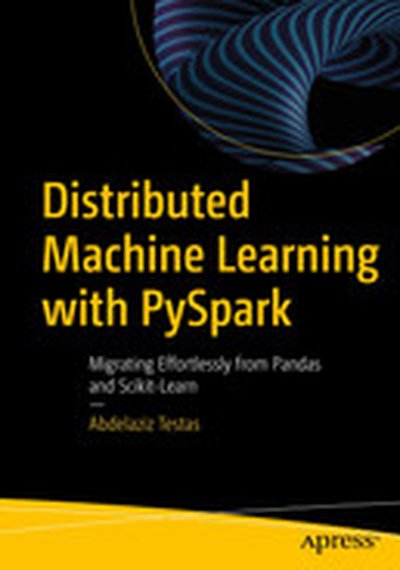
Migrate from pandas and scikit-learn to PySpark to handle vast amounts of data and achieve faster data processing time. This book will show you how to make this transition by adapting your skills and leveraging the similarities in syntax, functionality, and interoperability between these tools. Distributed Machine Learning with PySpark offers a roadmap to data scientists considering transitioning from small data libraries (pandas/scikit-learn) to big data processing and machine learning with PySpark. You will learn to translate Python code from pandas/scikit-learn to PySpark to preprocess large volumes of data and build, train, test, and evaluate popular machine learning algorithms such as linear and logistic regression, decision trees, random forests, support vector machines, Naïve Bayes, and neural networks. After completing this book, you will understand the foundational concepts of data preparation and machine learning and will have the skills necessary toapply these methods using PySpark, the industry standard for building scalable ML data pipelines. What You Will Learn Master the fundamentals of supervised learning, unsupervised learning, NLP, and recommender systems Understand the differences between PySpark, scikit-learn, and pandas Perform linear regression, logistic regression, and decision tree regression with pandas, scikit-learn, and PySpark Distinguish between the pipelines of PySpark and scikit-learn Who This Book Is For Data scientists, data engineers, and machine learning practitioners who have some familiarity with Python, but who are new to distributed machine learning and the PySpark framework.
Now that you can write models in Python, a new world of possibility has opened up. In this session, Christopher Marland introduces you to Snowpark and how it integrates with dbt, before demonstrating a real-world use case where Python transformations outperform SQL, starting from raw data and moving through to a completed analysis.
This talk is ideal for people who are familiar with PySpark but new to dbt, or who are experienced dbt users and curious about taking advantage of their new Pythonic superpowers from inside of a familiar development environment.
Speaker: Christopher Marland, Snowflake Solutions Architect, Aimpoint Digital
Register for Coalesce at https://coalesce.getdbt.com
Legacy data warehouses are costly to maintain, unscalable and cannot deliver on data science, ML and real-time analytics use cases. Migrating from your enterprise data warehouse to Databricks lets you scale as your business needs grow and accelerate innovation by running all your data, analytics and AI workloads on a single unified data platform.
In the first part of this session we will guide you through the well-designed process and tools that will help you from the assessment phase to the actual implementation of an EDW migration project. Also, we will address ways to convert PL/SQL proprietary code to an open standard python code and take advantage of PySpark for ETL workloads and Databricks SQL’s data analytics workload power.
The second part of this session will be based on an EDW migration project of SNCF (French national railways); one of the major enterprise customers of Databricks in France. Databricks partnered with SNCF to migrate its real estate entity from Oracle DW and IBM DataStage to Databricks on AWS. We will walk you through the customer context, urgency to migration, challenges, target architecture, nitty-gritty details of implementation, best practices, recommendations, and learnings in order to execute a successful migration project in a very accelerated time frame.
Talk by: Himanshu Arora and Amine Benhamza
Connect with us: Website: https://databricks.com Twitter: https://twitter.com/databricks LinkedIn: https://www.linkedin.com/company/databricks Instagram: https://www.instagram.com/databricksinc Facebook: https://www.facebook.com/databricksinc
Apache Spark is a popular distributed framework for big data processing. It is commonly used for ETL (extract, transform and load) across large datasets. Today, the transform stage can often include the application of deep learning models on the data. For example, common models can be used for classification of images, sentiment analysis of text, language translation, anomaly detection, and many other use cases. Applying these models within Spark can be done today with the combination of PySpark, Pandas_UDF, and a lot of glue code. Often, that glue code can be difficult to get right, because it requires expertise across multiple domains - deep learning frameworks, PySpark APIs, pandas_UDF internal behavior, and performance optimization.
In this session, we introduce a new, simplified API for deep learning inferencing on Spark, introduced in SPARK-40264 as a collaboration between NVIDIA and Databricks, which seeks to standardize and open source this glue code to make deep learning inference integrations easier for everyone. We discuss its design and demonstrate its usage across multiple deep learning frameworks and models.
Talk by: Lee Yang
Here’s more to explore: LLM Compact Guide: https://dbricks.co/43WuQyb Big Book of MLOps: https://dbricks.co/3r0Pqiz
Connect with us: Website: https://databricks.com Twitter: https://twitter.com/databricks LinkedIn: https://www.linkedin.com/company/databricks Instagram: https://www.instagram.com/databricksinc Facebook: https://www.facebook.com/databricksinc
PySpark has accomplished many milestones such as Project Zen, and been increasingly growing. We introduced pandas API on Spark, and hugely improved usability such as error messages, type hints, etc., and PySpark has become almost the very standard of distributed computing in Python. With this trend, the kind of PySpark use cases became also very complicated especially for modern data applications such as notebooks, IDEs, even devices such as smart home devices leveraging the power of data, that virtually need a lightweight separate client. However, today’s PySpark client is considerably heavy, and does not allow the separation from its scheduler, optimizer and analyzer as an example.
In Apache Spark 3.4, one of the key features we introduced in PySpark is the Python client for Spark Connect that decouples client-server architecture for Apache Spark that allows remote connectivity to Spark clusters using the DataFrame API and unresolved logical plans as the protocol. The separation between client and server allows Apache Spark and its open ecosystem to be leveraged from everywhere. It can be embedded in modern data applications. In this talk, we will introduce what Spark Connect is, the internals of Spark Connect with Python, how to use Spark Connect with Python in the end-user perspective, and what’s next beyond Apache Spark 3.4.
Talk by: Hyukjin Kwon and Ruifeng Zheng
Connect with us: Website: https://databricks.com Twitter: https://twitter.com/databricks LinkedIn: https://www.linkedin.com/company/databricks Instagram: https://www.instagram.com/databricksinc Facebook: https://www.facebook.com/databricksinc
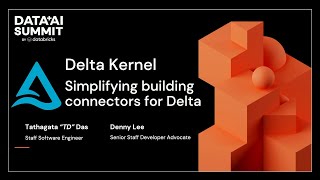
Since the release of Delta 2.0, the project has been growing at a breakneck speed. In this session, we will cover all the latest capabilities that makes Delta Lake the best format for the lakehouse. Based on lessons learned from this past year, we will introduce Project Aqueduct and how we will simplify building Delta Lake APIs from Rust and Go to Trino, Flink, and PySpark.
Talk by: Tathagata Das and Denny Lee
Connect with us: Website: https://databricks.com Twitter: https://twitter.com/databricks LinkedIn: https://www.linkedin.com/company/databricks Instagram: https://www.instagram.com/databricksinc Facebook: https://www.facebook.com/databricksinc
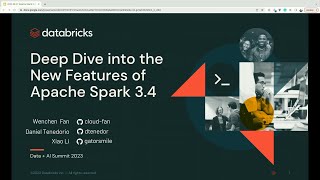
Join us for this Technical Deep Dive session. In 2022, Apache Spark™ was awarded the prestigious SIGMOD Systems Award, because Spark is the de facto standard for data processing.
In this session, we will share the latest progress in Apache Spark community. With tremendous contribution from the open source community, Spark 3.4 managed to resolve in excess of 2,400 Jira tickets. We will talk about the major features and improvements in Spark 3.4. The major updates are Spark Connect, numerous PySpark and SQL language features, engine performance enhancements, as well as operational improvements in Spark UX and error handling.
Talk by: Xiao Li and Daniel Tenedorio
Connect with us: Website: https://databricks.com Twitter: https://twitter.com/databricks LinkedIn: https://www.linkedin.com/company/databricks Instagram: https://www.instagram.com/databricksinc Facebook: https://www.facebook.com/databricksinc
Get ready to level up your big data processing skills! Join us for an introductory talk on Apache Spark, the distributed computing system used by tech giants like Netflix and Amazon. We'll cover PySpark DataFrames and how to use them. Whether you're a Python developer new to big data or looking to explore new technologies, this talk is for you. You'll gain foundational knowledge about Apache Spark and its capabilities, and learn how to leverage DataFrames and SQL APIs to efficiently process large amounts of data. Don't miss out on this opportunity to up your big data game!
Summary The data ecosystem has been growing rapidly, with new communities joining and bringing their preferred programming languages to the mix. This has led to inefficiencies in how data is stored, accessed, and shared across process and system boundaries. The Arrow project is designed to eliminate wasted effort in translating between languages, and Voltron Data was created to help grow and support its technology and community. In this episode Wes McKinney shares the ways that Arrow and its related projects are improving the efficiency of data systems and driving their next stage of evolution.
Announcements
Hello and welcome to the Data Engineering Podcast, the show about modern data management When you’re ready to build your next pipeline, or want to test out the projects you hear about on the show, you’ll need somewhere to deploy it, so check out our friends at Linode. With their new managed database service you can launch a production ready MySQL, Postgres, or MongoDB cluster in minutes, with automated backups, 40 Gbps connections from your application hosts, and high throughput SSDs. Go to dataengineeringpodcast.com/linode today and get a $100 credit to launch a database, create a Kubernetes cluster, or take advantage of all of their other services. And don’t forget to thank them for their continued support of this show! Atlan is the metadata hub for your data ecosystem. Instead of locking your metadata into a new silo, unleash its transformative potential with Atlan’s active metadata capabilities. Push information about data freshness and quality to your business intelligence, automatically scale up and down your warehouse based on usage patterns, and let the bots answer those questions in Slack so that the humans can focus on delivering real value. Go to dataengineeringpodcast.com/atlan today to learn more about how Atlan’s active metadata platform is helping pioneering data teams like Postman, Plaid, WeWork & Unilever achieve extraordinary things with metadata and escape the chaos. Struggling with broken pipelines? Stale dashboards? Missing data? If this resonates with you, you’re not alone. Data engineers struggling with unreliable data need look no further than Monte Carlo, the leading end-to-end Data Observability Platform! Trusted by the data teams at Fox, JetBlue, and PagerDuty, Monte Carlo solves the costly problem of broken data pipelines. Monte Carlo monitors and alerts for data issues across your data warehouses, data lakes, dbt models, Airflow jobs, and business intelligence tools, reducing time to detection and resolution from weeks to just minutes. Monte Carlo also gives you a holistic picture of data health with automatic, end-to-end lineage from ingestion to the BI layer directly out of the box. Start trusting your data with Monte Carlo today! Visit dataengineeringpodcast.com/montecarlo to learn more. Data engineers don’t enjoy writing, maintaining, and modifying ETL pipelines all day, every day. Especially once they realize 90% of all major data sources like Google Analytics, Salesforce, Adwords, Facebook, Spreadsheets, etc., are already available as plug-and-play connectors with reliable, intuitive SaaS solutions. Hevo Data is a highly reliable and intuitive data pipeline platform used by data engineers from 40+ countries to set up and run low-latency ELT pipelines with zero maintenance. Boasting more than 150 out-of-the-box connectors that can be set up in minutes, Hevo also allows you to monitor and control your pipelines. You get: real-time data flow visibility, fail-safe mechanisms, and alerts if anything breaks; preload transformations and auto-schema mapping precisely control how data lands in your destination; models and workflows to transform data for analytics; and reverse-ETL capability to move the transformed data back to your business software to inspire timely action. All of this, plus its transparent pricing and 24*7 live support, makes it consistently voted by users as the Leader in the Data Pipeline category on review platforms like G2. Go to dataengineeringpodcast.com/hevodata and sign up for a free 14-day trial that also comes with 24×7 support. Your host is Tobias Macey and today I’m interviewing Wes McKinney about his work at Voltron Data and on the Arrow ecosystem
Interview
Introduction How did you get involved in the area of data management? Can you describe what you are building at Voltron Data and the story behind it? What is the vision for the broader data ecosystem that you are trying to realize through your investment in Arrow and related projects?
How does your work at Voltron Data contribute to the realization of that vision?
What is the impact on engineer productivity and compute efficiency that gets introduced by the impedance mismatches between language and framework representations of data? The scope and capabilities of the Arrow project have grown substantially since it was first introduced. Can you give an overview of the current features and extensions to the project? What are some of the ways that ArrowVe and its related projects can be integrated with or replace the different elements of a data platform? Can you describe how Arrow is implemented?
What are the most complex/challenging aspects of the engineering needed to support interoperable data interchange between language runtimes?
How are you balancing the desire to move quickly and improve the Arrow protocol and implementations, with the need to wait for other players in the ecosystem (e.g. database engines, compute frameworks, etc.) to add support? With the growing application of data formats such as graphs and vectors, what do you see as the role of Arrow and its ideas in those use cases? For workflows that rely on integrating structured and unstructured data, what are the options for interaction with non-tabular data? (e.g. images, documents, etc.) With your support-focused business model, how are you approaching marketing and customer education to make it viable and scalable? What are the most interesting, innovative, or unexpected ways that you have seen Arrow used? What are the most interesting, unexpected, or challenging lessons that you have learned while working on Arrow and its ecosystem? When is Arrow the wrong choice? What do you have planned for the future of Arrow?
Contact Info
Website wesm on GitHub @wesmckinn on Twitter
Parting Question
From your perspective, what is the biggest gap in the tooling or technology for data management today?
Closing Announcements
Thank you for listening! Don’t forget to check out our other shows. Podcast.init covers the Python language, its community, and the innovative ways it is being used. The Machine Learning Podcast helps you go from idea to production with machine learning. Visit the site to subscribe to the show, sign up for the mailing list, and read the show notes. If you’ve learned something or tried out a project from the show then tell us about it! Email [email protected]) with your story. To help other people find the show please leave a review on Apple Podcasts and tell your friends and co-workers
Links
Voltron Data Pandas
Podcast Episode
Apache Arrow Partial Differential Equation FPGA == Field-Programmable Gate Array GPU == Graphics Processing Unit Ursa Labs Voltron (cartoon) Feature Engineering PySpark Substrait Arrow Flight Acero Arrow Datafusion Velox Ibis SIMD == Single Instruction, Multiple Data Lance DuckDB
Podcast Episode
Data Threads Conference Nano-Arrow Arrow ADBC Protocol Apache Iceberg
Podcast Episode
The intro and outro music is from The Hug by The Freak Fandango Orchestra / CC BY-SA
Sponsored By:
Atlan: 
Have you ever woken up to a crisis because a number on a dashboard is broken and no one knows why? Or sent out frustrating slack messages trying to find the right data set? Or tried to understand what a column name means?
Our friends at Atlan started out as a data team themselves and faced all this collaboration chaos themselves, and started building Atlan as an internal tool for themselves. Atlan is a collaborative workspace for data-driven teams, like Github for engineering or Figma for design teams. By acting as a virtual hub for data assets ranging from tables and dashboards to SQL snippets & code, Atlan enables teams to create a single source of truth for all their data assets, and collaborate across the modern data stack through deep integrations with tools like Snowflake, Slack, Looker and more.
Go to dataengineeringpodcast.com/atlan and sign up for a free trial. If you’re a data engineering podcast listener, you get credits worth $3000 on an annual subscription.a href="https://dataengineeringpodcast.com/montecarlo"…
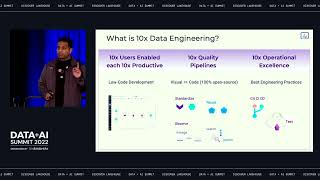
Can we take Data Engineering on Spark 10x beyond where it is today?
Yes, we can enable 10x more users on Spark, and make them 10x more productive from day 1. Data engineering can run at scale, and it can still be 10x simpler and faster to develop, deploy, and manage pipelines.
Low code is the key. A modern data engineering platform built on low code will enable all data users, from new graduates to experts, to visually develop high-quality pipelines. With Visual = Code, the visual elements will be stored as PySpark code on Git and deployed using the best software practices taken from DevOps. Search and lineage help data engineers and their customers in analytics understand how each column value was produced, when it was updated, and the associated quality metric.
See how a complete, low-code data engineering platform can reduce complexity and effort, enabling you to rapidly deploy, scale, and use Spark, making data and analytics a strategic asset in your company.
Connect with us: Website: https://databricks.com Facebook: https://www.facebook.com/databricksinc Twitter: https://twitter.com/databricks LinkedIn: https://www.linkedin.com/company/data... Instagram: https://www.instagram.com/databricksinc/
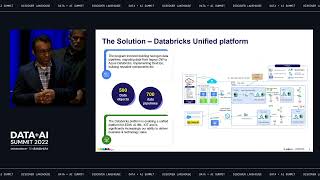
Learn how Wipro helped a world leader in medical technology to modernize its data used the PySpark interface on Azure Databricks to create reusable generic frameworks, including slowly changing dimensions (SCDs), data validation/reconciliation tools, and delta lake tables created from metadata.
Connect with us: Website: https://databricks.com Facebook: https://www.facebook.com/databricksinc Twitter: https://twitter.com/databricks LinkedIn: https://www.linkedin.com/company/data... Instagram: https://www.instagram.com/databricksinc/