talk-data.com talk-data.com

Topic

Hadoop

Apache Hadoop

big_data distributed_computing data_processing

258

tagged

Activity Trend

3 peak/qtr
2020-Q1 2026-Q1

Activities

258 activities · Newest first

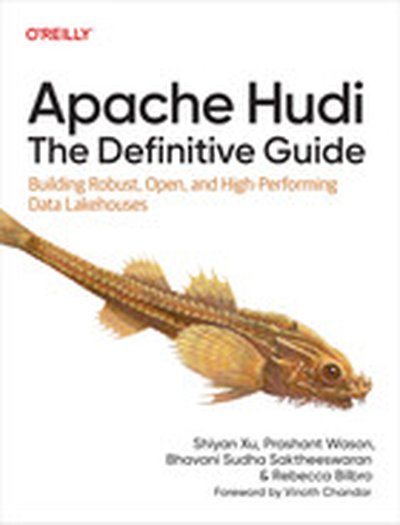
Apache Hudi: The Definitive Guide

Overcome challenges in building transactional guarantees on rapidly changing data by using Apache Hudi. With this practical guide, data engineers, data architects, and software architects will discover how to seamlessly build an interoperable lakehouse from disparate data sources and deliver faster insights using your query engine of choice. Authors Shiyan Xu, Prashant Wason, Bhavani Sudha Saktheeswaran, and Rebecca Bilbro provide practical examples and insights to help you unlock the full potential of data lakehouses for different levels of analytics, from batch to interactive to streaming. You'll also learn how to evaluate storage choices and leverage built-in automated table optimizations to build, maintain, and operate production data applications. Understand the need for transactional data lakehouses and the challenges associated with building them Explore data ecosystem support provided by Apache Hudi for popular data sources and query engines Perform different write and read operations on Apache Hudi tables and effectively use them for various use cases, including batch and stream applications Apply different storage techniques and considerations such as indexing and clustering to maximize your lakehouse performance Build end-to-end incremental data pipelines using Apache Hudi for faster ingestion and fresher analytics

There was a post on the data engineering subreddit recently that discussed how difficult it is to keep up with the data engineering world. Did you learn Hadoop, great we are on Snowflake, BigQuery and Databricks now. Just learned Airflow, well now we have Airflow 3.0. And the list goes on. But what doesn’t change, and what have been the lessons over the past decade. That’s what I’ll be covering in this talk. Real lessons and realities that come up time and time again whether you’re working for a start-up or a large enterprise.

Apache Bigtop is a time-proven open-source software stack for building data platform, which has been built around the Hadoop and Spark ecosystem since 2011. Its software composition has been changed during such a long period, and recently job scheduler is removed mainly due to the inactivity of its development. The speaker believes that Airflow perfectly fits into this gap and is proposing incorporating it in the Bigtop stack. This presentation will introduce how easily users can build a data platform with Bigtop including Airflow, and how Airflow can integrate those software with its wide range of providers and enterprise-readiness such as the Kerberos support.

As your organization scales to 20+ data science teams and 300+ DS/ML/DE engineers, you face a critical challenge: how to build a secure, reliable, and scalable orchestration layer that supports both fast experimentation and stable production workflows. We chose Airflow — and didn’t regret it! But to make it truly work at our scale, we had to rethink its architecture from the ground up. In this talk, we’ll share how we turned Airflow into a powerful MLOps platform through its core capability: running pipelines across multiple K8s GPU clusters from a single UI (!) using per-cluster worker pools. To support ease of use, we developed MLTool — our own library for fast and standardized DAG development, integrated Vault for secure secret management across teams, enabled real-time logging with S3 persistence and built a custom SparkSubmitOperator for Kerberos-authenticated Spark/Hadoop jobs in Kubernetes. We also streamlined the developer experience — users can generate a GitLab repo and deploy a versioned pipeline to prod in under 10 minutes! We’re proud of what we’ve built — and our users are too. Now we want to share it with the world!

Sponsored by: AWS | Ripple: Well-Architected Data & AI Platforms - AWS and Databricks in Harmony

Join us as we explore the well-architected framework for modern data lakehouse architecture, where AWS's comprehensive data, AI, and infrastructure capabilities align with Databricks' unified platform approach. Building upon core principles of Operational Excellence, Security, Reliability, Performance, and Cost Optimization, we'll demonstrate how Data and AI Governance alongside Interoperability and Usability enable organizations to build robust, scalable platforms. Learn how Ripple modernized its data infrastructure by migrating from a legacy Hadoop system to a scalable, real-time analytics platform using Databricks on AWS. This session covers the challenges of high operational costs, latency, and peak-time bottlenecks—and how Ripple achieved 80% cost savings and 55% performance improvements with Photon, Graviton, Delta Lake, and Structured Streaming.

AI Powering Epsilon's Identity Strategy: Unified Marketing Platform on Databricks

Join us to hear about how Epsilon Data Management migrated Epsilon’s unique, AI-powered marketing identity solution from multi-petabyte on-prem Hadoop and data warehouse systems to a unified Databricks Lakehouse platform. This transition enabled Epsilon to further scale its Decision Sciences solution and enable new cloud-based AI research capabilities on time and within budget, without being bottlenecked by the resource constraints of on-prem systems. Learn how Delta Lake, Unity Catalog, MLflow and LLM endpoints powered massive data volume, reduced data duplication, improved lineage visibility, accelerated Data Science and AI, and enabled new data to be immediately available for consumption by the entire Epsilon platform in a privacy-safe way. Using the Databricks platform as the base for AI and Data Science at global internet scale, Epsilon deploys marketing solutions across multiple cloud providers and multiple regions for many customers.

Summary In this episode of the Data Engineering Podcast Mai-Lan Tomsen Bukovec, Vice President of Technology at AWS, talks about the evolution of Amazon S3 and its profound impact on data architecture. From her work on compute systems to leading the development and operations of S3, Mylan shares insights on how S3 has become a foundational element in modern data systems, enabling scalable and cost-effective data lakes since its launch alongside Hadoop in 2006. She discusses the architectural patterns enabled by S3, the importance of metadata in data management, and how S3's evolution has been driven by customer needs, leading to innovations like strong consistency and S3 tables.

Announcements Hello and welcome to the Data Engineering Podcast, the show about modern data managementData migrations are brutal. They drag on for months—sometimes years—burning through resources and crushing team morale. Datafold's AI-powered Migration Agent changes all that. Their unique combination of AI code translation and automated data validation has helped companies complete migrations up to 10 times faster than manual approaches. And they're so confident in their solution, they'll actually guarantee your timeline in writing. Ready to turn your year-long migration into weeks? Visit dataengineeringpodcast.com/datafold today for the details.This is a pharmaceutical Ad for Soda Data Quality. Do you suffer from chronic dashboard distrust? Are broken pipelines and silent schema changes wreaking havoc on your analytics? You may be experiencing symptoms of Undiagnosed Data Quality Syndrome — also known as UDQS. Ask your data team about Soda. With Soda Metrics Observability, you can track the health of your KPIs and metrics across the business — automatically detecting anomalies before your CEO does. It’s 70% more accurate than industry benchmarks, and the fastest in the category, analyzing 1.1 billion rows in just 64 seconds. And with Collaborative Data Contracts, engineers and business can finally agree on what “done” looks like — so you can stop fighting over column names, and start trusting your data again.Whether you’re a data engineer, analytics lead, or just someone who cries when a dashboard flatlines, Soda may be right for you. Side effects of implementing Soda may include: Increased trust in your metrics, reduced late-night Slack emergencies, spontaneous high-fives across departments, fewer meetings and less back-and-forth with business stakeholders, and in rare cases, a newfound love of data. Sign up today to get a chance to win a $1000+ custom mechanical keyboard. Visit dataengineeringpodcast.com/soda to sign up and follow Soda’s launch week. It starts June 9th.Your host is Tobias Macey and today I'm interviewing Mai-Lan Tomsen Bukovec about the evolutions of S3 and how it has transformed data architectureInterview IntroductionHow did you get involved in the area of data management?Most everyone listening knows what S3 is, but can you start by giving a quick summary of what roles it plays in the data ecosystem?What are the major generational epochs in S3, with a particular focus on analytical/ML data systems?The first major driver of analytical usage for S3 was the Hadoop ecosystem. What are the other elements of the data ecosystem that helped shape the product direction of S3?Data storage and retrieval have been core primitives in computing since its inception. What are the characteristics of S3 and all of its copycats that led to such a difference in architectural patterns vs. other shared data technologies? (e.g. NFS, Gluster, Ceph, Samba, etc.)How does the unified pool of storage that is exemplified by S3 help to blur the boundaries between application data, analytical data, and ML/AI data?What are some of the default patterns for storage and retrieval across those three buckets that can lead to anti-patterns which add friction when trying to unify those use cases?The age of AI is leading to a massive potential for unlocking unstructured data, for which S3 has been a massive dumping ground over the years. How is that changing the ways that your customers think about the value of the assets that they have been hoarding for so long?What new architectural patterns is that generating?What are the most interesting, innovative, or unexpected ways that you have seen S3 used for analytical/ML/Ai applications?What are the most interesting, unexpected, or challenging lessons that you have learned while working on S3?When is S3 the wrong choice?What do you have planned for the future of S3?Contact Info LinkedInParting Question From your perspective, what is the biggest gap in the tooling or technology for data management today?Closing Announcements Thank you for listening! Don't forget to check out our other shows. Podcast.init covers the Python language, its community, and the innovative ways it is being used. The AI Engineering Podcast is your guide to the fast-moving world of building AI systems.Visit the site to subscribe to the show, sign up for the mailing list, and read the show notes.If you've learned something or tried out a project from the show then tell us about it! Email [email protected] with your story.Links AWS S3KinesisKafkaSQSEMRDrupalWordpressNetflix Blog on S3 as a Source of TruthHadoopMapReduceNasa JPLFINRA == Financial Industry Regulatory AuthorityS3 Object VersioningS3 Cross RegionS3 TablesIcebergParquetAWS KMSIceberg RESTDuckDBNFS == Network File SystemSambaGlusterFSCephMinIOS3 MetadataPhotoshop Generative FillAdobe FireflyTurbotax AI AssistantAWS Access AnalyzerData ProductsS3 Access PointAWS Nova ModelsLexisNexis ProtegeS3 Intelligent TieringS3 Principal Engineering TenetsThe intro and outro music is from The Hug by The Freak Fandango Orchestra / CC BY-SA

Get the inside story of Yahoo’s data lake transformation. As a Hadoop pioneer, Yahoo’s move to Google Cloud is a significant shift in data strategy. Explore the business drivers behind this transformation, technical hurdles encountered, and strategic partnership with Google Cloud that enabled a seamless migration. We’ll uncover key lessons, best practices for data lake modernization, and how Yahoo is using BigQuery, Dataproc, Pub/Sub, and other services to drive business value, enhance operational efficiency, and fuel their AI initiatives.

This morning, a great article came across my feed that gave me PTSD, asking if Iceberg is the Hadoop of the Modern Data Stack?

In this rant, I bring the discussion back to a central question you should ask with any hot technology - do you need it at all? Do you need a tool built for the top 1% of companies at a sufficient data scale? Or is a spreadsheet good enough?

Link: https://blog.det.life/apache-iceberg-the-hadoop-of-the-modern-data-stack-c83f63a4ebb9

❤️ If you like my podcasts, please like and rate it on your favorite podcast platform.

🤓 My works:

📕Fundamentals of Data Engineering: https://www.oreilly.com/library/view/fundamentals-of-data/9781098108298/

🎥 Deeplearning.ai Data Engineering Certificate: https://www.coursera.org/professional-certificates/data-engineering

🔥Practical Data Modeling: https://practicaldatamodeling.substack.com/

🤓 My SubStack: https://joereis.substack.com/

Big Data is Dead: Long Live Hot Data 🔥

Over the last decade, Big Data was everywhere. Let's set the record straight on what is and isn't Big Data. We have been consumed by a conversation about data volumes when we should focus more on the immediate task at hand: Simplifying our work.

Some of us may have Big Data, but our quest to derive insights from it is measured in small slices of work that fit on your laptop or in your hand. Easy data is here— let's make the most of it.

📓 Resources Big Data is Dead: https://motherduck.com/blog/big-data-is-dead/ Small Data Manifesto: https://motherduck.com/blog/small-data-manifesto/ Small Data SF: https://www.smalldatasf.com/

➡️ Follow Us LinkedIn: https://linkedin.com/company/motherduck X/Twitter : https://twitter.com/motherduck Blog: https://motherduck.com/blog/


Explore the "Small Data" movement, a counter-narrative to the prevailing big data conference hype. This talk challenges the assumption that data scale is the most important feature of every workload, defining big data as any dataset too large for a single machine. We'll unpack why this distinction is crucial for modern data engineering and analytics, setting the stage for a new perspective on data architecture.

Delve into the history of big data systems, starting with the non-linear hardware costs that plagued early data practitioners. Discover how Google's foundational papers on GFS, MapReduce, and Bigtable led to the creation of Hadoop, fundamentally changing how we scale data processing. We'll break down the "big data tax"—the inherent latency and system complexity overhead required for distributed systems to function, a critical concept for anyone evaluating data platforms.

Learn about the architectural cornerstone of the modern cloud data warehouse: the separation of storage and compute. This design, popularized by systems like Snowflake and Google BigQuery, allows storage to scale almost infinitely while compute resources are provisioned on-demand. Understand how this model paved the way for massive data lakes but also introduced new complexities and cost considerations that are often overlooked.

We examine the cracks appearing in the big data paradigm, especially for OLAP workloads. While systems like Snowflake are still dominant, the rise of powerful alternatives like DuckDB signals a shift. We reveal the hidden costs of big data analytics, exemplified by a petabyte-scale query costing nearly $6,000, and argue that for most use cases, it's too expensive to run computations over massive datasets.

The key to efficient data processing isn't your total data size, but the size of your "hot data" or working set. This talk argues that the revenge of the single node is here, as modern hardware can often handle the actual data queried without the overhead of the big data tax. This is a crucial optimization technique for reducing cost and improving performance in any data warehouse.

Discover the core principles for designing systems in a post-big data world. We'll show that since only 1 in 500 users run true big data queries, prioritizing simplicity over premature scaling is key. For low latency, process data close to the user with tools like DuckDB and SQLite. This local-first approach offers a compelling alternative to cloud-centric models, enabling faster, more cost-effective, and innovative data architectures.

Overcome the limitations of your legacy data warehouse or BI systems and reap the benefits of a cloud-native stack with LeapLogic, Impetus’ automated cloud migration accelerator. Join our session to explore how LeapLogic’s end-to-end automated capabilities can fast-track and streamline the transformation of legacy data warehouse, ETL, Hadoop, analytics, and reporting workloads to the cloud. Gain actionable insights from real-world success stories of Fortune 500 enterprises that have successfully modernised their legacy workloads, positioning them at the forefront of the GenAI revolution. 

0:00

hi everyone Welcome to our event this event is brought to you by data dos club which is a community of people who love

0:06

data and we have weekly events and today one is one of such events and I guess we

0:12

are also a community of people who like to wake up early if you're from the states right Christopher or maybe not so

0:19

much because this is the time we usually have uh uh our events uh for our guests

0:27

and presenters from the states we usually do it in the evening of Berlin time but yes unfortunately it kind of

0:34

slipped my mind but anyways we have a lot of events you can check them in the

0:41

description like there's a link um I don't think there are a lot of them right now on that link but we will be

0:48

adding more and more I think we have like five or six uh interviews scheduled so um keep an eye on that do not forget

0:56

to subscribe to our YouTube channel this way you will get notified about all our future streams that will be as awesome

1:02

as the one today and of course very important do not forget to join our community where you can hang out with

1:09

other data enthusiasts during today's interview you can ask any question there's a pin Link in live chat so click

1:18

on that link ask your question and we will be covering these questions during the interview now I will stop sharing my

1:27

screen and uh there is there's a a message in uh and Christopher is from

1:34

you so we actually have this on YouTube but so they have not seen what you wrote

1:39

but there is a message from to anyone who's watching this right now from Christopher saying hello everyone can I

1:46

call you Chris or you okay I should go I should uh I should look on YouTube then okay yeah but anyways I'll you don't

1:53

need like you we'll need to focus on answering questions and I'll keep an eye

1:58

I'll be keeping an eye on all the question questions so um

2:04

yeah if you're ready we can start I'm ready yeah and you prefer Christopher

2:10

not Chris right Chris is fine Chris is fine it's a bit shorter um

2:18

okay so this week we'll talk about data Ops again maybe it's a tradition that we talk about data Ops every like once per

2:25

year but we actually skipped one year so because we did not have we haven't had

2:31

Chris for some time so today we have a very special guest Christopher Christopher is the co-founder CEO and

2:37

head chef or hat cook at data kitchen with 25 years of experience maybe this

2:43

is outdated uh cuz probably now you have more and maybe you stopped counting I

2:48

don't know but like with tons of years of experience in analytics and software engineering Christopher is known as the

2:55

co-author of the data Ops cookbook and data Ops Manifesto and it's not the

3:00

first time we have Christopher here on the podcast we interviewed him two years ago also about data Ops and this one

3:07

will be about data hops so we'll catch up and see what actually changed in in

3:13

these two years and yeah so welcome to the interview well thank you for having

3:19

me I'm I'm happy to be here and talking all things related to data Ops and why

3:24

why why bother with data Ops and happy to talk about the company or or what's changed

3:30

excited yeah so let's dive in so the questions for today's interview are prepared by Johanna berer as always

3:37

thanks Johanna for your help so before we start with our main topic for today

3:42

data Ops uh let's start with your ground can you tell us about your career Journey so far and also for those who

3:50

have not heard have not listened to the previous podcast maybe you can um talk

3:55

about yourself and also for those who did listen to the previous you can also maybe give a summary of what has changed

4:03

in the last two years so we'll do yeah so um my name is Chris so I guess I'm

4:09

a sort of an engineer so I spent about the first 15 years of my career in

4:15

software sort of working and building some AI systems some non- AI systems uh

4:21

at uh Us's NASA and MIT linol lab and then some startups and then um

4:30

Microsoft and then about 2005 I got I got the data bug uh I think you know my

4:35

kids were small and I thought oh this data thing was easy and I'd be able to go home uh for dinner at 5 and life

4:41

would be fine um because I was a big you started your own company right and uh it didn't work out that way

4:50

and um and what was interesting is is for me it the problem wasn't doing the

4:57

data like I we had smart people who did data science and data engineering the act of creating things it was like the

5:04

systems around the data that were hard um things it was really hard to not have

5:11

errors in production and I would sort of driving to work and I had a Blackberry at the time and I would not look at my

5:18

Blackberry all all morning I had this long drive to work and I'd sit in the parking lot and take a deep breath and

5:24

look at my Blackberry and go uh oh is there going to be any problems today and I'd be and if there wasn't I'd walk and

5:30

very happy um and if there was I'd have to like rce myself um and you know and

5:36

then the second problem is the team I worked for we just couldn't go fast enough the customers were super

5:42

demanding they didn't care they all they always thought things should be faster and we are always behind and so um how

5:50

do you you know how do you live in that world where things are breaking left and right you're terrified of making errors

5:57

um and then second you just can't go fast enough um and it's preh Hadoop era

6:02

right it's like before all this big data Tech yeah before this was we were using

6:08

uh SQL Server um and we actually you know we had smart people so we we we

6:14

built an engine in SQL Server that made SQL Server a column or

6:20

database so we built a column or database inside of SQL Server um so uh

6:26

in order to make certain things fast and and uh yeah it was it was really uh it's not

6:33

bad I mean the principles are the same right before Hadoop it's it's still a database there's still indexes there's

6:38

still queries um things like that we we uh at the time uh you would use olap

6:43

engines we didn't use those but you those reports you know are for models it's it's not that different um you know

6:50

we had a rack of servers instead of the cloud um so yeah and I think so what what I

6:57

took from that was uh it's just hard to run a team of people to do do data and analytics and it's not

7:05

really I I took it from a manager perspective I started to read Deming and

7:11

think about the work that we do as a factory you know and in a factory that produces insight and not automobiles um

7:18

and so how do you run that factory so it produces things that are good of good

7:24

quality and then second since I had come from software I've been very influenced

7:29

by by the devops movement how you automate deployment how you run in an agile way how you

7:35

produce um how you how you change things quickly and how you innovate and so

7:41

those two things of like running you know running a really good solid production line that has very low errors

7:47

um and then second changing that production line at at very very often they're kind of opposite right um and so

7:55

how do you how do you as a manager how do you technically approach that and

8:00

then um 10 years ago when we started data kitchen um we've always been a profitable company and so we started off

8:07

uh with some customers we started building some software and realized that we couldn't work any other way and that

8:13

the way we work wasn't understood by a lot of people so we had to write a book and a Manifesto to kind of share our our

8:21

methods and then so yeah we've been in so we've been in business now about a little over 10

8:28

years oh that's cool and uh like what

8:33

uh so let's talk about dat offs and you mentioned devops and how you were inspired by that and by the way like do

8:41

you remember roughly when devops as I think started to appear like when did people start calling these principles

8:49

and like tools around them as de yeah so agile Manifesto well first of all the I

8:57

mean I had a boss in 1990 at Nasa who had this idea build a

9:03

little test a little learn a lot right that was his Mantra and then which made

9:09

made a lot of sense um and so and then the sort of agile software Manifesto

9:14

came out which is very similar in 2001 and then um the sort of first real

9:22

devops was a guy at Twitter started to do automat automated deployment you know

9:27

push a button and that was like 200 Nish and so the first I think devops

9:33

Meetup was around then so it's it's it's been 15 years I guess 6 like I was

9:39

trying to so I started my career in 2010 so I my first job was a Java

9:44

developer and like I remember for some things like we would just uh SFTP to the

9:52

machine and then put the jar archive there and then like keep our fingers crossed that it doesn't break uh uh like

10:00

it was not really the I wouldn't call it this way right you were deploying you

10:06

had a Dey process I put it yeah

10:11

right was that so that was documented too it was like put the jar on production cross your

10:17

fingers I think there was uh like a page on uh some internal Viki uh yeah that

10:25

describes like with passwords and don't like what you should do yeah that was and and I think what's interesting is

10:33

why that changed right and and we laugh at it now but that was why didn't you

10:38

invest in automating deployment or a whole bunch of automated regression

10:44

tests right that would run because I think in software now that would be rare

10:49

that people wouldn't use C CD they wouldn't have some automated tests you know functional

10:56

regression tests that would be the

Summary

Data lakehouse architectures have been gaining significant adoption. To accelerate adoption in the enterprise Microsoft has created the Fabric platform, based on their OneLake architecture. In this episode Dipti Borkar shares her experiences working on the product team at Fabric and explains the various use cases for the Fabric service.

Announcements

Hello and welcome to the Data Engineering Podcast, the show about modern data management Data lakes are notoriously complex. For data engineers who battle to build and scale high quality data workflows on the data lake, Starburst is an end-to-end data lakehouse platform built on Trino, the query engine Apache Iceberg was designed for, with complete support for all table formats including Apache Iceberg, Hive, and Delta Lake. Trusted by teams of all sizes, including Comcast and Doordash. Want to see Starburst in action? Go to dataengineeringpodcast.com/starburst and get $500 in credits to try Starburst Galaxy today, the easiest and fastest way to get started using Trino. Your host is Tobias Macey and today I'm interviewing Dipti Borkar about her work on Microsoft Fabric and performing analytics on data withou

Interview

Introduction How did you get involved in the area of data management? Can you describe what Microsoft Fabric is and the story behind it? Data lakes in various forms have been gaining significant popularity as a unified interface to an organization's analytics. What are the motivating factors that you see for that trend? Microsoft has been investing heavily in open source in recent years, and the Fabric platform relies on several open components. What are the benefits of layering on top of existing technologies rather than building a fully custom solution?

What are the elements of Fabric that were engineered specifically for the service? What are the most interesting/complicated integration challenges?

How has your prior experience with Ahana and Presto informed your current work at Microsoft? AI plays a substantial role in the product. What are the benefits of embedding Copilot into the data engine?

What are the challenges in terms of safety and reliability?

What are the most interesting, innovative, or unexpected ways that you have seen the Fabric platform used? What are the most interesting, unexpected, or challenging lessons that you have learned while working on data lakes generally, and Fabric specifically? When is Fabric the wrong choice? What do you have planned for the future of data lake analytics?

Contact Info

LinkedIn

Parting Question

From your perspective, what is the biggest gap in the tooling or technology for data management today?

Closing Announcements

Thank you for listening! Don't forget to check out our other shows. Podcast.init covers the Python language, its community, and the innovative ways it is being used. The Machine Learning Podcast helps you go from idea to production with machine learning. Visit the site to subscribe to the show, sign up for the mailing list, and read the show notes. If you've learned something or tried out a project from the show then tell us about it! Email [email protected] with your story.

Links

Microsoft Fabric Ahana episode DB2 Distributed Spark Presto Azure Data MAD Landscape

Podcast Episode ML Podcast Episode

Tableau dbt Medallion Architecture Microsoft Onelake ORC Parquet Avro Delta Lake Iceberg

Podcast Episode

Hudi

Podcast Episode

Hadoop PowerBI

Podcast Episode

Velox Gluten Apache XTable GraphQL Formula 1 McLaren

The intro and outro music is from The Hug by The Freak Fandango Orchestra / CC BY-SA Sponsored By: Starburst: Starburst Logo

This episode is brought to you by Starburst - an end-to-end data lakehouse platform for data engineers who are battling to build and scale high quality data pipelines on the data lake. Powered by T

Unifying storage for your data analytics workloads doesn‘t have to be hard. See how Google Cloud Storage brings your data closer to compute and meets your applications where they are, all while achieving exabyte scale, strong consistency, and lower costs. You'll get new product announcements and see enterprise customers present real-world solutions using Cloud Storage with BigQuery, Hadoop, Spark, Kafka, and more.

Click the blue “Learn more” button above to tap into special offers designed to help you implement what you are learning at Google Cloud Next 25.

session
by Susheel Kaushik (Google Cloud) , Apurva Desai (Google Cloud) , Ramnik Kaur (LiveRamp) , Adnan Hasan (Google Cloud) , Dean Batten (LiveRamp) , Dana Soltani (Google Cloud)

Learn how Dataproc can support your hybrid multicloud strategy and help you meet your business goals for your big data open source analytics workloads. Discover how LiveRamp achieved performance boosts and cost reductions by migrating to Dataproc. Learn their migration secrets, overcome common hurdles, and leverage Dataproc's hidden gems for a seamless transition.

Click the blue “Learn more” button above to tap into special offers designed to help you implement what you are learning at Google Cloud Next 25.

Struggling with large, complex data migrations? Facing tight deadlines and countless roadblocks? Get the true story of Verizon’s massive challenge: migrating 30 data lakes – a staggering 7 PB of data – from on-premise Hadoop to Google Cloud, all while powering critical applications. We‘ll reveal how Verizon, working with Google and Partners, defied the odds, and made it in record time. Discover the strategies, tools, and collaborations that propelled their success. Get actionable insights applicable to your own complex data migration projects.

Click the blue “Learn more” button above to tap into special offers designed to help you implement what you are learning at Google Cloud Next 25.

Big Data Computing

This book primarily aims to provide an in-depth understanding of recent advances in big data computing technologies, methodologies, and applications along with introductory details of big data computing models such as Apache Hadoop, MapReduce, Hive, Pig, Mahout in-memory storage systems, NoSQL databases, and big data streaming services.

Igor Khrol: Big Data With Open Source Solutions

Join Igor Khrol as he delves into the world of Big Data with Open Source Solutions at Automattic, a company rooted in the power of open source. 📊🌐 Discover their unique approach to maintaining a data ecosystem based on Hadoop, Spark, Trino, Airflow, Superset, and JupyterHub, all hosted on bare metal infrastructure, and gain insights on how it compares to cloud-based alternatives in 2023. 💡🚀 #BigData #opensource

✨ H I G H L I G H T S ✨

🙌 A huge shoutout to all the incredible participants who made Big Data Conference Europe 2023 in Vilnius, Lithuania, from November 21-24, an absolute triumph! 🎉 Your attendance and active participation were instrumental in making this event so special. 🌍

Don't forget to check out the session recordings from the conference to relive the valuable insights and knowledge shared! 📽️

Once again, THANK YOU for playing a pivotal role in the success of Big Data Conference Europe 2023. 🚀 See you next year for another unforgettable conference! 📅 #BigDataConference #SeeYouNextYear

Learning and Operating Presto

The Presto community has mushroomed since its origins at Facebook in 2012. But ramping up this open source distributed SQL query engine can be challenging even for the most experienced engineers. With this practical book, data engineers and architects, platform engineers, cloud engineers, and software engineers will learn how to use Presto operations at your organization to derive insights on datasets wherever they reside. Authors Angelica Lo Duca, Tim Meehan, Vivek Bharathan, and Ying Su explain what Presto is, where it came from, and how it differs from other data warehousing solutions. You'll discover why Facebook, Uber, Alibaba Cloud, Hewlett Packard Enterprise, IBM, Intel, and many more use Presto and how you can quickly deploy Presto in production. With this book, you will: Learn how to install and configure Presto Use Presto with business intelligence tools Understand how to connect Presto to a variety of data sources Extend Presto for real-time business insight Learn how to apply best practices and tuning Get troubleshooting tips for logs, error messages, and more Explore Presto's architectural concepts and usage patterns Understand Presto security and administration

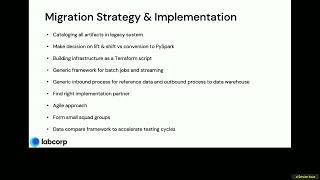
Labcorp Data Platform Journey: From Selection to Go-Live in Six Months

Join this session to learn about the Labcorp data platform transformation from on-premises Hadoop to AWS Databricks Lakehouse. We will share best practices and lessons learned from cloud-native data platform selection, implementation, and migration from Hadoop (within six months) with Unity Catalog.

We will share steps taken to retire several legacy on-premises technologies and leverage Databricks native features like Spark streaming, workflows, job pools, cluster policies and Spark JDBC within Databricks platform. Lessons learned in Implementing Unity Catalog and building a security and governance model that scales across applications. We will show demos that walk you through batch frameworks, streaming frameworks, data compare tools used across several applications to improve data quality and speed of delivery.

Discover how we have improved operational efficiency, resiliency and reduced TCO, and how we scaled building workspaces and associated cloud infrastructure using Terraform provider.

Talk by: Mohan Kolli and Sreekanth Ratakonda

Connect with us: Website: https://databricks.com Twitter: https://twitter.com/databricks LinkedIn: https://www.linkedin.com/company/databricks Instagram: https://www.instagram.com/databricksinc Facebook: https://www.facebook.com/databricksinc