talk-data.com talk-data.com

Topic

Superset

Apache Superset

bi data_exploration visualization

19

tagged

Activity Trend

1 peak/qtr
2020-Q1 2026-Q1

Activities

19 activities · Newest first

A l’occasion de cette démo, en partant d’une page blanche et de différentes sources de données, nous irons jusqu’à déployer une application Data Analytics augmentée par des LMM en utilisant ces deux produits lancés par OVHcloud en 2025.

OVHcloud DataPlatform : une solution unifiée et permettant vos équipes de gérer en self-service de bout en bout vos projets Data & Analytics : de la collecte de tous types de données, leur exploration, leur stockage, leurs transformations, jusqu’à la construction de tableaux de bords partagés via des applications dédiées. Une service pay-as-you-go pour accélérer de déploiement et simplifier la gestion des projets Data.

AI Endpoints : une solution serverless qui permet aux développeurs d’intégrer facilement des fonctionnalités d'IA avancées à leurs applications. Grâce à plus de 40 modèles open-source de pointe incluant LLM et IA générative – pour des usages comme les agents conversationnels, modèles vocaux, assistants de code, etc. - AI Endpoints démocratise l’utilisation de l'IA, indépendamment de la taille ou du secteur de l'organisation.

Et cela en s’appuyant sur les meilleurs standards Data open-source (Apache Iceberg, Spark, SuperSet, Trino, Jupyter Notebooks…) dans des environnements respectueux de votre souveraineté technologique.

Following on from the Building consumable data products keynote, we will dive deeper into the interactions around the data product catalog, to show how the network effect of explicit data sharing relationships starts to pay dividends to the participants. Such as:

For the product consumer:

• Searching for products, understanding content, costs, terms and conditions, licenses, quality certifications etc

• Inspecting sample data, choosing preferred data format, setting up a secure subscription, and seeing data provisioned into a database from the product catalog.

• Providing feedback and requesting help

• Reviewing own active subscriptions

• Understanding the lineage behind each product along with outstanding exceptions and future plans

For the product manager/owner:

• Setting up a new product, creating a new release of an existing product and issuing a data correction/restatement

• Reviewing a product’s active subscriptions and feedback/requests from consumers

• Interacting with the technical teams on pipeline implementations along with issues and proposed enhancements

• For the data governance team

• Viewing the network of dependencies between data products (the data mesh) to understand the data value chains and risk concentrations

• Reviewing a dashboard of metrics around the data products including popularity, errors/exceptions, subscriptions, interaction

• Show traceability from a governance policy relating to, say data sovereignty or data privacy to the product implementations.

• Building trust profiles for producers and consumers

The aim of the demonstrations and discussions is to explore the principles and patterns relating to data products, rather than push a particular implementation approach.

Having said that, all of the software used in the demonstrations is open source. Principally this is Egeria, Open Lineage and Unity Catalog from the Linux Foundation, plus Apache Airflow, Apache Kafka and Apache SuperSet from the Apache Software Foundation.  

Videos of the demonstrations will be available on YouTube after the conference and the complete demo software can be downloaded and run on a laptop so you can share your experiences with your teams after the event.

Building a Self-Service Data Platform With a Small Data Team

Discover how Dodo Brands, a global pizza and coffee business with over 1,200 retail locations and 40k employees, revolutionized their analytics infrastructure by creating a self-service data platform. This session explores the approach to empowering analysts, data scientists and ML engineers to independently build analytical pipelines with minimal involvement from data engineers. By leveraging Databricks as the backbone of their platform, the team developed automated tools like a "job-generator" that uses Jinja templates to streamline the creation of data jobs. This approach minimized manual coding and enabled non-data engineers to create over 1,420 data jobs — 90% of which were auto-generated by user configurations. Supporting thousands of weekly active users via tools like Apache Superset. This session provides actionable insights for organizations seeking to scale their analytics capabilities efficiently without expanding their data engineering teams.

Summary

Building a data platform is a substrantial engineering endeavor. Once it is running, the next challenge is figuring out how to address release management for all of the different component parts. The services and systems need to be kept up to date, but so does the code that controls their behavior. In this episode your host Tobias Macey reflects on his current challenges in this area and some of the factors that contribute to the complexity of the problem.

Announcements

Hello and welcome to the Data Engineering Podcast, the show about modern data management This episode is supported by Code Comments, an original podcast from Red Hat. As someone who listens to the Data Engineering Podcast, you know that the road from tool selection to production readiness is anything but smooth or straight. In Code Comments, host Jamie Parker, Red Hatter and experienced engineer, shares the journey of technologists from across the industry and their hard-won lessons in implementing new technologies. I listened to the recent episode "Transforming Your Database" and appreciated the valuable advice on how to approach the selection and integration of new databases in applications and the impact on team dynamics. There are 3 seasons of great episodes and new ones landing everywhere you listen to podcasts. Search for "Code Commentst" in your podcast player or go to dataengineeringpodcast.com/codecomments today to subscribe. My thanks to the team at Code Comments for their support. Data lakes are notoriously complex. For data engineers who battle to build and scale high quality data workflows on the data lake, Starburst is an end-to-end data lakehouse platform built on Trino, the query engine Apache Iceberg was designed for, with complete support for all table formats including Apache Iceberg, Hive, and Delta Lake. Trusted by teams of all sizes, including Comcast and Doordash. Want to see Starburst in action? Go to dataengineeringpodcast.com/starburst and get $500 in credits to try Starburst Galaxy today, the easiest and fastest way to get started using Trino. Your host is Tobias Macey and today I want to talk about my experiences managing the QA and release management process of my data platform

Interview

Introduction As a team, our overall goal is to ensure that the production environment for our data platform is highly stable and reliable. This is the foundational element of establishing and maintaining trust with the consumers of our data. In order to support this effort, we need to ensure that only changes that have been tested and verified are promoted to production. Our current challenge is one that plagues all data teams. We want to have an environment that mirrors our production environment that is available for testing, but it’s not feasible to maintain a complete duplicate of all of the production data. Compounding that challenge is the fact that each of the components of our data platform interact with data in slightly different ways and need different processes for ensuring that changes are being promoted safely.

Contact Info

LinkedIn Website

Closing Announcements

Thank you for listening! Don't forget to check out our other shows. Podcast.init covers the Python language, its community, and the innovative ways it is being used. The Machine Learning Podcast helps you go from idea to production with machine learning. Visit the site to subscribe to the show, sign up for the mailing list, and read the show notes. If you've learned something or tried out a project from the show then tell us about it! Email [email protected] with your story.

Links

Data Platforms and Leaky Abstractions Episode Building A Data Platform From Scratch Airbyte

Podcast Episode

Trino dbt Starburst Galaxy Superset Dagster LakeFS

Podcast Episode

Nessie

Podcast Episode

Iceberg Snowflake LocalStack DSL == Domain Specific Language

The intro and outro music is from The Hug by The Freak Fandango Orchestra / CC BY-S

Igor Khrol: Big Data With Open Source Solutions

Join Igor Khrol as he delves into the world of Big Data with Open Source Solutions at Automattic, a company rooted in the power of open source. 📊🌐 Discover their unique approach to maintaining a data ecosystem based on Hadoop, Spark, Trino, Airflow, Superset, and JupyterHub, all hosted on bare metal infrastructure, and gain insights on how it compares to cloud-based alternatives in 2023. 💡🚀 #BigData #opensource

✨ H I G H L I G H T S ✨

🙌 A huge shoutout to all the incredible participants who made Big Data Conference Europe 2023 in Vilnius, Lithuania, from November 21-24, an absolute triumph! 🎉 Your attendance and active participation were instrumental in making this event so special. 🌍

Don't forget to check out the session recordings from the conference to relive the valuable insights and knowledge shared! 📽️

Once again, THANK YOU for playing a pivotal role in the success of Big Data Conference Europe 2023. 🚀 See you next year for another unforgettable conference! 📅 #BigDataConference #SeeYouNextYear

Summary

For business analytics the way that you model the data in your warehouse has a lasting impact on what types of questions can be answered quickly and easily. The major strategies in use today were created decades ago when the software and hardware for warehouse databases were far more constrained. In this episode Maxime Beauchemin of Airflow and Superset fame shares his vision for the entity-centric data model and how you can incorporate it into your own warehouse design.

Announcements

Hello and welcome to the Data Engineering Podcast, the show about modern data management Introducing RudderStack Profiles. RudderStack Profiles takes the SaaS guesswork and SQL grunt work out of building complete customer profiles so you can quickly ship actionable, enriched data to every downstream team. You specify the customer traits, then Profiles runs the joins and computations for you to create complete customer profiles. Get all of the details and try the new product today at dataengineeringpodcast.com/rudderstack Your host is Tobias Macey and today I'm interviewing Max Beauchemin about the concept of entity-centric data modeling for analytical use cases

Interview

Introduction How did you get involved in the area of data management? Can you describe what entity-centric modeling (ECM) is and the story behind it?

How does it compare to dimensional modeling strategies? What are some of the other competing methods Comparison to activity schema

What impact does this have on ML teams? (e.g. feature engineering)

What role does the tooling of a team have in the ways that they end up thinking about modeling? (e.g. dbt vs. informatica vs. ETL scripts, etc.)

What is the impact on the underlying compute engine on the modeling strategies used?

What are some examples of data sources or problem domains for which this approach is well suited?

What are some cases where entity centric modeling techniques might be counterproductive?

What are the ways that the benefits of ECM manifest in use cases that are down-stream from the warehouse?

What are some concrete tactical steps that teams should be thinking about to implement a workable domain model using entity-centric principles?

How does this work across business domains within a given organization (especially at "enterprise" scale)?

What are the most interesting, innovative, or unexpected ways that you have seen ECM used?

What are the most interesting, unexpected, or challenging lessons that you have learned while working on ECM?

When is ECM the wrong choice?

What are your predictions for the future direction/adoption of ECM or other modeling techniques?

Contact Info

mistercrunch on GitHub LinkedIn

Parting Question

From your perspective, what is the biggest gap in the tooling or technology for data management today?

Closing Announcements

Thank you for listening! Don't forget to check out our other shows. Podcast.init covers the Python language, its community, and the innovative ways it is being used. The Machine Learning Podcast helps you go from idea to production with machine learning. Visit the site to subscribe to the show, sign up for the mailing list, and read the show notes. If you've learned something or tried out a project from the show then tell us about it! Email [email protected]) with your story. To help other people find the show please leave a review on Apple Podcasts and tell your friends and co-workers

Links

Entity Centric Modeling Blog Post Max's Previous Apperances

Defining Data Engineering with Maxime Beauchemin Self Service Data Exploration And Dashboarding With Superset Exploring The Evolving Role Of Data Engineers Alumni Of AirBnB's Early Years Reflect On What They Learned About Building Data Driven Organizations

Apache Airflow Apache Superset Preset Ubisoft Ralph Kimball The Rise Of The Data Engineer The Downfall Of The Data Engineer The Rise Of The Data Scientist Dimensional Data Modeling Star Schema Databas

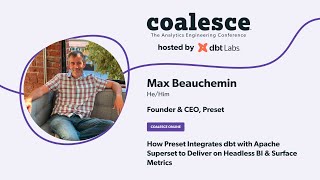
How Preset Integrates dbt with Apache Superset to Deliver on Headless BI & Surface Metrics

At Preset, we offer a managed service for Apache Superset, the most popular open source business intelligence platform (by Github stars) in the world. We believe the future of BI is not only rooted in open source but also adopts the best ideas from the software development life cycle. To that end, we've created a workflow that enables you to manage Superset datasets, charts, and dashboards as code and we integrated dbt into our platform. In this talk, I'll showcase the speed and change management benefits that are enabled by this workflow of managing core BI assets using dbt and version control.

Check the slides here: https://docs.google.com/presentation/d/1SjbXOgJnuAnmu3B3cY1YAEOMZdARH72Siwneq2yRjfU/edit?usp=sharing

Coalesce 2023 is coming! Register for free at https://coalesce.getdbt.com/.

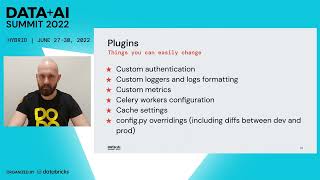
Integrating Apache Superset into a B2B Platform: Why and How

Our IT team creates a portal for managing a pizzeria franchise business. This portal is a rather large and unwieldy b2b system that has been developing for more than 10 years.

Our partners need dashboards to manage their business. These dashboards must be fully integrated into the portal. This is the job for our data engineers!

In this talk, I will tell you how and why we chose Apache Superset, what difficulties we encountered during integration and what refinements we had to make to achieve this goal.

Connect with us: Website: https://databricks.com Facebook: https://www.facebook.com/databricksinc Twitter: https://twitter.com/databricks LinkedIn: https://www.linkedin.com/company/data... Instagram: https://www.instagram.com/databricksinc/

Apache Superset is a modern, open-source data exploration & visualization platform originally created by Maxime Beauchemin. In this talk, I will showcase advanced technical Superset features like the rich Superset API, how to version control dashboards using Github, embedding Superset charts in other applications, and more. This talk will be technical and hands-on, and I will share all code examples I use so you can play with them yourself afterwards!

Summary The reason for collecting, cleaning, and organizing data is to make it usable by the organization. One of the most common and widely used methods of access is through a business intelligence dashboard. Superset is an open source option that has been gaining popularity due to its flexibility and extensible feature set. In this episode Maxime Beauchemin discusses how data engineers can use Superset to provide self service access to data and deliver analytics. He digs into how it integrates with your data stack, how you can extend it to fit your use case, and why open source systems are a good choice for your business intelligence. If you haven’t already tried out Superset then this conversation is well worth your time. Give it a listen and then take it for a test drive today.

Announcements

Hello and welcome to the Data Engineering Podcast, the show about modern data management When you’re ready to build your next pipeline, or want to test out the projects you hear about on the show, you’ll need somewhere to deploy it, so check out our friends at Linode. With their managed Kubernetes platform it’s now even easier to deploy and scale your workflows, or try out the latest Helm charts from tools like Pulsar and Pachyderm. With simple pricing, fast networking, object storage, and worldwide data centers, you’ve got everything you need to run a bulletproof data platform. Go to dataengineeringpodcast.com/linode today and get a $100 credit to try out a Kubernetes cluster of your own. And don’t forget to thank them for their continued support of this show! Modern Data teams are dealing with a lot of complexity in their data pipelines and analytical code. Monitoring data quality, tracing incidents, and testing changes can be daunting and often takes hours to days. Datafold helps Data teams gain visibility and confidence in the quality of their analytical data through data profiling, column-level lineage and intelligent anomaly detection. Datafold also helps automate regression testing of ETL code with its Data Diff feature that instantly shows how a change in ETL or BI code affects the produced data, both on a statistical level and down to individual rows and values. Datafold integrates with all major data warehouses as well as frameworks such as Airflow & dbt and seamlessly plugs into CI workflows. Go to dataengineeringpodcast.com/datafold today to start a 30-day trial of Datafold. Once you sign up and create an alert in Datafold for your company data, they will send you a cool water flask. RudderStack’s smart customer data pipeline is warehouse-first. It builds your customer data warehouse and your identity graph on your data warehouse, with support for Snowflake, Google BigQuery, Amazon Redshift, and more. Their SDKs and plugins make event streaming easy, and their integrations with cloud applications like Salesforce and ZenDesk help you go beyond event streaming. With RudderStack you can use all of your customer data to answer more difficult questions and then send those insights to your whole customer data stack. Sign up free at dataengineeringpodcast.com/rudder today. Your host is Tobias Macey and today I’m interviewing Max Beauchemin about Superset, an open source platform for data exploration, dashboards, and business intelligence

Interview

Introduction How did you get involved in the area of data management? Can you start by describing what Superset is? Superset is becoming part of the reference architecture for a modern data stack. What are the factors that have contributed to its popularity over other tools such as Redash, Metabase, Looker, etc.? Where do dashboarding and exploration tools like Superset fit in the responsibilities and workflow of a data engineer? What are some of the challenges that Superset faces in being performant when working with large data sources?

Which data sources have you found to be the most challenging to work with?

What are some anti-patterns that users of Superset mig

Superset is the leading open source data exploration and visualization platform. In this talk, we’ll be presenting Superset with a focus on advanced topics that are most relevant to Data Engineers. The presentation will be largely a live demo of the product, with a deeper dive into advanced topics for Data Engineers. This is a sponsored talk, presented by Preset .

Apache Superset Quick Start Guide

Apache Superset Quick Start Guide teaches you how to leverage Apache Superset to create interactive and insightful data visualizations. With this book, you'll understand how to integrate Superset with popular databases and build user-friendly dashboards tailored for business intelligence needs. What this Book will help me do Set up and configure Apache Superset for data visualization tasks. Integrate data from SQL databases into Superset for dashboards. Design dashboards tailored to represent business metrics and insights. Use Superset's visualization techniques to explore and present various datasets. Understand and apply user role management and security features in Superset. Author(s) None Shekhar is an experienced data visualization and business intelligence specialist with years of experience in working with Apache Superset. They have written several guides on utilizing open-source tools for enterprise needs. Their technical expertise and approachable writing style make this guide practical and engaging. Who is it for? This book is geared towards data analysts, business intelligence professionals, and developers. Beginners to Superset can quickly grasp the fundamentals, while those with prior experience in data visualization will appreciate the advanced techniques. It's perfect for anyone looking to enhance their data storytelling and dashboard design skills.

podcast_episode
by Val Kroll , Julie Hoyer , Tim Wilson (Analytics Power Hour - Columbus (OH) , Taylor Udell (Heap) , Moe Kiss (Canva) , Michael Helbling (Search Discovery)

Business Intelligence. It's a term that's been around for a few decades, but that is every bit as difficult to nail down as "data science," "big data," or a jellyfish. Think too hard about it, and you might actually find yourself struggling to define "analytics!" With the latest generation of BI tools, though, it's a topic that is making the rounds at cocktail parties the world over! (Cocktail parties just aren't what they used to be.) On this episode, the crew snags Taylor Udell from Heap to join in a discussion on the subject, and Moe (unsuccessfully) attempts to end the episode after six minutes. Possibly because neither Tableau nor Superset can definitively prove where avocado toast originated (but Wikipedia backs her up). But we all know Tim can't be shut up that quickly, right?! For complete show notes, including links to items mentioned in this episode and a transcript of the show, visit the show page.

Summary

With the attention being paid to the systems that power large volumes of high velocity data it is easy to forget about the value of data collection at human scales. Ona is a company that is building technologies to support mobile data collection, analysis of the aggregated information, and user-friendly presentations. In this episode CTO Peter Lubell-Doughtie describes the architecture of the platform, the types of environments and use cases where it is being employed, and the value of small data.

Preamble

Hello and welcome to the Data Engineering Podcast, the show about modern data management When you’re ready to build your next pipeline you’ll need somewhere to deploy it, so check out Linode. With private networking, shared block storage, node balancers, and a 40Gbit network, all controlled by a brand new API you’ve got everything you need to run a bullet-proof data platform. Go to dataengineeringpodcast.com/linode to get a $20 credit and launch a new server in under a minute. Are you struggling to keep up with customer request and letting errors slip into production? Want to try some of the innovative ideas in this podcast but don’t have time? DataKitchen’s DataOps software allows your team to quickly iterate and deploy pipelines of code, models, and data sets while improving quality. Unlike a patchwork of manual operations, DataKitchen makes your team shine by providing an end to end DataOps solution with minimal programming that uses the tools you love. Join the DataOps movement and sign up for the newsletter at datakitchen.io/de today. After that learn more about why you should be doing DataOps by listening to the Head Chef in the Data Kitchen at dataengineeringpodcast.com/datakitchen Go to dataengineeringpodcast.com to subscribe to the show, sign up for the mailing list, read the show notes, and get in touch. Join the community in the new Zulip chat workspace at dataengineeringpodcast.com/chat Your host is Tobias Macey and today I’m interviewing Peter Lubell-Doughtie about using Ona for collecting data and processing it with Canopy

Interview

Introduction How did you get involved in the area of data management? What is Ona and how did the company get started?

What are some examples of the types of customers that you work with?

What types of data do you support in your collection platform? What are some of the mechanisms that you use to ensure the accuracy of the data that is being collected by users? Does your mobile collection platform allow for anyone to submit data without having to be associated with a given account or organization? What are some of the integration challenges that are unique to the types of data that get collected by mobile field workers? Can you describe the flow of the data from collection through to analysis? To help improve the utility of the data being collected you have started building Canopy. What was the tipping point where it became worth the time and effort to start that project?

What are the architectural considerations that you factored in when designing it? What have you found to be the most challenging or unexpected aspects of building an enterprise data warehouse for general users?

What are your plans for the future of Ona and Canopy?

Contact Info

Email pld on Github Website

Parting Question

From your perspective, what is the biggest gap in the tooling or technology for data management today?

Links

OpenSRP Ona Canopy Open Data Kit Earth Institute at Columbia University Sustainable Engineering Lab WHO Bill and Melinda Gates Foundation XLSForms PostGIS Kafka Druid Superset Postgres Ansible Docker Terraform

The intro and outro music is from The Hug by The Freak Fandango Orchestra / CC BY-SA Support Data Engineering Podcast

Modern Big Data Processing with Hadoop

Delve into the world of big data with 'Modern Big Data Processing with Hadoop.' This comprehensive guide introduces you to the powerful capabilities of Apache Hadoop and its ecosystem to solve data processing and analytics challenges. By the end, you will have mastered the techniques necessary to architect innovative, scalable, and efficient big data solutions. What this Book will help me do Master the principles of building an enterprise-level big data strategy with Apache Hadoop. Learn to integrate Hadoop with tools such as Apache Spark, Elasticsearch, and more for comprehensive solutions. Set up and manage your big data architecture, including deployment on cloud platforms with Apache Ambari. Develop real-time data pipelines and enterprise search solutions. Leverage advanced visualization tools like Apache Superset to make sense of data insights. Author(s) None R. Patil, None Kumar, and None Shindgikar are experienced big data professionals and accomplished authors. With years of hands-on experience in implementing and managing Apache Hadoop systems, they bring a depth of expertise to their writing. Their dedication lies in making complex technical concepts accessible while demonstrating real-world best practices. Who is it for? This book is designed for data professionals aiming to advance their expertise in big data solutions using Apache Hadoop. Ideal readers include engineers and project managers involved in data architecture and those aspiring to become big data architects. Some prior exposure to big data systems is beneficial to fully benefit from this book's insights and tutorials.

Performance Optimization and Tuning Techniques for IBM Power Systems Processors Including IBM POWER8

This IBM® Redbooks® publication focuses on gathering the correct technical information, and laying out simple guidance for optimizing code performance on IBM POWER8® processor-based systems that run the IBM AIX®, IBM i, or Linux operating systems. There is straightforward performance optimization that can be performed with a minimum of effort and without extensive previous experience or in-depth knowledge. The POWER8 processor contains many new and important performance features, such as support for eight hardware threads in each core and support for transactional memory. The POWER8 processor is a strict superset of the IBM POWER7+™ processor, and so all of the performance features of the POWER7+ processor, such as multiple page sizes, also appear in the POWER8 processor. Much of the technical information and guidance for optimizing performance on POWER8 processors that is presented in this guide also applies to POWER7+ and earlier processors, except where the guide explicitly indicates that a feature is new in the POWER8 processor. This guide strives to focus on optimizations that tend to be positive across a broad set of IBM POWER® processor chips and systems. Specific guidance is given for the POWER8 processor; however, the general guidance is applicable to the IBM POWER7+, IBM POWER7®, IBM POWER6®, IBM POWER5, and even to earlier processors. This guide is directed at personnel who are responsible for performing migration and implementation activities on POWER8 processor-based systems. This includes system administrators, system architects, network administrators, information architects, and database administrators (DBAs).

Performance Optimization and Tuning Techniques for IBM Processors, including IBM POWER8

This IBM® Redbooks® publication focuses on gathering the correct technical information, and laying out simple guidance for optimizing code performance on IBM POWER8™ systems that run the AIX®, IBM i, or Linux operating systems. There is much straightforward performance optimization that can be performed with a minimum of effort and without extensive previous experience or in-depth knowledge. The POWER8 processor contains many new and important performance features, such as support for eight hardware threads in each core and support for transactional memory. POWER8 is a strict superset of IBM POWER7+™, and so all of the performance features of POWER7+, such as multiple page sizes, also appear in POWER8. Much of the technical information and guidance for optimizing performance on POWER8 presented in this guide also applies to POWER7+ and earlier processors, except where the guide explicitly indicates that a feature is new in POWER8. This guide strives to focus on optimizations that tend to be positive across a broad set of IBM POWER® processor chips and systems. Specific guidance is given for the POWER8 processor; however, the general guidance is applicable to the IBM POWER7+, IBM POWER7®, IBM POWER6®, IBM POWER5, and even to earlier processors. This guide is directed to personnel who are responsible for performing migration and implementation activities on IBM POWER8-based servers. This includes system administrators, system architects, network administrators, information architects, and database administrators (DBAs).

Building Dashboards for Windows SharePoint Services 3.0 Using SharePoint Designer 2007

In this Wrox Blox, you'll learn how to create powerful Dashboards for Windows SharePoint Services 3.0. First, we introduce Web Part Pages and some of the out-of-the box Web Parts available in WSS. We then look at how to use Web Part Connections to add interactivity to our Dashboards. Later we create advanced Dashboard Views using the Data Form Web Part available with SharePoint Designer 2007. While the author focuses on Windows SharePoint Services, all of the topics discussed also apply to Microsoft Office SharePoint Server 2007 as it is a superset of WSS. This Wrox Blox will be valuable for anyone wishing to share data on their SharePoint site.

Sams Teach Yourself XSLT in 21 Days

The book covers XSLT and Xpath (as a part of XSLT), as these topics have everything to do with processing XML. It will also cover XML from an XSLT processing and design point of view. Other XML technologies will not be discussed as superset of XSLT, most notably XSL. XSL Formatting Objects alone is enough material for an entire book. Apart from that, XSLT and Xpath form the processing/programming section of the entire XSL specification. This book presents an overview of XSLT and guides readers through transforming their first XML data. In this book you will also learn: Selecting Data-Stylesheets and Xpath Basics; Inserting text and elements in output; Copying elements from the source and inserting text; Conditional processing basics and expressions; Modularizing stylesheets; Understanding, creating, and using templates; Controlling output, as well as creating more advanced output; Using multi-file stylesheets, variables, and parameters; Working with numbers, strings, multiple XML sources, and namespaces; Selecting data based upon keys; Recursion; Creating computational stylesheets; Working with parses; Designing XML and XSLT applications; Extending XSLT.