talk-data.com talk-data.com

Topic

Iceberg

Apache Iceberg

table_format data_lake schema_evolution file_format storage open_table_format

206

tagged

Activity Trend

39 peak/qtr
2020-Q1 2026-Q1

Activities

206 activities · Newest first

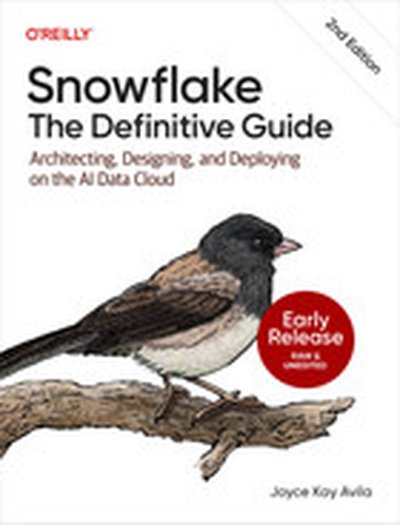
Snowflake: The Definitive Guide, 2nd Edition

Snowflake is reshaping data management by integrating AI, analytics, and enterprise workloads into a single cloud platform. Snowflake: The Definitive Guide is a comprehensive resource for data architects, engineers, and business professionals looking to harness Snowflake's evolving capabilities, including Cortex AI, Snowpark, and Polaris Catalog for Apache Iceberg. This updated edition provides real-world strategies and hands-on activities for optimizing performance, securing data, and building AI-driven applications. With hands-on SQL examples and best practices, this book helps readers process structured and unstructured data, implement scalable architectures, and integrate Snowflake's AI tools seamlessly. Whether you're setting up accounts, managing access controls, or leveraging generative AI, this guide equips you with the expertise to maximize Snowflake's potential. Implement AI-powered workloads with Snowflake Cortex Explore Snowsight and Streamlit for no-code development Ensure security with access control and data governance Optimize storage, queries, and computing costs Design scalable data architectures for analytics and machine learning
Practical Data Engineering with Apache Projects: Solving Everyday Data Challenges with Spark, Iceberg, Kafka, Flink, and More

This book is a comprehensive guide designed to equip you with the practical skills and knowledge necessary to tackle real-world data challenges using Open Source solutions. Focusing on 10 real-world data engineering projects, it caters specifically to data engineers at the early stages of their careers, providing a strong foundation in essential open source tools and techniques such as Apache Spark, Flink, Airflow, Kafka, and many more. Each chapter is dedicated to a single project, starting with a clear presentation of the problem it addresses. You will then be guided through a step-by-step process to solve the problem, leveraging widely-used open-source data tools. This hands-on approach ensures that you not only understand the theoretical aspects of data engineering but also gain valuable experience in applying these concepts to real-world scenarios. At the end of each chapter, the book delves into common challenges that may arise during the implementation of the solution, offering practical advice on troubleshooting these issues effectively. Additionally, the book highlights best practices that data engineers should follow to ensure the robustness and efficiency of their solutions. A major focus of the book is using open-source projects and tools to solve problems encountered in data engineering. In summary, this book is an indispensable resource for data engineers looking to build a strong foundation in the field. By offering practical, real-world projects and emphasizing problem-solving and best practices, it will prepare you to tackle the complex data challenges encountered throughout your career. Whether you are an aspiring data engineer or looking to enhance your existing skills, this book provides the knowledge and tools you need to succeed in the ever-evolving world of data engineering. You Will Learn: The foundational concepts of data engineering and practical experience in solving real-world data engineering problems How to proficiently use open-source data tools like Apache Kafka, Flink, Spark, Airflow, and Trino 10 hands-on data engineering projects Troubleshoot common challenges in data engineering projects Who is this book for: Early-career data engineers and aspiring data engineers who are looking to build a strong foundation in the field; mid-career professionals looking to transition into data engineering roles; and technology enthusiasts interested in gaining insights into data engineering practices and tools.

Engineering Lakehouses with Open Table Formats

Engineering Lakehouses with Open Table Formats introduces the architecture and capabilities of open table formats like Apache Iceberg, Apache Hudi, and Delta Lake. The book guides you through the design, implementation, and optimization of lakehouses that can handle modern data processing requirements effectively with real-world practical insights. What this Book will help me do Understand the fundamentals of open table formats and their benefits in lakehouse architecture. Learn how to implement performant data processing using tools like Apache Spark and Flink. Master advanced topics like indexing, partitioning, and interoperability between data formats. Explore data lifecycle management and integration with frameworks like Apache Airflow and dbt. Build secure lakehouses with regulatory compliance using best practices detailed in the book. Author(s) Dipankar Mazumdar and Vinoth Govindarajan are seasoned professionals with extensive experience in big data processing and software architecture. They bring their expertise from working with data lakehouses and are known for their ability to explain complex technical concepts clearly. Their collaborative approach brings valuable insights into the latest trends in data management. Who is it for? This book is ideal for data engineers, architects, and software professionals aiming to master modern lakehouse architectures. If you are familiar with data lakes or warehouses and wish to transition to an open data architectural design, this book is suited for you. Readers should have basic knowledge of databases, Python, and Apache Spark for the best experience.

AWS re:Invent 2025 - Best practices for building Apache Iceberg based lakehouse architectures on AWS

Discover advanced strategies for implementing Apache Iceberg on AWS, focusing on Amazon S3 Tables and integration of Iceberg Rest Catalog with the lakehouse in Amazon SageMaker. We'll cover performance optimization techniques for Amazon Athena and Amazon Redshift queries, real-time processing using Apache Spark, and integration with Amazon EMR, AWS Glue, and Trino. Explore practical implementations of zero-ETL, change data capture (CDC) patterns, and medallion architecture. Gain hands-on expertise in implementing enterprise-grade lakehouse solutions with Iceberg on AWS.

Learn more: More AWS events: https://go.aws/3kss9CP

Subscribe: More AWS videos: http://bit.ly/2O3zS75 More AWS events videos: http://bit.ly/316g9t4

ABOUT AWS: Amazon Web Services (AWS) hosts events, both online and in-person, bringing the cloud computing community together to connect, collaborate, and learn from AWS experts. AWS is the world's most comprehensive and broadly adopted cloud platform, offering over 200 fully featured services from data centers globally. Millions of customers—including the fastest-growing startups, largest enterprises, and leading government agencies—are using AWS to lower costs, become more agile, and innovate faster.

AWSreInvent #AWSreInvent2025 #AWS

AWS re:Invent 2025 - Accelerate analytics and AI w/ an open and secure lakehouse architecture-ANT309

Data lakes, data warehouses, or both? Join this session to explore how to build a unified, open, and secure data lakehouse architecture, fully compatible with Apache Iceberg, in Amazon SageMaker. Learn how the lakehouse breaks down data silos and opens your data estate offering flexibility to use your preferred query engines and tools that accelerate time to insights. Learn about recent launches that improve data interoperability and performance, and enable large language models (LLMs) and AI agents to interact with your data. Discover robust security features, including consistent fine-grained access controls, attribute-based access control, and tag-based access control that help democratize data without compromises.

Learn more: More AWS events: https://go.aws/3kss9CP

Subscribe: More AWS videos: http://bit.ly/2O3zS75 More AWS events videos: http://bit.ly/316g9t4

ABOUT AWS: Amazon Web Services (AWS) hosts events, both online and in-person, bringing the cloud computing community together to connect, collaborate, and learn from AWS experts. AWS is the world's most comprehensive and broadly adopted cloud platform, offering over 200 fully featured services from data centers globally. Millions of customers—including the fastest-growing startups, largest enterprises, and leading government agencies—are using AWS to lower costs, become more agile, and innovate faster.

AWSreInvent #AWSreInvent2025 #AWS

AWS re:Invent 2025 - Using graphs over your data lake to power generative AI applications (DAT447)

In this session, learn about new Amazon Neptune capabilities for high-performance graph analytics and queries over data lakes to unlock the implicit and explicit relationships in your data, driving more accurate, trustworthy generative AI responses. We'll demonstrate building knowledge graphs from structured and unstructured data, combining graph algorithms (PageRank, Louvain clustering, path optimization) with semantic search, and executing Cypher queries on Parquet and Iceberg formats in Amazon S3. Through code samples and benchmarks, learn advanced architectures to use Neptune for multi-hop reasoning, entity linking, and context enrichment at scale. This session assumes familiarity with graph concepts and data lake architectures.

Learn more: More AWS events: https://go.aws/3kss9CP

Subscribe: More AWS videos: http://bit.ly/2O3zS75 More AWS events videos: http://bit.ly/316g9t4

ABOUT AWS: Amazon Web Services (AWS) hosts events, both online and in-person, bringing the cloud computing community together to connect, collaborate, and learn from AWS experts. AWS is the world's most comprehensive and broadly adopted cloud platform, offering over 200 fully featured services from data centers globally. Millions of customers—including the fastest-growing startups, largest enterprises, and leading government agencies—are using AWS to lower costs, become more agile, and innovate faster.

AWSreInvent #AWSreInvent2025 #AWS

AI is only as good as the data it runs on. With data spread across multiple platforms, it’s a challenge to ensure quality and security. As the first Iceberg-based OneLake integration partner, we’re enabling seamless, bidirectional data access between Snowflake and Microsoft Fabric. Join this session to see how the Onelake integration and Snowflake’s robust features for the Microsoft ecosystem unlock endless possibilities, from building better AI to developing powerful business applications.

DuckDB is the best way to execute SQL on a single node. But with its embedding-friendly nature, it makes an excellent foundation for building distributed systems. George Fraser, CEO of Fivetran, will tell us how Fivetran used DuckDB to power its Iceberg data lake writer—coordinating thousands of small, parallel tasks across a fleet of workers, each running DuckDB queries on bounded datasets. The result is a high-throughput, dual-format (Iceberg + Delta) data lake architecture where every write scales linearly, snapshots stay perfectly in sync, and performance rivals a commercial database while remaining open and portable.

We were told to scale compute. But what if the real problem was never about big data, but about bad data access? In this talk, we’ll unpack two powerful, often misunderstood techniques—projection pushdown and predicate pushdown—and why they matter more than ever in a world where we want lightweight, fast queries over large datasets. These optimizations aren’t just academic—they’re the difference between querying a terabyte in seconds vs. minutes. We’ll show how systems like Flink and DuckDB leverage these techniques, what limits them (hello, Protobuf), and how smart schema and storage design—especially in formats like Iceberg and Arrow can unlock dramatic speed gains. Along the way, we’ll highlight the importance of landing data in queryable formats, and why indexing and query engines matter just as much as compute. This talk is for anyone who wants to stop fully scanning their data lakes just to read one field.

Snowflake's latest features, like Cortex, are revolutionizing how we approach AI and data innovation. But how do you build the robust, AI-ready data pipelines needed to power them without getting bogged down in complex coding and lengthy development cycles?

This hands-on lab reveals how to bridge that gap. Discover how Coalesce’s data transformation platform lets you harness Snowflake’s most powerful capabilities. We’ll show you how to automate the complex groundwork, freeing you to focus on delivering high-impact data and AI projects faster than ever. You’ll learn how to:

•Automate and accelerate pipeline development by 10x using ready-made templates to handle common data transformations •Seamlessly operationalize Snowflake Cortex, bringing powerful AI and ML functions directly into your data workflows in minutes •Master modern data engineering on Snowflake by simplifying the use of advanced features like Dynamic Tables, Iceberg Tables, and Snowpark automation. Get Ready for the Lab:

For the best hands-on experience, please sign up for a Snowflake trial account before the event. Once activated, create your Coalesce trial account via Snowflake’s Partner Connect portal.

This is a Hands-On workshop, all attendees must bring their own laptop to participate.

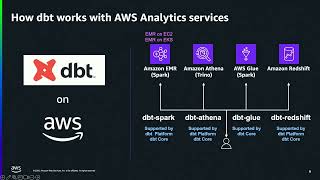
Best practice for leveraging Amazon Analytic Services + dbt

As organizations increasingly adopt modern data stacks, the combination of dbt and AWS Analytics services emerged as a powerful pairing for analytics engineering at scale. This session will explore proven strategies and hard-learned lessons for optimizing this technology stack to use dbt-athena, dbt-redshift, and dbt-glue to deliver reliable, performant data transformations. We will also cover case studies, best practices, and modern lakehouse scenarios with Apache Iceberg and Amazon S3 Tables.

Mamma mia! My data’s in the Iceberg

Iceberg is an open storage format for large analytical datasets that is now interoperable with most modern data platforms. But the setup is complicated, and caveats abound. Jeremy Cohen will tour the archipelago of Iceberg integrations — across data warehouses, catalogs, and dbt — and demonstrate the promise of cross platform dbt Mesh to provide flexibility and collaboration for data teams. The more the merrier.

dbt Mesh allowed for monolithic dbt projects to be broken down into more consumable and governed smaller projects. Now, learn how cross-platform mesh will allow you to take this one step further with development across data platforms using Iceberg tables. After this course you will be able to: Identify ideal use cases dbt Mesh Configure cross-project references between data platforms Navigate dbt Catalog Prerequisites for this course include: dbt Fundamentals, specifically data models and building model dependencies dbt Model governance Various data platforms What to bring: You will need to bring your own laptop to complete the hands-on exercises. We will provide all the other sandbox environments for dbt and data platform. Duration : 2 hours Fee : $200 Trainings and certifications are not offered separately and must be purchased with a Coalesce pass. Trainings and certifications are not available for Coalesce Online passes.

Below the tip of the Iceberg: How Wikimedia reduced reporting latency 10x using dbt and Iceberg

Learn how the Wikimedia Foundation implemented an on-prem, open source data lake to fund Wikipedia and the future of open knowledge. We'll discuss data architecture including challenges integrating open source tools, learnings from our implementation, how we achieved a 10x decrease in query run times, and more.

What’s new in the dbt language across Core and Fusion

The dbt language is growing to support new workflows across both dbt Core and the dbt Fusion engine. In this session, we’ll walk through the latest updates to dbt—from sample mode to iceberg catalogs to UDFs—showing how they work across different engines. You’ll also learn how to track the roadmap, contribute to development, and stay connected to the future of dbt.

Unleash the power of dbt on Google Cloud: BigQuery, Iceberg, DataFrames and beyond

The data world has long been divided, with data engineers and data scientists working in silos. This fragmentation creates a long, difficult journey from raw data to machine learning models. We've unified these worlds through the Google Cloud and dbt partnership. In this session, we'll show you an end-to-end workflow that simplifies data to AI journey. The availability of dbt Cloud on Google Cloud Marketplace streamlines getting started, and its integration with BigQuery's new Apache Iceberg tables creates an open foundation. We'll also highlight how BigQuery DataFrames' integration with dbt Python models lets you perform complex data science at scale, all within a single, streamlined process. Join us to learn how to build a unified data and AI platform with dbt on Google Cloud.

What’s the big deal about Apache Iceberg anyway? "Might Iceberg solve problems for my team?" "I’m using Iceberg already, but I find it lacking in key areas!" If you have any of the above thoughts, this peer exchange is for you! Last year’s peer exchange on Apache Iceberg was standing room only given all the hype surrounding the open table format. However, when participants were asked asked when they might start testing Iceberg capabilities, most said: “wait at least a few months for the dust to settle”. So now we’re a year later, the dust has settled, adoption of Iceberg by analytics engineers continue to grow. But, there’s still some open questions and product integrations to be built. Join your peers in socially constructing knowledge that’ll inform you for the year to come and beyond!