Discover how to build a powerful AI Lakehouse and unified data fabric natively on Google Cloud. Leverage BigQuery's serverless scale and robust analytics capabilities as the core, seamlessly integrating open data formats with Apache Iceberg and efficient processing using managed Spark environments like Dataproc. Explore the essential components of this modern data environment, including data architecture best practices, robust integration strategies, high data quality assurance, and efficient metadata management with Google Cloud Data Catalog. Learn how Google Cloud's comprehensive ecosystem accelerates advanced analytics, preparing your data for sophisticated machine learning initiatives and enabling direct connection to services like Vertex AI.
 talk-data.com
Topic
Iceberg
Apache Iceberg
206
tagged
Activity Trend
Top Events
Get ready for a customer story that’s as bold as it is eye-opening. In this session, Eutelsat and DataOps.live pull back the curtain on what it really takes to deliver business-changing outcomes with a specific focus on the Use Cases addressed by Apache at the core. And these Use Cases are BIG – think about big, big numbers, and you still aren’t even close!
You’ll hear the inside story of how Eutelsat found itself with two “competing” cloud data platforms. What could have been an expensive headache turned out to be an advantage: Iceberg made it not only possible but cheaper and simpler to use both together, unlocking agility and cost savings that no single platform alone could provide.
The impact is already tangible. Telemetry pipelines are live and delivering massive value. Next up: interoperable Data Products seamlessly moving from Snowflake to Cloudera and vice versa, driving cross-platform innovation. And that’s just the start—Eutelsat is also positioning Iceberg as a future-proof standard for data sharing and export.
This is a story of scale, speed, and simplification—the kind of transformation only possible when a visionary team meets the right technology.
Holly Smith will take a closer look at the three big projects in this space; Delta, Hudi and Iceberg. They’re all trying to solve for similar data problems and have tackled the various challenges in different ways. Her talk will start with the very basics of how we got here, what the history is before diving deep into the underlying tech, their roadmaps, and their impacts on the data landscape as a whole.
We’re excited to be back at Big Data LDN this year—huge thanks to the organisers for hosting Databricks London once more!
Join us for an evening of insights, networking, and community with the Databricks Team and Advancing Analytics!
🎤 Agenda:
6:00 PM – 6:10 PM | Kickoff & Warm Welcome
Grab a drink, say hi, and get the lowdown on what’s coming up. We’ll set the scene for an evening of learning and laughs.
6:10 PM – 6:50 PM | The Metadata Marathon: How three projects are racing forward – Holly Smith (Staff Developer Advocate, Databricks)
With the enormous amount of discussion about open storage formats between nerds and even not-nerds, it can be hard to keep track of who’s doing what and how this actually makes any impact on day to day data projects.
Holly will take a closer look at the three big projects in this space; Delta, Hudi and Iceberg. They’re all trying to solve for similar data problems and have tackled the various challenges in different ways. Her talk will start with the very basics of how we got here, what the history is before diving deep into the underlying tech, their roadmaps, and their impacts on the data landscape as a whole.
6:50 PM – 7:10 PM | What’s New in Databricks & Databricks AI – Simon Whiteley & Gavi Regunath
Hot off the press! Simon and Gavi will walk you through the latest and greatest from Databricks, including shiny new AI features and platform updates you’ll want to try ASAP.
7:10 PM onwards | Q&A Panel + Networking
Your chance to ask the experts anything—then stick around for drinks, snacks, and some good old-fashioned data geekery.
Data leaders today face a familiar challenge: complex pipelines, duplicated systems, and spiraling infrastructure costs. Standardizing around Kafka for real-time and Iceberg for large-scale analytics has gone some way towards addressing this but still requires separate stacks, leaving teams to stitch them together at high expense and risk.
This talk will explore how Kafka and Iceberg together form a new foundation for data infrastructure. One that unifies streaming and analytics into a single, cost-efficient layer. By standardizing on these open technologies, organizations can reduce data duplication, simplify governance, and unlock both instant insights and long-term value from the same platform.
You will come away with a clear understanding of why this convergence is reshaping the industry, how it lowers operational risk, and advantages it offers for building durable, future-proof data capabilities.
The modern enterprise is increasingly defined by the need for open, governed, and intelligent data access. This session explores how Apache Iceberg, Dremio, and the Model Context Protocol (MCP) come together to enable the Agentic Lakehouse. A data platform that is interoperable, high-performing, and AI-ready.
We’ll begin with Apache Iceberg, which provides the foundation for data interoperability across teams and organisations, ensuring shared datasets can be reliably accessed and evolved. From there, we’ll highlight how Dremio extends Iceberg with turnkey governance, management, and performance acceleration, unifying your lakehouse with databases and warehouses under one platform. Finally, we’ll introduce MCP and showcase how innovations like the Dremio MCP server enable natural-language analytics on your data.
With the power of Dremio’s built-in semantic layer, AI agents and humans alike can ask complex business questions in plain language and receive accurate, governed answers.
Join us to learn how to unlock the next generation of data interaction with the Agentic Lakehouse.
Do data differently with Qlik Open Lakehouse: optimized Iceberg performance, faster queries, and reduced cost at scale.
Unlock the true potential of your data with the Qlik Open Lakehouse, a revolutionary approach to Iceberg integration designed for the enterprise. Many organizations face the pain points of managing multiple, costly data platforms and struggling with low-latency ingestion. While Apache Iceberg offers robust features like ACID transactions and schema evolution, achieving optimal performance isn't automatic; it requires sophisticated maintenance. Introducing the Qlik Open Lakehouse, a fully managed and optimized solution built on Apache Iceberg, powered by Qlik's Adaptive Iceberg Optimizer. Discover how you can do data differently and achieve 10x faster queries, a 33-42% reduction in file API overhead, and ultimately, a 50% reduction in costs through streamlined operations and compute savings.
Data leaders today face a familiar challenge: complex pipelines, duplicated systems, and spiraling infrastructure costs. Standardizing around Kafka for real-time and Iceberg for large-scale analytics has gone some way towards addressing this but still requires separate stacks, leaving teams to stitch them together at high expense and risk.
This talk will explore how Kafka and Iceberg together form a new foundation for data infrastructure. One that unifies streaming and analytics into a single, cost-efficient layer. By standardizing on these open technologies, organizations can reduce data duplication, simplify governance, and unlock both instant insights and long-term value from the same platform.
You will come away with a clear understanding of why this convergence is reshaping the industry, how it lowers operational risk, and advantages it offers for building durable, future-proof data capabilities.
In this session, Paul Wilkinson, Principal Solutions Architect at Redpanda, will demonstrate Redpanda's native Iceberg capability: a game-changing addition that bridges the gap between real-time streaming and analytical workloads, eliminating the complexity of traditional data lake architectures while maintaining the performance and simplicity that Redpanda is known for.
Paul will explore how this new capability enables organizations to seamlessly transition streaming data into analytical formats without complex ETL pipelines or additional infrastructure overhead in a follow-along demo - allowing you to build your own streaming lakehouse and show it to your team!
So you’ve heard of Databricks, but still not sure what the fuss is all about. Yes you’ve heard it’s Spark, but then there’s this Delta thing that’s both a data lake and a data warehouse (isn’t that what Iceberg is?) And then there's Unity Catalog, that's not just a catalog, it also does access management but even surprising things like optimise your data and programmatic access to lineage and billing? But then serverless came out and now you don’t even have to learn Spark? And of course there’s a bunch of AI stuff to use or create yourself. So why not spend 30 mins learning the details of what Databricks does, and how it can turn you into a rockstar Data Engineer.
In today’s rapidly evolving data landscape, organisations face increasing pressure to maintain control and sovereignty over their data. After a quick introduction to Apache Iceberg and Apache Polaris (Incubating), this session will dive into a real world use case demonstrating how these technologies can power a robust, governance focused data platform. We’ll explore strategies to secure access to data, discuss upcoming roadmap features like RBAC, FGAC, and ABAC, and show how to build custom extensions to tailor governance to your organisation’s needs.
Moving data between operational systems and analytics platforms is often a painful process. Traditional pipelines that transfer data in and out of warehouses tend to become complex, brittle, and expensive to maintain over time.
Much of this complexity, however, is avoidable. Data in motion and data at rest—Kafka Topics and Iceberg Tables—can be treated as two sides of the same coin. By establishing an equivalence between Topics and Tables, it’s possible to transparently map between them and rethink how pipelines are built.
This talk introduces a declarative approach to bridging streaming and table-based systems. By shifting complexity into the data layer, we can decompose complex, imperative pipelines into simpler, more reliable workflows
We’ll explore the design principles behind this approach, including schema mapping and evolution between Kafka and Iceberg, and how to build a system that can continuously materialize and optimize hundreds of thousands of topics as Iceberg tables.
Whether you're building new pipelines or modernizing legacy systems, this session will provide practical patterns and strategies for creating resilient, scalable, and future-proof data architectures.
Data leaders today face a familiar challenge: complex pipelines, duplicated systems, and spiraling infrastructure costs. Standardizing around Kafka for real-time and Iceberg for large-scale analytics has gone some way towards addressing this but still requires separate stacks, leaving teams to stitch them together at high expense and risk.
This talk will explore how Kafka and Iceberg together form a new foundation for data infrastructure. One that unifies streaming and analytics into a single, cost-efficient layer. By standardizing on these open technologies, organizations can reduce data duplication, simplify governance, and unlock both instant insights and long-term value from the same platform.
You will come away with a clear understanding of why this convergence is reshaping the industry, how it lowers operational risk, and advantages it offers for building durable, future-proof data capabilities.
Data leaders today face a familiar challenge: complex pipelines, duplicated systems, and spiraling infrastructure costs. Standardizing around Kafka for real-time and Iceberg for large-scale analytics has gone some way towards addressing this but still requires separate stacks, leaving teams to stitch them together at high expense and risk. This talk will explore how Kafka and Iceberg together form a new foundation for data infrastructure. One that unifies streaming and analytics into a single, cost-efficient layer. By standardizing on these open technologies, organizations can reduce data duplication, simplify governance, and unlock both instant insights and long-term value from the same platform. You will come away with a clear understanding of why this convergence is reshaping the industry, how it lowers operational risk, and advantages it offers for building durable, future-proof data capabilities.
At first, streaming Postgres changes into Iceberg feels like a no-brainer. You spin up Debezium or Kafka Connect, point it at Iceberg, and it all looks boringly straightforward. The surprise comes once the pipeline hits production. Replication slots vanish and start filling up WAL space, LSNs don't line up and cause duplicates or gaps, and Iceberg sinks fail in ways that push back all the way to your primary database. Then you throw in schema changes, backfills, and compaction, and suddenly the \"boring\" pipeline becomes a source of late-night firefights. In this talk, I'll share real stories from running Postgres to Iceberg CDC pipelines in production. We'll look at the unexpected problems that show up, why they happen, and the strategies that actually helped keep things stable. If you've ever thought of Postgres -> Iceberg as just plumbing, this session will show you why it's not so boring after all.
En regardant certaines des premières pull requests dans le repository ClickHouse, vous verrez un fort accent mis sur l’intégration avec des systèmes externes. Au fil du temps, ClickHouse est devenu un puissant pont entre les data lakes et les data warehouses, prenant en charge les files d’attente, les bases de données et les object stores, avec une compatibilité pour plus de 60 formats d’entrée et de sortie. Cette polyvalence permet aux utilisateurs de bénéficier de la flexibilité d’un data lake tout en conservant les performances de requêtes en temps réel.
Dans cette session, nous discuterons de la manière dont nos utilisateurs exploitent ClickHouse et Iceberg, ainsi que de certaines fonctionnalités en cours de développement pour faciliter cette mouvance.
Discussion of Rightmove's data hive and analytics platform.
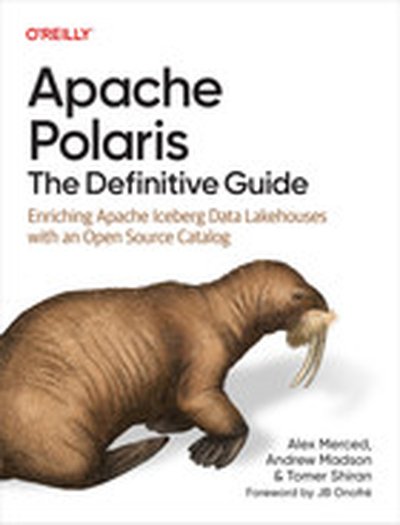
Revolutionize your understanding of modern data management with Apache Polaris (incubating), the open source catalog designed for data lakehouse industry standard Apache Iceberg. This comprehensive guide takes you on a journey through the intricacies of Apache Iceberg data lakehouses, highlighting the pivotal role of Iceberg catalogs. Authors Alex Merced, Andrew Madson, and Tomer Shiran explore Apache Polaris's architecture and features in detail, equipping you with the knowledge needed to leverage its full potential. Data engineers, data architects, data scientists, and data analysts will learn how to seamlessly integrate Apache Polaris with popular data tools like Apache Spark, Snowflake, and Dremio to enhance data management capabilities, optimize workflows, and secure datasets. Get a comprehensive introduction to Iceberg data lakehouses Understand how catalogs facilitate efficient data management and querying in Iceberg Explore Apache Polaris's unique architecture and its powerful features Deploy Apache Polaris locally, and deploy managed Apache Polaris from Snowflake and Dremio Perform basic table operations on Apache Spark, Snowflake, and Dremio
Summary In this episode of the Data Engineering Podcast Hannes Mühleisen and Mark Raasveldt, the creators of DuckDB, share their work on Duck Lake, a new entrant in the open lakehouse ecosystem. They discuss how Duck Lake, is focused on simplicity, flexibility, and offers a unified catalog and table format compared to other lakehouse formats like Iceberg and Delta. Hannes and Mark share insights into how Duck Lake revolutionizes data architecture by enabling local-first data processing, simplifying deployment of lakehouse solutions, and offering benefits such as encryption features, data inlining, and integration with existing ecosystems.
Announcements Hello and welcome to the Data Engineering Podcast, the show about modern data managementData teams everywhere face the same problem: they're forcing ML models, streaming data, and real-time processing through orchestration tools built for simple ETL. The result? Inflexible infrastructure that can't adapt to different workloads. That's why Cash App and Cisco rely on Prefect. Cash App's fraud detection team got what they needed - flexible compute options, isolated environments for custom packages, and seamless data exchange between workflows. Each model runs on the right infrastructure, whether that's high-memory machines or distributed compute. Orchestration is the foundation that determines whether your data team ships or struggles. ETL, ML model training, AI Engineering, Streaming - Prefect runs it all from ingestion to activation in one platform. Whoop and 1Password also trust Prefect for their data operations. If these industry leaders use Prefect for critical workflows, see what it can do for you at dataengineeringpodcast.com/prefect.Data migrations are brutal. They drag on for months—sometimes years—burning through resources and crushing team morale. Datafold's AI-powered Migration Agent changes all that. Their unique combination of AI code translation and automated data validation has helped companies complete migrations up to 10 times faster than manual approaches. And they're so confident in their solution, they'll actually guarantee your timeline in writing. Ready to turn your year-long migration into weeks? Visit dataengineeringpodcast.com/datafold today for the details. Your host is Tobias Macey and today I'm interviewing Hannes Mühleisen and Mark Raasveldt about DuckLake, the latest entrant into the open lakehouse ecosystemInterview IntroductionHow did you get involved in the area of data management?Can you describe what DuckLake is and the story behind it?What are the particular problems that DuckLake is solving for?How does this compare to the capabilities of MotherDuck?Iceberg and Delta already have a well established ecosystem, but so does DuckDB. Who are the primary personas that you are trying to focus on in these early days of DuckLake?One of the major factors driving the adoption of formats like Iceberg is cost efficiency for large volumes of data. That brings with it challenges of large batch processing of data. How does DuckLake account for these axes of scale?There is also a substantial investment in the ecosystem of technologies that support Iceberg. The most notable ecosystem challenge for DuckDB and DuckLake is in the query layer. How are you thinking about the evolution and growth of that capability beyond DuckDB (e.g. support in Trino/Spark/Flink)?What are your opinions on the viability of a future where DuckLake and Iceberg become a unified standard and implementation? (why can't Iceberg REST catalog implementations just use DuckLake under the hood?)Digging into the specifics of the specification and implementation, what are some of the capabilities that it offers above and beyond Iceberg?Is it now possible to enforce PK/FK constraints, indexing on underlying data?Given that DuckDB has a vector type, how do you think about the support for vector storage/indexing?How do the capabilities of DuckLake and the integration with DuckDB change the ways that data teams design their data architecture and access patterns?What are your thoughts on the impact of "data gravity" in today's data ecosystem, with engines like DuckDB, KuzuDB, LanceDB, etc. available for embedded and edge use cases?What are the most interesting, innovative, or unexpected ways that you have seen DuckLake used?What are the most interesting, unexpected, or challenging lessons that you have learned while working on DuckLake?When is DuckLake the wrong choice?What do you have planned for the future of DuckLake?Contact Info HannesWebsiteMarkWebsiteParting Question From your perspective, what is the biggest gap in the tooling or technology for data management today?Closing Announcements Thank you for listening! Don't forget to check out our other shows. Podcast.init covers the Python language, its community, and the innovative ways it is being used. The AI Engineering Podcast is your guide to the fast-moving world of building AI systems.Visit the site to subscribe to the show, sign up for the mailing list, and read the show notes.If you've learned something or tried out a project from the show then tell us about it! Email [email protected] with your story.Links DuckDBPodcast EpisodeDuckLakeDuckDB LabsMySQLCWIMonetDBIcebergIceberg REST CatalogDeltaHudiLanceDuckDB Iceberg ConnectorACID == Atomicity, Consistency, Isolation, DurabilityMotherDuckMotherDuck Managed DuckLakeTrinoSparkPrestoSpark DuckLake DemoDelta KernelArrowdltS3 TablesAttribute Based Access Control (ABAC)ParquetArrow FlightHadoopHDFSDuckLake RoadmapThe intro and outro music is from The Hug by The Freak Fandango Orchestra / CC BY-SA