talk-data.com talk-data.com

Topic

Stitch

etl data_integration cloud

19

tagged

Activity Trend

4 peak/qtr
2020-Q1 2026-Q1

Activities

19 activities · Newest first

In this session, we’ll walk through why we decided to abandon Redshift, driven by the need for elasticity, cost efficiency, and faster iteration. We'll also discuss how we designed a structured migration blueprint, including a vendor evaluation, proof of concept, and a four-pillared framework to guide our journey.

We’ll then dive into the areas where things got turbulent: why off-the-shelf translation tools failed, why LLMs didn’t help, and the specific technical challenges we encountered. From surrogate key issues to Stitch's unflattened data and Snowplow’s monolithic event tables.

We’ll explain how we kept the migration on track by turning our analysts into co-navigators, embedding them into validation loops to leverage domain knowledge, and how a parallel ingestion strategy helped stabilize progress during high-risk phases.

Finally, we’ll share what this migration unlocked for us: faster ingestion, better permission management and more. Expect real-world pitfalls, lessons learned, and actionable insights for your own migration journey.

Join Amperity’s Marcus Owens, Lead Solution Consultant, to learn more about the rapid innovations in data architecture brought by the new wave of AI agents. This session will start with a quick overview of what makes a good AI Agent – and then focus on how Agentic strategies can accelerate two key needs in customer data: 

Make Customer Data Usable – How AI Agents accelerate customer data engineering with Amperity’s Stitch and Chuck Data – saving data engineering teams hundreds of hours of effort. 

Make Use of Customer Data – How AmpAI allows Marketers to build outcome-driven customer journeys, going from intent to results faster than ever before.

Data leaders today face a familiar challenge: complex pipelines, duplicated systems, and spiraling infrastructure costs. Standardizing around Kafka for real-time and Iceberg for large-scale analytics has gone some way towards addressing this but still requires separate stacks, leaving teams to stitch them together at high expense and risk.

This talk will explore how Kafka and Iceberg together form a new foundation for data infrastructure. One that unifies streaming and analytics into a single, cost-efficient layer. By standardizing on these open technologies, organizations can reduce data duplication, simplify governance, and unlock both instant insights and long-term value from the same platform.

You will come away with a clear understanding of why this convergence is reshaping the industry, how it lowers operational risk, and advantages it offers for building durable, future-proof data capabilities.

Data leaders today face a familiar challenge: complex pipelines, duplicated systems, and spiraling infrastructure costs. Standardizing around Kafka for real-time and Iceberg for large-scale analytics has gone some way towards addressing this but still requires separate stacks, leaving teams to stitch them together at high expense and risk.

This talk will explore how Kafka and Iceberg together form a new foundation for data infrastructure. One that unifies streaming and analytics into a single, cost-efficient layer. By standardizing on these open technologies, organizations can reduce data duplication, simplify governance, and unlock both instant insights and long-term value from the same platform.

You will come away with a clear understanding of why this convergence is reshaping the industry, how it lowers operational risk, and advantages it offers for building durable, future-proof data capabilities.

Data leaders today face a familiar challenge: complex pipelines, duplicated systems, and spiraling infrastructure costs. Standardizing around Kafka for real-time and Iceberg for large-scale analytics has gone some way towards addressing this but still requires separate stacks, leaving teams to stitch them together at high expense and risk.

This talk will explore how Kafka and Iceberg together form a new foundation for data infrastructure. One that unifies streaming and analytics into a single, cost-efficient layer. By standardizing on these open technologies, organizations can reduce data duplication, simplify governance, and unlock both instant insights and long-term value from the same platform.

You will come away with a clear understanding of why this convergence is reshaping the industry, how it lowers operational risk, and advantages it offers for building durable, future-proof data capabilities.

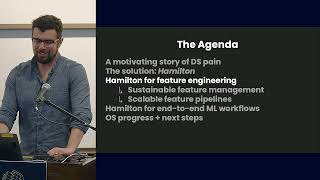
Scalable & Sustainable Feature Engineering with Hamilton | DAGWorks

ABOUT THE TALK: Hamilton is a novel open-source framework for developing and maintaining scalable feature engineering dataflows.

We introduce the framework, discuss its motivations and initial successes at Stitch Fix, showcase its lightweight data lineage and catalog abilities, and share recent extensions that seamlessly integrate it with distributed compute offerings, such as Dask, Ray, and Spark.

ABOUT THE SPEAKER: Elijah Ben Izzy has always enjoyed working at the intersection of math and engineering. He has more recently focused on building tools to make data scientists and researchers more productive.

He built infrastructure to help quantitative researchers efficiently turn ideas into production trading models at Two Sigma and ran the Model Lifecycle team at Stitch Fix.

He is now the CTO at DAGWorks, which aims to solve the problem of building and maintaining complex ETLs for machine learning.

ABOUT DATA COUNCIL: Data Council (https://www.datacouncil.ai/) is a community and conference series that provides data professionals with the learning and networking opportunities they need to grow their careers.

Make sure to subscribe to our channel for the most up-to-date talks from technical professionals on data related topics including data infrastructure, data engineering, ML systems, analytics and AI from top startups and tech companies.

FOLLOW DATA COUNCIL: Twitter: https://twitter.com/DataCouncilAI LinkedIn: https://www.linkedin.com/company/datacouncil-ai/

Summary

Business intelligence has gone through many generational shifts, but each generation has largely maintained the same workflow. Data analysts create reports that are used by the business to understand and direct the business, but the process is very labor and time intensive. The team at Omni have taken a new approach by automatically building models based on the queries that are executed. In this episode Chris Merrick shares how they manage integration and automation around the modeling layer and how it improves the organizational experience of business intelligence.

Announcements

Hello and welcome to the Data Engineering Podcast, the show about modern data management Truly leveraging and benefiting from streaming data is hard - the data stack is costly, difficult to use and still has limitations. Materialize breaks down those barriers with a true cloud-native streaming database - not simply a database that connects to streaming systems. With a PostgreSQL-compatible interface, you can now work with real-time data using ANSI SQL including the ability to perform multi-way complex joins, which support stream-to-stream, stream-to-table, table-to-table, and more, all in standard SQL. Go to dataengineeringpodcast.com/materialize today and sign up for early access to get started. If you like what you see and want to help make it better, they're hiring across all functions! Your host is Tobias Macey and today I'm interviewing Chris Merrick about the Omni Analytics platform and how they are adding automatic data modeling to your business intelligence

Interview

Introduction How did you get involved in the area of data management? Can you describe what Omni Analytics is and the story behind it?

What are the core goals that you are trying to achieve with building Omni?

Business intelligence has gone through many evolutions. What are the unique capabilities that Omni Analytics offers over other players in the market?

What are the technical and organizational anti-patterns that typically grow up around BI systems?

What are the elements that contribute to BI being such a difficult product to use effectively in an organization?

Can you describe how you have implemented the Omni platform?

How have the design/scope/goals of the product changed since you first started working on it?

What does the workflow for a team using Omni look like?

What are some of the developments in the broader ecosystem that have made your work possible?

What are some of the positive and negative inspirations that you have drawn from the experience that you and your team-mates have gained in previous businesses?

What are the most interesting, innovative, or unexpected ways that you have seen Omni used?

What are the most interesting, unexpected, or challenging lessons that you have learned while working on Omni?

When is Omni the wrong choice?

What do you have planned for the future of Omni?

Contact Info

LinkedIn @cmerrick on Twitter

Parting Question

From your perspective, what is the biggest gap in the tooling or technology for data management today?

Closing Announcements

Thank you for listening! Don't forget to check out our other shows. Podcast.init covers the Python language, its community, and the innovative ways it is being used. The Machine Learning Podcast helps you go from idea to production with machine learning. Visit the site to subscribe to the show, sign up for the mailing list, and read the show notes. If you've learned something or tried out a project from the show then tell us about it! Email [email protected]) with your story. To help other people find the show please leave a review on Apple Podcasts and tell your friends and co-workers

Links

Omni Analytics Stitch RJ Metrics Looker

Podcast Episode

Singer dbt

Podcast Episode

Teradata Fivetran Apache Arrow

Podcast Episode

DuckDB

Podcast Episode

BigQuery Snowflake

Podcast Episode

The intro and outro music is from The Hug by The Freak Fandango Orchestra / CC BY-SA Sponsored By: Materialize: Materialize

Looking for the simplest way to get the freshest data possible to your teams? Because let's face it: if real-time were easy, everyone would be using it. Look no further than Materialize, the streaming database you already know how to use.

Materialize’s PostgreSQL-compatible interface lets users leverage the tools they already use, with unsurpassed simplicity enabled by full ANSI SQL support. Delivered as a single platform with the separation of storage and compute, strict-serializability, active replication, horizontal scalability and workload isolation — Materialize is now the fastest way to build products with streaming data, drastically reducing the time, expertise, cost and maintenance traditionally associated with implementation of real-time features.

Sign up now for early access to Materialize and get started with the power of streaming data with the same simplicity and low implementation cost as batch cloud data warehouses.

Go to materialize.comSupport Data Engineering Podcast

Send us a text In this podcast we introduce you to the wonders of Airbyte with Frederik de Smedt. Airbyte is an open-source data pipeline platform that serves as an alternative to Stitch data and Fivetran.

Check out more about Airbyte here: GithubOfficial websiteTour de Tools is brought to you by Dataroots Music from Uppbeat (free for Creators!)thumbnail: the official logo of airbyte

Delta Live Tables: Modern Software Engineering and Management for ETL

Data engineers have the difficult task of cleansing complex, diverse data, and transforming it into a usable source to drive data analytics, data science, and machine learning. They need to know the data infrastructure platform in depth, build complex queries in various languages and stitch them together for production. Join this talk to learn how Delta Live Tables (DLT) simplifies the complexity of data transformation and ETL. DLT is the first ETL framework to use modern software engineering practices to deliver reliable and trusted data pipelines at any scale. Discover how analysts and data engineers can innovate rapidly with simple pipeline development and maintenance, how to remove operational complexity by automating administrative tasks and gaining visibility into pipeline operations, how built-in quality controls and monitoring ensure accurate BI, data science, and ML, and how simplified batch and streaming can be implemented with self-optimizing and auto-scaling data pipelines.

Connect with us: Website: https://databricks.com Facebook: https://www.facebook.com/databricksinc Twitter: https://twitter.com/databricks LinkedIn: https://www.linkedin.com/company/data... Instagram: https://www.instagram.com/databricksinc/

Fundamentals of Data Engineering

Data engineering has grown rapidly in the past decade, leaving many software engineers, data scientists, and analysts looking for a comprehensive view of this practice. With this practical book, you'll learn how to plan and build systems to serve the needs of your organization and customers by evaluating the best technologies available through the framework of the data engineering lifecycle. Authors Joe Reis and Matt Housley walk you through the data engineering lifecycle and show you how to stitch together a variety of cloud technologies to serve the needs of downstream data consumers. You'll understand how to apply the concepts of data generation, ingestion, orchestration, transformation, storage, and governance that are critical in any data environment regardless of the underlying technology. This book will help you: Get a concise overview of the entire data engineering landscape Assess data engineering problems using an end-to-end framework of best practices Cut through marketing hype when choosing data technologies, architecture, and processes Use the data engineering lifecycle to design and build a robust architecture Incorporate data governance and security across the data engineering lifecycle

Summary Collecting, integrating, and activating data are all challenging activities. When that data pertains to your customers it can become even more complex. To simplify the work of managing the full flow of your customer data and keep you in full control the team at Rudderstack created their eponymous open source platform that allows you to work with first and third party data, as well as build and manage reverse ETL workflows. In this episode CEO and founder Soumyadeb Mitra explains how Rudderstack compares to the various other tools and platforms that share some overlap, how to set it up for your own data needs, and how it is architected to scale to meet demand.

Announcements

Hello and welcome to the Data Engineering Podcast, the show about modern data management When you’re ready to build your next pipeline, or want to test out the projects you hear about on the show, you’ll need somewhere to deploy it, so check out our friends at Linode. With their managed Kubernetes platform it’s now even easier to deploy and scale your workflows, or try out the latest Helm charts from tools like Pulsar and Pachyderm. With simple pricing, fast networking, object storage, and worldwide data centers, you’ve got everything you need to run a bulletproof data platform. Go to dataengineeringpodcast.com/linode today and get a $100 credit to try out a Kubernetes cluster of your own. And don’t forget to thank them for their continued support of this show! Today’s episode is Sponsored by Prophecy.io – the low-code data engineering platform for the cloud. Prophecy provides an easy-to-use visual interface to design & deploy data pipelines on Apache Spark & Apache Airflow. Now all the data users can use software engineering best practices – git, tests and continuous deployment with a simple to use visual designer. How does it work? – You visually design the pipelines, and Prophecy generates clean Spark code with tests on git; then you visually schedule these pipelines on Airflow. You can observe your pipelines with built in metadata search and column level lineage. Finally, if you have existing workflows in AbInitio, Informatica or other ETL formats that you want to move to the cloud, you can import them automatically into Prophecy making them run productively on Spark. Create your free account today at dataengineeringpodcast.com/prophecy. The only thing worse than having bad data is not knowing that you have it. With Bigeye’s data observability platform, if there is an issue with your data or data pipelines you’ll know right away and can get it fixed before the business is impacted. Bigeye let’s data teams measure, improve, and communicate the quality of your data to company stakeholders. With complete API access, a user-friendly interface, and automated yet flexible alerting, you’ve got everything you need to establish and maintain trust in your data. Go to dataengineeringpodcast.com/bigeye today to sign up and start trusting your analyses. Your host is Tobias Macey and today I’m interviewing Soumyadeb Mitra about his experience as the founder of Rudderstack and its role in your data platform

Interview

Introduction How did you get involved in the area of data management? Can you describe what Rudderstack is and the story behind it? What are the main use cases that Rudderstack is designed to support? Who are the target users of Rudderstack?

How does the availability of the managed cloud service change the user profiles that you can target? How do these user profiles influence your focus and prioritization of features and user experience?

How would you characterize the position of Rudderstack in the current data ecosystem?

What other tools/systems might you replace with Rudderstack?

How do you think about the application of Rudderstack compared to tools for data integration (e.g. Singer, Stitch, Fivetran) and reverse ETL (e.g. Grouparoo, Hightouch, Census)? Can you describe how the Rudderstack platform is desig

How to Lead in Data Science

A field guide for the unique challenges of data science leadership, filled with transformative insights, personal experiences, and industry examples. In How To Lead in Data Science you will learn: Best practices for leading projects while balancing complex trade-offs Specifying, prioritizing, and planning projects from vague requirements Navigating structural challenges in your organization Working through project failures with positivity and tenacity Growing your team with coaching, mentoring, and advising Crafting technology roadmaps and championing successful projects Driving diversity, inclusion, and belonging within teams Architecting a long-term business strategy and data roadmap as an executive Delivering a data-driven culture and structuring productive data science organizations How to Lead in Data Science is full of techniques for leading data science at every seniority level—from heading up a single project to overseeing a whole company's data strategy. Authors Jike Chong and Yue Cathy Chang share hard-won advice that they've developed building data teams for LinkedIn, Acorns, Yiren Digital, large asset-management firms, Fortune 50 companies, and more. You'll find advice on plotting your long-term career advancement, as well as quick wins you can put into practice right away. Carefully crafted assessments and interview scenarios encourage introspection, reveal personal blind spots, and highlight development areas. About the Technology Lead your data science teams and projects to success! To make a consistent, meaningful impact as a data science leader, you must articulate technology roadmaps, plan effective project strategies, support diversity, and create a positive environment for professional growth. This book delivers the wisdom and practical skills you need to thrive as a data science leader at all levels, from team member to the C-suite. About the Book How to Lead in Data Science shares unique leadership techniques from high-performance data teams. It’s filled with best practices for balancing project trade-offs and producing exceptional results, even when beginning with vague requirements or unclear expectations. You’ll find a clearly presented modern leadership framework based on current case studies, with insights reaching all the way to Aristotle and Confucius. As you read, you’ll build practical skills to grow and improve your team, your company’s data culture, and yourself. What's Inside How to coach and mentor team members Navigate an organization’s structural challenges Secure commitments from other teams and partners Stay current with the technology landscape Advance your career About the Reader For data science practitioners at all levels. About the Authors Dr. Jike Chong and Yue Cathy Chang build, lead, and grow high-performing data teams across industries in public and private companies, such as Acorns, LinkedIn, large asset-management firms, and Fortune 50 companies. Quotes Spot-on as a career resource! Captures what’s important to be successful as a data scientist. - Eric Colson, Former Data Executive at Stitch Fix, Netflix The first-of-its-kind book to discuss data science career development in a systematic way! Highly valuable and timely in a world that generates more and more data!” - Michael Li, VP of Data at Coinbase A valuable reference filled with new and useful coaching and techniques. A must-have. - Jesse Bridgewater, VP Data Science at Brightline, formerly Livongo, Twitter, eBay A great book providing frameworks and tools that help contemplate and address key problems faced by data science leaders. - Ron Kohavi, Best-selling Author, Former Executive at Airbnb, Microsoft, Amazon

Summary All of the fancy data platform tools and shiny dashboards that you use are pointless if the consumers of your analysis don’t have trust in the answers. Stemma helps you establish and maintain that trust by giving visibility into who is using what data, annotating the reports with useful context, and understanding who is responsible for keeping it up to date. In this episode Mark Grover explains what he is building at Stemma, how it expands on the success of the Amundsen project, and why trust is the most important asset for data teams.

Announcements

Hello and welcome to the Data Engineering Podcast, the show about modern data management When you’re ready to build your next pipeline, or want to test out the projects you hear about on the show, you’ll need somewhere to deploy it, so check out our friends at Linode. With their managed Kubernetes platform it’s now even easier to deploy and scale your workflows, or try out the latest Helm charts from tools like Pulsar and Pachyderm. With simple pricing, fast networking, object storage, and worldwide data centers, you’ve got everything you need to run a bulletproof data platform. Go to dataengineeringpodcast.com/linode today and get a $100 credit to try out a Kubernetes cluster of your own. And don’t forget to thank them for their continued support of this show! RudderStack’s smart customer data pipeline is warehouse-first. It builds your customer data warehouse and your identity graph on your data warehouse, with support for Snowflake, Google BigQuery, Amazon Redshift, and more. Their SDKs and plugins make event streaming easy, and their integrations with cloud applications like Salesforce and ZenDesk help you go beyond event streaming. With RudderStack you can use all of your customer data to answer more difficult questions and then send those insights to your whole customer data stack. Sign up free at dataengineeringpodcast.com/rudder today. We’ve all been asked to help with an ad-hoc request for data by the sales and marketing team. Then it becomes a critical report that they need updated every week or every day. Then what do you do? Send a CSV via email? Write some Python scripts to automate it? But what about incremental sync, API quotas, error handling, and all of the other details that eat up your time? Today, there is a better way. With Census, just write SQL or plug in your dbt models and start syncing your cloud warehouse to SaaS applications like Salesforce, Marketo, Hubspot, and many more. Go to dataengineeringpodcast.com/census today to get a free 14-day trial. Your host is Tobias Macey and today I’m interviewing Mark Grover about his work at Stemma to bring the Amundsen project to a wider audience and increase trust in their data.

Interview

Introduction Can you describe what Stemma is and the story behind it? Can you give me more context into how and why Stemma fits into the current data engineering world? Among the popular tools of today for data warehousing and other products that stitch data together – what is Stemma’s place? Where does it fit into the workflow? How has the explosion in options for data cataloging and discovery influenced your thinking on the necessary feature set for that class of tools? How do you compare to your competitors With how long we have been using data and building systems to analyze it, why do you think that trust in the results is still such a momentous problem? Tell me more about Stemma and how it compares to Amundsen? Can you tell me more about the impact of Stemma/Amundsen to companies that use it? What are the opportunities for innovating on top of Stemma to help organizations streamline communication between data producers and consumers? Beyond the technological capabilities of a data platform, the bigger question is usually the social/organizational patterns around data. How have the "best practices" around the people side of data changed in the recent past?

What are the points of friction that

Brian Amadio is a Data Platform Engineer at Stitch Fix, where experimentation underpins everything they do across merchandising, planning, forecasting, operations and more.  In this conversation with Tristan, Julia, and Brian you'll get into the weeds of executing multi-armed bandit experiments and learn how you can perform experiments even with limited data.  For full show notes and to read 6+ years of back issues of the podcast's companion newsletter, head to https://roundup.getdbt.com. The Analytics Engineering Podcast is sponsored by dbt Labs.

97 Things Every Data Engineer Should Know

Take advantage of today's sky-high demand for data engineers. With this in-depth book, current and aspiring engineers will learn powerful real-world best practices for managing data big and small. Contributors from notable companies including Twitter, Google, Stitch Fix, Microsoft, Capital One, and LinkedIn share their experiences and lessons learned for overcoming a variety of specific and often nagging challenges. Edited by Tobias Macey, host of the popular Data Engineering Podcast, this book presents 97 concise and useful tips for cleaning, prepping, wrangling, storing, processing, and ingesting data. Data engineers, data architects, data team managers, data scientists, machine learning engineers, and software engineers will greatly benefit from the wisdom and experience of their peers. Topics include: The Importance of Data Lineage - Julien Le Dem Data Security for Data Engineers - Katharine Jarmul The Two Types of Data Engineering and Data Engineers - Jesse Anderson Six Dimensions for Picking an Analytical Data Warehouse - Gleb Mezhanskiy The End of ETL as We Know It - Paul Singman Building a Career as a Data Engineer - Vijay Kiran Modern Metadata for the Modern Data Stack - Prukalpa Sankar Your Data Tests Failed! Now What? - Sam Bail

Summary Data integration is a critical piece of every data pipeline, yet it is still far from being a solved problem. There are a number of managed platforms available, but the list of options for an open source system that supports a large variety of sources and destinations is still embarrasingly short. The team at Airbyte is adding a new entry to that list with the goal of making robust and easy to use data integration more accessible to teams who want or need to maintain full control of their data. In this episode co-founders John Lafleur and Michel Tricot share the story of how and why they created Airbyte, discuss the project’s design and architecture, and explain their vision of what an open soure data integration platform should offer. If you are struggling to maintain your extract and load pipelines or spending time on integrating with a new system when you would prefer to be working on other projects then this is definitely a conversation worth listening to.

Announcements

Hello and welcome to the Data Engineering Podcast, the show about modern data management When you’re ready to build your next pipeline, or want to test out the projects you hear about on the show, you’ll need somewhere to deploy it, so check out our friends at Linode. With their managed Kubernetes platform it’s now even easier to deploy and scale your workflows, or try out the latest Helm charts from tools like Pulsar and Pachyderm. With simple pricing, fast networking, object storage, and worldwide data centers, you’ve got everything you need to run a bulletproof data platform. Go to dataengineeringpodcast.com/linode today and get a $100 credit to try out a Kubernetes cluster of your own. And don’t forget to thank them for their continued support of this show! Modern Data teams are dealing with a lot of complexity in their data pipelines and analytical code. Monitoring data quality, tracing incidents, and testing changes can be daunting and often takes hours to days. Datafold helps Data teams gain visibility and confidence in the quality of their analytical data through data profiling, column-level lineage and intelligent anomaly detection. Datafold also helps automate regression testing of ETL code with its Data Diff feature that instantly shows how a change in ETL or BI code affects the produced data, both on a statistical level and down to individual rows and values. Datafold integrates with all major data warehouses as well as frameworks such as Airflow & dbt and seamlessly plugs into CI workflows. Go to dataengineeringpodcast.com/datafold today to start a 30-day trial of Datafold. Once you sign up and create an alert in Datafold for your company data, they will send you a cool water flask. RudderStack’s smart customer data pipeline is warehouse-first. It builds your customer data warehouse and your identity graph on your data warehouse, with support for Snowflake, Google BigQuery, Amazon Redshift, and more. Their SDKs and plugins make event streaming easy, and their integrations with cloud applications like Salesforce and ZenDesk help you go beyond event streaming. With RudderStack you can use all of your customer data to answer more difficult questions and then send those insights to your whole customer data stack. Sign up free at dataengineeringpodcast.com/rudder today. Your host is Tobias Macey and today I’m interviewing Michel Tricot and John Lafleur about Airbyte, an open source framework for building data integration pipelines.

Interview

Introduction How did you get involved in the area of data management? Can you start by explaining what Airbyte is and the story behind it? Businesses and data engineers have a variety of options for how to manage their data integration. How would you characterize the overall landscape and how does Airbyte distinguish itself in that space? How would you characterize your target users?

How have those personas instructed the priorities and design of Airbyte? What do you see as the benefits and tradeoffs of a UI oriented data integration platform as compared to a code first approach?

what are the complex/challenging elements of data integration that makes it such a slippery problem? motivation for creating open source ELT as a business Can you describe how the Airbyte platform is implemented?

What was your motivation for choosing Java as the primary language?

incidental complexity of forcing all connectors to be packaged as containers shortcomings of the Singer specification/motivation for creating a backwards incompatible interface perceived potential for community adoption of Airbyte specification tradeoffs of using JSON as interchange format vs. e.g. protobuf/gRPC/Avro/etc.

information lost when converting records to JSON types/how to preserve that information (e.g. field constraints, valid enums, etc.)

interfaces/extension points for integrating with other tools, e.g. Dagster abstraction layers for simplifying implementation of new connectors tradeoffs of storing all connectors in a monorepo with the Airbyte core

impact of community adoption/contributions

What is involved in setting up an Airbyte installation? What are the available axes for scaling an Airbyte deployment? challenges of setting up and maintaining CI environment for Airbyte How are you managing governance and long term sustainability of the project? What are some of the most interesting, unexpected, or innovative ways that you have seen Airbyte used? What are the most interesting, unexpected, or challenging lessons that you have learned while building Airbyte? When is Airbyte the wrong choice? What do you have planned for the future of the project?

Contact Info

Michel

LinkedIn @MichelTricot on Twitter michel-tricot on GitHub

John

LinkedIn @JeanLafleur on Twitter johnlafleur on GitHub

Parting Question

From your perspective, what is the biggest gap in the tooling or technology for data management today?

Links

Airbyte Liveramp Fivetran

Podcast Episode

Stitch Data Matillion DataCoral

Podcast Episode

Singer Meltano

Podcast Episode

Airflow

Podcast.init Episode

Kotlin Docker Monorepo Airbyte Specification Great Expectations

Podcast Episode

Dagster

Data Engineering Podcast Episode Podcast.init Episode

Prefect

Podcast Episode

DBT

Podcast Episode

Kubernetes Snowflake

Podcast Episode

Redshift Presto Spark Parquet

Podcast Episode

The intro and outro music is from The Hug by The Freak Fandango Orchestra / CC BY-SA

Support Data Engineering Podcast

Summary In recent years the traditional approach to building data warehouses has shifted from transforming records before loading, to transforming them afterwards. As a result, the tooling for those transformations needs to be reimagined. The data build tool (dbt) is designed to bring battle tested engineering practices to your analytics pipelines. By providing an opinionated set of best practices it simplifies collaboration and boosts confidence in your data teams. In this episode Drew Banin, creator of dbt, explains how it got started, how it is designed, and how you can start using it today to create reliable and well-tested reports in your favorite data warehouse.

Announcements

Hello and welcome to the Data Engineering Podcast, the show about modern data management When you’re ready to build your next pipeline, or want to test out the projects you hear about on the show, you’ll need somewhere to deploy it, so check out our friends at Linode. With 200Gbit private networking, scalable shared block storage, and a 40Gbit public network, you’ve got everything you need to run a fast, reliable, and bullet-proof data platform. If you need global distribution, they’ve got that covered too with world-wide datacenters including new ones in Toronto and Mumbai. And for your machine learning workloads, they just announced dedicated CPU instances. Go to dataengineeringpodcast.com/linode today to get a $20 credit and launch a new server in under a minute. And don’t forget to thank them for their continued support of this show! Understanding how your customers are using your product is critical for businesses of any size. To make it easier for startups to focus on delivering useful features Segment offers a flexible and reliable data infrastructure for your customer analytics and custom events. You only need to maintain one integration to instrument your code and get a future-proof way to send data to over 250 services with the flip of a switch. Not only does it free up your engineers’ time, it lets your business users decide what data they want where. Go to dataengineeringpodcast.com/segmentio today to sign up for their startup plan and get $25,000 in Segment credits and $1 million in free software from marketing and analytics companies like AWS, Google, and Intercom. On top of that you’ll get access to Analytics Academy for the educational resources you need to become an expert in data analytics for measuring product-market fit. You listen to this show to learn and stay up to date with what’s happening in databases, streaming platforms, big data, and everything else you need to know about modern data management. For even more opportunities to meet, listen, and learn from your peers you don’t want to miss out on this year’s conference season. We have partnered with organizations such as O’Reilly Media, Dataversity, and the Open Data Science Conference. Go to dataengineeringpodcast.com/conferences to learn more and take advantage of our partner discounts when you register. Go to dataengineeringpodcast.com to subscribe to the show, sign up for the mailing list, read the show notes, and get in touch. To help other people find the show please leave a review on iTunes and tell your friends and co-workers Join the community in the new Zulip chat workspace at dataengineeringpodcast.com/chat Your host is Tobias Macey and today I’m interviewing Drew Banin about DBT, the Data Build Tool, a toolkit for building analytics the way that developers build applications

Interview

Introduction How did you get involved in the area of data management? Can you start by explaining what DBT is and your motivation for creating it? Where does it fit in the overall landscape of data tools and the lifecycle of data in an analytics pipeline? Can you talk through the workflow for someone using DBT? One of the useful features of DBT for stability of analytics is the ability to write and execute tests. Can you explain how those are implemented? The packaging capabilities are beneficial for enabling collaboration. Can you talk through how the packaging system is implemented?

Are these packages driven by Fishtown Analytics or the dbt community?

What are the limitations of modeling everything as a SELECT statement? Making SQL code reusable is notoriously difficult. How does the Jinja templating of DBT address this issue and what are the shortcomings?

What are your thoughts on higher level approaches to SQL that compile down to the specific statements?

Can you explain how DBT is implemented and how the design has evolved since you first began working on it? What are some of the features of DBT that are often overlooked which you find particularly useful? What are some of the most interesting/unexpected/innovative ways that you have seen DBT used? What are the additional features that the commercial version of DBT provides? What are some of the most useful or challenging lessons that you have learned in the process of building and maintaining DBT? When is it the wrong choice? What do you have planned for the future of DBT?

Contact Info

Email @drebanin on Twitter drebanin on GitHub

Parting Question

From your perspective, what is the biggest gap in the tooling or technology for data management today?

Links

DBT Fishtown Analytics 8Tracks Internet Radio Redshift Magento Stitch Data Fivetran Airflow Business Intelligence Jinja template language BigQuery Snowflake Version Control Git Continuous Integration Test Driven Development Snowplow Analytics

Podcast Episode

dbt-utils We Can Do Better Than SQL blog post from EdgeDB EdgeDB Looker LookML

Podcast Interview

Presto DB

Podcast Interview

Spark SQL Hive Azure SQL Data Warehouse Data Warehouse Data Lake Data Council Conference Slowly Changing Dimensions dbt Archival Mode Analytics Periscope BI dbt docs dbt repository

The intro and outro music is from The Hug by The Freak Fandango Orchestra / CC BY-SA

Support Data Engineering Podcast

In this episode, Wayne Eckerson and Jeff Magnusson discuss the data architecture Stitch Fix created to support its data science workloads, as well as the need to balance man and machine and art and science.

Magnusson is the vice president of data platform at Stitch Fix. He leads a team responsible for building the data platform that supports the company's team of 80+ data scientists, as well as other business users. That platform is designed to facilitate self-service among data scientists and promote velocity and innovation that differentiate Stitch Fix in the marketplace. Before Stitch Fix, Magnusson managed the data platform architecture team at Netflix where he helped design and open source many of the components of the Hadoop-based infrastructure and big data platform.

In this episode, Wayne Eckerson and Jeff Magnusson discuss a self-service model for data science work and the role of a data platform in that environment. Magnusson also talks about Flotilla, a new open source API that makes it easy for data scientists to execute tasks on the data platform.

Magnusson is the vice president of data platform at Stitch Fix. He leads a team responsible for building the data platform that supports the company's team of 80+ data scientists, as well as other business users. That platform is designed to facilitate self-service among data scientists and promote velocity and innovation that differentiate Stitch Fix in the marketplace. Before Stitch Fix, Magnusson managed the data platform architecture team at Netflix where he helped design and open source many of the components of the Hadoop-based infrastructure and big data platform.