talk-data.com talk-data.com

Topic

postgresql

332

tagged

Activity Trend

6 peak/qtr
2020-Q1 2026-Q1

Activities

332 activities · Newest first

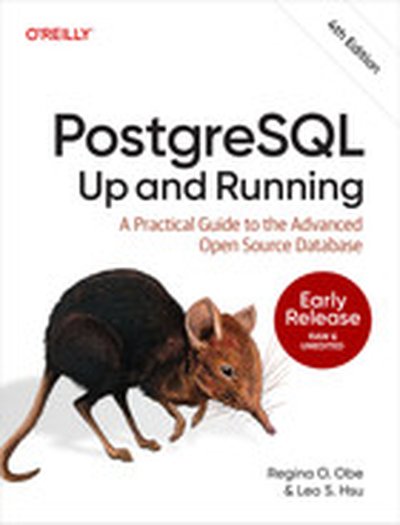
PostgreSQL: Up and Running, 4th Edition

Thinking of migrating to PostgreSQL? This concise introduction helps you understand and use this open source database system. Not only will you learn about the new enterprise class features in versions 16 to 18, but you'll also discover all that PostgreSQL has to offer—much more than a relational database system. As an open source product, it has hundreds of plug-ins, expanding the capability of PostgreSQL beyond all other database systems. With examples throughout, this book shows you how to perform tasks that are difficult or impossible in other databases. The revised fourth edition covers the latest features of Postgres, such as ISO-SQL constructs rarely found in other databases, foreign data wrapper (FDW) enhancements, JSON constructs, multirange data types, query parallelization, and replication. If you're an experienced PostgreSQL user, you'll pick up gems you may have missed before. Learn basic administration tasks such as role management, database creation, backup, and restore Use psql command-line utility and the pgAdmin graphical administration tool Explore PostgreSQL tables, constraints, and indexes Learn powerful SQL constructs not generally found in other databases Use several different languages to write database functions and stored procedures Tune your queries to run as fast as your hardware will allow Query external and variegated data sources with foreign data wrappers Learn how to use built-in replication to replicate data
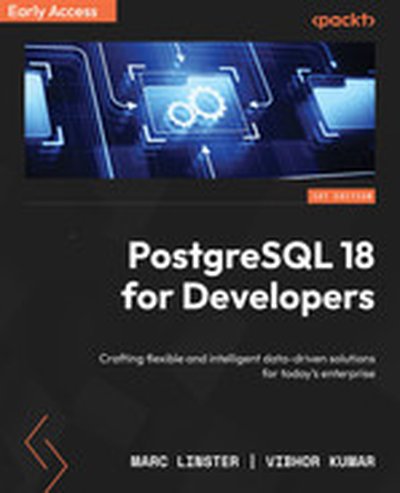
PostgreSQL 18 for Developers

Developing intelligent applications that integrate AI, analytics, and transactional capabilities using the latest release of the world's most popular open-source database Key Features Practical examples demonstrating how to use Postgres to develop intelligent applications Best practices for developers of intelligent data management applications Includes the latest PostgreSQL 18 features for AI, analytics, and transactions ures for AI, analytics, and transactions Book Description In today’s data-first world, businesses need applications that blend transactions, analytics, and AI to power real-time insights at scale. Mastering PostgreSQL 18 for AI-Powered Enterprise Apps is your essential guide to building intelligent, high-performance systems with the latest features of PostgreSQL 18. Through hands-on examples and expert guidance, you’ll learn to design architectures that unite OLTP and OLAP, embed AI directly into apps, and optimize for speed, scalability, and reliability. Discover how to apply cutting-edge PostgreSQL tools for real-time decisions, predictive analytics, and automation. Go beyond basics with advanced strategies trusted by industry leaders. Whether you’re building data-rich applications, internal analytics platforms, or AI-driven services, this book equips you with the patterns and insights to deliver enterprise-grade innovation. Ideal for developers, architects, and tech leads driving digital transformation, this book empowers you to lead the future of intelligent applications. Harness the power of PostgreSQL 18—and unlock the full potential of your data. What you will learn How to leverage PostgreSQL 18 for building intelligent data-driven applications for the modern enterprise Data management principles and best practices for managing transactions, analytics, and AI use cases How to utilize Postgres capabilities to address architectural challenges and attain optimal performance for each use case Methods for utilizing the latest Postgres innovation to create integrated data management applications Guidelines on when to use Postgres and when to opt for specialized data management solutions Who this book is for This book is intended for developers creating intelligent, data-driven applications for the modern enterprise. It features hands-on examples that demonstrate how to use PostgreSQL as the database for business applications that integrate transactions, analytics, and AI. We explore the fundamental architectural principles of data management and detail how developers utilize PostgreSQL 18's latest capabilities to build AI-enabled applications. The book assumes a working knowledge of SQL and does not address the needs of data analysts or those looking to master SQL.

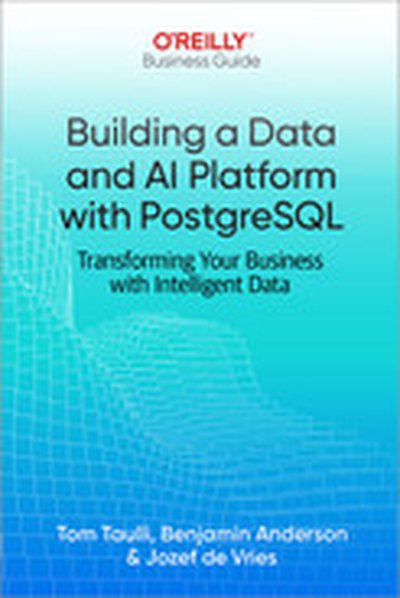
Building a Data and AI Platform with PostgreSQL

In a world where data sovereignty, scalability, and AI innovation are at the forefront of enterprise strategy, PostgreSQL is emerging as the key to unlocking transformative business value. This new guide serves as your beacon for navigating the convergence of AI, open source technologies, and intelligent data platforms. Authors Tom Taulli, Benjamin Anderson, and Jozef de Vries offer a strategic and practical approach to building AI and data platforms that balance innovation with governance, empowering organizations to take control of their data future. Whether you're designing frameworks for advanced AI applications, modernizing legacy infrastructures, or solving data challenges at scale, you can use this guide to bridge the gap between technical complexity and actionable strategy. Written for IT executives, data leaders, and practitioners alike, it will equip you with the tools and insights to harness Postgre's unique capabilities—extensibility, unstructured data management, and hybrid workloads—for long-term success in an AI-driven world. Learn how to build an AI and data platform using PostgreSQL Overcome data challenges like modernization, integration, and governance Optimize AI performance with model fine-tuning and retrieval-augmented generation (RAG) best practices Discover use cases that align data strategy with business goals Take charge of your data and AI future with this comprehensive and accessible roadmap

Extending SQL Databases with Python

What if your database could run Python code inside SQL? In this talk, we’ll explore how to extend popular databases using Python, without needing to write a line of C.

We’ll cover three systems—SQLite, DuckDB, and PostgreSQL—and show how Python can be used in each to build custom SQL functions, accelerate data workflows, and prototype analytical logic. Each database offers a unique integration path: - SQLite and DuckDB allow you to register Python functions directly into SQL via sqlite3.create_function, making it easy to inject business logic or custom transformations. - PostgreSQL offers PL/Python, a full-featured procedural language for writing SQL functions in Python. We’ll also touch on advanced use cases, including embedding the Python interpreter directly into a PostgreSQL extension for deeper integration.

By the end of this talk, you’ll understand the capabilities, limitations, and gotchas of Python-powered extensions in each system—and how to choose the right tool depending on your use case, whether you’re analyzing data, building pipelines, or hacking on your own database.

AWS re:Invent 2025 - A tale of two transactions (DAT455)

If you are curious how transactions are processed differently in Amazon Aurora DSQL versus Amazon Aurora PostgreSQL, join Marc Brooker, AWS VP and Distinguished Engineer, as he dives into how transactions are processed in these two databases – right down to the code level. You’ll understand how each database handles multiple transactions accessing or changing the data at the same time, why they use different approaches, and what that means for your architectures. You’ll leave with a deep intuition for what makes database workloads scale and ability to think about how to apply those lessons to your architectures and code.

Learn more: More AWS events: https://go.aws/3kss9CP

Subscribe: More AWS videos: http://bit.ly/2O3zS75 More AWS events videos: http://bit.ly/316g9t4

ABOUT AWS: Amazon Web Services (AWS) hosts events, both online and in-person, bringing the cloud computing community together to connect, collaborate, and learn from AWS experts. AWS is the world's most comprehensive and broadly adopted cloud platform, offering over 200 fully featured services from data centers globally. Millions of customers—including the fastest-growing startups, largest enterprises, and leading government agencies—are using AWS to lower costs, become more agile, and innovate faster.

AWSreInvent #AWSreInvent2025 #AWS

AWS re:Invent 2025 - Build serverless chatbots using Amazon ElastiCache & Aurora PostgreSQL (DAT314)

In this session, learn how to build a serverless-first chatbot application by leveraging Amazon Aurora with pgvector as a vector store and Amazon ElastiCache Serverless for Valkey to manage chat history, semantic caching, and agent memory. Discover how to harness these services to create contextually aware, scalable chatbots with agentic capabilities that retain conversational memory across interactions. Explore architectural patterns, implementation strategies, and real-world use cases. Gain insights into optimizing query latency, performance, and cost-effectiveness. Whether you’re a developer, architect, or decision-maker, this session equips you with practical knowledge to build modern, serverless-powered chatbot applications using generative AI.

Learn more: More AWS events: https://go.aws/3kss9CP

Subscribe: More AWS videos: http://bit.ly/2O3zS75 More AWS events videos: http://bit.ly/316g9t4

ABOUT AWS: Amazon Web Services (AWS) hosts events, both online and in-person, bringing the cloud computing community together to connect, collaborate, and learn from AWS experts. AWS is the world's most comprehensive and broadly adopted cloud platform, offering over 200 fully featured services from data centers globally. Millions of customers—including the fastest-growing startups, largest enterprises, and leading government agencies—are using AWS to lower costs, become more agile, and innovate faster.

AWSreInvent #AWSreInvent2025 #AWS

AWS re:Invent 2025 - Amazon Aurora HA and DR design patterns for global resilience (DAT442)

Amazon Aurora is a serverless relational database with unparalleled high performance and availability at global scale for PostgreSQL, MySQL, and DSQL. Aurora provides managed high availability (HA) and disaster recovery (DR) capabilities in and across AWS Regions. In this session, explore the Aurora HA and DR capabilities and discover design patterns that enable the development of resilient applications. Learn how to establish in-Region and cross-Region HA and DR using Aurora features including Multi-AZ deployments and Aurora Global Database, and how Aurora DSQL multi-Region clusters provides the highest level of availability and application resilience.

Learn more: More AWS events: https://go.aws/3kss9CP

Subscribe: More AWS videos: http://bit.ly/2O3zS75 More AWS events videos: http://bit.ly/316g9t4

ABOUT AWS: Amazon Web Services (AWS) hosts events, both online and in-person, bringing the cloud computing community together to connect, collaborate, and learn from AWS experts. AWS is the world's most comprehensive and broadly adopted cloud platform, offering over 200 fully featured services from data centers globally. Millions of customers—including the fastest-growing startups, largest enterprises, and leading government agencies—are using AWS to lower costs, become more agile, and innovate faster.

AWSreInvent #AWSreInvent2025 #AWS

AWS re:Invent 2025 - Deep dive into Amazon Aurora and its innovations (DAT441)

With an innovative architecture that decouples compute from storage and advanced features like Amazon Aurora Global Database and low-latency read replicas, Aurora reimagines what it means to be a relational database. Aurora is a built-for-the-cloud, serverless relational database service that delivers unparalleled performance and availability at global scale for MySQL, PostgreSQL, and DSQL. In this session, dive deep into new features – and Aurora’s most popular offerings including serverless, I/O-Optimized, zero-ETL integrations, MCP integration, and generative AI support for vector search and storage. Also learn about the groundbreaking Aurora DSQL engine.

Learn more: More AWS events: https://go.aws/3kss9CP

Subscribe: More AWS videos: http://bit.ly/2O3zS75 More AWS events videos: http://bit.ly/316g9t4

ABOUT AWS: Amazon Web Services (AWS) hosts events, both online and in-person, bringing the cloud computing community together to connect, collaborate, and learn from AWS experts. AWS is the world's most comprehensive and broadly adopted cloud platform, offering over 200 fully featured services from data centers globally. Millions of customers—including the fastest-growing startups, largest enterprises, and leading government agencies—are using AWS to lower costs, become more agile, and innovate faster.

AWSreInvent #AWSreInvent2025 #AWS

Sascha Lorenz presents a short talk on a surprising finding: Microsoft's preferred ORM often runs more efficiently on PostgreSQL than on SQL Server. We'll examine why PostgreSQL sometimes optimizes EF workloads more effectively, compare execution plans, and discuss which index strategies make the difference.

AWS re:Invent 2025 - PostgreSQL performance: Real-world workload tuning (DAT410)

PostgreSQL performance isn’t magic—it’s engineering. In this code talk, we dive deep into practical tuning techniques to avoid common pitfalls that silently degrade performance by improving an underperforming PostgreSQL database workload. Learn how excessive indexes hurt write throughput, why HOT updates fail, and how vacuum behavior can stall your system. We’ll demonstrate how to use Query Plan Management (QPM) and pg_hint_plan for plan stability and decode wait events to uncover hidden bottlenecks. With real SQL examples and system insights, this session equips you to tune PostgreSQL for predictable, high-performance workloads.

Learn more: More AWS events: https://go.aws/3kss9CP

Subscribe: More AWS videos: http://bit.ly/2O3zS75 More AWS events videos: http://bit.ly/316g9t4

ABOUT AWS: Amazon Web Services (AWS) hosts events, both online and in-person, bringing the cloud computing community together to connect, collaborate, and learn from AWS experts. AWS is the world's most comprehensive and broadly adopted cloud platform, offering over 200 fully featured services from data centers globally. Millions of customers—including the fastest-growing startups, largest enterprises, and leading government agencies—are using AWS to lower costs, become more agile, and innovate faster.

AWSreInvent #AWSreInvent2025 #AWS

AWS re:Invent 2025 - Amazon Aurora DSQL: A developer's perspective  (DAT401)

In this live coding session, we'll show you how to work with Amazon Aurora DSQL from a developer's perspective. We'll develop a sample application to highlight some of the ways developing for Aurora DSQL is different than PostgreSQL. We'll cover authentication and connection management, optimistic concurrency transaction patterns, primary key selection, analyzing query performance, and best practices.

Learn more: More AWS events: https://go.aws/3kss9CP

Subscribe: More AWS videos: http://bit.ly/2O3zS75 More AWS events videos: http://bit.ly/316g9t4

ABOUT AWS: Amazon Web Services (AWS) hosts events, both online and in-person, bringing the cloud computing community together to connect, collaborate, and learn from AWS experts. AWS is the world's most comprehensive and broadly adopted cloud platform, offering over 200 fully featured services from data centers globally. Millions of customers—including the fastest-growing startups, largest enterprises, and leading government agencies—are using AWS to lower costs, become more agile, and innovate faster.

AWSreInvent #AWSreInvent2025 #AWS

Learn how to build an advanced AI agent using Azure Database for PostgreSQL and the new Microsoft Agent Framework. This hands-on lab walks you through integrating Retrieval-Augmented Generation (RAG), semantic re-ranking, Semantic Operators, and GraphRAG (using Apache AGE) to enable intelligent legal question-answering using real case data. Gain practical AI implementation skills with your own PostgreSQL-backed applications.

Please RSVP and arrive at least 5 minutes before the start time, at which point remaining spaces are open to standby attendees.

Learn how to build an advanced AI agent using Azure Database for PostgreSQL and Semantic Kernel. This hands-on lab walks you through integrating Retrieval-Augmented Generation (RAG), semantic re-ranking, Semantic Operators, and GraphRAG (using Apache AGE) to enable intelligent legal question answering using real case data. Gain practical AI implementation skills with your own PostgreSQL-backed applications.

Please RSVP and arrive at least 5 minutes before the start time, at which point remaining spaces are open to standby attendees.

Learn how to seamlessly modernize a Linux application stack in Azure. Participants will be able to step through the migration process with a Linux/Postgres/Java application and utilize infrastructure as a code (IaC) for scale migrations.

Please RSVP and arrive at least 5 minutes before the start time, at which point remaining spaces are open to standby attendees.

Optimizing performance, deployments, and security for Linux on Azure

Whether you use Ubuntu, RHEL, SLES, or Rocky, deploying Linux on Azure is more than provisioning VMs. Learn to build secure, performant Linux environments using Azure-native tools and partner integrations. See how to streamline image creation, harden workloads, monitor performance, and stay compliant with Azure Monitor, Defender for Linux, PostgreSQL on Azure, and the secure Linux baseline. Whether architect or OSS advocate, this session helps you confidently “train your penguin” for the cloud.

Multi-tenant apps need scalable platforms to meet growing workload and AI demands, but scaling PostgreSQL can be complex. Elastic Clusters in Azure Database for PostgreSQL offers a fix: simple horizontal scale out of PostgreSQL data with row and schema-based sharding built into the managed service. Join us to learn how this best-in-class capability is empowering ITOps, architects and developers to build and manage resilient, high-performing multi-tenant apps while optimizing operations and cost.

“On Air at Microsoft Ignite” will dive into key announcements with expert interviews, demos, and real-world applications for all the latest news. ​​

Hour 3 will feature:​ Microsoft 365 Copilot and agent updates: Jeremy Chapman​ Team Viewer: Sebastian Schrötel​ Responsible AI & Centru AI: Ana Welch​ Capgemini: Arnaud Balssa​ Cognizant: Manpreet Singh​ SAP: Dr. Walter Sun​ NTT DATA: Charlie Doubek, Geoff Newman​ Nasdaq: Secure Innovation with PostgreSQL on Azure: Charles Feddersen, Mohsin Shafqat

Learn how to seamlessly modernize a Linux application stack in Azure. Participants will be able to step through the migration process with a Linux/Postgres/Java application and utilize infrastructure as a code (IaC) for scale migrations.

Please RSVP and arrive at least 5 minutes before the start time, at which point remaining spaces are open to standby attendees.

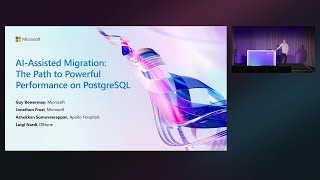
AI-assisted migration: The path to powerful performance on PostgreSQL

Apollo Hospitals unlocked faster performance and sped up innovation by migrating to Azure Database for PostgreSQL. Ready to move beyond your legacy databases? Join us to learn how to make the move seamless with AI-assisted migration for Oracle workloads. Plus, hear how a move to Azure enables innovation and explore the latest features that deliver the resilience and extensibility needed to bolster your databases to support more intelligent applications and demanding workloads.

Learn how to seamlessly modernize a Linux application stack in Azure. Participants will be able to step through the migration process with a Linux/Postgres/Java application and utilize infrastructure as a code (IaC) for scale migrations.

Please RSVP and arrive at least 5 minutes before the start time, at which point remaining spaces are open to standby attendees.