In unserem technisch orientierten Vortrag zeigen wir, wie sich IoT-Daten und SAP-Systeme heute direkt und ohne Umwege integrieren lassen. Im Mittelpunkt steht IoTnova, der Managed Service auf Basis von ThingsBoard, der als leistungsfähige IoT-Plattform Gerätedaten sicher sammelt, verwaltet und verarbeitet – sowohl in der Cloud als auch On-Premises. Wir demonstrieren die direkte Integration von SAP in IoTnova und erläutern, wie dadurch der Einsatz zusätzlicher Middleware stark reduziert werden kann. Ergänzend werfen wir einen Blick auf flexible Werkzeuge wie Apache Hop für Datenintegration und -transformation sowie Redpanda für hochperformantes Datenstreaming. Der Vortrag bietet praxisnahe Einblicke, wie moderne IoT-Architekturen umgesetzt werden können – von der Erfassung über die Integration bis hin zur Nutzung der Daten in Unternehmenssystemen.
 talk-data.com
Topic
Redpanda
12
tagged
Activity Trend
Top Events
In this session, Paul Wilkinson, Principal Solutions Architect at Redpanda, will demonstrate Redpanda's native Iceberg capability: a game-changing addition that bridges the gap between real-time streaming and analytical workloads, eliminating the complexity of traditional data lake architectures while maintaining the performance and simplicity that Redpanda is known for.
Paul will explore how this new capability enables organizations to seamlessly transition streaming data into analytical formats without complex ETL pipelines or additional infrastructure overhead in a follow-along demo - allowing you to build your own streaming lakehouse and show it to your team!
Shu Zhao discusses a personal AI-powered assistant running entirely on edge hardware; she demonstrates a tool that reduces screen time by taking notes and handling messages, routing processed information to Notion or GitHub. Tech stack includes RedPanda for message streaming and storage; Ollama running Llama 3.1 8B for local reasoning; and Jetson Nano as the compact hardware powering it.
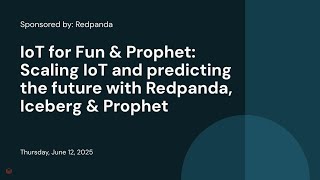
In this talk, we’ll walk through a complete real-time IoT architecture—from an economical, high-powered ESP32 microcontroller publishing environmental sensor data to AWS IoT, through Redpanda Connect into a Redpanda BYOC cluster, and finally into Apache Iceberg for long-term analytical storage. Once the data lands, we’ll query it using Python and perform linear regression with Prophet to forecast future trends. Along the way, we’ll explore the design of a scalable, cloud-native pipeline for streaming IoT data. Whether you're tracking the weather or building the future, this session will help you architect with confidence—and maybe even predict it.
Redpanda, a leading Kafka API-compatible streaming platform, now supports storing topics in Apache Iceberg, seamlessly fusing low-latency streaming with data lakehouses using BigQuery and BigLake in GCP. Iceberg Topics eliminate complex & inefficient ETL between streams and tables, making real-time data instantly accessible for analysis in BigQuery This push-button integration eliminates the need for costly connectors or custom pipelines, enabling both simple and sophisticated SQL queries across streams and other datasets. By combining Redpanda and Iceberg, GCP customers gain a secure, scalable, and cost-effective solution that transforms their agility while reducing infrastructure and human capital costs.
This Session is hosted by a Google Cloud Next Sponsor.
Visit your registration profile at g.co/cloudnext to opt out of sharing your contact information with the sponsor hosting this session.
Send us a text Welcome to the cozy corner of the tech world where ones and zeros mingle with casual chit-chat. Datatopics Unplugged is your go-to spot for relaxed discussions around tech, news, data, and society. In this episode, we’re joined by a special guest: Alex Gallego, founder and CEO of Red Panda. Together, we dive deep into building data-intensive applications, the evolution of streaming technologies, and balancing high throughput and low latency demands. Key topics covered: What is Red Panda and why it matters: Red Panda’s mission to redefine data streaming while being the fastest Kafka-compatible option on the market.Batch vs. streaming data: An accessible guide to understanding the classic debate and how the tech landscape is shifting towards unified data frameworks.Scaling at speed: The challenges and innovations driving Red Panda’s performance optimizations, from zero-copy architecture to storage engines.AI, ML, and streaming data integration: How Red Panda empowers real-time machine learning and AI-powered workloads with ease.Open source vs. enterprise models: Navigating licensing challenges and balancing business goals in the hybrid cloud era.Leadership and career shifts: Alex’s reflections on moving from technical lead to CEO, blending engineering know-how with company vision.
A 30 minute demo of how to use Redpanda Connect (powered by Benthos) to generate vector embeddings on streaming text.
A 30 minute demo of how to use Redpanda Connect (powered by Benthos) to generate vector embeddings on streaming text. This session will walk through the architecture and configuration used to seamlessly integrate Redpanda Connect with LangChain, OpenAI, and MongoDB Atlas to build a complete Retrieval Augmented Generation data pipeline.
Summary
Building streaming applications has gotten substantially easier over the past several years. Despite this, it is still operationally challenging to deploy and maintain your own stream processing infrastructure. Decodable was built with a mission of eliminating all of the painful aspects of developing and deploying stream processing systems for engineering teams. In this episode Eric Sammer discusses why more companies are including real-time capabilities in their products and the ways that Decodable makes it faster and easier.
Announcements
Hello and welcome to the Data Engineering Podcast, the show about modern data management Introducing RudderStack Profiles. RudderStack Profiles takes the SaaS guesswork and SQL grunt work out of building complete customer profiles so you can quickly ship actionable, enriched data to every downstream team. You specify the customer traits, then Profiles runs the joins and computations for you to create complete customer profiles. Get all of the details and try the new product today at dataengineeringpodcast.com/rudderstack This episode is brought to you by Datafold – a testing automation platform for data engineers that finds data quality issues before the code and data are deployed to production. Datafold leverages data-diffing to compare production and development environments and column-level lineage to show you the exact impact of every code change on data, metrics, and BI tools, keeping your team productive and stakeholders happy. Datafold integrates with dbt, the modern data stack, and seamlessly plugs in your data CI for team-wide and automated testing. If you are migrating to a modern data stack, Datafold can also help you automate data and code validation to speed up the migration. Learn more about Datafold by visiting dataengineeringpodcast.com/datafold You shouldn't have to throw away the database to build with fast-changing data. You should be able to keep the familiarity of SQL and the proven architecture of cloud warehouses, but swap the decades-old batch computation model for an efficient incremental engine to get complex queries that are always up-to-date. With Materialize, you can! It’s the only true SQL streaming database built from the ground up to meet the needs of modern data products. Whether it’s real-time dashboarding and analytics, personalization and segmentation or automation and alerting, Materialize gives you the ability to work with fresh, correct, and scalable results — all in a familiar SQL interface. Go to dataengineeringpodcast.com/materialize today to get 2 weeks free! As more people start using AI for projects, two things are clear: It’s a rapidly advancing field, but it’s tough to navigate. How can you get the best results for your use case? Instead of being subjected to a bunch of buzzword bingo, hear directly from pioneers in the developer and data science space on how they use graph tech to build AI-powered apps. . Attend the dev and ML talks at NODES 2023, a free online conference on October 26 featuring some of the brightest minds in tech. Check out the agenda and register today at Neo4j.com/NODES. Your host is Tobias Macey and today I'm interviewing Eric Sammer about starting your stream processing journey with Decodable
Interview
Introduction How did you get involved in the area of data management? Can you describe what Decodable is and the story behind it?
What are the notable changes to the Decodable platform since we last spoke? (October 2021) What are the industry shifts that have influenced the product direction?
What are the problems that customers are trying to solve when they come to Decodable? When you launched your focus was on SQL transformations of streaming data. What was the process for adding full Java support in addition to SQL? What are the developer experience challenges that are particular to working with streaming data?
How have you worked to address that in the Decodable platform and interfaces?
As you evolve the technical and product direction, what is your heuristic for balancing the unification of interfaces and system integration against the ability to swap different components or interfaces as new technologies are introduced? What are the most interesting, innovative, or unexpected ways that you have seen Decodable used? What are the most interesting, unexpected, or challenging lessons that you have learned while working on Decodable? When is Decodable the wrong choice? What do you have planned for the future of Decodable?
Contact Info
esammer on GitHub LinkedIn
Parting Question
From your perspective, what is the biggest gap in the tooling or technology for data management today?
Closing Announcements
Thank you for listening! Don't forget to check out our other shows. Podcast.init covers the Python language, its community, and the innovative ways it is being used. The Machine Learning Podcast helps you go from idea to production with machine learning. Visit the site to subscribe to the show, sign up for the mailing list, and read the show notes. If you've learned something or tried out a project from the show then tell us about it! Email [email protected]) with your story. To help other people find the show please leave a review on Apple Podcasts and tell your friends and co-workers
Links
Decodable
Podcast Episode
Understanding the Apache Flink Journey Flink
Podcast Episode
Debezium
Podcast Episode
Kafka Redpanda
Podcast Episode
Kinesis PostgreSQL
Podcast Episode
Snowflake
Podcast Episode
Databricks Startree Pinot
Podcast Episode
Rockset
Podcast Episode
Druid InfluxDB Samza Storm Pulsar
Podcast Episode
ksqlDB
Podcast Episode
dbt GitHub Actions Airbyte Singer Splunk Outbox Pattern
The intro and outro music is from The Hug by The Freak Fandango Orchestra / CC BY-SA
Sponsored By:
Neo4J: 
NODES 2023 is a free online conference focused on graph-driven innovations with content for all skill levels. Its 24 hours are packed with 90 interactive technical sessions from top developers and data scientists across the world covering a broad range of topics and use cases. The event tracks: - Intelligent Applications: APIs, Libraries, and Frameworks – Tools and best practices for creating graph-powered applications and APIs with any software stack and programming language, including Java, Python, and JavaScript - Machine Learning and AI – How graph technology provides context for your data and enhances the accuracy of your AI and ML projects (e.g.: graph neural networks, responsible AI) - Visualization: Tools, Techniques, and Best Practices – Techniques and tools for exploring hidden and unknown patterns in your data and presenting complex relationships (knowledge graphs, ethical data practices, and data representation)
Don’t miss your chance to hear about the latest graph-powered implementations and best practices for free on October 26 at NODES 2023. Go to Neo4j.com/NODES today to see the full agenda and register!Rudderstack: 
Introducing RudderStack Profiles. RudderStack Profiles takes the SaaS guesswork and SQL grunt work out of building complete customer profiles so you can quickly ship actionable, enriched data to every downstream team. You specify the customer traits, then Profiles runs the joins and computations for you to create complete customer profiles. Get all of the details and try the new product today at dataengineeringpodcast.com/rudderstackMaterialize: 
You shouldn't have to throw away the database to build with fast-changing data. Keep the familiar SQL, keep the proven architecture of cloud warehouses, but swap the decades-old batch computation model for an efficient incremental engine to get complex queries that are always up-to-date.
That is Materialize, the only true SQL streaming database built from the ground up to meet the needs of modern data products: Fresh, Correct, Scalable — all in a familiar SQL UI. Built on Timely Dataflow and Differential Dataflow, open source frameworks created by cofounder Frank McSherry at Microsoft Research, Materialize is trusted by data and engineering teams at Ramp, Pluralsight, Onward and more to build real-time data products without the cost, complexity, and development time of stream processing.
Go to materialize.com today and get 2 weeks free!Datafold: 
This episode is brought to you by Datafold – a testing automation platform for data engineers that finds data quality issues before the code and data are deployed to production. Datafold leverages data-diffing to compare…
Summary
Real-time capabilities have quickly become an expectation for consumers. The complexity of providing those capabilities is still high, however, making it more difficult for small teams to compete. Meroxa was created to enable teams of all sizes to deliver real-time data applications. In this episode DeVaris Brown discusses the types of applications that are possible when teams don't have to manage the complex infrastructure necessary to support continuous data flows.
Announcements
Hello and welcome to the Data Engineering Podcast, the show about modern data management RudderStack helps you build a customer data platform on your warehouse or data lake. Instead of trapping data in a black box, they enable you to easily collect customer data from the entire stack and build an identity graph on your warehouse, giving you full visibility and control. Their SDKs make event streaming from any app or website easy, and their extensive library of integrations enable you to automatically send data to hundreds of downstream tools. Sign up free at dataengineeringpodcast.com/rudderstack Your host is Tobias Macey and today I'm interviewing DeVaris Brown about the impact of real-time data on business opportunities and risk profiles
Interview
Introduction How did you get involved in the area of data management? Can you describe what Meroxa is and the story behind it?
How have the focus and goals of the platform and company evolved over the past 2 years?
Who are the target customers for Meroxa?
What problems are they trying to solve when they come to your platform?
Applications powered by real-time data were the exclusive domain of large and/or sophisticated tech companies for several years due to the inherent complexities involved. What are the shifts that have made them more accessible to a wider variety of teams?
What are some of the remaining blockers for teams who want to start using real-time data?
With the democratization of real-time data, what are the new categories of products and applications that are being unlocked?
How are organizations thinking about the potential value that those types of apps/services can provide?
With data flowing constantly, there are new challenges around oversight and accuracy. How does real-time data change the risk profile for applications that are consuming it?
What are some of the technical controls that are available for organizations that are risk-averse?
What skills do developers need to be able to effectively design, develop, and deploy real-time data applications?
How does this differ when talking about internal vs. consumer/end-user facing applications?
What are the most interesting, innovative, or unexpected ways that you have seen Meroxa used? What are the most interesting, unexpected, or challenging lessons that you have learned while working on Meroxa? When is Meroxa the wrong choice? What do you have planned for the future of Meroxa?
Contact Info
LinkedIn @devarispbrown on Twitter
Parting Question
From your perspective, what is the biggest gap in the tooling or technology for data management today?
Closing Announcements
Thank you for listening! Don't forget to check out our other shows. Podcast.init covers the Python language, its community, and the innovative ways it is being used. The Machine Learning Podcast helps you go from idea to production with machine learning. Visit the site to subscribe to the show, sign up for the mailing list, and read the show notes. If you've learned something or tried out a project from the show then tell us about it! Email [email protected]) with your story. To help other people find the show please leave a review on Apple Podcasts and tell your friends and co-workers
Links
Meroxa
Podcast Episode
Kafka Kafka Connect Conduit - golang Kafka connect replacement Pulsar Redpanda Flink Beam Clickhouse Druid Pinot
The intro and outro music is from The Hug by The Freak Fandango Orchestra / CC
Summary Transactions are a necessary feature for ensuring that a set of actions are all performed as a single unit of work. In streaming systems this is necessary to ensure that a set of messages or transformations are all executed together across different queues. In this episode Denis Rystsov explains how he added support for transactions to the Redpanda streaming engine. He discusses the use cases for transactions, the different strategies, semantics, and guarantees that they might need to support, and how his implementation ended up improving the performance of bulk write operations. This is an interesting deep dive into the internals of a high performance streaming engine and the details that are involved in building distributed systems.
Announcements
Hello and welcome to the Data Engineering Podcast, the show about modern data management When you’re ready to build your next pipeline, or want to test out the projects you hear about on the show, you’ll need somewhere to deploy it, so check out our friends at Linode. With their managed Kubernetes platform it’s now even easier to deploy and scale your workflows, or try out the latest Helm charts from tools like Pulsar and Pachyderm. With simple pricing, fast networking, object storage, and worldwide data centers, you’ve got everything you need to run a bulletproof data platform. Go to dataengineeringpodcast.com/linode today and get a $100 credit to try out a Kubernetes cluster of your own. And don’t forget to thank them for their continued support of this show! Struggling with broken pipelines? Stale dashboards? Missing data? If this resonates with you, you’re not alone. Data engineers struggling with unreliable data need look no further than Monte Carlo, the world’s first end-to-end, fully automated Data Observability Platform! In the same way that application performance monitoring ensures reliable software and keeps application downtime at bay, Monte Carlo solves the costly problem of broken data pipelines. Monte Carlo monitors and alerts for data issues across your data warehouses, data lakes, ETL, and business intelligence, reducing time to detection and resolution from weeks or days to just minutes. Start trusting your data with Monte Carlo today! Visit dataengineeringpodcast.com/impact today to save your spot at IMPACT: The Data Observability Summit a half-day virtual event featuring the first U.S. Chief Data Scientist, founder of the Data Mesh, Creator of Apache Airflow, and more data pioneers spearheading some of the biggest movements in data. The first 50 to RSVP with this link will be entered to win an Oculus Quest 2 — Advanced All-In-One Virtual Reality Headset. RSVP today – you don’t want to miss it! Atlan is a collaborative workspace for data-driven teams, like Github for engineering or Figma for design teams. By acting as a virtual hub for data assets ranging from tables and dashboards to SQL snippets & code, Atlan enables teams to create a single source of truth for all their data assets, and collaborate across the modern data stack through deep integrations with tools like Snowflake, Slack, Looker and more. Go to dataengineeringpodcast.com/atlan today and sign up for a free trial. If you’re a data engineering podcast listener, you get credits worth $3000 on an annual subscription Your host is Tobias Macey and today I’m interviewing Denis Rystsov about implementing transactions in the RedPanda streaming engine
Interview
Introduction How did you get involved in the area of data management? Can you quickly recap what RedPanda is and the goals of the project? What are the use cases for transactions in a pub/sub messaging system?
What are the elements of streaming systems that make atomic transactions a complex problem?
What was the motivation for starting down the path of adding transactions to the RedPanda engine?
How did the constraint of supporting the Kafka API influence your implementation strategy for transaction semantics?
Summary Kafka has become a de facto standard interface for building decoupled systems and working with streaming data. Despite its widespread popularity, there are numerous accounts of the difficulty that operators face in keeping it reliable and performant, or trying to scale an installation. To make the benefits of the Kafka ecosystem more accessible and reduce the operational burden, Alexander Gallego and his team at Vectorized created the Red Panda engine. In this episode he explains how they engineered a drop-in replacement for Kafka, replicating the numerous APIs, that can scale more easily and deliver consistently low latencies with a much lower hardware footprint. He also shares some of the areas of innovation that they have found to help foster the next wave of streaming applications while working within the constraints of the existing Kafka interfaces. This was a fascinating conversation with an energetic and enthusiastic engineer and founder about the challenges and opportunities in the realm of streaming data.
Announcements
Hello and welcome to the Data Engineering Podcast, the show about modern data management What are the pieces of advice that you wish you had received early in your career of data engineering? If you hand a book to a new data engineer, what wisdom would you add to it? I’m working with O’Reilly on a project to collect the 97 things that every data engineer should know, and I need your help. Go to dataengineeringpodcast.com/97things to add your voice and share your hard-earned expertise. When you’re ready to build your next pipeline, or want to test out the projects you hear about on the show, you’ll need somewhere to deploy it, so check out our friends at Linode. With their managed Kubernetes platform it’s now even easier to deploy and scale your workflows, or try out the latest Helm charts from tools like Pulsar and Pachyderm. With simple pricing, fast networking, object storage, and worldwide data centers, you’ve got everything you need to run a bulletproof data platform. Go to dataengineeringpodcast.com/linode today and get a $60 credit to try out a Kubernetes cluster of your own. And don’t forget to thank them for their continued support of this show! Are you bogged down by having to manually manage data access controls, repeatedly move and copy data, and create audit reports to prove compliance? How much time could you save if those tasks were automated across your cloud platforms? Immuta is an automated data governance solution that enables safe and easy data analytics in the cloud. Our comprehensive data-level security, auditing and de-identification features eliminate the need for time-consuming manual processes and our focus on data and compliance team collaboration empowers you to deliver quick and valuable data analytics on the most sensitive data to unlock the full potential of your cloud data platforms. Learn how we streamline and accelerate manual processes to help you derive real results from your data at dataengineeringpodcast.com/immuta. If you’re looking for a way to optimize your data engineering pipeline – with instant query performance – look no further than Qubz. Qubz is next-generation OLAP technology built for the scale of Big Data from UST Global, a renowned digital services provider. Qubz lets users and enterprises analyze data on the cloud and on-premise, with blazing speed, while eliminating the complex engineering required to operationalize analytics at scale. With an emphasis on visual data engineering, connectors for all major BI tools and data sources, Qubz allow users to query OLAP cubes with sub-second response times on hundreds of billions of rows. To learn more, and sign up for a free demo, visit dataengineeringpodcast.com/qubz. You listen to this show to learn and stay up to date with what’s happening in databases, streaming platforms, big data, and everything else you need to know about modern data platforms. For more opportunities to s