talk-data.com talk-data.com

Topic

Kinesis

Amazon Kinesis

stream_processing realtime aws

22

tagged

Activity Trend

3 peak/qtr
2020-Q1 2026-Q1

Activities

22 activities · Newest first

AWS re:Invent 2025 - Autonomous agents powered by streaming data and Retrieval Augmented Generation

Unlock the potential of intelligent autonomous agents that combine real-time streaming data with Retrieval Augmented Generation (RAG) for dynamic decision-making. You will learn how to use streaming technologies like Amazon Kinesis, Amazon MSK, and Managed Service for Apache Flink create a robust pipeline to transform raw events into actionable insights. This session will show you how autonomous agents leverage these real-time insights with RAG architecture powered by OpenSearch, enabling immediate, context-aware responses to changing conditions. This practical architecture drives real-world value in critical scenarios like predictive maintenance, automated incident response, and intelligent customer service automation, with improved accuracy and reduced latency.

Learn more: More AWS events: https://go.aws/3kss9CP

Subscribe: More AWS videos: http://bit.ly/2O3zS75 More AWS events videos: http://bit.ly/316g9t4

ABOUT AWS: Amazon Web Services (AWS) hosts events, both online and in-person, bringing the cloud computing community together to connect, collaborate, and learn from AWS experts. AWS is the world's most comprehensive and broadly adopted cloud platform, offering over 200 fully featured services from data centers globally. Millions of customers—including the fastest-growing startups, largest enterprises, and leading government agencies—are using AWS to lower costs, become more agile, and innovate faster.

AWSreInvent #AWSreInvent2025 #AWS

AWS re:Invent 2025 - Powering your Agentic AI experience with AWS Streaming and Messaging (ANT310)

Organizations are accelerating innovation with generative AI and agentic AI use cases. This session explores how AWS streaming and messaging services such as Amazon Managed Streaming for Apache Kafka, Kinesis Data Streams, Amazon Managed Service for Apache Flink, and Amazon SQS build intelligent, responsive applications. Discover how streaming supports real-time data ingestion and processing, while messaging ensures reliable coordination between AI agents, orchestrates workflows, and delivers critical information at scale. Learn architectural patterns that highlight how a unified approach acts on data as fast as needed, providing the reliability and scale to grow for your next generation of AI.

Learn more: More AWS events: https://go.aws/3kss9CP

Subscribe: More AWS videos: http://bit.ly/2O3zS75 More AWS events videos: http://bit.ly/316g9t4

ABOUT AWS: Amazon Web Services (AWS) hosts events, both online and in-person, bringing the cloud computing community together to connect, collaborate, and learn from AWS experts. AWS is the world's most comprehensive and broadly adopted cloud platform, offering over 200 fully featured services from data centers globally. Millions of customers—including the fastest-growing startups, largest enterprises, and leading government agencies—are using AWS to lower costs, become more agile, and innovate faster.

AWSreInvent #AWSreInvent2025 #AWS

AWS re:Invent 2025 - Amazon Kinesis Data Streams under the hood (ANT423)

Discover how AWS is changing data streaming with Amazon Kinesis Data Streams for infrastructure and operations. This session will explore recent innovations in how Kinesis Data Streams enables you to build robust, scalable data streaming applications that can handle millions of events per second. Join this session to see how you can leverage Amazon Kinesis Data Streams to build scalable, resilient data streaming applications for faster insights and improved decision-making.

Learn more: More AWS events: https://go.aws/3kss9CP

Subscribe: More AWS videos: http://bit.ly/2O3zS75 More AWS events videos: http://bit.ly/316g9t4

ABOUT AWS: Amazon Web Services (AWS) hosts events, both online and in-person, bringing the cloud computing community together to connect, collaborate, and learn from AWS experts. AWS is the world's most comprehensive and broadly adopted cloud platform, offering over 200 fully featured services from data centers globally. Millions of customers—including the fastest-growing startups, largest enterprises, and leading government agencies—are using AWS to lower costs, become more agile, and innovate faster.

AWSreInvent #AWSreInvent2025 #AWS

Enterprises want the flexibility to operate across multiple clouds, whether to optimize costs, improve resiliency, to avoid vendor lock-in, or for data sovereignty. But for developers, that flexibility usually comes at the cost of extra complexity and redundant code. The goal here is simple: write once, run anywhere, with minimum boilerplate. In Apache Airflow, we’ve already begun tackling this problem with abstractions like Common-SQL, which lets you write database queries once and run them on 20+ databases, from Snowflake to Postgres to SQLite to SAP HANA. Similarly, Common-IO standardizes cloud blob storage interactions across all public clouds. With Airflow 3.0, we are pushing this further by introducing a Common Message Bus provider, which is an abstraction, initially supporting Amazon SQS and expanding to Google PubSub and Apache Kafka soon after. We expect additional implementations such as Amazon Kinesis and Managed Kafka over time. This talk will dive into why these abstractions matter, how they reduce friction for developers while giving enterprises true multi-cloud optionality, and what’s next for Airflow’s evolving provider ecosystem.

Race to Real-Time: Low-Latency Streaming ETL Meets Next-Gen Databricks OLTP-DB

In today’s digital economy, real-time insights and rapid responsiveness are paramount to delivering exceptional user experiences and lowering TCO. In this session, discover a pioneering approach that leverages a low-latency streaming ETL pipeline built with Spark Structured Streaming and Databricks’ new OLTP-DB—a serverless, managed Postgres offering designed for transactional workloads. Validated in a live customer scenario, this architecture achieves sub-2 second end-to-end latency by seamlessly ingesting streaming data from Kinesis and merging it into OLTP-DB. This breakthrough not only enhances performance and scalability but also provides a replicable blueprint for transforming data pipelines across various verticals. Join us as we delve into the advanced optimization techniques and best practices that underpin this innovation, demonstrating how Databricks’ next-generation solutions can revolutionize real-time data processing and unlock a myriad of new use cases in data landscape.

Let's Save Tons of Money With Cloud-Native Data Ingestion!

Delta Lake is a fantastic technology for quickly querying massive data sets, but first you need those massive data sets! In this session we will dive into the cloud-native architecture Scribd has adopted to ingest data from AWS Aurora, SQS, Kinesis Data Firehose and more. By using off-the-shelf open source tools like kafka-delta-ingest, oxbow and Airbyte, Scribd has redefined its ingestion architecture to be more event-driven, reliable, and most importantly: cheaper. No jobs needed! Attendees will learn how to use third-party tools in concert with a Databricks and Unity Catalog environment to provide a highly efficient and available data platform. This architecture will be presented in the context of AWS but can be adapted for Azure, Google Cloud Platform or even on-premise environments.

AWS re:Invent 2024 - Solving different data ingestion use cases with AWS (ANT330)

Ingesting data is typically the first step in building your data pipelines. The growing landscape of data types like unstructured data, incremental data, and open table formats such as Apache Iceberg makes it all the more critical to build durable data pipelines, land the data immediately, apply the desired schema structure, and provide quality outputs for different types of use cases. Join this session to explore specific solutions that can help solve for different data ingestion challenges. Learn about the robust architectures and key strategies for efficiently ingesting and processing data with services like AWS Glue, Amazon Kinesis, Amazon Redshift, and Amazon OpenSearch Service.

Learn more: AWS re:Invent: https://go.aws/reinvent. More AWS events: https://go.aws/3kss9CP

Subscribe: More AWS videos: http://bit.ly/2O3zS75 More AWS events videos: http://bit.ly/316g9t4

About AWS: Amazon Web Services (AWS) hosts events, both online and in-person, bringing the cloud computing community together to connect, collaborate, and learn from AWS experts. AWS is the world's most comprehensive and broadly adopted cloud platform, offering over 200 fully featured services from data centers globally. Millions of customers—including the fastest-growing startups, largest enterprises, and leading government agencies—are using AWS to lower costs, become more agile, and innovate faster.

AWSreInvent #AWSreInvent2024

AWS re:Invent 2024 - A practitioner’s guide to data for generative AI (DAT319)

In this session, gain the skills needed to deploy end-to-end generative AI applications using your most valuable data. While this session focuses on the Retrieval Augmented Generation (RAG) process, the concepts also apply to other methods of customizing generative AI applications. Discover best practice architectures using AWS database services like Amazon Aurora, Amazon OpenSearch Service, or Amazon MemoryDB along with data processing services like AWS Glue and streaming data services like Amazon Kinesis. Learn data lake, governance, and data quality concepts and how Amazon Bedrock Knowledge Bases, Amazon Bedrock Agents, and other features tie solution components together.

Learn more: AWS re:Invent: https://go.aws/reinvent. More AWS events: https://go.aws/3kss9CP

Subscribe: More AWS videos: http://bit.ly/2O3zS75 More AWS events videos: http://bit.ly/316g9t4

About AWS: Amazon Web Services (AWS) hosts events, both online and in-person, bringing the cloud computing community together to connect, collaborate, and learn from AWS experts. AWS is the world's most comprehensive and broadly adopted cloud platform, offering over 200 fully featured services from data centers globally. Millions of customers—including the fastest-growing startups, largest enterprises, and leading government agencies—are using AWS to lower costs, become more agile, and innovate faster.

AWSreInvent #AWSreInvent2024

Summary

Building streaming applications has gotten substantially easier over the past several years. Despite this, it is still operationally challenging to deploy and maintain your own stream processing infrastructure. Decodable was built with a mission of eliminating all of the painful aspects of developing and deploying stream processing systems for engineering teams. In this episode Eric Sammer discusses why more companies are including real-time capabilities in their products and the ways that Decodable makes it faster and easier.

Announcements

Hello and welcome to the Data Engineering Podcast, the show about modern data management Introducing RudderStack Profiles. RudderStack Profiles takes the SaaS guesswork and SQL grunt work out of building complete customer profiles so you can quickly ship actionable, enriched data to every downstream team. You specify the customer traits, then Profiles runs the joins and computations for you to create complete customer profiles. Get all of the details and try the new product today at dataengineeringpodcast.com/rudderstack This episode is brought to you by Datafold – a testing automation platform for data engineers that finds data quality issues before the code and data are deployed to production. Datafold leverages data-diffing to compare production and development environments and column-level lineage to show you the exact impact of every code change on data, metrics, and BI tools, keeping your team productive and stakeholders happy. Datafold integrates with dbt, the modern data stack, and seamlessly plugs in your data CI for team-wide and automated testing. If you are migrating to a modern data stack, Datafold can also help you automate data and code validation to speed up the migration. Learn more about Datafold by visiting dataengineeringpodcast.com/datafold You shouldn't have to throw away the database to build with fast-changing data. You should be able to keep the familiarity of SQL and the proven architecture of cloud warehouses, but swap the decades-old batch computation model for an efficient incremental engine to get complex queries that are always up-to-date. With Materialize, you can! It’s the only true SQL streaming database built from the ground up to meet the needs of modern data products. Whether it’s real-time dashboarding and analytics, personalization and segmentation or automation and alerting, Materialize gives you the ability to work with fresh, correct, and scalable results — all in a familiar SQL interface. Go to dataengineeringpodcast.com/materialize today to get 2 weeks free! As more people start using AI for projects, two things are clear: It’s a rapidly advancing field, but it’s tough to navigate. How can you get the best results for your use case? Instead of being subjected to a bunch of buzzword bingo, hear directly from pioneers in the developer and data science space on how they use graph tech to build AI-powered apps. . Attend the dev and ML talks at NODES 2023, a free online conference on October 26 featuring some of the brightest minds in tech. Check out the agenda and register today at Neo4j.com/NODES. Your host is Tobias Macey and today I'm interviewing Eric Sammer about starting your stream processing journey with Decodable

Interview

Introduction How did you get involved in the area of data management? Can you describe what Decodable is and the story behind it?

What are the notable changes to the Decodable platform since we last spoke? (October 2021) What are the industry shifts that have influenced the product direction?

What are the problems that customers are trying to solve when they come to Decodable? When you launched your focus was on SQL transformations of streaming data. What was the process for adding full Java support in addition to SQL? What are the developer experience challenges that are particular to working with streaming data?

How have you worked to address that in the Decodable platform and interfaces?

As you evolve the technical and product direction, what is your heuristic for balancing the unification of interfaces and system integration against the ability to swap different components or interfaces as new technologies are introduced? What are the most interesting, innovative, or unexpected ways that you have seen Decodable used? What are the most interesting, unexpected, or challenging lessons that you have learned while working on Decodable? When is Decodable the wrong choice? What do you have planned for the future of Decodable?

Contact Info

esammer on GitHub LinkedIn

Parting Question

From your perspective, what is the biggest gap in the tooling or technology for data management today?

Closing Announcements

Thank you for listening! Don't forget to check out our other shows. Podcast.init covers the Python language, its community, and the innovative ways it is being used. The Machine Learning Podcast helps you go from idea to production with machine learning. Visit the site to subscribe to the show, sign up for the mailing list, and read the show notes. If you've learned something or tried out a project from the show then tell us about it! Email [email protected]) with your story. To help other people find the show please leave a review on Apple Podcasts and tell your friends and co-workers

Links

Decodable

Podcast Episode

Understanding the Apache Flink Journey Flink

Podcast Episode

Debezium

Podcast Episode

Kafka Redpanda

Podcast Episode

Kinesis PostgreSQL

Podcast Episode

Snowflake

Podcast Episode

Databricks Startree Pinot

Podcast Episode

Rockset

Podcast Episode

Druid InfluxDB Samza Storm Pulsar

Podcast Episode

ksqlDB

Podcast Episode

dbt GitHub Actions Airbyte Singer Splunk Outbox Pattern

The intro and outro music is from The Hug by The Freak Fandango Orchestra / CC BY-SA Sponsored By: Neo4J: NODES Conference Logo
NODES 2023 is a free online conference focused on graph-driven innovations with content for all skill levels. Its 24 hours are packed with 90 interactive technical sessions from top developers and data scientists across the world covering a broad range of topics and use cases. The event tracks: - Intelligent Applications: APIs, Libraries, and Frameworks – Tools and best practices for creating graph-powered applications and APIs with any software stack and programming language, including Java, Python, and JavaScript - Machine Learning and AI – How graph technology provides context for your data and enhances the accuracy of your AI and ML projects (e.g.: graph neural networks, responsible AI) - Visualization: Tools, Techniques, and Best Practices – Techniques and tools for exploring hidden and unknown patterns in your data and presenting complex relationships (knowledge graphs, ethical data practices, and data representation)

Don’t miss your chance to hear about the latest graph-powered implementations and best practices for free on October 26 at NODES 2023. Go to Neo4j.com/NODES today to see the full agenda and register!Rudderstack: Rudderstack

Introducing RudderStack Profiles. RudderStack Profiles takes the SaaS guesswork and SQL grunt work out of building complete customer profiles so you can quickly ship actionable, enriched data to every downstream team. You specify the customer traits, then Profiles runs the joins and computations for you to create complete customer profiles. Get all of the details and try the new product today at dataengineeringpodcast.com/rudderstackMaterialize: Materialize
You shouldn't have to throw away the database to build with fast-changing data. Keep the familiar SQL, keep the proven architecture of cloud warehouses, but swap the decades-old batch computation model for an efficient incremental engine to get complex queries that are always up-to-date.

That is Materialize, the only true SQL streaming database built from the ground up to meet the needs of modern data products: Fresh, Correct, Scalable — all in a familiar SQL UI. Built on Timely Dataflow and Differential Dataflow, open source frameworks created by cofounder Frank McSherry at Microsoft Research, Materialize is trusted by data and engineering teams at Ramp, Pluralsight, Onward and more to build real-time data products without the cost, complexity, and development time of stream processing.

Go to materialize.com today and get 2 weeks free!Datafold: Datafold

This episode is brought to you by Datafold – a testing automation platform for data engineers that finds data quality issues before the code and data are deployed to production. Datafold leverages data-diffing to compare…

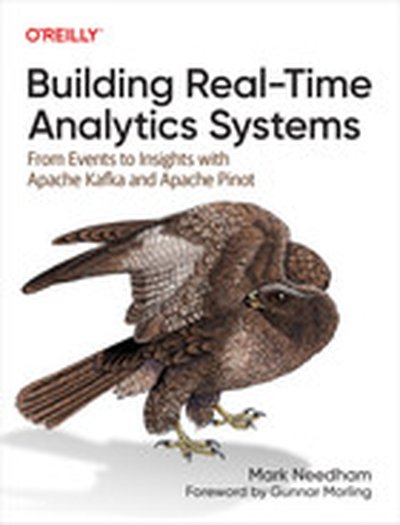
Building Real-Time Analytics Systems

Gain deep insight into real-time analytics, including the features of these systems and the problems they solve. With this practical book, data engineers at organizations that use event-processing systems such as Kafka, Google Pub/Sub, and AWS Kinesis will learn how to analyze data streams in real time. The faster you derive insights, the quicker you can spot changes in your business and act accordingly. Author Mark Needham from StarTree provides an overview of the real-time analytics space and an understanding of what goes into building real-time applications. The book's second part offers a series of hands-on tutorials that show you how to combine multiple software products to build real-time analytics applications for an imaginary pizza delivery service. You will: Learn common architectures for real-time analytics Discover how event processing differs from real-time analytics Ingest event data from Apache Kafka into Apache Pinot Combine event streams with OLTP data using Debezium and Kafka Streams Write real-time queries against event data stored in Apache Pinot Build a real-time dashboard and order tracking app Learn how Uber, Stripe, and Just Eat use real-time analytics

Embracing the Future of Data Engineering: The Serverless, Real-Time Lakehouse in Action

As we venture into the future of data engineering, streaming and serverless technologies take center stage. In this fun, hands-on, in-depth and interactive session you can learn about the essence of future data engineering today.

We will tackle the challenge of processing streaming events continuously created by hundreds of sensors in the conference room from a serverless web app (bring your phone and be a part of the demo). The focus is on the system architecture, the involved products and the solution they provide. Which Databricks product, capability and settings will be most useful for our scenario? What does streaming really mean and why does it make our life easier? What are the exact benefits of serverless and how "serverless" is a particular solution?

Leveraging the power of the Databricks Lakehouse Platform, I will demonstrate how to create a streaming data pipeline with Delta Live Tables ingesting data from AWS Kinesis. Further, I’ll utilize advanced Databricks workflows triggers for efficient orchestration and real-time alerts feeding into a real-time dashboard. And since I don’t want you to leave with empty hands - I will use Delta Sharing to share the results of the demo we built with every participant in the room. Join me in this hands-on exploration of cutting-edge data engineering techniques and witness the future in action.

Talk by: Frank Munz

Connect with us: Website: https://databricks.com Twitter: https://twitter.com/databricks LinkedIn: https://www.linkedin.com/company/databricks Instagram: https://www.instagram.com/databricksinc Facebook: https://www.facebook.com/databricksinc

Sponsored: AWS-Real Time Stream Data & Vis Using Databricks DLT, Amazon Kinesis, & Amazon QuickSight

Amazon Kinesis Data Analytics is a managed service that can capture streaming data from IoT devices. Databricks Lakehouse platform provides ease of processing streaming and batch data using Delta Live Tables. Amazon Quicksight with powerful visualization capabilities can provides various advanced visualization capabilities with direct integration with Databricks. Combining these services, customers can capture, process, and visualize data from hundreds and thousands of IoT sensors with ease.

Talk by: Venkat Viswanathan

Here’s more to explore: Big Book of Data Engineering: 2nd Edition: https://dbricks.co/3XpPgNV The Data Team's Guide to the Databricks Lakehouse Platform: https://dbricks.co/46nuDpI

Connect with us: Website: https://databricks.com Twitter: https://twitter.com/databricks LinkedIn: https://www.linkedin.com/company/databricks Instagram: https://www.instagram.com/databricksinc Facebook: https://www.facebook.com/databricksinc

How Freewheel Processes Billions of Ad tech Events in Real Time | Freewheel

ABOUT THE TALK: The power to gather, analyze, and quickly act on real-time bidding data is critical for advertisers and publishers. A data platform that supports real-time bidding empowers these participants to obtain insights from the huge amounts of data generated by programmatic advertising.

Learn how our Beeswax data platform captures real-time information about bids and impressions and provides feedback to advertisers, enabling them to make data-driven decisions for optimal results. It is built on an event-based architecture, leveraging AWS Kinesis and Snowflake's Snowpipe, that is capable of processing bid requests at a massive scale - around half a million QPS in real-time! We also talk about how the platform evolved over time and how we've built the platform and monitoring infrastructure to enable sustained growth.

ABOUT THE SPEAKER: Margi Dubal is a Director of Data Engineering at Freewheel, a Comcast Company. She currently leads various data teams to build scalable, reliable, and high-quality data solutions. Prior to joining Freewheel, Margi has held data engineering management positions at Paperless Post, Amplify and Adknowledge Inc.

ABOUT DATA COUNCIL: Data Council (https://www.datacouncil.ai/) is a community and conference series that provides data professionals with the learning and networking opportunities they need to grow their careers.

Make sure to subscribe to our channel for the most up-to-date talks from technical professionals on data related topics including data infrastructure, data engineering, ML systems, analytics and AI from top startups and tech companies.

FOLLOW DATA COUNCIL: Twitter: https://twitter.com/DataCouncilAI LinkedIn: https://www.linkedin.com/company/datacouncil-ai/

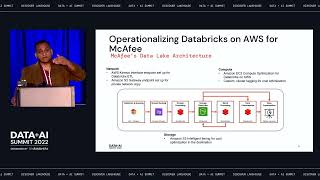
How McAfee Leverages Databricks on AWS at Scale

McAfee, a global leader in online protection security enables home users and businesses to stay ahead of fileless attacks, viruses, malware, and other online threats. Learn how McAfee leverages Databricks on AWS to create a centralized data platform as a single source of truth to power customer insights. We will also describe how McAfee uses additional AWS services specifically Kinesis and CloudWatch to provide real time data streaming and monitor and optimize their Databricks on AWS deployment. Finally, we’ll discuss business benefits and lessons learned during McAfee’s petabyte scale migration to Databricks on AWS using Databricks Delta clone technology coupled with network, compute, storage optimizations on AWS.

Connect with us: Website: https://databricks.com Facebook: https://www.facebook.com/databricksinc Twitter: https://twitter.com/databricks LinkedIn: https://www.linkedin.com/company/data... Instagram: https://www.instagram.com/databricksinc/

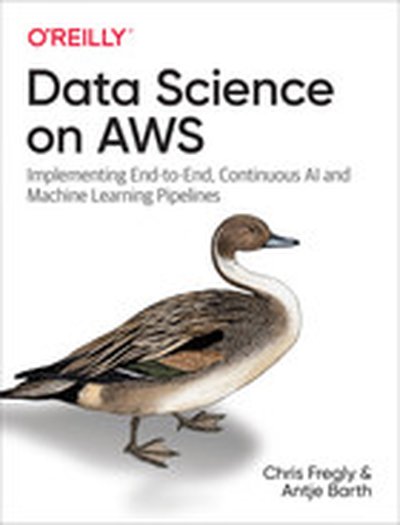
Data Science on AWS

With this practical book, AI and machine learning practitioners will learn how to successfully build and deploy data science projects on Amazon Web Services. The Amazon AI and machine learning stack unifies data science, data engineering, and application development to help level up your skills. This guide shows you how to build and run pipelines in the cloud, then integrate the results into applications in minutes instead of days. Throughout the book, authors Chris Fregly and Antje Barth demonstrate how to reduce cost and improve performance. Apply the Amazon AI and ML stack to real-world use cases for natural language processing, computer vision, fraud detection, conversational devices, and more Use automated machine learning to implement a specific subset of use cases with SageMaker Autopilot Dive deep into the complete model development lifecycle for a BERT-based NLP use case including data ingestion, analysis, model training, and deployment Tie everything together into a repeatable machine learning operations pipeline Explore real-time ML, anomaly detection, and streaming analytics on data streams with Amazon Kinesis and Managed Streaming for Apache Kafka Learn security best practices for data science projects and workflows including identity and access management, authentication, authorization, and more

Summary One of the biggest challenges in building reliable platforms for processing event pipelines is managing the underlying infrastructure. At Snowplow Analytics the complexity is compounded by the need to manage multiple instances of their platform across customer environments. In this episode Josh Beemster, the technical operations lead at Snowplow, explains how they manage automation, deployment, monitoring, scaling, and maintenance of their streaming analytics pipeline for event data. He also shares the challenges they face in supporting multiple cloud environments and the need to integrate with existing customer systems. If you are daunted by the needs of your data infrastructure then it’s worth listening to how Josh and his team are approaching the problem.

Announcements

Hello and welcome to the Data Engineering Podcast, the show about modern data management When you’re ready to build your next pipeline, or want to test out the projects you hear about on the show, you’ll need somewhere to deploy it, so check out our friends at Linode. With 200Gbit private networking, scalable shared block storage, a 40Gbit public network, fast object storage, and a brand new managed Kubernetes platform, you’ve got everything you need to run a fast, reliable, and bullet-proof data platform. And for your machine learning workloads, they’ve got dedicated CPU and GPU instances. Go to dataengineeringpodcast.com/linode today to get a $20 credit and launch a new server in under a minute. And don’t forget to thank them for their continued support of this show! You listen to this show to learn and stay up to date with what’s happening in databases, streaming platforms, big data, and everything else you need to know about modern data management. For even more opportunities to meet, listen, and learn from your peers you don’t want to miss out on this year’s conference season. We have partnered with organizations such as O’Reilly Media, Corinium Global Intelligence, ODSC, and Data Council. Upcoming events include the Software Architecture Conference in NYC, Strata Data in San Jose, and PyCon US in Pittsburgh. Go to dataengineeringpodcast.com/conferences to learn more about these and other events, and take advantage of our partner discounts to save money when you register today. Your host is Tobias Macey and today I’m interviewing Josh Beemster about how Snowplow manages deployment and maintenance of their managed service in their customer’s cloud accounts.

Interview

Introduction How did you get involved in the area of data management? Can you start by giving an overview of the components in your system architecture and the nature of your managed service? What are some of the challenges that are inherent to private SaaS nature of your managed service? What elements of your system require the most attention and maintenance to keep them running properly? Which components in the pipeline are most subject to variability in traffic or resource pressure and what do you do to ensure proper capacity? How do you manage deployment of the full Snowplow pipeline for your customers?

How has your strategy for deployment evolved since you first began Soffering the managed service? How has the architecture of the pipeline evolved to simplify operations?

How much customization do you allow for in the event that the customer has their own system that they want to use in place of one of your supported components?

What are some of the common difficulties that you encounter when working with customers who need customized components, topologies, or event flows?

How does that reflect in the tooling that you use to manage their deployments?

What types of metrics do you track and what do you use for monitoring and alerting to ensure that your customers pipelines are running smoothly? What are some of the most interesting/unexpected/challenging lessons that you have learned in the process of working with and on Snowplow? What are some lessons that you can generalize for management of data infrastructure more broadly? If you could start over with all of Snowplow and the infrastructure automation for it today, what would you do differently? What do you have planned for the future of the Snowplow product and infrastructure management?

Contact Info

LinkedIn jbeemster on GitHub @jbeemster1 on Twitter

Parting Question

From your perspective, what is the biggest gap in the tooling or technology for data management today?

Closing Announcements

Thank you for listening! Don’t forget to check out our other show, Podcast.init to learn about the Python language, its community, and the innovative ways it is being used. Visit the site to subscribe to the show, sign up for the mailing list, and read the show notes. If you’ve learned something or tried out a project from the show then tell us about it! Email [email protected]) with your story. To help other people find the show please leave a review on iTunes and tell your friends and co-workers Join the community in the new Zulip chat workspace at dataengineeringpodcast.com/chat

Links

Snowplow Analytics

Podcast Episode

Terraform Consul Nomad Meltdown Vulnerability Spectre Vulnerability AWS Kinesis Elasticsearch SnowflakeDB Indicative S3 Segment AWS Cloudwatch Stackdriver Apache Kafka Apache Pulsar Google Cloud PubSub AWS SQS AWS SNS AWS Redshift Ansible AWS Cloudformation Kubernetes AWS EMR

The intro and outro music is from The Hug by The Freak Fandango Orchestra / CC BY-SA

Support Data Engineering Podcast

Summary

Processing high velocity time-series data in real-time is a complex challenge. The team at PipelineDB has built a continuous query engine that simplifies the task of computing aggregates across incoming streams of events. In this episode Derek Nelson and Usman Masood explain how it is architected, strategies for designing your data flows, how to scale it up and out, and edge cases to be aware of.

Preamble

Hello and welcome to the Data Engineering Podcast, the show about modern data management When you’re ready to build your next pipeline, or want to test out the projects you hear about on the show, you’ll need somewhere to deploy it, so check out Linode. With 200Gbit private networking, scalable shared block storage, and a 40Gbit public network, you’ve got everything you need to run a fast, reliable, and bullet-proof data platform. If you need global distribution, they’ve got that covered too with world-wide datacenters including new ones in Toronto and Mumbai. Go to dataengineeringpodcast.com/linode today to get a $20 credit and launch a new server in under a minute. Go to dataengineeringpodcast.com to subscribe to the show, sign up for the mailing list, read the show notes, and get in touch. Join the community in the new Zulip chat workspace at dataengineeringpodcast.com/chat Your host is Tobias Macey and today I’m interviewing Usman Masood and Derek Nelson about PipelineDB, an open source continuous query engine for PostgreSQL

Interview

Introduction How did you get involved in the area of data management? Can you start by explaining what PipelineDB is and the motivation for creating it?

What are the major use cases that it enables? What are some example applications that are uniquely well suited to the capabilities of PipelineDB?

What are the major concepts and components that users of PipelineDB should be familiar with? Given the fact that it is a plugin for PostgreSQL, what level of compatibility exists between PipelineDB and other plugins such as Timescale and Citus? What are some of the common patterns for populating data streams? What are the options for scaling PipelineDB systems, both vertically and horizontally?

How much elasticity does the system support in terms of changing volumes of inbound data? What are some of the limitations or edge cases that users should be aware of?

Given that inbound data is not persisted to disk, how do you guard against data loss?

Is it possible to archive the data in a stream, unaltered, to a separate destination table or other storage location? Can a separate table be used as an input stream?

Since the data being processed by the continuous queries is potentially unbounded, how do you approach checkpointing or windowing the data in the continuous views? What are some of the features that you have found to be the most useful which users might initially overlook? What would be involved in generating an alert or notification on an aggregate output that was in some way anomalous? What are some of the most challenging aspects of building continuous aggregates on unbounded data? What have you found to be some of the most interesting, complex, or challenging aspects of building and maintaining PipelineDB? What are some of the most interesting or unexpected ways that you have seen PipelineDB used? When is PipelineDB the wrong choice? What do you have planned for the future of PipelineDB now that you have hit the 1.0 milestone?

Contact Info

Derek

derekjn on GitHub LinkedIn

Usman

@usmanm on Twitter Website

Parting Question

From your perspective, what is the biggest gap in the tooling or technology for data management today?

Links

PipelineDB Stride PostgreSQL

Podcast Episode

AdRoll Probabilistic Data Structures TimescaleDB

[Podcast Episode](

Hive Redshift Kafka Kinesis ZeroMQ Nanomsg HyperLogLog Bloom Filter

The intro and outro music is from The Hug by The Freak Fandango Orchestra / CC BY-SA Support Data Engineerin

Summary

A data lake can be a highly valuable resource, as long as it is well built and well managed. Unfortunately, that can be a complex and time-consuming effort, requiring specialized knowledge and diverting resources from your primary business. In this episode Yoni Iny, CTO of Upsolver, discusses the various components that are necessary for a successful data lake project, how the Upsolver platform is architected, and how modern data lakes can benefit your organization.

Preamble

Hello and welcome to the Data Engineering Podcast, the show about modern data management When you’re ready to build your next pipeline you’ll need somewhere to deploy it, so check out Linode. With private networking, shared block storage, node balancers, and a 40Gbit network, all controlled by a brand new API you’ve got everything you need to run a bullet-proof data platform. Go to dataengineeringpodcast.com/linode to get a $20 credit and launch a new server in under a minute. Go to dataengineeringpodcast.com to subscribe to the show, sign up for the mailing list, read the show notes, and get in touch. Join the community in the new Zulip chat workspace at dataengineeringpodcast.com/chat Your host is Tobias Macey and today I’m interviewing Yoni Iny about Upsolver, a data lake platform that lets developers integrate and analyze streaming data with ease

Interview

Introduction How did you get involved in the area of data management? Can you start by describing what Upsolver is and how it got started?

What are your goals for the platform?

There are a lot of opinions on both sides of the data lake argument. When is it the right choice for a data platform?

What are the shortcomings of a data lake architecture?

How is Upsolver architected?

How has that architecture changed over time? How do you manage schema validation for incoming data? What would you do differently if you were to start over today?

What are the biggest challenges at each of the major stages of the data lake? What is the workflow for a user of Upsolver and how does it compare to a self-managed data lake? When is Upsolver the wrong choice for an organization considering implementation of a data platform? Is there a particular scale or level of data maturity for an organization at which they would be better served by moving management of their data lake in house? What features or improvements do you have planned for the future of Upsolver?

Contact Info

Yoni

yoniiny on GitHub LinkedIn

Upsolver

Website @upsolver on Twitter LinkedIn Facebook

Parting Question

From your perspective, what is the biggest gap in the tooling or technology for data management today?

Links

Upsolver Data Lake Israeli Army Data Warehouse Data Engineering Podcast Episode About Data Curation Three Vs Kafka Spark Presto Drill Spot Instances Object Storage Cassandra Redis Latency Avro Parquet ORC Data Engineering Podcast Episode About Data Serialization Formats SSTables Run Length Encoding CSV (Comma Separated Values) Protocol Buffers Kinesis ETL DevOps Prometheus Cloudwatch DataDog InfluxDB SQL Pandas Confluent KSQL

The intro and outro music is from The Hug by The Freak Fandango Orchestra / CC BY-SA Support Data Engineering Podcast

Summary

Every business with a website needs some way to keep track of how much traffic they are getting, where it is coming from, and which actions are being taken. The default in most cases is Google Analytics, but this can be limiting when you wish to perform detailed analysis of the captured data. To address this problem, Alex Dean co-founded Snowplow Analytics to build an open source platform that gives you total control of your website traffic data. In this episode he explains how the project and company got started, how the platform is architected, and how you can start using it today to get a clearer view of how your customers are interacting with your web and mobile applications.

Preamble

Hello and welcome to the Data Engineering Podcast, the show about modern data management When you’re ready to build your next pipeline you’ll need somewhere to deploy it, so check out Linode. With private networking, shared block storage, node balancers, and a 40Gbit network, all controlled by a brand new API you’ve got everything you need to run a bullet-proof data platform. Go to dataengineeringpodcast.com/linode to get a $20 credit and launch a new server in under a minute. You work hard to make sure that your data is reliable and accurate, but can you say the same about the deployment of your machine learning models? The Skafos platform from Metis Machine was built to give your data scientists the end-to-end support that they need throughout the machine learning lifecycle. Skafos maximizes interoperability with your existing tools and platforms, and offers real-time insights and the ability to be up and running with cloud-based production scale infrastructure instantaneously. Request a demo at dataengineeringpodcast.com/metis-machine to learn more about how Metis Machine is operationalizing data science. Go to dataengineeringpodcast.com to subscribe to the show, sign up for the mailing list, read the show notes, and get in touch. Join the community in the new Zulip chat workspace at dataengineeringpodcast.com/chat This is your host Tobias Macey and today I’m interviewing Alexander Dean about Snowplow Analytics

Interview

Introductions How did you get involved in the area of data engineering and data management? What is Snowplow Analytics and what problem were you trying to solve when you started the company? What is unique about customer event data from an ingestion and processing perspective? Challenges with properly matching up data between sources Data collection is one of the more difficult aspects of an analytics pipeline because of the potential for inconsistency or incorrect information. How is the collection portion of the Snowplow stack designed and how do you validate the correctness of the data?

Cleanliness/accuracy

What kinds of metrics should be tracked in an ingestion pipeline and how do you monitor them to ensure that everything is operating properly? Can you describe the overall architecture of the ingest pipeline that Snowplow provides?

How has that architecture evolved from when you first started? What would you do differently if you were to start over today?

Ensuring appropriate use of enrichment sources What have been some of the biggest challenges encountered while building and evolving Snowplow? What are some of the most interesting uses of your platform that you are aware of?

Keep In Touch

Alex

@alexcrdean on Twitter LinkedIn

Snowplow

@snowplowdata on Twitter

Parting Question

From your perspective, what is the biggest gap in the tooling or technology for data management today?

Links

Snowplow

GitHub

Deloitte Consulting OpenX Hadoop AWS EMR (Elastic Map-Reduce) Business Intelligence Data Warehousing Google Analytics CRM (Customer Relationship Management) S3 GDPR (General Data Protection Regulation) Kinesis Kafka Google Cloud Pub-Sub JSON-Schema Iglu IAB Bots And Spiders List Heap Analytics

Podcast Interview

Redshift SnowflakeDB Snowplow Insights Googl

Summary

Building an ETL pipeline is a common need across businesses and industries. It’s easy to get one started but difficult to manage as new requirements are added and greater scalability becomes necessary. Rather than duplicating the efforts of other engineers it might be best to use a hosted service to handle the plumbing so that you can focus on the parts that actually matter for your business. In this episode CTO and co-founder of Alooma, Yair Weinberger, explains how the platform addresses the common needs of data collection, manipulation, and storage while allowing for flexible processing. He describes the motivation for starting the company, how their infrastructure is architected, and the challenges of supporting multi-tenancy and a wide variety of integrations.

Preamble

Hello and welcome to the Data Engineering Podcast, the show about modern data management When you’re ready to build your next pipeline you’ll need somewhere to deploy it, so check out Linode. With private networking, shared block storage, node balancers, and a 40Gbit network, all controlled by a brand new API you’ve got everything you need to run a bullet-proof data platform. Go to dataengineeringpodcast.com/linode to get a $20 credit and launch a new server in under a minute. For complete visibility into the health of your pipeline, including deployment tracking, and powerful alerting driven by machine-learning, DataDog has got you covered. With their monitoring, metrics, and log collection agent, including extensive integrations and distributed tracing, you’ll have everything you need to find and fix performance bottlenecks in no time. Go to dataengineeringpodcast.com/datadog today to start your free 14 day trial and get a sweet new T-Shirt. Go to dataengineeringpodcast.com to subscribe to the show, sign up for the newsletter, read the show notes, and get in touch. Your host is Tobias Macey and today I’m interviewing Yair Weinberger about Alooma, a company providing data pipelines as a service

Interview

Introduction How did you get involved in the area of data management? What is Alooma and what is the origin story? How is the Alooma platform architected?

I want to go into stream VS batch here What are the most challenging components to scale?

How do you manage the underlying infrastructure to support your SLA of 5 nines? What are some of the complexities introduced by processing data from multiple customers with various compliance requirements?

How do you sandbox user’s processing code to avoid security exploits?

What are some of the potential pitfalls for automatic schema management in the target database? Given the large number of integrations, how do you maintain the

What are some challenges when creating integrations, isn’t it simply conforming with an external API?

For someone getting started with Alooma what does the workflow look like? What are some of the most challenging aspects of building and maintaining Alooma? What are your plans for the future of Alooma?

Contact Info

LinkedIn @yairwein on Twitter

Parting Question

From your perspective, what is the biggest gap in the tooling or technology for data management today?

Links

Alooma Convert Media Data Integration ESB (Enterprise Service Bus) Tibco Mulesoft ETL (Extract, Transform, Load) Informatica Microsoft SSIS OLAP Cube S3 Azure Cloud Storage Snowflake DB Redshift BigQuery Salesforce Hubspot Zendesk Spark The Log: What every software engineer should know about real-time data’s unifying abstraction by Jay Kreps RDBMS (Relational Database Management System) SaaS (Software as a Service) Change Data Capture Kafka Storm Google Cloud PubSub Amazon Kinesis Alooma Code Engine Zookeeper Idempotence Kafka Streams Kubernetes SOC2 Jython Docker Python Javascript Ruby Scala PII (Personally Identifiable Information) GDPR (General Data Protection Regulation) Amazon EMR (Elastic Map Reduce) Sequoia Capital Lightspeed Investors Redis Aerospike Cassandra MongoDB

The intro and outro music is from The Hug by The Freak Fandango Orchestra / CC BY-SA Support Data Engineering Podcast