talk-data.com talk-data.com

Topic

CloudWatch

Amazon CloudWatch

monitoring observability aws

9

tagged

Activity Trend

4 peak/qtr
2020-Q1 2026-Q1

Activities

9 activities · Newest first

AWS re:Invent 2025 - Sustainable computing for climate solutions (AIM417)

High Performance Computing (HPC) is crucial for solving complex environmental challenges such as air pollution and extreme weather forecasting, yet HPC workloads are traditionally computationally intensive. This session explores patterns and key AWS services like AWS Batch, ParallelCluster, EC2 Spot Instances, Graviton processors, FSx for Lustre, and Cloudwatch that help optimize the balance between computational performance and environmental sustainability. Attendees will explore a real-world example of how researchers from University of Oxford are using sustainable HPC solutions for community air quality improvement through large-scale geospatial data processing and machine learning.

Learn more: More AWS events: https://go.aws/3kss9CP

Subscribe: More AWS videos: http://bit.ly/2O3zS75 More AWS events videos: http://bit.ly/316g9t4

ABOUT AWS: Amazon Web Services (AWS) hosts events, both online and in-person, bringing the cloud computing community together to connect, collaborate, and learn from AWS experts. AWS is the world's most comprehensive and broadly adopted cloud platform, offering over 200 fully featured services from data centers globally. Millions of customers—including the fastest-growing startups, largest enterprises, and leading government agencies—are using AWS to lower costs, become more agile, and innovate faster.

AWSreInvent #AWSreInvent2025 #AWS

AWS re:Invent 2025 - Intelligent Observability & Modernization w/ Amazon OpenSearch Service (ANT315)

Discover how Amazon OpenSearch Service is evolving beyond traditional search and analytics to power next-generation observability. We'll showcase how organizations can reduce operational costs by modernizing their observability stack using OpenTelemetry, OpenSearch, S3, and CloudWatch. We'll demonstrate building sophisticated observability solutions that combine OpenSearch's real-time analytics with AI-powered insights using Amazon Q.

Learn more: More AWS events: https://go.aws/3kss9CP

Subscribe: More AWS videos: http://bit.ly/2O3zS75 More AWS events videos: http://bit.ly/316g9t4

ABOUT AWS: Amazon Web Services (AWS) hosts events, both online and in-person, bringing the cloud computing community together to connect, collaborate, and learn from AWS experts. AWS is the world's most comprehensive and broadly adopted cloud platform, offering over 200 fully featured services from data centers globally. Millions of customers—including the fastest-growing startups, largest enterprises, and leading government agencies—are using AWS to lower costs, become more agile, and innovate faster.

AWSreInvent #AWSreInvent2025 #AWS

AWS re:Invent 2025 - Architecting for sustainable IT at scale (AIM255)

Explore how organizations can build and scale applications on AWS with sustainability in mind. This session covers architectural principles for carbon-efficient cloud workloads, including right-sizing resources, leveraging AWS Graviton-based instances, and adopting managed services. Learn how to measure and optimize the sustainability of your workloads using the AWS Customer Carbon Footprint Tool and CloudWatch.

Learn more: More AWS events: https://go.aws/3kss9CP

Subscribe: More AWS videos: http://bit.ly/2O3zS75 More AWS events videos: http://bit.ly/316g9t4

ABOUT AWS: Amazon Web Services (AWS) hosts events, both online and in-person, bringing the cloud computing community together to connect, collaborate, and learn from AWS experts. AWS is the world's most comprehensive and broadly adopted cloud platform, offering over 200 fully featured services from data centers globally. Millions of customers—including the fastest-growing startups, largest enterprises, and leading government agencies—are using AWS to lower costs, become more agile, and innovate faster.

AWSreInvent #AWSreInvent2025 #AWS

AWS re:Invent 2025 - Sustainable and cost-efficient generative AI with agentic workflows (AIM333)

Building sustainable, cost-effective generative AI on AWS requires integrating agentic AI, efficient architecture, and cloud-native optimization. Agentic systems using Amazon Bedrock AgentCore employ contextual memory, asynchronous execution, and on-demand tool invocation to minimize compute waste. MCP enables secure connections between AI agents, AWS services, and custom tools. Efficiency increases through AWS's Trainium and Inferentia2 silicon (50% better performance per watt), Amazon SageMaker for scalable development, and optimization techniques like quantization and speculative decoding. Auto-scaling, batch processing, and spot instances prevent over-provisioning. Combined with CloudWatch and Cost Explorer monitoring, this approach delivers high-performance, low-carbon generative AI solutions.

Learn more: More AWS events: https://go.aws/3kss9CP

Subscribe: More AWS videos: http://bit.ly/2O3zS75 More AWS events videos: http://bit.ly/316g9t4

ABOUT AWS: Amazon Web Services (AWS) hosts events, both online and in-person, bringing the cloud computing community together to connect, collaborate, and learn from AWS experts. AWS is the world's most comprehensive and broadly adopted cloud platform, offering over 200 fully featured services from data centers globally. Millions of customers—including the fastest-growing startups, largest enterprises, and leading government agencies—are using AWS to lower costs, become more agile, and innovate faster.

AWSreInvent #AWSreInvent2025 #AWS

Many SRE teams still rely on manual intervention for incident handling; automation can improve response times and reduce toil. We will cover: Setting up comprehensive observability: Cloud Logging, Cloud Monitoring, and OpenTelemetry; Incident automation strategies: Runbooks, Auto-Healing, and ChatOps; Lessons from AWS CloudWatch and Azure Monitor applied to GCP; Case study: Reducing MTTR (Mean Time to Resolution) through automated detection and remediation

We will share the case study of Airflow at StyleSeat, where within a year our data grew from 2 million data points per day to 200 million. Our original solution for orchestrating this data was not enough, so we migrated to an Airflow based solution. Previous implementation Our tasks were orchestrated with hourly triggers on AWS Cloudwatch rules in their own log groups. Each task was a lambda individually defined as a task and executed python code from a docker image. As complexity increased, there were frequent downtimes and manual executions for failed tasks and their downstream dependencies.With every downtime, our business stakeholders started losing trust in Data and recovery times were longer with each downtime. We needed a modern orchestration platform which would enable our team to define and instrument complex pipelines as code, provide visibility into executions and define retry criteria on failures. Airflow was identified as a crucial & critical piece in modernizing our orchestration which would help us further onboard DBT. We wanted a managed solution and a partner who could help guide us to a successful migration.

How McAfee Leverages Databricks on AWS at Scale

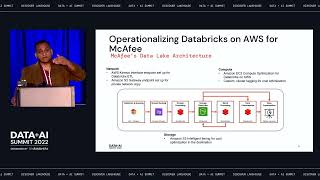
McAfee, a global leader in online protection security enables home users and businesses to stay ahead of fileless attacks, viruses, malware, and other online threats. Learn how McAfee leverages Databricks on AWS to create a centralized data platform as a single source of truth to power customer insights. We will also describe how McAfee uses additional AWS services specifically Kinesis and CloudWatch to provide real time data streaming and monitor and optimize their Databricks on AWS deployment. Finally, we’ll discuss business benefits and lessons learned during McAfee’s petabyte scale migration to Databricks on AWS using Databricks Delta clone technology coupled with network, compute, storage optimizations on AWS.

Connect with us: Website: https://databricks.com Facebook: https://www.facebook.com/databricksinc Twitter: https://twitter.com/databricks LinkedIn: https://www.linkedin.com/company/data... Instagram: https://www.instagram.com/databricksinc/

Summary One of the biggest challenges in building reliable platforms for processing event pipelines is managing the underlying infrastructure. At Snowplow Analytics the complexity is compounded by the need to manage multiple instances of their platform across customer environments. In this episode Josh Beemster, the technical operations lead at Snowplow, explains how they manage automation, deployment, monitoring, scaling, and maintenance of their streaming analytics pipeline for event data. He also shares the challenges they face in supporting multiple cloud environments and the need to integrate with existing customer systems. If you are daunted by the needs of your data infrastructure then it’s worth listening to how Josh and his team are approaching the problem.

Announcements

Hello and welcome to the Data Engineering Podcast, the show about modern data management When you’re ready to build your next pipeline, or want to test out the projects you hear about on the show, you’ll need somewhere to deploy it, so check out our friends at Linode. With 200Gbit private networking, scalable shared block storage, a 40Gbit public network, fast object storage, and a brand new managed Kubernetes platform, you’ve got everything you need to run a fast, reliable, and bullet-proof data platform. And for your machine learning workloads, they’ve got dedicated CPU and GPU instances. Go to dataengineeringpodcast.com/linode today to get a $20 credit and launch a new server in under a minute. And don’t forget to thank them for their continued support of this show! You listen to this show to learn and stay up to date with what’s happening in databases, streaming platforms, big data, and everything else you need to know about modern data management. For even more opportunities to meet, listen, and learn from your peers you don’t want to miss out on this year’s conference season. We have partnered with organizations such as O’Reilly Media, Corinium Global Intelligence, ODSC, and Data Council. Upcoming events include the Software Architecture Conference in NYC, Strata Data in San Jose, and PyCon US in Pittsburgh. Go to dataengineeringpodcast.com/conferences to learn more about these and other events, and take advantage of our partner discounts to save money when you register today. Your host is Tobias Macey and today I’m interviewing Josh Beemster about how Snowplow manages deployment and maintenance of their managed service in their customer’s cloud accounts.

Interview

Introduction How did you get involved in the area of data management? Can you start by giving an overview of the components in your system architecture and the nature of your managed service? What are some of the challenges that are inherent to private SaaS nature of your managed service? What elements of your system require the most attention and maintenance to keep them running properly? Which components in the pipeline are most subject to variability in traffic or resource pressure and what do you do to ensure proper capacity? How do you manage deployment of the full Snowplow pipeline for your customers?

How has your strategy for deployment evolved since you first began Soffering the managed service? How has the architecture of the pipeline evolved to simplify operations?

How much customization do you allow for in the event that the customer has their own system that they want to use in place of one of your supported components?

What are some of the common difficulties that you encounter when working with customers who need customized components, topologies, or event flows?

How does that reflect in the tooling that you use to manage their deployments?

What types of metrics do you track and what do you use for monitoring and alerting to ensure that your customers pipelines are running smoothly? What are some of the most interesting/unexpected/challenging lessons that you have learned in the process of working with and on Snowplow? What are some lessons that you can generalize for management of data infrastructure more broadly? If you could start over with all of Snowplow and the infrastructure automation for it today, what would you do differently? What do you have planned for the future of the Snowplow product and infrastructure management?

Contact Info

LinkedIn jbeemster on GitHub @jbeemster1 on Twitter

Parting Question

From your perspective, what is the biggest gap in the tooling or technology for data management today?

Closing Announcements

Thank you for listening! Don’t forget to check out our other show, Podcast.init to learn about the Python language, its community, and the innovative ways it is being used. Visit the site to subscribe to the show, sign up for the mailing list, and read the show notes. If you’ve learned something or tried out a project from the show then tell us about it! Email [email protected]) with your story. To help other people find the show please leave a review on iTunes and tell your friends and co-workers Join the community in the new Zulip chat workspace at dataengineeringpodcast.com/chat

Links

Snowplow Analytics

Podcast Episode

Terraform Consul Nomad Meltdown Vulnerability Spectre Vulnerability AWS Kinesis Elasticsearch SnowflakeDB Indicative S3 Segment AWS Cloudwatch Stackdriver Apache Kafka Apache Pulsar Google Cloud PubSub AWS SQS AWS SNS AWS Redshift Ansible AWS Cloudformation Kubernetes AWS EMR

The intro and outro music is from The Hug by The Freak Fandango Orchestra / CC BY-SA

Support Data Engineering Podcast

Summary

A data lake can be a highly valuable resource, as long as it is well built and well managed. Unfortunately, that can be a complex and time-consuming effort, requiring specialized knowledge and diverting resources from your primary business. In this episode Yoni Iny, CTO of Upsolver, discusses the various components that are necessary for a successful data lake project, how the Upsolver platform is architected, and how modern data lakes can benefit your organization.

Preamble

Hello and welcome to the Data Engineering Podcast, the show about modern data management When you’re ready to build your next pipeline you’ll need somewhere to deploy it, so check out Linode. With private networking, shared block storage, node balancers, and a 40Gbit network, all controlled by a brand new API you’ve got everything you need to run a bullet-proof data platform. Go to dataengineeringpodcast.com/linode to get a $20 credit and launch a new server in under a minute. Go to dataengineeringpodcast.com to subscribe to the show, sign up for the mailing list, read the show notes, and get in touch. Join the community in the new Zulip chat workspace at dataengineeringpodcast.com/chat Your host is Tobias Macey and today I’m interviewing Yoni Iny about Upsolver, a data lake platform that lets developers integrate and analyze streaming data with ease

Interview

Introduction How did you get involved in the area of data management? Can you start by describing what Upsolver is and how it got started?

What are your goals for the platform?

There are a lot of opinions on both sides of the data lake argument. When is it the right choice for a data platform?

What are the shortcomings of a data lake architecture?

How is Upsolver architected?

How has that architecture changed over time? How do you manage schema validation for incoming data? What would you do differently if you were to start over today?

What are the biggest challenges at each of the major stages of the data lake? What is the workflow for a user of Upsolver and how does it compare to a self-managed data lake? When is Upsolver the wrong choice for an organization considering implementation of a data platform? Is there a particular scale or level of data maturity for an organization at which they would be better served by moving management of their data lake in house? What features or improvements do you have planned for the future of Upsolver?

Contact Info

Yoni

yoniiny on GitHub LinkedIn

Upsolver

Website @upsolver on Twitter LinkedIn Facebook

Parting Question

From your perspective, what is the biggest gap in the tooling or technology for data management today?

Links

Upsolver Data Lake Israeli Army Data Warehouse Data Engineering Podcast Episode About Data Curation Three Vs Kafka Spark Presto Drill Spot Instances Object Storage Cassandra Redis Latency Avro Parquet ORC Data Engineering Podcast Episode About Data Serialization Formats SSTables Run Length Encoding CSV (Comma Separated Values) Protocol Buffers Kinesis ETL DevOps Prometheus Cloudwatch DataDog InfluxDB SQL Pandas Confluent KSQL

The intro and outro music is from The Hug by The Freak Fandango Orchestra / CC BY-SA Support Data Engineering Podcast