Best Datadog configuration at scale—Volkswagen Group case study.
 talk-data.com
Topic
Datadog
monitoring
observability
analytics
53
tagged
Activity Trend
7
peak/qtr
2020-Q1
2026-Q2
Top Events
Data Engineering Podcast
34
Google Cloud Next '25
4
Google Cloud Next '24
3
Microsoft Ignite 2025
2
Kickoff Event in Berlin || What's new & OpenTelemetry
2
NYC Python x PyData NYC: 🗲 Talk Night at Datadog! 🗲
1
BLN DevOps February edition #45
1
Data Council 2023
1
Airflow Summit 2025
1
AI & Infra – A Full-Stack Observability Showcase + Panel
1
Crunch Data Conference 2022
1
Grafana & Friends Berlin 🏝️ Summer Meetup at Trade Republic
1
Discussion on database observability and index optimization techniques.
Datadog is a world-class data platform ingesting more than a 100 trillion events a day, providing real-time insights. Before Airflow’s prominence, we built batch processing on Luigi, Spotify’s open-source orchestrator. As Airflow gained wide adoption, we evaluated adopting the major improvements of release 2.0, but opted for building our own orchestrator instead to realize our dataset-centric, event-driven vision. Meanwhile, the 3.0 release aligned Airflow with the same vision we pursued internally, as a modern asset-driven orchestrator. It showed how futile it is to build our own compared to the momentum of the community. We evaluated several orchestrators and decided to join forces with the Airflow project. This talk follows our journey from building a custom orchestrator to adopting and contributing to Airflow 3. We’ll share our thought process, our asset partitions use case, and how we’re working with the community to materialize the Data Awareness (AIP-73) vision. Partition-based incremental scheduling is core to our orchestration model, enabling scalable, observable pipelines thanks to Datadog’s Data Observability product providing visibility into pipeline health.
by
Amol Devgan
(Snyk)
,
Utkarsh Guleri
(Google Cloud)
,
Mike Flouton
(GitLab)
,
Jimmy Caputo
(Datadog)
,
Trevor Stuart
(Harness)
Code assist tools are transforming software development, enhancing productivity with intelligent suggestions and automation. Yet they also pose challenges in ensuring code security, managing observability, and addressing risks from automation. Join experts from Google Cloud, Datadog, GitLab, Harness, and Snyk in a dynamic panel as they explore the potential of code assist tools and share strategies to mitigate risks, safeguard workflows, and maximize the impact of these tools in today’s fast-paced development landscape.
There’s an old saying: “If you fail to plan, you are planning to fail.” This is true when it comes to migrating workloads to the cloud. Attempting a move without insights into your apps is setting the stage for disaster. How can you ensure your migration to Google Cloud is secure and meets your customers’ expectations? We’ll discuss the role Datadog plays in a migration to Google Cloud. We’ll explore best practices and guide you through the steps to achieve a seamless and successful migration.
This Session is hosted by a Google Cloud Next Sponsor.
Visit your registration profile at g.co/cloudnext to opt out of sharing your contact information with the sponsor hosting this session.
Automation enables engineering teams to reduce duplication of effort and build consistency around various processes, especially observability. Providing out-of-the-box solutions and using infrastructure as code are some of the ways to automate your systems so all of your teams can onboard and get all the right features. In this talk, we will discuss how Datadog and Project44 have created self-service platforms so their engineers can automatically obtain observability into their systems.
This Session is hosted by a Google Cloud Next Sponsor.
Visit your registration profile at g.co/cloudnext to opt out of sharing your contact information with the sponsor hosting this session.
Datadog recently announced the embedded OpenTelemetry Collector at their annual conference DASH24. OpenTelemetry (OTel) is an open source, vendor-neutral observability solution that consists of a suite of components—including APIs, SDKs, and the OTel Collector. It allows teams to monitor their applications and services in a standardized format. In this talk we will give you a introduction to OTel, let you know the status quo about the project and tell you why using it could be a game-changer for your observability strategy.
Datadog is a powerful, ever-evolving Observability and Security Platform that continues to expand its features and capabilities day-by-day. Keeping pace with each new feature, enhancement and products can be challenging. In this session, we'll explore the latest updates in-depth and highlight the most significant features and product additions from recent months.
Half a year ago, my team at Trade Republic fully migrated our observability stack from Datadog to LGTM (Loki, Grafana, Tempo, Mimir). Operations after migration are as important as the migration itself, involving ongoing challenges such as performance and scalability issues, bugs, and incidents. In this talk, I’ll share our experiences from the past six months, detailing the challenges we faced and the valuable lessons we learned while using Grafana tools. Join us to gain insights into the practical aspects of managing and optimising an observability stack in a dynamic environment.
by
Sriram Raman
(Datadog)
,
Merlin Yamssi
(Google Cloud)
,
Prithpal Bhogill
(Google Cloud)
,
Jason Hand
(Datadog)
We’ll explore how you can leverage Gemini to improve productivity while using Datadog for monitoring your Cloud environment, and how you can simplify the Datadog Agent installation and maximize monitoring coverage for the entire fleet. This session will also show how your teams can use Gemini's assistance to simplify routine processes to set up observability. You’ll gain useful tips on how to use Gemini to address the most common observability challenges and also go behind the scenes to explore the large language models that power it.
Click the blue “Learn more” button above to tap into special offers designed to help you implement what you are learning at Google Cloud Next 25.
Just as food delivery has evolved and become ubiquitous, the Software Delivery Lifecycle has also made leaps and bounds. We get there by shifting left and taking a platform centric approach. In this session join us as we discuss modern software delivery, ways that Datadog has implemented SDLC internally and enable our user’s production of high-quality software with higher velocity.
By attending this session, your contact information may be shared with the sponsor for relevant follow up for this event only.
Click the blue “Learn more” button above to tap into special offers designed to help you implement what you are learning at Google Cloud Next 25.
Although cloud computing has the potential to save you money, many organizations face growing IT costs and struggle to keep their spending within budget. As one of the leading SaaS observability platforms, Datadog uses a massive amount of cloud resources and has worked diligently to keep our IT spending constrained. In this session, we’ll share the practices that we use to optimize costs and how you can apply them to reduce your spend, increase performance, and meet your business goals.
By attending this session, your contact information may be shared with the sponsor for relevant follow up for this event only.
Click the blue “Learn more” button above to tap into special offers designed to help you implement what you are learning at Google Cloud Next 25.
In the current environment, cost awareness on top of a great developer experience is more relevant than ever. As an answer to that, at Trade Republic, we have decided to re-evaluate the cost-to-use of our observability offering and ruled against continuing the path forward with Datadog. In this talk I will provide an overview of our mission to migrate to an alternative stack, which outcome we have so far and what we have learned.
This talk was recorded at Crunch Conference. Wouter from Datadog spoke about data infrastructure in a multi-cloud environment.
"In this talk we'll talk about the Data Engineering Platform Datadog has built in multiple clouds. We'll discuss why, how, how it's used and the challenges we've faced."
The event was organized by Crafthub.
You can watch the rest of the conference talks on our channel.
If you are interested in more speakers, tickets and details of the conference, check out our website: https://crunchconf.com/
If you are interested in more events from our company: https://crafthub.events/
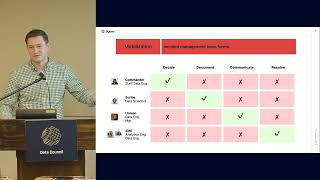
ABOUT THE TALK: Incident management is a key practice used by DevOps and SRE teams to keep software reliable—but it's still uncommon among data teams! Datadog says incident management can "streamline their response procedures, reducing mean time to repair (MTTR) and minimizing any impact on end users."
In this talk, Kyle Kirwan, co-founder of data observability company Bigeye, will explain the basics of incident management and how data teams can use it to reduce disruptions to analytics and machine learning applications.
ABOUT THE SPEAKER: Kyle Kirwan is the co-founder and CEO of Bigeye. He began his career as a data scientist, went on to lead the development of Uber's internal data catalog/lineage/quality tools, and now helps data teams use data observability to improve pipeline reliability and data quality.
ABOUT DATA COUNCIL: Data Council (https://www.datacouncil.ai/) is a community and conference series that provides data professionals with the learning and networking opportunities they need to grow their careers.
Make sure to subscribe to our channel for the most up-to-date talks from technical professionals on data related topics including data infrastructure, data engineering, ML systems, analytics and AI from top startups and tech companies.
FOLLOW DATA COUNCIL: Twitter: https://twitter.com/DataCouncilAI LinkedIn: https://www.linkedin.com/company/datacouncil-ai/
Summary Most of the time when you think about a data pipeline or ETL job what comes to mind is a purely mechanistic progression of functions that move data from point A to point B. Sometimes, however, one of those transformations is actually a full-fledged machine learning project in its own right. In this episode Tal Galfsky explains how he and the team at Cherre tackled the problem of messy data for Addresses by building a natural language processing and entity resolution system that is served as an API to the rest of their pipelines. He discusses the myriad ways that addresses are incomplete, poorly formed, and just plain wrong, why it was a big enough pain point to invest in building an industrial strength solution for it, and how it actually works under the hood. After listening to this you’ll look at your data pipelines in a new light and start to wonder how you can bring more advanced strategies into the cleaning and transformation process.
Announcements
Hello and welcome to the Data Engineering Podcast, the show about modern data management When you’re ready to build your next pipeline, or want to test out the projects you hear about on the show, you’ll need somewhere to deploy it, so check out our friends at Linode. With their managed Kubernetes platform it’s now even easier to deploy and scale your workflows, or try out the latest Helm charts from tools like Pulsar and Pachyderm. With simple pricing, fast networking, object storage, and worldwide data centers, you’ve got everything you need to run a bulletproof data platform. Go to dataengineeringpodcast.com/linode today and get a $100 credit to try out a Kubernetes cluster of your own. And don’t forget to thank them for their continued support of this show! Modern Data teams are dealing with a lot of complexity in their data pipelines and analytical code. Monitoring data quality, tracing incidents, and testing changes can be daunting and often takes hours to days. Datafold helps Data teams gain visibility and confidence in the quality of their analytical data through data profiling, column-level lineage and intelligent anomaly detection. Datafold also helps automate regression testing of ETL code with its Data Diff feature that instantly shows how a change in ETL or BI code affects the produced data, both on a statistical level and down to individual rows and values. Datafold integrates with all major data warehouses as well as frameworks such as Airflow & dbt and seamlessly plugs into CI workflows. Go to dataengineeringpodcast.com/datafold today to start a 30-day trial of Datafold. Once you sign up and create an alert in Datafold for your company data, they will send you a cool water flask. RudderStack’s smart customer data pipeline is warehouse-first. It builds your customer data warehouse and your identity graph on your data warehouse, with support for Snowflake, Google BigQuery, Amazon Redshift, and more. Their SDKs and plugins make event streaming easy, and their integrations with cloud applications like Salesforce and ZenDesk help you go beyond event streaming. With RudderStack you can use all of your customer data to answer more difficult questions and then send those insights to your whole customer data stack. Sign up free at dataengineeringpodcast.com/rudder today. Your host is Tobias Macey and today I’m interviewing Tal Galfsky about how Cherre is bringing order to the messy problem of physical addresses and entity resolution in their data pipelines.
Interview
Introduction How did you get involved in the area of data management? Started as physicist and evolved into Data Science Can you start by giving a brief recap of what Cherre is and the types of data that you deal with? Cherre is a company that connects data We’re not a data vendor, in that we don’t sell data, primarily We help companies connect and make sense of their data The real estate market is historically closed, gut let, behind on tech What are the biggest challenges that you deal with in your role when working with real estate data? Lack of a standard domain model in real estate. Ontology. What is a property? Each data source, thinks about properties in a very different way. Therefore, yielding similar, but completely different data. QUALITY (Even if the dataset are talking about the same thing, there are different levels of accuracy, freshness). HIREARCHY. When is one source better than another What are the teams and systems that rely on address information? Any company that needs to clean or organize (make sense) their data, need to identify, people, companies, and properties. Our clients use Address resolution in multiple ways. Via the UI or via an API. Our service is both external and internal so what I build has to be good enough for the demanding needs of our data science team, robust enough for our engineers, and simple enough that non-expert clients can use it. Can you give an example for the problems involved in entity resolution Known entity example. Empire state buidling. To resolve addresses in a way that makes sense for the client you need to capture the real world entities. Lots, buildings, units.
Identify the type of the object (lot, building, unit) Tag the object with all the relevant addresses Relations to other objects (lot, building, unit)
What are some examples of the kinds of edge cases or messiness that you encounter in addresses? First class is string problems. Second class component problems. third class is geocoding. I understand that you have developed a service for normalizing addresses and performing entity resolution to provide canonical references for downstream analyses. Can you give an overview of what is involved? What is the need for the service. The main requirement here is connecting an address to lot, building, unit with latitude and longitude coordinates
How were you satisfying this requirement previously? Before we built our model and dedicated service we had a basic prototype for pipeline only to handle NYC addresses. What were the motivations for designing and implementing this as a service? Need to expand nationwide and to deal with client queries in real time. What are some of the other data sources that you rely on to be able to perform this normalization and resolution? Lot data, building data, unit data, Footprints and address points datasets. What challenges do you face in managing these other sources of information? Accuracy, hirearchy, standardization, unified solution, persistant ids and primary keys
Digging into the specifics of your solution, can you talk through the full lifecycle of a request to resolve an address and the various manipulations that are performed on it? String cleaning, Parse and tokenize, standardize, Match What are some of the other pieces of information in your system that you would like to see addressed in a similar fashion? Our named entity solution with connection to knowledge graph and owner unmasking. What are some of the most interesting, unexpected, or challenging lessons that you learned while building this address resolution system? Scaling nyc geocode example. The NYC model was exploding a subset of the options for messing up an address. Flexibility. Dependencies. Client exposure. Now that you have this system running in production, if you were to start over today what would you do differently? a lot but at this point the module boundaries and client interface are defined in such way that we are able to make changes or completely replace any given part of it without breaking anything client facing What are some of the other projects that you are excited to work on going forward? Named entity resolution and Knowledge Graph
Contact Info
Parting Question
From your perspective, what is the biggest gap in the tooling or technology for data management today? BigQuery is huge asset and in particular UDFs but they don’t support API calls or python script
Closing Announcements
Thank you for listening! Don’t forget to check out our other show, Podcast.init to learn about the Python language, its community, and the innovative ways it is being used. Visit the site to subscribe to the show, sign up for the mailing list, and read the show notes. If you’ve learned something or tried out a project from the show then tell us about it! Email [email protected]) with your story. To help other people find the show please leave a review on iTunes and tell your friends and co-workers Join the community in the new Zulip chat workspace at dataengineeringpodcast.com/chat
Links
Cherre
Podcast Episode
Photonics Knowledge Graph Entity Resolution BigQuery NLP == Natural Language Processing dbt
Podcast Episode
Airflow
Podcast.init Episode
Datadog
Podcast Episode
The intro and outro music is from The Hug by The Freak Fandango Orchestra / CC BY-SA
Support Data Engineering Podcast
Summary With all of the tools and services available for building a data platform it can be difficult to separate the signal from the noise. One of the best ways to get a true understanding of how a technology works in practice is to hear from people who are running it in production. In this episode Zeeshan Qureshi and Michelle Ark share their experiences using DBT to manage the data warehouse for Shopify. They explain how the structured the project to allow for multiple teams to collaborate in a scalable manner, the additional tooling that they added to address the edge cases that they have run into, and the optimizations that they baked into their continuous integration process to provide fast feedback and reduce costs. This is a great conversation about the lessons learned from real world use of a specific technology and how well it lives up to its promises.
Announcements
Hello and welcome to the Data Engineering Podcast, the show about modern data management When you’re ready to build your next pipeline, or want to test out the projects you hear about on the show, you’ll need somewhere to deploy it, so check out our friends at Linode. With their managed Kubernetes platform it’s now even easier to deploy and scale your workflows, or try out the latest Helm charts from tools like Pulsar and Pachyderm. With simple pricing, fast networking, object storage, and worldwide data centers, you’ve got everything you need to run a bulletproof data platform. Go to dataengineeringpodcast.com/linode today and get a $100 credit to try out a Kubernetes cluster of your own. And don’t forget to thank them for their continued support of this show! Modern Data teams are dealing with a lot of complexity in their data pipelines and analytical code. Monitoring data quality, tracing incidents, and testing changes can be daunting and often takes hours to days. Datafold helps Data teams gain visibility and confidence in the quality of their analytical data through data profiling, column-level lineage and intelligent anomaly detection. Datafold also helps automate regression testing of ETL code with its Data Diff feature that instantly shows how a change in ETL or BI code affects the produced data, both on a statistical level and down to individual rows and values. Datafold integrates with all major data warehouses as well as frameworks such as Airflow & dbt and seamlessly plugs into CI workflows. Go to dataengineeringpodcast.com/datafold today to start a 30-day trial of Datafold. Once you sign up and create an alert in Datafold for your company data, they will send you a cool water flask. Today’s episode of Data Engineering Podcast is sponsored by Datadog, the monitoring and analytics platform for cloud-scale infrastructure and applications. Datadog’s machine-learning based alerts, customizable dashboards, and 400+ vendor-backed integrations makes it easy to unify disparate data sources and pivot between correlated metrics and events for faster troubleshooting. By combining metrics, traces, and logs in one place, you can easily improve your application performance. Try Datadog free by starting a your 14-day trial and receive a free t-shirt once you install the agent. Go to dataengineeringpodcast.com/datadog today see how you can unify your monitoring today. Your host is Tobias Macey and today I’m interviewing Zeeshan Qureshi and Michelle Ark about how Shopify is building their production data warehouse platform with DBT
Interview
Introduction How did you get involved in the area of data management? Can you start by giving an overview of what the Shopify platform is? What kinds of data sources are you working with?
Can you share some examples of the types of analysis, decisions, and products that you are building with the data that you manage? How have you structured your data teams to be able to deliver those projects?
What are the systems that you have in place, technological or otherwise, to allow you to support the needs of
Summary Collecting and processing metrics for monitoring use cases is an interesting data problem. It is eminently possible to generate millions or billions of data points per second, the information needs to be propagated to a central location, processed, and analyzed in timeframes on the order of milliseconds or single-digit seconds, and the consumers of the data need to be able to query the information quickly and flexibly. As the systems that we build continue to grow in scale and complexity the need for reliable and manageable monitoring platforms increases proportionately. In this episode Rob Skillington, CTO of Chronosphere, shares his experiences building metrics systems that provide observability to companies that are operating at extreme scale. He describes how the M3DB storage engine is designed to manage the pressures of a critical system component, the inherent complexities of working with telemetry data, and the motivating factors that are contributing to the growing need for flexibility in querying the collected metrics. This is a fascinating conversation about an area of data management that is often taken for granted.
Announcements
Hello and welcome to the Data Engineering Podcast, the show about modern data management When you’re ready to build your next pipeline, or want to test out the projects you hear about on the show, you’ll need somewhere to deploy it, so check out our friends at Linode. With their managed Kubernetes platform it’s now even easier to deploy and scale your workflows, or try out the latest Helm charts from tools like Pulsar and Pachyderm. With simple pricing, fast networking, object storage, and worldwide data centers, you’ve got everything you need to run a bulletproof data platform. Go to dataengineeringpodcast.com/linode today and get a $100 credit to try out a Kubernetes cluster of your own. And don’t forget to thank them for their continued support of this show! Modern Data teams are dealing with a lot of complexity in their data pipelines and analytical code. Monitoring data quality, tracing incidents, and testing changes can be daunting and often takes hours to days. Datafold helps Data teams gain visibility and confidence in the quality of their analytical data through data profiling, column-level lineage and intelligent anomaly detection. Datafold also helps automate regression testing of ETL code with its Data Diff feature that instantly shows how a change in ETL or BI code affects the produced data, both on a statistical level and down to individual rows and values. Datafold integrates with all major data warehouses as well as frameworks such as Airflow & dbt and seamlessly plugs into CI workflows. Go to dataengineeringpodcast.com/datafold today to start a 30-day trial of Datafold. Once you sign up and create an alert in Datafold for your company data, they will send you a cool water flask. Today’s episode of Data Engineering Podcast is sponsored by Datadog, the monitoring and analytics platform for cloud-scale infrastructure and applications. Datadog’s machine-learning based alerts, customizable dashboards, and 400+ vendor-backed integrations makes it easy to unify disparate data sources and pivot between correlated metrics and events for faster troubleshooting. By combining metrics, traces, and logs in one place, you can easily improve your application performance. Try Datadog free by starting a your 14-day trial and receive a free t-shirt once you install the agent. Go to dataengineeringpodcast.com/datadog today see how you can unify your monitoring today. Your host is Tobias Macey and today I’m interviewing Rob Skillington about Chronosphere, a scalable, reliable and customizable monitoring-as-a-service purpose built for cloud-native applications.
Interview
Introduction How did you get involved in the area of data management? Can you start by describing what you are building at Chronosphere and your motivation for turning it into a business? What are the
Summary Businesses often need to be able to ingest data from their customers in order to power the services that they provide. For each new source that they need to integrate with it is another custom set of ETL tasks that they need to maintain. In order to reduce the friction involved in supporting new data transformations David Molot and Hassan Syyid built the Hotlue platform. In this episode they describe the data integration challenges facing many B2B companies, how their work on the Hotglue platform simplifies their efforts, and how they have designed the platform to make these ETL workloads embeddable and self service for end users.
Announcements
Hello and welcome to the Data Engineering Podcast, the show about modern data management When you’re ready to build your next pipeline, or want to test out the projects you hear about on the show, you’ll need somewhere to deploy it, so check out our friends at Linode. With their managed Kubernetes platform it’s now even easier to deploy and scale your workflows, or try out the latest Helm charts from tools like Pulsar and Pachyderm. With simple pricing, fast networking, object storage, and worldwide data centers, you’ve got everything you need to run a bulletproof data platform. Go to dataengineeringpodcast.com/linode today and get a $60 credit to try out a Kubernetes cluster of your own. And don’t forget to thank them for their continued support of this show! Modern Data teams are dealing with a lot of complexity in their data pipelines and analytical code. Monitoring data quality, tracing incidents, and testing changes can be daunting and often takes hours to days. Datafold helps Data teams gain visibility and confidence in the quality of their analytical data through data profiling, column-level lineage and intelligent anomaly detection. Datafold also helps automate regression testing of ETL code with its Data Diff feature that instantly shows how a change in ETL or BI code affects the produced data, both on a statistical level and down to individual rows and values. Datafold integrates with all major data warehouses as well as frameworks such as Airflow & dbt and seamlessly plugs into CI workflows. Go to dataengineeringpodcast.com/datafold today to start a 30-day trial of Datafold. Once you sign up and create an alert in Datafold for your company data, they will send you a cool water flask. This episode of Data Engineering Podcast is sponsored by Datadog, a unified monitoring and analytics platform built for developers, IT operations teams, and businesses in the cloud age. Datadog provides customizable dashboards, log management, and machine-learning-based alerts in one fully-integrated platform so you can seamlessly navigate, pinpoint, and resolve performance issues in context. Monitor all your databases, cloud services, containers, and serverless functions in one place with Datadog’s 400+ vendor-backed integrations. If an outage occurs, Datadog provides seamless navigation between your logs, infrastructure metrics, and application traces in just a few clicks to minimize downtime. Try it yourself today by starting a free 14-day trial and receive a Datadog t-shirt after installing the agent. Go to dataengineeringpodcast.com/datadog today to see how you can enhance visibility into your stack with Datadog. Your host is Tobias Macey and today I’m interviewing David Molot and Hassan Syyid about Hotglue, an embeddable data integration tool for B2B developers built on the Python ecosystem.
Interview
Introduction How did you get involved in the area of data management? Can you start by describing what you are building at Hotglue?
What was your motivation for starting a business to address this particular problem?
Who is the target user of Hotglue and what are their biggest data problems?
What are the types and sources of data that they are likely to be working with? How are they currently handling solutions for those problems? How does the introduction of Hotglue simplify or improve their work?
What is involved in getting Hotglue integrated into a given customer’s environment? How is Hotglue itself implemented?
How has the design or goals of the platform evolved since you first began building it? What were some of the initial assumptions that you had at the outset and how well have they held up as you progressed?
Once a customer has set up Hotglue what is their workflow for building and executing an ETL workflow?
What are their options for working with sources that aren’t supported out of the box?
What are the biggest design and implementation challenges that you are facing given the need for your product to be embedded in customer platforms and exposed to their end users? What are some of the most interesting, innovative, or unexpected ways that you have seen Hotglue used? What are the most interesting, unexpected, or challenging lessons that you have learned while building Hotglue? When is Hotglue the wrong choice? What do you have planned for the future of the product?
Contact Info
David
@davidmolot on Twitter LinkedIn
Hassan
hsyyid on GitHub LinkedIn
Parting Question
From your perspective, what is the biggest gap in the tooling or technology for data management today?
Closing Announcements
Thank you for listening! Don’t forget to check out our other show, Podcast.init to learn about the Python language, its community, and the innovative ways it is being used. Visit the site to subscribe to the show, sign up for the mailing list, and read the show notes. If you’ve learned something or tried out a project from the show then tell us about it! Email [email protected]) with your story. To help other people find the show please leave a review on iTunes and tell your friends and co-workers Join the community in the new Zulip chat workspace at dataengineeringpodcast.com/chat
Links
Hotglue Python
The Python Podcast.init
B2B == Business to Business Meltano
Podcast Episode
Airbyte Singer
The intro and outro music is from The Hug by The Freak Fandango Orchestra / CC BY-SA
Support Data Engineering Podcast
Summary The data warehouse has become the central component of the modern data stack. Building on this pattern, the team at Hightouch have created a platform that synchronizes information about your customers out to third party systems for use by marketing and sales teams. In this episode Tejas Manohar explains the benefits of sourcing customer data from one location for all of your organization to use, the technical challenges of synchronizing the data to external systems with varying APIs, and the workflow for enabling self-service access to your customer data by your marketing teams. This is an interesting conversation about the importance of the data warehouse and how it can be used beyond just internal analytics.
Announcements
Hello and welcome to the Data Engineering Podcast, the show about modern data management When you’re ready to build your next pipeline, or want to test out the projects you hear about on the show, you’ll need somewhere to deploy it, so check out our friends at Linode. With their managed Kubernetes platform it’s now even easier to deploy and scale your workflows, or try out the latest Helm charts from tools like Pulsar and Pachyderm. With simple pricing, fast networking, object storage, and worldwide data centers, you’ve got everything you need to run a bulletproof data platform. Go to dataengineeringpodcast.com/linode today and get a $60 credit to try out a Kubernetes cluster of your own. And don’t forget to thank them for their continued support of this show! Modern Data teams are dealing with a lot of complexity in their data pipelines and analytical code. Monitoring data quality, tracing incidents, and testing changes can be daunting and often takes hours to days. Datafold helps Data teams gain visibility and confidence in the quality of their analytical data through data profiling, column-level lineage and intelligent anomaly detection. Datafold also helps automate regression testing of ETL code with its Data Diff feature that instantly shows how a change in ETL or BI code affects the produced data, both on a statistical level and down to individual rows and values. Datafold integrates with all major data warehouses as well as frameworks such as Airflow & dbt and seamlessly plugs into CI workflows. Go to dataengineeringpodcast.com/datafold today to start a 30-day trial of Datafold. Once you sign up and create an alert in Datafold for your company data, they will send you a cool water flask. This episode of Data Engineering Podcast is sponsored by Datadog, a unified monitoring and analytics platform built for developers, IT operations teams, and businesses in the cloud age. Datadog provides customizable dashboards, log management, and machine-learning-based alerts in one fully-integrated platform so you can seamlessly navigate, pinpoint, and resolve performance issues in context. Monitor all your databases, cloud services, containers, and serverless functions in one place with Datadog’s 400+ vendor-backed integrations. If an outage occurs, Datadog provides seamless navigation between your logs, infrastructure metrics, and application traces in just a few clicks to minimize downtime. Try it yourself today by starting a free 14-day trial and receive a Datadog t-shirt after installing the agent. Go to dataengineeringpodcast.com/datadog today to see how you can enhance visibility into your stack with Datadog. Your host is Tobias Macey and today I’m interviewing Tejas Manohar about Hightouch, a data platform that helps you sync your customer data from your data warehouse to your CRM, marketing, and support tools
Interview
Introduction How did you get involved in the area of data management? Can you start by giving an overview of what you are building at Hightouch and your motivation for creating it? What are the main points of friction for teams who are trying to make use of customer data? Where is Hightouch positioned in the ecosystem of customer data tools such as Segment, Mixpanel