talk-data.com talk-data.com

Topic

SaaS

Software as a Service (SaaS)

cloud_computing software_delivery subscription

310

tagged

Activity Trend

23 peak/qtr
2020-Q1 2026-Q1

Activities

310 activities · Newest first

D&A leaders have a key strategic decision to make over the next few years. What does their strategic and long-term data management platform looks like and where to source it from? There are four options that this session will discuss: utilizing the all encompassing data and AI platform from their cloud service providers, extending their ISV solution providers to enable their data platform, engaging their enterprise SaaS application providers to support D&A use cases, or taking a blended approach.

Join Microsoft’s product team for a hands-on lab where you'll design and deploy an AI-powered application using SQL Database in Microsoft Fabric. This session dives into HTAP capabilities, enabling seamless transactional and analytical processing. You'll provision a SaaS-native SQL Database, use Copilot to generate schema and queries, and implement advanced patterns like RAG with vector search. Walk away with practical skills and a working solution you can apply immediately.

Please RSVP and arrive at least 5 minutes before the start time, at which point remaining spaces are open to standby attendees.

Join Microsoft’s product team for a hands-on lab where you'll design and deploy an AI-powered application using SQL Database in Microsoft Fabric. This session dives into HTAP capabilities, enabling seamless transactional and analytical processing. You'll provision a SaaS-native SQL Database, use Copilot to generate schema and queries, and implement advanced patterns like RAG with vector search. Walk away with practical skills and a working solution you can apply immediately.

Please RSVP and arrive at least 5 minutes before the start time, at which point remaining spaces are open to standby attendees.

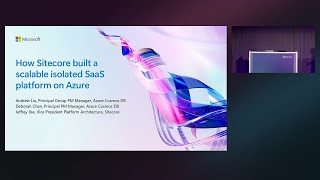
How Sitecore built a scalable, isolated SaaS platform on Azure

Isolating tenants, managing costs, and ensuring reliability are core challenges for any multi-tenant SaaS app. This session provides a blueprint on Azure using real world examples. We'll dive deep into the data tier, contrasting Azure Cosmos DB’s DB-per-tenant pooling model against the partition-key-per-tenant strategy to find your ideal balance of cost and isolation. Learn how these choices impact your TCO and security posture and manage tenants with design patterns like deployment stamps.

Join Microsoft’s product team for a hands-on lab where you'll design and deploy an AI-powered application using SQL Database in Microsoft Fabric. This session dives into HTAP capabilities, enabling seamless transactional and analytical processing. You'll provision a SaaS-native SQL Database, use Copilot to generate schema and queries, and implement advanced patterns like RAG with vector search. Walk away with practical skills and a working solution you can apply immediately.

Please RSVP and arrive at least 5 minutes before the start time, at which point remaining spaces are open to standby attendees.

Today, we’re turning the tables and interviewing our host, Arman Eshraghi, Founding CEO at Qrvey, the only embedded analytics solution purpose-built for SaaS. Arman tells us about:

What inspired him to start the SaaS Scaled podcastHow the vision of the podcast has changed since its inception in 2021How the fundamental objective remains: unscripted discussions in which experts share their knowledgeGetting comfortable and having sincere, authentic, organic discussionsWhat makes SaaS Scaled stand out among other podcasts

A reliable, performant, secure and scalable data layer is critical for SaaS applications — but managing and scaling it remains a major challenge. Snowflake is uniquely architected to address many of the challenges of SaaS applications. In this session, we’ll explore the key challenges of building SaaS applications, uncover opportunities for optimization, and demonstrate how Snowflake enables scalable, efficient and secure architectures.

Elis partage son parcours vers le cloud et le SaaS avec Semarchy xDM, et son projet de migration vers Snowflake. La présentation mettra en avant l’architecture actuelle, les capacités attendues de Snowflake, ainsi que les défis et limites anticipés de cette transition. Un retour d’expérience concret pour éclairer les enjeux et bénéfices d’une telle évolution.

Une couche de données fiable, performante, sécurisée et évolutive est essentielle pour les applications SaaS – mais sa gestion et son évolutivité restent un défi majeur. Snowflake est conçue de manière unique pour relever bon nombre des défis des applications SaaS. Dans cette session, nous explorerons les principaux défis de la création d'applications SaaS, découvrirons les opportunités d'optimisation et démontrerons comment Snowflake permet des architectures évolutives, efficaces et sécurisées.

Mettre en place un RAG (Retrieval-Augmented Generation) semble simple : connecter un LLM à une base documentaire et obtenir des réponses enrichies. Mais lorsqu’il s’agit de gérer des millions de documents, comme le font certains clients de Hymalaia comme Zenchef, la réalité est tout autre : un RAG qui fonctionne vraiment demande une ingénierie avancée et une architecture robuste. Le RAG avancé couple la puissance des LLM à des moteurs de recherche intelligents pour offrir pertinence, traçabilité et fiabilité. Dans ce talk, Cédric Carbone expliquera les fondements clés : multipass d’indexation, hybridation des algorithmes, reranking et stratégies anti-biais. Il illustrera ensuite ces principes avec un cas concret : Hymalaia, la solution SaaS de création et de déploiement d’agents IA conversationnels augmentés. Vous verrez comment un RAG bien conçu transforme un LLM en véritable outil de confiance pour la décision et l’action, capable de passer à l’échelle de vos données.

It’s no secret that AI is reliant on ‘rock solid’ data. However given the vast amounts of data that companies now have spread across a distributed SaaS, on-premises and multi-cloud data estate, many companies they are a million miles away from this. We are also well past the point where people can govern data on their own. They need help and a total rethink is now needed to conquer data complexity and create a high quality, compliant data foundation for AI Success.


In this watershed keynote, conference char Mike Ferguson details what needs to be done to govern data in the era of AI, how companies can conquer the complexity they face, by implementing an always on, active and unified approach to data governance to continuously detect, automate and consistently enforce multiple types of policies across a distributed data estate. The session will cover:

• Current problems with data governance today and why old approaches are broken

• Requirements to dramatically improve data governance using AI and AI automation

• The need for an integrated and unified data governance platform

• Why a data catalog, data intelligence, data observability, AI Agents and orchestration all need to be integrated for AI-Assisted active data governance

• Understanding the AI-assisted data governance services and AI-Agents you need

• Establishing health metrics to measure effectiveness of your data governance program

• Creating a Data Governance Action Framework for your enterprise

• Monitoring the health and security of your data using data governance observability

• Enabling continuous reporting and AI-Assisted data governance action automation

• Implementing data governance AI Agents for different data governance disciplines

Joseph Toma is the Cloud and AI Director for Media and Communications. Joseph’s career spans across enterprise, scale-up, and start-up environments, most notably as the CEO of Jugo, an innovative AI SaaS platform. His tenure as Managing Partner at Kyndryl and various leadership roles at IBM, including Hybrid Cloud and Red Hat Sales Director, took him to three continents and has equipped him with a unique perspective that shapes his approach to supporting customers. Joseph is based in London where he lives with his wife, young child, and cavapoo.

In this episode, I sat down with tech humanist Kate O’Neill to explore how organizations can balance human-centered design in a time when everyone is racing to find ways to leverage AI in their businesses. Kate introduced her “Now–Next Continuum,” a framework that distinguishes digital transformation (catching up) from true innovation (looking ahead). We dug into real-world challenges and tensions of moving fast vs. creating impact with AI, how ethics fits into decision making, and the role of data in making informed decisions. 

Kate stressed the importance of organizations having clear purpose statements and values from the outset, proxy metrics she uses to gauge human-friendliness, and applying a “harms of action vs. harms of inaction” lens for ethical decisions. Her key point: human-centered approaches to AI and technology creation aren’t slow; they create intentional structures that speed up smart choices while avoiding costly missteps.

Highlights/ Skip to:

How Kate approaches discussions with executives about moving fast, but also moving in a human-centered way when building out AI solutions (1:03) Exploring the lack of technical backgrounds among many CEOs and how this shapes the way organizations make big decisions around technical solutions (3:58)  FOMO and the “Solution in Search of a Problem” problem in Data (5:18)  Why ongoing ethnographic research and direct exposure to users are essential for true innovation (11:21)  Balancing organizational purpose and human-centered tech decisions, and why a defined purpose must precede these decisions (18:09) How organizations can define, measure, operationalize, and act on ethical considerations in AI and data products (35:57) Risk management vs. strategic optimism: balancing risk reduction with embracing the art of the possible when building AI solutions (43:54)

Quotes from Today’s Episode "I think the ethics and the governance and all those kinds of discussions [about the implications of digital transformation] are all very big word - kind of jargon-y kinds of discussions - that are easy to think aren't important, but what they all tend to come down to is that alignment between what the business is trying to do and what the person on the other side of the business is trying to do." –Kate O’Neill

" I've often heard the term digital transformation used almost interchangeably with the term innovation. And I think that that's a grave disservice that we do to those two concepts because they're very different. Digital transformation, to me, seems as if it sits much more comfortably on the earlier side of the Now-Next Continuum. So, it's about moving the past to the present… Innovation is about standing in the present and looking to the future and thinking about the art of the possible, like you said. What could we do? What could we extract from this unstructured data (this mess of stuff that’s something new and different) that could actually move us into green space, into territory that no one’s doing yet? And those are two very different sets of questions. And in most organizations, they need to be happening simultaneously." –Kate O’Neill

"The reason I chose human-friendly [as a term] over human-centered partly because I wanted to be very honest about the goal and not fall back into, you know, jargony kinds of language that, you know, you and I and the folks listening probably all understand in a certain way, but the CEOs and the folks that I'm necessarily trying to get reading this book and make their decisions in a different way based on it." –Kate O’Neill

“We love coming up with new names for different things. Like whether something is “cloud,” or whether it’s like, you know, “SaaS,” or all these different terms that we’ve come up with over the years… After spending so long working in tech, it is kind of fun to laugh at it. But it’s nice that there’s a real earnestness [to it]. That’s sort of evergreen [laugh]. People are always trying to genuinely solve human problems, which is what I try to tap into these days, with the work that I do, is really trying to help businesses—business leaders, mostly, but a lot of those are non-tech leaders, and I think that’s where this really sticks is that you get a lot of people who have ascended into CEO or other C-suite roles who don’t come from a technology background.” 

–Kate O’Neill

"My feeling is that if you're not regularly doing ethnographic research and having a lot of exposure time directly to customers, you’re doomed. The people—the makers—have to be exposed to the users and stakeholders.  There has to be ongoing work in this space; it can't just be about defining project requirements and then disappearing. However, I don't see a lot of data teams and AI teams that have non-technical research going on where they're regularly spending time with end users or customers such that they could even imagine what the art of the possible could be.”

–Brian T. O’Neill

Links

KO Insights: https://www.koinsights.com/ LinkedIn for Kate O’Neill: https://www.linkedin.com/in/kateoneill/ Kate O’Neill Book: What Matters Next: A Leader's Guide to Making Human-Friendly Tech Decisions in a World That's Moving Too Fast

Today, we’re joined by  Chris Silvestri, Founder at Conversion Alchemy, an agency that combines copywriting, UX design, and psychology to help SaaS and eCommerce companies convert more visitors into customers. We talk about:  How failure to crystallize strategy results in messaging shortcomings & low conversionsTactics to get started with & accelerate messaging content, including use of AIImpacts of improving messaging to differentiate your SaaS offeringGrowth stages at which it’s most impactful to fine-tune messagingUse of AI models to act as prospects in order to gain insights, including use of real research to construct partially synthetic personas

Brought to You By: •⁠ WorkOS — The modern identity platform for B2B SaaS. •⁠ Statsig ⁠ — ⁠ The unified platform for flags, analytics, experiments, and more. • Sonar —  Code quality and code security for ALL code. — In this episode of The Pragmatic Engineer, I sit down with Peter Walker, Head of Insights at Carta, to break down how venture capital and startups themselves are changing. We go deep on the numbers: why fewer companies are getting funded despite record VC investment levels, how hiring has shifted dramatically since 2021, and why solo founders are on the rise even though most VCs still prefer teams. We also unpack the growing emphasis on ARR per FTE, what actually happens in bridge and down rounds, and why the time between fundraising rounds has stretched far beyond the old 18-month cycle. We cover what all this means for engineers: what to ask before joining a startup, how to interpret valuation trends, and what kind of advisor roles startups are actually looking for. If you work at a startup, are considering joining one, or just want a clearer picture of how venture-backed companies operate today, this episode is for you. — Timestamps (00:00) Intro (01:21) How venture capital works and the goal of VC-backed startups (03:10) Venture vs. non-venture backed businesses  (05:59) Why venture-backed companies prioritize growth over profitability (09:46) A look at the current health of venture capital  (13:19) The hiring slowdown at startups (16:00) ARR per FTE: The new metric VCs care about (21:50) Priced seed rounds vs. SAFEs  (24:48) Why some founders are incentivized to raise at high valuations (29:31) What a bridge round is and why they can signal trouble (33:15) Down rounds and how optics can make or break startups  (36:47) Why working at startups offers more ownership and learning (37:47) What the data shows about raising money in the summer (41:45) The length of time it takes to close a VC deal (44:29) How AI is reshaping startup formation, team size, and funding trends (48:11) Why VCs don’t like solo founders (50:06) How employee equity (ESOPs) work (53:50) Why acquisition payouts are often smaller than employees expect (55:06) Deep tech vs. software startups: (57:25) Startup advisors: What they do, how much equity they get (1:02:08) Why time between rounds is increasing and what that means (1:03:57) Why it’s getting harder to get from Seed to Series A  (1:06:47) A case for quitting (sometimes)  (1:11:40) How to evaluate a startup before joining as an engineer (1:13:22) The skills engineers need to thrive in a startup environment (1:16:04) Rapid fire round — The Pragmatic Engineer deepdives relevant for this episode:

— See the transcript and other references from the episode at ⁠⁠https://newsletter.pragmaticengineer.com/podcast⁠⁠ — Production and marketing by ⁠⁠⁠⁠⁠⁠⁠⁠https://penname.co/⁠⁠⁠⁠⁠⁠⁠⁠. For inquiries about sponsoring the podcast, email [email protected].

Get full access to The Pragmatic Engineer at newsletter.pragmaticengineer.com/subscribe

Today, we’re joined by Erik Huddleston, Chief Executive Officer of Aprimo, the #1 digital asset management and content operations platform.  We talk about: Automating content creation, plus scaling upstream & downstream processes with brand safety agentsFramework for CEOs to think through how to best apply AI more generallyThe importance of role clarity: understanding the core activities that impact the financial planHow SaaS vendors can survive tech consolidation by being strategically relevant to the budget ownerThe importance of a good personal knowledge management system