talk-data.com talk-data.com

Topic

Go

programming_language golang

9

tagged

Activity Trend

2 peak/qtr
2020-Q1 2026-Q1

Activities

9 activities · Newest first

Scalability and reliability are 🔑 when you're processing millions of orders every day. Load testing helps ensure everything runs smoothly — even during peak times like holidays 🎄📈. But here's the catch: manually analysing those results is slow, tedious, and often misses critical issues like latency spikes, excessive resource usage, or sneaky memory leaks 🐛 in your Golang services.

This talk dives into how AI can transform load test analysis — cutting through the noise to spot what really matters, faster and smarter 🤖⚙️.

For years now, I wanted to get my hands into Golang. The main issue was always time and a missing project fit. Gemini enabled me to learn in one evening the concepts of Golang and helped me create a small tool, that is helping in creating the Last Week In Kubernetes Development Newsletter. Explore with me what Gemini can do and how it can help you learn a new programming language by contributing to Open Source projects. Let’s also take a look at pitfalls and limits to the system and how you can work around them.

Click the blue “Learn more” button above to tap into special offers designed to help you implement what you are learning at Google Cloud Next 25.

Making Moves with Arrow Data: Introducing Arrow Database Connectivity (ADBC) | Voltron Data

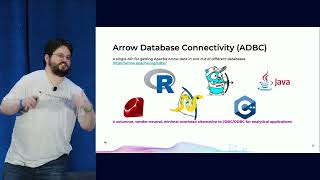
ABOUT THE TALK: In this talk, we'll dive into one of the newest Apache Arrow subprojects, Arrow Database Connectivity (ADBC), an API specification for Arrow-based database access.

Over the course of this session, you’ll get a crash course in ADBC and learn how it communicates with different data APIs (like Arrow Flight SQL and Postgres) using Arrow-native in-memory data. By the end, you’ll understand the use cases it can conquer and know where to access the resources you need to get started.

This talk will cover goals, use-cases, and examples of using ADBC to communicate with different Data APIs (such as Flight SQL or postgres) with Arrow Native in-memory data.

ABOUT THE SPEAKER: Matthew Topol is a committer for the Apache Arrow project, frequently enhancing the Golang Arrow and Parquet libraries among other enhancements and helping to grow the Arrow Community. Recently, Matt has joined Voltron Data in order to work on the Apache Arrow libraries full time and grow the Arrow Golang community. In June 2022, Matt's first book was published, which is the first (and currently only) book on Apache Arrow titled "In-Memory Analytics with Apache Arrow".

ABOUT DATA COUNCIL: Data Council (https://www.datacouncil.ai/) is a community and conference series that provides data professionals with the learning and networking opportunities they need to grow their careers.

Make sure to subscribe to our channel for the most up-to-date talks from technical professionals on data related topics including data infrastructure, data engineering, ML systems, analytics and AI from top startups and tech companies.

FOLLOW DATA COUNCIL: Twitter: https://twitter.com/DataCouncilAI LinkedIn: https://www.linkedin.com/company/datacouncil-ai/

Summary

Real-time capabilities have quickly become an expectation for consumers. The complexity of providing those capabilities is still high, however, making it more difficult for small teams to compete. Meroxa was created to enable teams of all sizes to deliver real-time data applications. In this episode DeVaris Brown discusses the types of applications that are possible when teams don't have to manage the complex infrastructure necessary to support continuous data flows.

Announcements

Hello and welcome to the Data Engineering Podcast, the show about modern data management RudderStack helps you build a customer data platform on your warehouse or data lake. Instead of trapping data in a black box, they enable you to easily collect customer data from the entire stack and build an identity graph on your warehouse, giving you full visibility and control. Their SDKs make event streaming from any app or website easy, and their extensive library of integrations enable you to automatically send data to hundreds of downstream tools. Sign up free at dataengineeringpodcast.com/rudderstack Your host is Tobias Macey and today I'm interviewing DeVaris Brown about the impact of real-time data on business opportunities and risk profiles

Interview

Introduction How did you get involved in the area of data management? Can you describe what Meroxa is and the story behind it?

How have the focus and goals of the platform and company evolved over the past 2 years?

Who are the target customers for Meroxa?

What problems are they trying to solve when they come to your platform?

Applications powered by real-time data were the exclusive domain of large and/or sophisticated tech companies for several years due to the inherent complexities involved. What are the shifts that have made them more accessible to a wider variety of teams?

What are some of the remaining blockers for teams who want to start using real-time data?

With the democratization of real-time data, what are the new categories of products and applications that are being unlocked?

How are organizations thinking about the potential value that those types of apps/services can provide?

With data flowing constantly, there are new challenges around oversight and accuracy. How does real-time data change the risk profile for applications that are consuming it?

What are some of the technical controls that are available for organizations that are risk-averse?

What skills do developers need to be able to effectively design, develop, and deploy real-time data applications?

How does this differ when talking about internal vs. consumer/end-user facing applications?

What are the most interesting, innovative, or unexpected ways that you have seen Meroxa used? What are the most interesting, unexpected, or challenging lessons that you have learned while working on Meroxa? When is Meroxa the wrong choice? What do you have planned for the future of Meroxa?

Contact Info

LinkedIn @devarispbrown on Twitter

Parting Question

From your perspective, what is the biggest gap in the tooling or technology for data management today?

Closing Announcements

Thank you for listening! Don't forget to check out our other shows. Podcast.init covers the Python language, its community, and the innovative ways it is being used. The Machine Learning Podcast helps you go from idea to production with machine learning. Visit the site to subscribe to the show, sign up for the mailing list, and read the show notes. If you've learned something or tried out a project from the show then tell us about it! Email [email protected]) with your story. To help other people find the show please leave a review on Apple Podcasts and tell your friends and co-workers

Links

Meroxa

Podcast Episode

Kafka Kafka Connect Conduit - golang Kafka connect replacement Pulsar Redpanda Flink Beam Clickhouse Druid Pinot

The intro and outro music is from The Hug by The Freak Fandango Orchestra / CC

Delta Lake 2.0 Overview

After three years of hard work by the Delta community, we are proud to announce the release of Delta Lake 2.0. Completing the work to open-source all of Delta Lake while tens of thousands of organizations were running in production was no small feat and we have the ever-expanding Delta community to thank! Join this session to learn about how the wider Delta community collaborated together to bring these features and integrations together.

Join this session to learn about how the wider Delta community collaborated together to bring these features and integrations together. This includes the Integrations with Apache Spark™, Apache Flink, Apache Pulsar, Presto, Trino, and more.

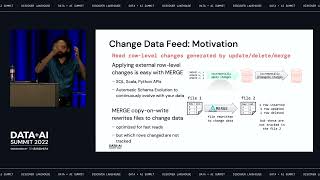
Features such as OPTIMIZE ZORDER, data skipping using column stats, S3 multi-cluster writes, Change Data Feed, and more.

Language APIs including Rust, Python, Ruby, GoLang, Scala, and Java.

Connect with us: Website: https://databricks.com Facebook: https://www.facebook.com/databricksinc Twitter: https://twitter.com/databricks LinkedIn: https://www.linkedin.com/company/data... Instagram: https://www.instagram.com/databricksinc/

Summary

With the increased ease of gaining access to servers in data centers across the world has come the need for supporting globally distributed data storage. With the first wave of cloud era databases the ability to replicate information geographically came at the expense of transactions and familiar query languages. To address these shortcomings the engineers at Cockroach Labs have built a globally distributed SQL database with full ACID semantics in Cockroach DB. In this episode Peter Mattis, the co-founder and VP of Engineering at Cockroach Labs, describes the architecture that underlies the database, the challenges they have faced along the way, and the ways that you can use it in your own environments today.

Preamble

Hello and welcome to the Data Engineering Podcast, the show about modern data management When you’re ready to build your next pipeline you’ll need somewhere to deploy it, so check out Linode. With private networking, shared block storage, node balancers, and a 40Gbit network, all controlled by a brand new API you’ve got everything you need to run a bullet-proof data platform. Go to dataengineeringpodcast.com/linode to get a $20 credit and launch a new server in under a minute. For complete visibility into the health of your pipeline, including deployment tracking, and powerful alerting driven by machine-learning, DataDog has got you covered. With their monitoring, metrics, and log collection agent, including extensive integrations and distributed tracing, you’ll have everything you need to find and fix performance bottlenecks in no time. Go to dataengineeringpodcast.com/datadog today to start your free 14 day trial and get a sweet new T-Shirt. Go to dataengineeringpodcast.com to subscribe to the show, sign up for the mailing list, read the show notes, and get in touch. Your host is Tobias Macey and today I’m interviewing Peter Mattis about CockroachDB, the SQL database for global cloud services

Interview

Introduction How did you get involved in the area of data management? What was the motivation for creating CockroachDB and building a business around it? Can you describe the architecture of CockroachDB and how it supports distributed ACID transactions?

What are some of the tradeoffs that are necessary to allow for georeplicated data with distributed transactions? What are some of the problems that you have had to work around in the RAFT protocol to provide reliable operation of the clustering mechanism?

Go is an unconventional language for building a database. What are the pros and cons of that choice? What are some of the common points of confusion that users of CockroachDB have when operating or interacting with it?

What are the edge cases and failure modes that users should be aware of?

I know that your SQL syntax is PostGreSQL compatible, so is it possible to use existing ORMs unmodified with CockroachDB?

What are some examples of extensions that are specific to CockroachDB?

What are some of the most interesting uses of CockroachDB that you have seen? When is CockroachDB the wrong choice? What do you have planned for the future of CockroachDB?

Contact Info

Peter

LinkedIn petermattis on GitHub @petermattis on Twitter

Cockroach Labs

@CockroackDB on Twitter Website cockroachdb on GitHub

Parting Question

From your perspective, what is the biggest gap in the tooling or technology for data management today?

Links

CockroachDB Cockroach Labs SQL Google Bigtable Spanner NoSQL RDBMS (Relational Database Management System) “Big Iron” (colloquial term for mainframe computers) RAFT Consensus Algorithm Consensus MVCC (Multiversion Concurrency Control) Isolation Etcd GDPR Golang C++ Garbage Collection Metaprogramming Rust Static Linking Docker Kubernetes CAP Theorem PostGreSQL ORM (Object Relational Mapping) Information Schema PG Catalog Interleaved Tables Vertica Spark Change Data Capture

The intro and outro music is from The Hug by The Freak Fandan

Summary

The data that is used in financial markets is time oriented and multidimensional, which makes it difficult to manage in either relational or timeseries databases. To make this information more manageable the team at Alapaca built a new data store specifically for retrieving and analyzing data generated by trading markets. In this episode Hitoshi Harada, the CTO of Alapaca, and Christopher Ryan, their lead software engineer, explain their motivation for building MarketStore, how it operates, and how it has helped to simplify their development workflows.

Preamble

Hello and welcome to the Data Engineering Podcast, the show about modern data management When you’re ready to build your next pipeline you’ll need somewhere to deploy it, so check out Linode. With private networking, shared block storage, node balancers, and a 40Gbit network, all controlled by a brand new API you’ve got everything you need to run a bullet-proof data platform. Go to dataengineeringpodcast.com/linode to get a $20 credit and launch a new server in under a minute. For complete visibility into the health of your pipeline, including deployment tracking, and powerful alerting driven by machine-learning, DataDog has got you covered. With their monitoring, metrics, and log collection agent, including extensive integrations and distributed tracing, you’ll have everything you need to find and fix performance bottlenecks in no time. Go to dataengineeringpodcast.com/datadog today to start your free 14 day trial and get a sweet new T-Shirt. Go to dataengineeringpodcast.com to subscribe to the show, sign up for the newsletter, read the show notes, and get in touch. Your host is Tobias Macey and today I’m interviewing Christopher Ryan and Hitoshi Harada about MarketStore, a storage server for large volumes of financial timeseries data

Interview

Introduction How did you get involved in the area of data management? What was your motivation for creating MarketStore? What are the characteristics of financial time series data that make it challenging to manage? What are some of the workflows that MarketStore is used for at Alpaca and how were they managed before it was available? With MarketStore’s data coming from multiple third party services, how are you managing to keep the DB up-to-date and in sync with those services?

What is the worst case scenario if there is a total failure in the data store? What guards have you built to prevent such a situation from occurring?

Since MarketStore is used for querying and analyzing data having to do with financial markets and there are potentially large quantities of money being staked on the results of that analysis, how do you ensure that the operations being performed in MarketStore are accurate and repeatable? What were the most challenging aspects of building MarketStore and integrating it into the rest of your systems? Motivation for open sourcing the code? What is the next planned major feature for MarketStore, and what use-case is it aiming to support?

Contact Info

Christopher

Email

Hitoshi

Email

Parting Question

From your perspective, what is the biggest gap in the tooling or technology for data management today?

Links

MarketStore

GitHub Release Announcement

Alpaca IBM DB2 GreenPlum Algorithmic Trading Backtesting OHLC (Open-High-Low-Close) HDF5 Golang C++ Timeseries Database List InfluxDB JSONRPC Slait CircleCI GDAX

The intro and outro music is from The Hug by The Freak Fandango Orchestra / CC BY-SA Support Data Engineering Podcast