We were told to scale compute. But what if the real problem was never about big data, but about bad data access? In this talk, we’ll unpack two powerful, often misunderstood techniques—projection pushdown and predicate pushdown—and why they matter more than ever in a world where we want lightweight, fast queries over large datasets. These optimizations aren’t just academic—they’re the difference between querying a terabyte in seconds vs. minutes. We’ll show how systems like Flink and DuckDB leverage these techniques, what limits them (hello, Protobuf), and how smart schema and storage design—especially in formats like Iceberg and Arrow can unlock dramatic speed gains. Along the way, we’ll highlight the importance of landing data in queryable formats, and why indexing and query engines matter just as much as compute. This talk is for anyone who wants to stop fully scanning their data lakes just to read one field.
 talk-data.com
Topic
Protobuf
Protocol Buffers
10
tagged
Activity Trend
Top Events
Red Stapler is a streaming-native system on Databricks that merges file-based ingestion and real-time user edits into one Lakeflow Declarative Pipelines for near real-time feedback. Protobuf definitions, managed in the Buf Schema Registry (BSR), govern schema and data-quality rules, ensuring backward compatibility. All records — valid or not — are stored in an SCD Type 2 table, capturing every version for full history and immediate quarantine views of invalid data. This unified approach boosts data governance, simplifies auditing and streamlines error fixes.Running on Lakeflow Declarative Pipelines Serverless and the Kafka-compatible Bufstream keeps costs low by scaling down to zero when idle. Red Stapler’s configuration-driven Protobuf logic adapts easily to evolving survey definitions without risking production. The result is consistent validation, quick updates and a complete audit trail — all critical for trustworthy, flexible data pipelines.

The "Protocol Buffers Handbook" by Clément Jean offers an in-depth exploration of Protocol Buffers (Protobuf), a powerful data serialization format. Learn everything from syntax and schema evolution to custom validations and cross-language integrations. With practical examples in Go and Python, this guide empowers you to efficiently serialize and manage structured data across platforms. What this Book will help me do Develop advanced skills in using Protocol Buffers (Protobuf) for efficient data serialization. Master the key concepts of Protobuf syntax and schema evolution for compatibility. Learn to create custom validation plugins and tailor Protobuf processes. Integrate Protobuf with multiple programming environments, including Go and Python. Automate Protobuf projects using tools like Buf and Bazel to streamline workflows. Author(s) Clément Jean is a skilled programmer and technical writer specializing in data serialization and distributed systems. With substantial experience in developing scalable microservices, he shares valuable insights into using Protocol Buffers effectively. Through this book, Clément offers a hands-on approach to Protobuf, blending theory with practical examples derived from real-world scenarios. Who is it for? This book is perfect for software engineers, system integrators, and data architects who aim to optimize data serialization and APIs, regardless of their programming language expertise. Beginners will grasp foundational Protobuf concepts, while experienced developers will extend their knowledge to advanced, practical applications. Those working with microservices and heavily data-dependent systems will find this book especially relevant.
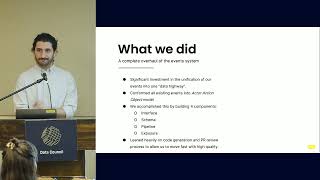
ABOUT THE TALK: After two years, three rounds of funding, and hundreds of new employees — Whatnot’s modern data stack has come from not existing to processing tens of millions of events across hundreds of different event types each day.
How does their small (but mighty!) team keep up? This talk explores data contracts — it covers the use of Interface Definition Language (Protobuf) to serve as the source of truth for event definitions, govern event construction in production, automatically generate DBT models in the data warehouse.
ABOUT THE SPEAKER: Zack Klein is a software engineer at Whatnot, where he thoroughly enjoys building data products and narrowly avoiding breaking production each day. Previously, he worked on big data platforms at Blackstone and HBO.
ABOUT DATA COUNCIL: Data Council (https://www.datacouncil.ai/) is a community and conference series that provides data professionals with the learning and networking opportunities they need to grow their careers.
Make sure to subscribe to our channel for the most up-to-date talks from technical professionals on data related topics including data infrastructure, data engineering, ML systems, analytics and AI from top startups and tech companies.
FOLLOW DATA COUNCIL: Twitter: https://twitter.com/DataCouncilAI LinkedIn: https://www.linkedin.com/company/datacouncil-ai/
Summary Machine learning has become a meaningful target for data applications, bringing with it an increase in the complexity of orchestrating the entire data flow. Flyte is a project that was started at Lyft to address their internal needs for machine learning and integrated closely with Kubernetes as the execution manager. In this episode Ketan Umare and Haytham Abuelfutuh share the story of the Flyte project and how their work at Union is focused on supporting and scaling the code and community that has made Flyte successful.
Announcements
Hello and welcome to the Data Engineering Podcast, the show about modern data management When you’re ready to build your next pipeline, or want to test out the projects you hear about on the show, you’ll need somewhere to deploy it, so check out our friends at Linode. With their managed Kubernetes platform it’s now even easier to deploy and scale your workflows, or try out the latest Helm charts from tools like Pulsar and Pachyderm. With simple pricing, fast networking, object storage, and worldwide data centers, you’ve got everything you need to run a bulletproof data platform. Go to dataengineeringpodcast.com/linode today and get a $100 credit to try out a Kubernetes cluster of your own. And don’t forget to thank them for their continued support of this show! This episode is brought to you by Acryl Data, the company behind DataHub, the leading developer-friendly data catalog for the modern data stack. Open Source DataHub is running in production at several companies like Peloton, Optum, Udemy, Zynga and others. Acryl Data provides DataHub as an easy to consume SaaS product which has been adopted by several companies. Signup for the SaaS product at dataengineeringpodcast.com/acryl RudderStack helps you build a customer data platform on your warehouse or data lake. Instead of trapping data in a black box, they enable you to easily collect customer data from the entire stack and build an identity graph on your warehouse, giving you full visibility and control. Their SDKs make event streaming from any app or website easy, and their state-of-the-art reverse ETL pipelines enable you to send enriched data to any cloud tool. Sign up free… or just get the free t-shirt for being a listener of the Data Engineering Podcast at dataengineeringpodcast.com/rudder. Data lake architectures provide the best combination of massive scalability and cost reduction, but they aren’t always the most performant option. That’s why Kyligence has built on top of the leading open source OLAP engine for data lakes, Apache Kylin. With their AI augmented engine they detect patterns from your critical queries, automatically build data marts with optimized table structures, and provide a unified SQL interface across your lake, cubes, and indexes. Their cost-based query router will give you interactive speeds across petabyte scale data sets for BI dashboards and ad-hoc data exploration. Stop struggling to speed up your data lake. Get started with Kyligence today at dataengineeringpodcast.com/kyligence Your host is Tobias Macey and today I’m interviewing Ketan Umare and Haytham Abuelfutuh about Flyte, the open source and kubernetes-native orchestration engine for your data systems
Interview
Introduction How did you get involved in the area of data management? Can you describe what Flyte is and the story behind it? What was missing in the ecosystem of available tools that made it necessary/worthwhile to create Flyte? Workflow orchestrators have been around for several years and have gone through a number of generational shifts. How would you characterize Flyte’s position in the ecosystem?
What do you see as the closest alternatives? What are the core differentiators that might lead someone to choose Flyte over e.g. Airflow/Prefect/Dagster?
What are the core primitives that Flyte exposes for building up complex workflows?
Machine learning use cases have been a core focus since the project’s inception. What are some of the ways that that manifests in the design and feature set?
Can you describe the architecture of Flyte?
How have the design and goals of the platform changed/evolved since you first started working on it?
What are the changes in the data ecosystem that have had the most substantial impact on the Flyte project? (e.g. roadmap, integrations, pushing people toward adoption, etc.) What is the process for setting up a Flyte deployment? What are the user personas that you prioritize in the design and feature development for Flyte? What is the workflow for someone building a new pipeline in Flyte?
What are the patterns that you and the community have established to encourage discovery and reuse of granular task definitions? Beyond code reuse, how can teams scale usage of Flyte at the company/organization level?
What are the affordances that you have created to facilitate local development and testing of workflows while ensuring a smooth transition to production?
What are the patterns that are available for CI/CD of workflows using Flyte?
How have you approached the design of data contracts/type definitions to provide a consistent/portable API for defining inter-task dependencies across languages? What are the available interfaces for extending Flyte and building integrations with other components across the data ecosystem? Data orchestration engines are a natural point for generating and taking advantage of rich metadata. How do you manage creation and propagation of metadata within and across the framework boundaries? Last year you founded Union to offer a managed version of Flyte. What are the features that you are offering beyond what is available in the open source?
What are the opportunities that you see for the Flyte ecosystem with a corporate entity to invest in expanding adoption?
What are the most interesting, innovative, or unexpected ways that you have seen Flyte used? What are the most interesting, unexpected, or challenging lessons that you have learned while working on Flyte? When is Flyte the wrong choice? What do you have planned for the future of Flyte?
Contact Info
Ketan Umare Haytham Abuelfutuh
Parting Question
From your perspective, what is the biggest gap in the tooling or technology for data management today?
Closing Announcements
Thank you for listening! Don’t forget to check out our other show, Podcast.init to learn about the Python language, its community, and the innovative ways it is being used. Visit the site to subscribe to the show, sign up for the mailing list, and read the show notes. If you’ve learned something or tried out a project from the show then tell us about it! Email [email protected]) with your story. To help other people find the show please leave a review on iTunes and tell your friends and co-workers
Links
Flyte
Slack Channel
Union.ai Kubeflow Airflow AWS Step Functions Protocol Buffers XGBoost MLFlow Dagster
Podcast Episode
Prefect
Podcast Episode
Arrow Parquet Metaflow Pytorch
Podcast.init Episode
dbt FastAPI
Podcast.init Interview
Python Type Annotations Modin
Podcast.init Interview
Monad Datahub
Podcast Episode
OpenMetadata
Podcast Episode
Hudi
Podcast Episode
Iceberg
Podcast Episode
Great Expectations
Podcast Episode
Pandera Union ML Weights and Biases Whylogs
Podcast Episode
The intro and outro music is from The Hug by The Freak Fandango Orchestra / CC BY-SA
Sponsored By: a…
Summary Data integration is a critical piece of every data pipeline, yet it is still far from being a solved problem. There are a number of managed platforms available, but the list of options for an open source system that supports a large variety of sources and destinations is still embarrasingly short. The team at Airbyte is adding a new entry to that list with the goal of making robust and easy to use data integration more accessible to teams who want or need to maintain full control of their data. In this episode co-founders John Lafleur and Michel Tricot share the story of how and why they created Airbyte, discuss the project’s design and architecture, and explain their vision of what an open soure data integration platform should offer. If you are struggling to maintain your extract and load pipelines or spending time on integrating with a new system when you would prefer to be working on other projects then this is definitely a conversation worth listening to.
Announcements
Hello and welcome to the Data Engineering Podcast, the show about modern data management When you’re ready to build your next pipeline, or want to test out the projects you hear about on the show, you’ll need somewhere to deploy it, so check out our friends at Linode. With their managed Kubernetes platform it’s now even easier to deploy and scale your workflows, or try out the latest Helm charts from tools like Pulsar and Pachyderm. With simple pricing, fast networking, object storage, and worldwide data centers, you’ve got everything you need to run a bulletproof data platform. Go to dataengineeringpodcast.com/linode today and get a $100 credit to try out a Kubernetes cluster of your own. And don’t forget to thank them for their continued support of this show! Modern Data teams are dealing with a lot of complexity in their data pipelines and analytical code. Monitoring data quality, tracing incidents, and testing changes can be daunting and often takes hours to days. Datafold helps Data teams gain visibility and confidence in the quality of their analytical data through data profiling, column-level lineage and intelligent anomaly detection. Datafold also helps automate regression testing of ETL code with its Data Diff feature that instantly shows how a change in ETL or BI code affects the produced data, both on a statistical level and down to individual rows and values. Datafold integrates with all major data warehouses as well as frameworks such as Airflow & dbt and seamlessly plugs into CI workflows. Go to dataengineeringpodcast.com/datafold today to start a 30-day trial of Datafold. Once you sign up and create an alert in Datafold for your company data, they will send you a cool water flask. RudderStack’s smart customer data pipeline is warehouse-first. It builds your customer data warehouse and your identity graph on your data warehouse, with support for Snowflake, Google BigQuery, Amazon Redshift, and more. Their SDKs and plugins make event streaming easy, and their integrations with cloud applications like Salesforce and ZenDesk help you go beyond event streaming. With RudderStack you can use all of your customer data to answer more difficult questions and then send those insights to your whole customer data stack. Sign up free at dataengineeringpodcast.com/rudder today. Your host is Tobias Macey and today I’m interviewing Michel Tricot and John Lafleur about Airbyte, an open source framework for building data integration pipelines.
Interview
Introduction How did you get involved in the area of data management? Can you start by explaining what Airbyte is and the story behind it? Businesses and data engineers have a variety of options for how to manage their data integration. How would you characterize the overall landscape and how does Airbyte distinguish itself in that space? How would you characterize your target users?
How have those personas instructed the priorities and design of Airbyte? What do you see as the benefits and tradeoffs of a UI oriented data integration platform as compared to a code first approach?
what are the complex/challenging elements of data integration that makes it such a slippery problem? motivation for creating open source ELT as a business Can you describe how the Airbyte platform is implemented?
What was your motivation for choosing Java as the primary language?
incidental complexity of forcing all connectors to be packaged as containers shortcomings of the Singer specification/motivation for creating a backwards incompatible interface perceived potential for community adoption of Airbyte specification tradeoffs of using JSON as interchange format vs. e.g. protobuf/gRPC/Avro/etc.
information lost when converting records to JSON types/how to preserve that information (e.g. field constraints, valid enums, etc.)
interfaces/extension points for integrating with other tools, e.g. Dagster abstraction layers for simplifying implementation of new connectors tradeoffs of storing all connectors in a monorepo with the Airbyte core
impact of community adoption/contributions
What is involved in setting up an Airbyte installation? What are the available axes for scaling an Airbyte deployment? challenges of setting up and maintaining CI environment for Airbyte How are you managing governance and long term sustainability of the project? What are some of the most interesting, unexpected, or innovative ways that you have seen Airbyte used? What are the most interesting, unexpected, or challenging lessons that you have learned while building Airbyte? When is Airbyte the wrong choice? What do you have planned for the future of the project?
Contact Info
Michel
LinkedIn @MichelTricot on Twitter michel-tricot on GitHub
John
LinkedIn @JeanLafleur on Twitter johnlafleur on GitHub
Parting Question
From your perspective, what is the biggest gap in the tooling or technology for data management today?
Links
Airbyte Liveramp Fivetran
Podcast Episode
Stitch Data Matillion DataCoral
Podcast Episode
Singer Meltano
Podcast Episode
Airflow
Podcast.init Episode
Kotlin Docker Monorepo Airbyte Specification Great Expectations
Podcast Episode
Dagster
Data Engineering Podcast Episode Podcast.init Episode
Prefect
Podcast Episode
DBT
Podcast Episode
Kubernetes Snowflake
Podcast Episode
Redshift Presto Spark Parquet
Podcast Episode
The intro and outro music is from The Hug by The Freak Fandango Orchestra / CC BY-SA
Support Data Engineering Podcast
Summary Building clean datasets with reliable and reproducible ingestion pipelines is completely useless if it’s not possible to find them and understand their provenance. The solution to discoverability and tracking of data lineage is to incorporate a metadata repository into your data platform. The metadata repository serves as a data catalog and a means of reporting on the health and status of your datasets when it is properly integrated into the rest of your tools. At WeWork they needed a system that would provide visibility into their Airflow pipelines and the outputs produced. In this episode Julien Le Dem and Willy Lulciuc explain how they built Marquez to serve that need, how it is architected, and how it compares to other options that you might be considering. Even if you already have a metadata repository this is worth a listen to learn more about the value that visibility of your data can bring to your organization.
Announcements
Hello and welcome to the Data Engineering Podcast, the show about modern data management When you’re ready to build your next pipeline, or want to test out the projects you hear about on the show, you’ll need somewhere to deploy it, so check out our friends at Linode. With 200Gbit private networking, scalable shared block storage, and a 40Gbit public network, you’ve got everything you need to run a fast, reliable, and bullet-proof data platform. If you need global distribution, they’ve got that covered too with world-wide datacenters including new ones in Toronto and Mumbai. And for your machine learning workloads, they just announced dedicated CPU instances. Go to dataengineeringpodcast.com/linode today to get a $20 credit and launch a new server in under a minute. And don’t forget to thank them for their continued support of this show! You work hard to make sure that your data is clean, reliable, and reproducible throughout the ingestion pipeline, but what happens when it gets to the data warehouse? Dataform picks up where your ETL jobs leave off, turning raw data into reliable analytics. Their web based transformation tool with built in collaboration features lets your analysts own the full lifecycle of data in your warehouse. Featuring built in version control integration, real-time error checking for their SQL code, data quality tests, scheduling, and a data catalog with annotation capabilities it’s everything you need to keep your data warehouse in order. Sign up for a free trial today at dataengineeringpodcast.com/dataform and email [email protected] with the subject "Data Engineering Podcast" to get a hands-on demo from one of their data experts. You listen to this show to learn and stay up to date with what’s happening in databases, streaming platforms, big data, and everything else you need to know about modern data management. For even more opportunities to meet, listen, and learn from your peers you don’t want to miss out on this year’s conference season. We have partnered with organizations such as O’Reilly Media, Corinium Global Intelligence, ODSC, and Data Council. Upcoming events include the Software Architecture Conference, the Strata Data conference, and PyCon US. Go to dataengineeringpodcast.com/conferences to learn more about these and other events, and take advantage of our partner discounts to save money when you register today. Your host is Tobias Macey and today I’m interviewing Willy Lulciuc and Julien Le Dem about Marquez, an open source platform to collect, aggregate, and visualize a data ecosystem’s metadata
Interview
Introduction How did you get involved in the area of data management? Can you start by describing what Marquez is?
What was missing in existing metadata management platforms that necessitated the creation of Marquez?
How do the capabilities of Marquez compare with tools and services that bill themselves as data catalogs?
How does it compare to the Amundsen platform that Lyft recently released?
What are some of the tools or platforms that are currently integrated with Marquez and what additional integrations would you like to see? What are some of the capabilities that are unique to Marquez and how are you using them at WeWork? What are the primary resource types that you support in Marquez?
What are some of the lowest common denominator attributes that are necessary and useful to track in a metadata repository?
Can you explain how Marquez is architected and how the design has evolved since you first began working on it?
Many metadata management systems are simply a service layer on top of a separate data storage engine. What are the benefits of using PostgreSQL as the system of record for Marquez?
What are some of the complexities that arise from relying on a relational engine as opposed to a document store or graph database?
How is the metadata itself stored and managed in Marquez?
How much up-front data modeling is necessary and what types of schema representations are supported?
Can you talk through the overall workflow of someone using Marquez in their environment?
What is involved in registering and updating datasets? How do you define and track the health of a given dataset? What are some of the interesting questions that can be answered from the information stored in Marquez?
What were your assumptions going into this project and how have they been challenged or updated as you began using it for production use cases? For someone who is interested in using Marquez what is involved in deploying and maintaining an installation of it? What have you found to be the most challenging or unanticipated aspects of building and maintaining a metadata repository and data discovery platform? When is Marquez the wrong choice for a metadata repository? What do you have planned for the future of Marquez?
Contact Info
Julien Le Dem
@J_ on Twitter Email julienledem on GitHub
Willy
LinkedIn @wslulciuc on Twitter wslulciuc on GitHub
Parting Question
From your perspective, what is the biggest gap in the tooling or technology for data management today?
Closing Announcements
Thank you for listening! Don’t forget to check out our other show, Podcast.init to learn about the Python language, its community, and the innovative ways it is being used. Visit the site to subscribe to the show, sign up for the mailing list, and read the show notes. If you’ve learned something or tried out a project from the show then tell us about it! Email [email protected]) with your story. To help other people find the show please leave a review on iTunes and tell your friends and co-workers Join the community in the new Zulip chat workspace at dataengineeringpodcast.com/chat
Links
Marquez
DataEngConf Presentation
WeWork Canary Yahoo Dremio Hadoop Pig Parquet
Podcast Episode
Airflow Apache Atlas Amundsen
Podcast Episode
Uber DataBook LinkedIn DataHub Iceberg Table Format
Podcast Episode
Delta Lake
Podcast Episode
Great Expectations data pipeline unit testing framework
Podcast.init Episode
Redshift SnowflakeDB
Podcast Episode
Apache Kafka Schema Registry
Podcast Episode
Open Tracing Jaeger Zipkin DropWizard Java framework Marquez UI Cayley Graph Database Kubernetes Marquez Helm Chart Marquez Docker Container Dagster
Podcast Episode
Luigi DBT
Podcast Episode
Thrift Protocol Buffers
The intro and outro music is from a href="http://freemusicarchive.org/music/The_Freak_Fandango_Orchestra/Love_death_and_a_drunken_monkey/04_-_The_Hug?utm_source=rss&utm_medium=rss"…
Summary
A data lake can be a highly valuable resource, as long as it is well built and well managed. Unfortunately, that can be a complex and time-consuming effort, requiring specialized knowledge and diverting resources from your primary business. In this episode Yoni Iny, CTO of Upsolver, discusses the various components that are necessary for a successful data lake project, how the Upsolver platform is architected, and how modern data lakes can benefit your organization.
Preamble
Hello and welcome to the Data Engineering Podcast, the show about modern data management When you’re ready to build your next pipeline you’ll need somewhere to deploy it, so check out Linode. With private networking, shared block storage, node balancers, and a 40Gbit network, all controlled by a brand new API you’ve got everything you need to run a bullet-proof data platform. Go to dataengineeringpodcast.com/linode to get a $20 credit and launch a new server in under a minute. Go to dataengineeringpodcast.com to subscribe to the show, sign up for the mailing list, read the show notes, and get in touch. Join the community in the new Zulip chat workspace at dataengineeringpodcast.com/chat Your host is Tobias Macey and today I’m interviewing Yoni Iny about Upsolver, a data lake platform that lets developers integrate and analyze streaming data with ease
Interview
Introduction How did you get involved in the area of data management? Can you start by describing what Upsolver is and how it got started?
What are your goals for the platform?
There are a lot of opinions on both sides of the data lake argument. When is it the right choice for a data platform?
What are the shortcomings of a data lake architecture?
How is Upsolver architected?
How has that architecture changed over time? How do you manage schema validation for incoming data? What would you do differently if you were to start over today?
What are the biggest challenges at each of the major stages of the data lake? What is the workflow for a user of Upsolver and how does it compare to a self-managed data lake? When is Upsolver the wrong choice for an organization considering implementation of a data platform? Is there a particular scale or level of data maturity for an organization at which they would be better served by moving management of their data lake in house? What features or improvements do you have planned for the future of Upsolver?
Contact Info
Yoni
yoniiny on GitHub LinkedIn
Upsolver
Website @upsolver on Twitter LinkedIn Facebook
Parting Question
From your perspective, what is the biggest gap in the tooling or technology for data management today?
Links
Upsolver Data Lake Israeli Army Data Warehouse Data Engineering Podcast Episode About Data Curation Three Vs Kafka Spark Presto Drill Spot Instances Object Storage Cassandra Redis Latency Avro Parquet ORC Data Engineering Podcast Episode About Data Serialization Formats SSTables Run Length Encoding CSV (Comma Separated Values) Protocol Buffers Kinesis ETL DevOps Prometheus Cloudwatch DataDog InfluxDB SQL Pandas Confluent KSQL
The intro and outro music is from The Hug by The Freak Fandango Orchestra / CC BY-SA Support Data Engineering Podcast
Summary
To process your data you need to know what shape it has, which is why schemas are important. When you are processing that data in multiple systems it can be difficult to ensure that they all have an accurate representation of that schema, which is why Confluent has built a schema registry that plugs into Kafka. In this episode Ewen Cheslack-Postava explains what the schema registry is, how it can be used, and how they built it. He also discusses how it can be extended for other deployment targets and use cases, and additional features that are planned for future releases.
Preamble
Hello and welcome to the Data Engineering Podcast, the show about modern data infrastructure When you’re ready to launch your next project you’ll need somewhere to deploy it. Check out Linode at dataengineeringpodcast.com/linode and get a $20 credit to try out their fast and reliable Linux virtual servers for running your data pipelines or trying out the tools you hear about on the show. Continuous delivery lets you get new features in front of your users as fast as possible without introducing bugs or breaking production and GoCD is the open source platform made by the people at Thoughtworks who wrote the book about it. Go to dataengineeringpodcast.com/gocd to download and launch it today. Enterprise add-ons and professional support are available for added peace of mind. Go to dataengineeringpodcast.com to subscribe to the show, sign up for the newsletter, read the show notes, and get in touch. You can help support the show by checking out the Patreon page which is linked from the site. To help other people find the show you can leave a review on iTunes, or Google Play Music, and tell your friends and co-workers Your host is Tobias Macey and today I’m interviewing Ewen Cheslack-Postava about the Confluent Schema Registry
Interview
Introduction How did you get involved in the area of data engineering? What is the schema registry and what was the motivating factor for building it? If you are using Avro, what benefits does the schema registry provide over and above the capabilities of Avro’s built in schemas? How did you settle on Avro as the format to support and what would be involved in expanding that support to other serialization options? Conversely, what would be involved in using a storage backend other than Kafka? What are some of the alternative technologies available for people who aren’t using Kafka in their infrastructure? What are some of the biggest challenges that you faced while designing and building the schema registry? What is the tipping point in terms of system scale or complexity when it makes sense to invest in a shared schema registry and what are the alternatives for smaller organizations? What are some of the features or enhancements that you have in mind for future work?
Contact Info
ewencp on GitHub Website @ewencp on Twitter
Parting Question
From your perspective, what is the biggest gap in the tooling or technology for data management today?
Links
Kafka Confluent Schema Registry Second Life Eve Online Yes, Virginia, You Really Do Need a Schema Registry JSON-Schema Parquet Avro Thrift Protocol Buffers Zookeeper Kafka Connect
The intro and outro music is from The Hug by The Freak Fandango Orchestra / CC BY-SA Support Data Engineering Podcast
Summary
Yelp needs to be able to consume and process all of the user interactions that happen in their platform in as close to real-time as possible. To achieve that goal they embarked on a journey to refactor their monolithic architecture to be more modular and modern, and then they open sourced it! In this episode Justin Cunningham joins me to discuss the decisions they made and the lessons they learned in the process, including what worked, what didn’t, and what he would do differently if he was starting over today.
Preamble
Hello and welcome to the Data Engineering Podcast, the show about modern data infrastructure When you’re ready to launch your next project you’ll need somewhere to deploy it. Check out Linode at www.dataengineeringpodcast.com/linode?utm_source=rss&utm_medium=rss and get a $20 credit to try out their fast and reliable Linux virtual servers for running your data pipelines or trying out the tools you hear about on the show. Go to dataengineeringpodcast.com to subscribe to the show, sign up for the newsletter, read the show notes, and get in touch. You can help support the show by checking out the Patreon page which is linked from the site. To help other people find the show you can leave a review on iTunes, or Google Play Music, and tell your friends and co-workers Your host is Tobias Macey and today I’m interviewing Justin Cunningham about Yelp’s data pipeline
Interview with Justin Cunningham
Introduction How did you get involved in the area of data engineering? Can you start by giving an overview of your pipeline and the type of workload that you are optimizing for? What are some of the dead ends that you experienced while designing and implementing your pipeline? As you were picking the components for your pipeline, how did you prioritize the build vs buy decisions and what are the pieces that you ended up building in-house? What are some of the failure modes that you have experienced in the various parts of your pipeline and how have you engineered around them? What are you using to automate deployment and maintenance of your various components and how do you monitor them for availability and accuracy? While you were re-architecting your monolithic application into a service oriented architecture and defining the flows of data, how were you able to make the switch while verifying that you were not introducing unintended mutations into the data being produced? Did you plan to open-source the work that you were doing from the start, or was that decision made after the project was completed? What were some of the challenges associated with making sure that it was properly structured to be amenable to making it public? What advice would you give to anyone who is starting a brand new project and how would that advice differ for someone who is trying to retrofit a data management architecture onto an existing project?
Keep in touch
Yelp Engineering Blog Email
Links
Kafka Redshift ETL Business Intelligence Change Data Capture LinkedIn Data Bus Apache Storm Apache Flink Confluent Apache Avro Game Days Chaos Monkey Simian Army PaaSta Apache Mesos Marathon SignalFX Sensu Thrift Protocol Buffers JSON Schema Debezium Kafka Connect Apache Beam
The intro and outro music is from The Hug by The Freak Fandango Orchestra / CC BY-SA Support Data Engineering Podcast