talk-data.com talk-data.com

Topic

Hadoop

Apache Hadoop

big_data distributed_computing data_processing

13

tagged

Activity Trend

3 peak/qtr
2020-Q1 2026-Q1

Activities

13 activities · Newest first

Sponsored by: AWS | Ripple: Well-Architected Data & AI Platforms - AWS and Databricks in Harmony

Join us as we explore the well-architected framework for modern data lakehouse architecture, where AWS's comprehensive data, AI, and infrastructure capabilities align with Databricks' unified platform approach. Building upon core principles of Operational Excellence, Security, Reliability, Performance, and Cost Optimization, we'll demonstrate how Data and AI Governance alongside Interoperability and Usability enable organizations to build robust, scalable platforms. Learn how Ripple modernized its data infrastructure by migrating from a legacy Hadoop system to a scalable, real-time analytics platform using Databricks on AWS. This session covers the challenges of high operational costs, latency, and peak-time bottlenecks—and how Ripple achieved 80% cost savings and 55% performance improvements with Photon, Graviton, Delta Lake, and Structured Streaming.

AI Powering Epsilon's Identity Strategy: Unified Marketing Platform on Databricks

Join us to hear about how Epsilon Data Management migrated Epsilon’s unique, AI-powered marketing identity solution from multi-petabyte on-prem Hadoop and data warehouse systems to a unified Databricks Lakehouse platform. This transition enabled Epsilon to further scale its Decision Sciences solution and enable new cloud-based AI research capabilities on time and within budget, without being bottlenecked by the resource constraints of on-prem systems. Learn how Delta Lake, Unity Catalog, MLflow and LLM endpoints powered massive data volume, reduced data duplication, improved lineage visibility, accelerated Data Science and AI, and enabled new data to be immediately available for consumption by the entire Epsilon platform in a privacy-safe way. Using the Databricks platform as the base for AI and Data Science at global internet scale, Epsilon deploys marketing solutions across multiple cloud providers and multiple regions for many customers.

Big Data is Dead: Long Live Hot Data 🔥

Over the last decade, Big Data was everywhere. Let's set the record straight on what is and isn't Big Data. We have been consumed by a conversation about data volumes when we should focus more on the immediate task at hand: Simplifying our work.

Some of us may have Big Data, but our quest to derive insights from it is measured in small slices of work that fit on your laptop or in your hand. Easy data is here— let's make the most of it.

📓 Resources Big Data is Dead: https://motherduck.com/blog/big-data-is-dead/ Small Data Manifesto: https://motherduck.com/blog/small-data-manifesto/ Small Data SF: https://www.smalldatasf.com/

➡️ Follow Us LinkedIn: https://linkedin.com/company/motherduck X/Twitter : https://twitter.com/motherduck Blog: https://motherduck.com/blog/


Explore the "Small Data" movement, a counter-narrative to the prevailing big data conference hype. This talk challenges the assumption that data scale is the most important feature of every workload, defining big data as any dataset too large for a single machine. We'll unpack why this distinction is crucial for modern data engineering and analytics, setting the stage for a new perspective on data architecture.

Delve into the history of big data systems, starting with the non-linear hardware costs that plagued early data practitioners. Discover how Google's foundational papers on GFS, MapReduce, and Bigtable led to the creation of Hadoop, fundamentally changing how we scale data processing. We'll break down the "big data tax"—the inherent latency and system complexity overhead required for distributed systems to function, a critical concept for anyone evaluating data platforms.

Learn about the architectural cornerstone of the modern cloud data warehouse: the separation of storage and compute. This design, popularized by systems like Snowflake and Google BigQuery, allows storage to scale almost infinitely while compute resources are provisioned on-demand. Understand how this model paved the way for massive data lakes but also introduced new complexities and cost considerations that are often overlooked.

We examine the cracks appearing in the big data paradigm, especially for OLAP workloads. While systems like Snowflake are still dominant, the rise of powerful alternatives like DuckDB signals a shift. We reveal the hidden costs of big data analytics, exemplified by a petabyte-scale query costing nearly $6,000, and argue that for most use cases, it's too expensive to run computations over massive datasets.

The key to efficient data processing isn't your total data size, but the size of your "hot data" or working set. This talk argues that the revenge of the single node is here, as modern hardware can often handle the actual data queried without the overhead of the big data tax. This is a crucial optimization technique for reducing cost and improving performance in any data warehouse.

Discover the core principles for designing systems in a post-big data world. We'll show that since only 1 in 500 users run true big data queries, prioritizing simplicity over premature scaling is key. For low latency, process data close to the user with tools like DuckDB and SQLite. This local-first approach offers a compelling alternative to cloud-centric models, enabling faster, more cost-effective, and innovative data architectures.

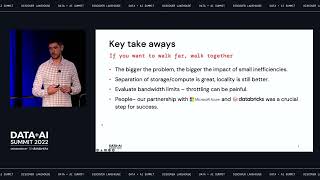
Igor Khrol: Big Data With Open Source Solutions

Join Igor Khrol as he delves into the world of Big Data with Open Source Solutions at Automattic, a company rooted in the power of open source. 📊🌐 Discover their unique approach to maintaining a data ecosystem based on Hadoop, Spark, Trino, Airflow, Superset, and JupyterHub, all hosted on bare metal infrastructure, and gain insights on how it compares to cloud-based alternatives in 2023. 💡🚀 #BigData #opensource

✨ H I G H L I G H T S ✨

🙌 A huge shoutout to all the incredible participants who made Big Data Conference Europe 2023 in Vilnius, Lithuania, from November 21-24, an absolute triumph! 🎉 Your attendance and active participation were instrumental in making this event so special. 🌍

Don't forget to check out the session recordings from the conference to relive the valuable insights and knowledge shared! 📽️

Once again, THANK YOU for playing a pivotal role in the success of Big Data Conference Europe 2023. 🚀 See you next year for another unforgettable conference! 📅 #BigDataConference #SeeYouNextYear

Labcorp Data Platform Journey: From Selection to Go-Live in Six Months

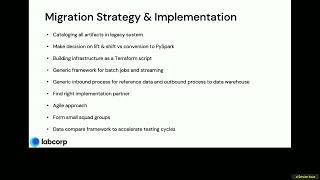
Join this session to learn about the Labcorp data platform transformation from on-premises Hadoop to AWS Databricks Lakehouse. We will share best practices and lessons learned from cloud-native data platform selection, implementation, and migration from Hadoop (within six months) with Unity Catalog.

We will share steps taken to retire several legacy on-premises technologies and leverage Databricks native features like Spark streaming, workflows, job pools, cluster policies and Spark JDBC within Databricks platform. Lessons learned in Implementing Unity Catalog and building a security and governance model that scales across applications. We will show demos that walk you through batch frameworks, streaming frameworks, data compare tools used across several applications to improve data quality and speed of delivery.

Discover how we have improved operational efficiency, resiliency and reduced TCO, and how we scaled building workspaces and associated cloud infrastructure using Terraform provider.

Talk by: Mohan Kolli and Sreekanth Ratakonda

Connect with us: Website: https://databricks.com Twitter: https://twitter.com/databricks LinkedIn: https://www.linkedin.com/company/databricks Instagram: https://www.instagram.com/databricksinc Facebook: https://www.facebook.com/databricksinc

ABN Story: Migrating to Future Proof Data Platformh

ABN AMRO Bank is one of the top leading banks in the Netherlands. It is the third largest bank in the Netherlands by revenue and number of mortgages held within the Netherlands, and has top management support of the objective to become a fully data-driven bank. ABN AMRO started its data journey almost seven years ago and has built a data platform off-premises with Hadoop technologies. This data platform has been used by more than 200 data providers, 150 data consumers, and more than 3000 datasets.

To become a fully digital bank and address the limitation of the on-premises platform requires a future-proof data platform DIAL (digital integration and access layer). ABN AMRO decided to build an Azure cloud-native data platform with the help of Microsoft and Databricks. Last year this cloud-native platform was ready for our data providers and data consumers. Six months ago we started the journey of migrating all the content from the on-premises data platform to the Azure data platform, this was a very large-scale migration and was achieved in six months.

In this session, we will focus on three things: 1. The migration strategy going from on-premises to a cloud-native platform 2. Which Databricks solutions were used in the data platform 3. How the Databricks team assisted in the overall migration

Talk by: Rakesh Singh and Marcel Kramer

Connect with us: Website: https://databricks.com Twitter: https://twitter.com/databricks LinkedIn: https://www.linkedin.com/company/databricks Instagram: https://www.instagram.com/databricksinc Facebook: https://www.facebook.com/databricksinc

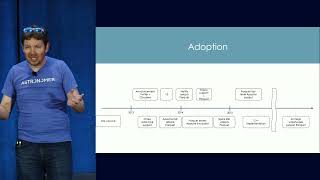
Ten years of building open source standards: From Parquet to Arrow to OpenLineage | Astronomer

ABOUT THE TALK: Over the last decade I have been lucky enough to contribute a few successful open source projects to the data ecosystem. In this talk

Julien Le Dem shares the story of his contribution to successful open source projects to the data ecosystem and what made their success possible. From the ideation process and early growth of the Apache Parquet columnar format and how this led to the creation of its in-memory alter-ego Apache Arrow. Julian will end with showing how this experience enabled the success of OpenLineage, an LFAI & Data project that brings observability to the data ecosystem.

ABOUT THE SPEAKER: Julien Le Dem is the Chief Architect of Astronomer and Co-Founder of Datakin. He co-created Apache Parquet and is involved in several open source projects including OpenLineage, Marquez (LFAI&Data), Apache Arrow, Apache Iceberg and a few others. Previously, he was a senior principal at Wework; principal architect at Dremio; and tech lead for Twitter’s data processing tools and principal engineer working on content platforms at Yahoo, where he received his Hadoop initiation.

ABOUT DATA COUNCIL: Data Council (https://www.datacouncil.ai/) is a community and conference series that provides data professionals with the learning and networking opportunities they need to grow their careers.

Make sure to subscribe to our channel for the most up-to-date talks from technical professionals on data related topics including data infrastructure, data engineering, ML systems, analytics and AI from top startups and tech companies.

FOLLOW DATA COUNCIL: Twitter: https://twitter.com/DataCouncilAI LinkedIn: https://www.linkedin.com/company/datacouncil-ai/

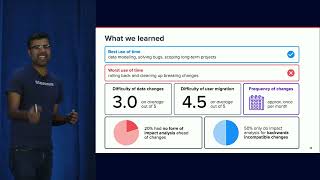
Feed The Alligators With the Lights On: How Data Engineers Can See Who Really Uses Data | Stemma

ABOUT THE TALK: At Lyft, Mark Grover built the Amundsen data catalog so data scientists could navigate hundreds of thousands of tables to distinguish trustworthy data from sandboxed, out-of-date data. When he took Amundsen open source, he helped dozens of data teams support a variety of demands to make data discoverable and self-serve. Mark frequently sees processes that seem “good enough” come back to bite data teams. In this talk, Mark takes us deep into query logs and APIs to see where all of that metadata lives, and he'll demonstrate how to use it so you don’t lose any fingers during your next data change.

ABOUT THE SPEAKER: Mark Grover is the co-founder/CEO of Stemma - a modern data catalog for building self-serve data culture used by Grafana, iRobot, SoFi, Convoy and many others. He is the co-creator of the leading open-source data catalog, Amundsen, used by Lyft, Instacart, Square, ING, Snap and many more! ​Mark was previously a developer on Apache Spark at Cloudera and is a committer and PMC member on a few open-source Apache project. He is a co-author of Hadoop Application Architectures.

ABOUT DATA COUNCIL: Data Council (https://www.datacouncil.ai/) is a community and conference series that provides data professionals with the learning and networking opportunities they need to grow their careers.

Make sure to subscribe to our channel for the most up-to-date talks from technical professionals on data related topics including data infrastructure, data engineering, ML systems, analytics and AI from top startups and tech companies.

FOLLOW DATA COUNCIL: Twitter: https://twitter.com/DataCouncilAI LinkedIn: https://www.linkedin.com/company/datacouncil-ai/

Pushing the limits of scale/performance for enterprise-wide analytics: A fire-side chat with Akamai

With the world’s most distributed compute platform — from cloud to edge — Akamai makes it easy for businesses to develop and run applications, while keeping experiences closer to users and threats farther away. ​So when it was time to scale it’s legacy Hadoop-like infrastructure reaching its capacity limits, while keeping their global operations running uninterrupted, Akamai partnered with Microsoft and Databricks to migrate to Azure Databricks.

Connect with us: Website: https://databricks.com Facebook: https://www.facebook.com/databricksinc Twitter: https://twitter.com/databricks LinkedIn: https://www.linkedin.com/company/data... Instagram: https://www.instagram.com/databricksinc/

Simplifying Migrations to Lakehouse—the Databricks Way

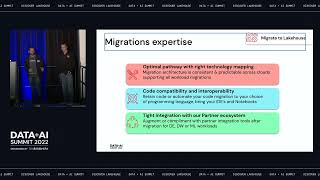
Customers around the world are experiencing tremendous success migrating from legacy on-premises Hadoop architectures to a modern Databricks Lakehouse in the cloud. At Databricks, we have formulated a migration methodology that helps customers sail through this migration journey with ease. In this talk, we will touch upon some of the key elements that minimize risks and simplify the process of migrating to Databricks, and will walk through some of the customer journeys and use cases.

Connect with us: Website: https://databricks.com Facebook: https://www.facebook.com/databricksinc Twitter: https://twitter.com/databricks LinkedIn: https://www.linkedin.com/company/data... Instagram: https://www.instagram.com/databricksinc/

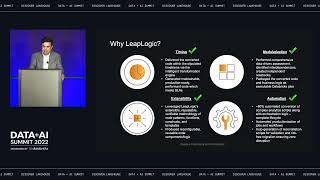
How AARP Services, Inc. automated SAS transformation to Databricks using LeapLogic

While SAS has been a standard in analytics and data science use cases, it is not cloud-native and does not scale well. Join us to learn how AARP automated the conversion of hundreds of complex data processing, model scoring, and campaign workloads to Databricks using LeapLogic, an intelligent code transformation accelerator that can transform any and all legacy ETL, analytics, data warehouse and Hadoop to modern data platforms.

In this session experts from AARP and Impetus will share about collaborating with Databricks and how they were able to: • Automate modernization of SAS marketing analytics based on coding best practices • Establish a rich library of Spark and Python equivalent functions on Databricks with the same capabilities as SAS procedures, DATA step operations, macros, and functions • Leverage Databricks-native services like Delta Live Tables to implement waterfall techniques for campaign execution and simplify pipeline monitoring

Connect with us: Website: https://databricks.com Facebook: https://www.facebook.com/databricksinc Twitter: https://twitter.com/databricks LinkedIn: https://www.linkedin.com/company/data... Instagram: https://www.instagram.com/databricksinc/

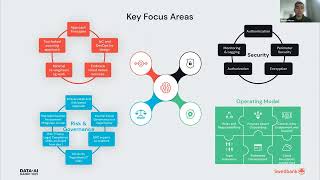
Swedbank: Enterprise Analytics in Cloud

Swedbank is the largest bank in Sweden & third largest in Nordics. They have about 7-8M customers across retail, mortgage , and investment (pensions). One of the key drivers for the bank was to look at data across all silos and build analytics to drive their ML models - they couldn’t. That’s when Swedbank made a strategic decision to go to the cloud and make bets on Databricks, Immuta, and Azure.

-Enterprise analytics in cloud is an initiative to move Swedbanks on-premise Hadoop based data lake into the cloud to provide improved analytical capabilities at scale. The strategic goals of the “Analytics Data Lake” are: -Advanced analytics: Improve analytical capabilities in terms of functionality, reduce analytics time to market and better predictive modelling -A Catalyst for Sharing Data: Make data Visible, Accessible, Understandable, Linked, and Trusted Technical advancements: Future proof with ability to add new tools/libraries, support for 3rd party solutions for Deep Learning/AI

To achieve these goals, Swedbank had to migrate existing capabilities and application services to Azure Databricks & implement Immuta as its unified access control plane. A “data discovery” space was created for data scientists to be able to come & scan (new) data, develop, train & operationalise ML models. To meet these goals Swedbank requires dynamic and granular data access controls to both mitigate data exposure (due to compromised accounts, attackers monitoring a network, and other threats) while empowering users via self-service data discovery & analytics. Protection of sensitive data is key to enable Swedbank to support key financial services use cases.

The presentation will focus on this journey, calling out key technical challenges, learning & benefits observed.

Connect with us: Website: https://databricks.com Facebook: https://www.facebook.com/databricksinc Twitter: https://twitter.com/databricks LinkedIn: https://www.linkedin.com/company/data... Instagram: https://www.instagram.com/databricksinc/

Big Data is Dead: Long Live Hot Data 🔥

Over the last decade, Big Data was everywhere. Let's set the record straight on what is and isn't Big Data. We have been consumed by a conversation about data volumes when we should focus more on the immediate task at hand: Simplifying our work.

Some of us may have Big Data, but our quest to derive insights from it is measured in small slices of work that fit on your laptop or in your hand. Easy data is here— let's make the most of it.

📓 Resources Big Data is Dead: https://motherduck.com/blog/big-data-is-dead/ Small Data Manifesto: https://motherduck.com/blog/small-data-manifesto/ Small Data SF: https://www.smalldatasf.com/

➡️ Follow Us LinkedIn: https://linkedin.com/company/motherduck X/Twitter : https://twitter.com/motherduck Blog: https://motherduck.com/blog/


Explore the "Small Data" movement, a counter-narrative to the prevailing big data conference hype. This talk challenges the assumption that data scale is the most important feature of every workload, defining big data as any dataset too large for a single machine. We'll unpack why this distinction is crucial for modern data engineering and analytics, setting the stage for a new perspective on data architecture.

Delve into the history of big data systems, starting with the non-linear hardware costs that plagued early data practitioners. Discover how Google's foundational papers on GFS, MapReduce, and Bigtable led to the creation of Hadoop, fundamentally changing how we scale data processing. We'll break down the "big data tax"—the inherent latency and system complexity overhead required for distributed systems to function, a critical concept for anyone evaluating data platforms.

Learn about the architectural cornerstone of the modern cloud data warehouse: the separation of storage and compute. This design, popularized by systems like Snowflake and Google BigQuery, allows storage to scale almost infinitely while compute resources are provisioned on-demand. Understand how this model paved the way for massive data lakes but also introduced new complexities and cost considerations that are often overlooked.

We examine the cracks appearing in the big data paradigm, especially for OLAP workloads. While systems like Snowflake are still dominant, the rise of powerful alternatives like DuckDB signals a shift. We reveal the hidden costs of big data analytics, exemplified by a petabyte-scale query costing nearly $6,000, and argue that for most use cases, it's too expensive to run computations over massive datasets.

The key to efficient data processing isn't your total data size, but the size of your "hot data" or working set. This talk argues that the revenge of the single node is here, as modern hardware can often handle the actual data queried without the overhead of the big data tax. This is a crucial optimization technique for reducing cost and improving performance in any data warehouse.

Discover the core principles for designing systems in a post-big data world. We'll show that since only 1 in 500 users run true big data queries, prioritizing simplicity over premature scaling is key. For low latency, process data close to the user with tools like DuckDB and SQLite. This local-first approach offers a compelling alternative to cloud-centric models, enabling faster, more cost-effective, and innovative data architectures.