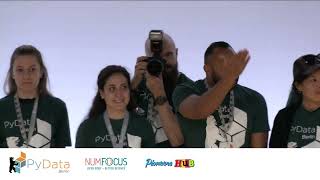
Closing Session
Closing Session
Event
Activities tracked
99
Sessions & talks
Showing 1–25 of 99 · Newest first
Closing Session
Kubeflow is a platform for building and deploying portable and scalable machine learning (ML) workflows using containers on Kubernetes-based systems.
We will code together a simple Kubeflow pipeline, show how to test it locally. As a bonus, we will explore one solution to avoid dependency hell using the modern dependency management tool uv.
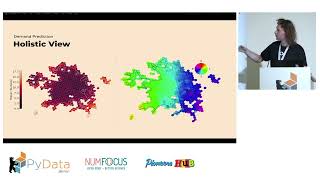
Free-floating carsharing systems struggle to balance vehicle supply and demand, which often results in inefficient fleet distribution and reduced vehicle utilization. This talk explores how data scraping can be used to model vehicle demand and user behavior, enabling targeted incentives to encourage self-balancing vehicle flows.
Using information scraped from a major mobility provider over multiple months, the presentation provides spatiotemporal analyses and machine learning results to determine whether it's practically possible to offer low-friction discounts that lead to improved fleet balance.
Managing who can see or do what with your data is a fundamental challenge, especially as applications and data grow in complexity. Traditional role-based systems often lack the granularity needed for modern data platforms. Fine-Grained Authorization (FGA) addresses this by controlling access at the individual resource level. In this 90-minute hands-on tutorial, we will explore implementing FGA using OpenFGA, an open-source authorization engine inspired by Google's Zanzibar. Attendees will learn the core concepts of Relationship-Based Access Control (ReBAC) and get practical experience defining authorization models, writing relationship tuples, and performing authorization checks using the OpenFGA Python SDK. Bring your laptop ready to code to learn how to build secure and flexible permission systems for your data applications.
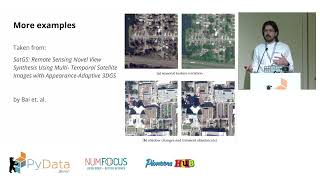
Energy infrastructure is vulnerable to damage by erosion or third party interference, which often takes the form of unsanctioned construction. In this talk we discuss our experiences using deep learning algorithms powered by large foundation models to monitor for changes in bi-temporal very-high resolution satellite imagery.
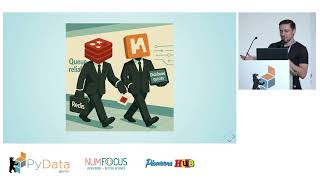
When a new requirement appears, whether it's document storage, pub/sub messaging, distributed queues, or even full-text search, Postgres can often handle it without introducing more infrastructure.
This talk explores how to leverage Postgres' native features like JSONB, LISTEN/NOTIFY, queueing patterns and vector extensions to build robust, scalable systems without increasing infrastructure complexity.
You'll learn practical patterns that extend Postgres just far enough, keeping systems simpler, more maintainable, and easier to operate, especially in small to medium projects or freelancing setups, where Postgres often already forms a critical part of the stack.
Postgres might not replace everything forever - but it can often get you much further than you think.
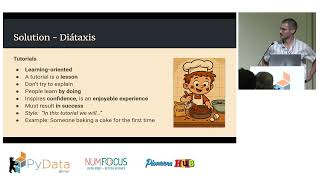
Clear documentation is crucial for the success of open-source libraries, but it’s often hard to get right. In this talk, I’ll share our experience applying the Diataxis documentation framework to improve two HoloViz ecosystem libraries, hvPlot and Panel. Attendees will come away with practical insights on applying Diataxis and strengthening documentation for their own projects.
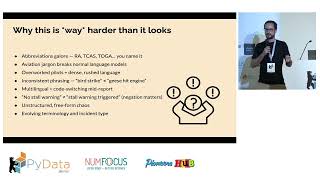
In aviation, search isn’t simple—people use abbreviations, slang, and technical terms that make exact matching tricky. We started with just Postgres, aiming for something that worked. Over time, we upgraded: semantic embeddings, reranking. We tackled filter complexity, slow index builds, and embedding updates and much more. Along the way, we learned a lot about making AI search fast, accurate, and actually usable for our users. It’s been a journey—full of turbulence, but worth the landing.
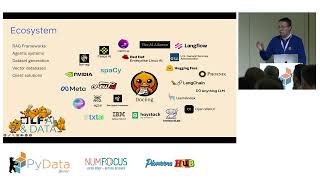
Docling, an open source package, is rapidly becoming the de facto standard for document parsing and export in the Python community. Earning close to 30,000 GitHub in less than one year and now part of the Linux AI & Data Foundation. Docling is redefining document AI with its ease and speed of use. In this session, we’ll introduce Docling and its features, including usages with various generative AI frameworks and protocols (e.g. MCP).
This talk introduces a new and innovative business model supported by a network of digital activists that form a collective force for protecting humanity, enabling digitally aware users to reclaim control over their data.
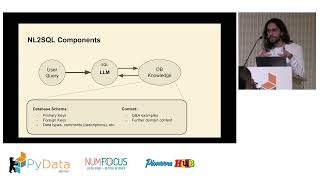
This hands-on tutorial will guide participants through building an end-to-end AI agent that translates natural language questions into SQL queries, validates and executes them on live databases, and returns accurate responses. Participants will build a system that intelligently routes between a specialized SQL agent and a ReAct chat agent, implementing RAG for query similarity matching, comprehensive safety validation, and human-in-the-loop confirmation. By the end of this session, attendees will have created a powerful and extensible system they can adapt to their own data sources.
Are your SQL queries becoming tangled webs that are difficult to decipher, debug, and maintain? This talk explores how to write shorter, more debuggable, and extensible SQL code using Pipelined SQL, an alternative syntax where queries are written as a series of orthogonal, understandable steps. We'll survey which databases and query engines currently support pipelined SQL natively or through extensions, and how it can be used on any platform by compiling pipelined SQL to any SQL dialect using open-source tools. A series of real-world examples, comparing traditional and pipelined SQL syntax side by side for a variety of use cases, will show you how to simplify existing code and make complex data transformations intuitive and manageable.
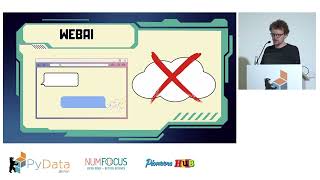
API calls suck! Okay, not all of them. But building your AI features reliant on third party APIs can bring a lot of trouble. In this talk you'll learn how to use web technologies to become more independent.
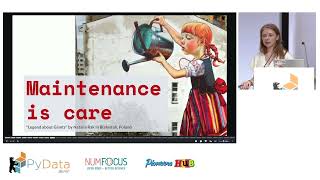
How we sustain what we build — and why the future of tech depends on care, not only code.
The last five years have reshaped tech — through a pandemic, economic uncertainty, shifting politics, and the rapid rise of AI. While these changes have opened new opportunities, they’ve also exposed the limits — and harms — of a “move fast and break things” mindset.