
talk-data.com talk-data.com

Topic

Playwright

automation_testing web_testing browser_automation

12

tagged

Activity Trend

4 peak/qtr
2020-Q1 2026-Q1

Activities

12 activities · Newest first

Companies today are hungry for external data to stay competitive, but actually getting and making sense of that data isn’t easy. Standard web scraping often produces messy or incomplete results, and modern anti-bot systems make reliable collection even tougher.

In this talk, I’ll share how pairing Python’s scraping frameworks (like Scrapy, Playwright, and Selenium) with AI/ML can turn raw, unstructured data into clear, actionable insights.

We’ll look at:

1) How to build scrapers that still work in 2025.

2) Ways to use AI to automatically clean, enrich, and classify data.

3) Real-world applications of sentiment analysis for reviews and social media.

4) Case studies showing how SMEs have used these pipelines to sharpen marketing and product strategies.

By the end, you’ll see how to design pipelines that don’t just gather data, but deliver real strategic value. The session will focus on practical Python tools, scalable deployment (Airflow, Kubernetes, cloud platforms), and key lessons learned from hands-on projects at the intersection of scraping and AI.
In this session, Simon Knott will explore how Playwright Agents can help you write and maintain tests using agentic loops like Claude Code or GitHub Copilot. You’ll learn how these agents work not just in demos but in real production apps, whether you have existing test coverage or are starting fresh. Simon will also dive into what’s happening under the hood and unpack the key challenges of making agentic test generation reliable and efficient.

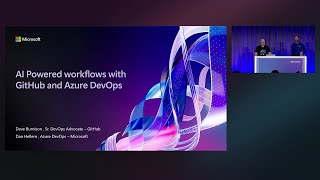
AI-powered workflows with GitHub and Azure DevOps

Modernize your DevOps strategy with Agentic DevOps by migrating your Azure Repos to GitHub while continuing to leverage the investments you’ve made in Azure Boards and Azure Pipelines. We’ll walk through real-world patterns for hybrid adoption, show how to integrate GitHub, Azure Boards and Azure Pipelines, and share best practices for enabling agent-based workflows with the MCP Servers for Azure DevOps, Playwright and Azure.

Delivered in a silent stage breakout.

Amazon Q is powerful out of the box, but in the terminal it becomes a superpower. In this talk, I share how I turned Amazon Q CLI into a fully-fledged, verification‑first AI platform using the Model Context Protocol (MCP) all without adding $0 extra cost. I’ll walk through how I built 49 MCP servers to remove hallucinations, browser automation with Playwright, and live AWS verification that eliminates hallucinations in practice. You’ll see Financial Services Institution grade guardrails (production protection, cost controls, and full audit trails) that makes Q feel native to a builder’s workflow, secure and reliable. You’ll leave with a blueprint to extend Amazon Q/ any agentic coding beyond chat into a trusted, terminal‑first, agentic platform you own and can evolve infinitely.

Hands-on bootcamp to build a working QA Agent from scratch. 8 live instructor-led sessions (weekends only) designed to help testers, QAs, and SDETs move beyond theory and actually build their own functional QA Agent from scratch. By the end you’ll know how to design and implement AI-driven QA workflows that assist with bug triage and prioritization, generate and organize test reports automatically, run and manage complex testing workflows, and take over repetitive tasks. Tools covered include LangChain, Streamlit, Postman, Playwright, Memory, Prompting, and Tool Use. Format: 8 live sessions, 3 hours each, instructor-led with real coding and projects.

Social media automation is one of the fastest and most practical ways to experience the value of generative AI. In this hands-on session, we’ll build a secure, scalable AI agent that automates social media interactions, specifically LinkedIn, using Azure AI Foundry, Playwright, and Pydantic AI. We'll walk through the architecture of a multi-agent system, explore best practices for secure deployment using Microsoft Purview, Defender for Cloud, and Sentinel, and demonstrate how to integrate browser automation with LLM-based decision-making. Whether you're an enterprise architect or a curious developer, this session will equip you with the tools and insights to build responsible AI agents that operate safely in real-world environments.

Anastasia Khabarova, QA engineer @ Qase: In this talk, Anastasia will share how Qase evolved its approach to UI testing — from brittle full-page screenshots to a robust system of visual component tests. You’ll hear about the challenges with visual regressions that escaped E2E tests, the tools explored, and how the team built a reliable testing workflow with Playwright. Learn practical strategies for stabilising tests, choosing what to test visually, and improving collaboration between QA and frontend.

Accessibility is more than a compliance requirement—it’s a powerful tool for creating resilient, reliable automated tests. Using NASA’s Open Mission Control Technologies (Open MCT) as a case study, this session will demonstrate how implementing accessibility standards not only improves usability but also strengthens test automation workflows. Attendees will see real-world examples of how traditional locators in Playwright can lead to brittle, flaky tests and how accessibility-driven development resolves these challenges. Through live demonstrations, including the use of a screen reader, we’ll explore the practical impact of semantic HTML, ARIA attributes, and focus management on both user experience and test stability. This session will provide actionable insights into incorporating accessibility standards into your applications, leveraging Playwright to write robust tests, and reducing test flakiness—all while making your applications more inclusive and user-friendly.

Learn the basics of end-to-end testing for a full stack web application with the Playwright testing framework. While documentation abounds with regards to the principles behind setting up a test environment that coordinates the database, back end, and front end of a full stack application, actually implementing the details behind these concepts is easier said than done. We will be going over the inner workings a fully built out example of a todo list application and a suite of associated tests.

In today’s landscape of rapidly evolving front-end and back-end codebases, test automation has become increasingly intricate. With modern interfaces enabling interaction through both UI and API, there are new opportunities to turn this complexity into an advantage. Join me for an in-depth look at Playwright’s API and network traffic capabilities, where you’ll learn to leverage these powerful tools to build test scripts that seamlessly interact across the application stack. From blocking and modifying to intercepting requests, you’ll leave this session ready to tackle even the most challenging testing scenarios.

I am a big believer in synthetic monitoring as a concept to build reliable production services. If engineers are supposed to run what they build, they need monitoring tools that work for them. I have built my own custom solutions in the past using Jenkins or GH Actions and later used SaaS tools for this. I want to share my experience how I got frontend engineers to build monitoring and get everyone on an engineering team to care about production system reliability. Daniel Paulus is an accomplished technology leader, presently leading as the VP of Engineering at Checkly, building synthetic monitoring with Playwright.