talk-data.com talk-data.com

Topic

Java

programming_language object_oriented enterprise

5

tagged

Activity Trend

25 peak/qtr
2020-Q1 2026-Q1

Activities

Showing filtered results

Filtering by: Bill Pribyl ×
Oracle PL/SQL Language Pocket Reference, 5th Edition

Be more productive with the Oracle PL/SQL language. The fifth edition of this popular pocket reference puts the syntax of specific PL/SQL language elements right at your fingertips, including features added in Oracle Database 12c. Whether you’re a developer or database administrator, when you need answers quickly, the Oracle PL/SQL Language Pocket Reference will save you hours of frustration with concise summaries of: Fundamental language elements, such as block structure, datatypes, and declarations Statements for program control, cursor management, and exception handling Records, procedures, functions, triggers, and packages Execution of PL/SQL functions in SQL Compilation options, object-oriented features, collections, and Java integration This handy pocket reference is a perfect companion to Steven Feuerstein and Bill Pribyl’s bestselling Oracle PL/SQL Programming.

Oracle PL/SQL Language Pocket Reference, 4th Edition

The fourth edition of this popular pocket guide provides quick-reference information that will help you use Oracle's PL/SQL language, including the newest Oracle Database 11g features. It's a companion to Steven Feuerstein and Bill Pribyl's bestselling Oracle PL/SQL Programming. This concise guide boils down the most vital PL/SQL information into an accessible summary of: The new edition describes such Oracle Database 11g elements as PL/SQL's function result cache, compound triggers, the CONTINUE statement, the SIMPLE_INTEGER datatype, and improvements to native compilation, regular expressions, and compiler optimization (including intra-unit inlining). In addition, this book now includes substantial new sections on Oracle's built-in functions and packages. Fundamental language elements (e.g., block structure, datatypes, declarations) Statements for program control, cursor management, and exception handling Records, procedures, functions, triggers, and packages Calling PL/SQL functions in SQL Compilation options, object-oriented features, collections, and Java integration When you need answers quickly, the Oracle PL/SQL Language Pocket Reference will save you hours of frustration.

Oracle PL/SQL Language Pocket Reference, Second Edition

Like most PL/SQL programmers, you've found Oracle PL/SQL Programming to be a reference book you can't do without. Packed with examples and recommendations, it's a book that has helped everyone, from Oracle Forms developers to database administrators, make the most of PL/SQL. But you can't always carry it with you, and even at your desk there are times when you just need a reminder, a quick answer to a problem you're up against. For times like those, PL/SQL experts Stephen Feuerstein, Bill Pribyl, and Chip Dawes have written a new edition of Oracle PL/SQL Language Pocket Reference. Updated for Oracle9i, this little book is easy to take with you and use anywhere for quick problem solving. The second edition of the Oracle PL/SQL Language Pocket Reference boils down the most vital information from Oracle PL/SQL Programming into a convenient quick reference to PL/SQL basics. This compact book will be indispensable for new and seasoned Oracle database developers alike. It summarizes features available in Oracle9i and provides essential information on PL/SQL block structure, fundamental language elements, control statements, and use of procedures, functions, packages, triggers, Oracle objects, external procedures, and methods of calling Java classes from PL/SQL. O'Reilly's Pocket References have become a favorite among developers and database administrators everywhere. By providing a wealth of important details in a concise, well-organized format, these handy books deliver just what you need to complete the task at hand. When you've reached a sticking point in your work and need to get to a solution quickly, the new edition of Oracle PL/SQL Language Pocket Reference is the book you'll want to have.

Oracle PL/SQL Programming, Third Edition

Nearly a quarter-million PL/SQL programmers--novices and experienced developers alike--have found the first and second editions of Oracle PL/SQL Programming to be indispensable references to this powerful language. Packed with examples and recommendations, this book has helped everyone, from Oracle Forms developers to database administrators, make the most of PL/SQL. This new edition is a comprehensive update of the original book, covering all versions of PL/SQL through Oracle9i Release 2. It adds much-requested new chapters on how to create and run PL/SQL programs, call Java methods from within PL/SQL, and define and use database triggers. An extensive new chapter--designed especially for experienced PL/SQL developers--describes PL/SQL's runtime architecture and how to use knowledge of Oracle internals to get the best performance from PL/SQL. The book contains information about the latest Oracle9i PL/SQL features, including: Record-based DML: You can now use records in INSERT and DELETE statements. Table functions: These are functions that return a result set (in the form of a PL/SQL collection). Such functions existed in Oracle8i but they are now much expanded. New and improved datatypes: Oracle now offers dramatically improved support for timestamps, time zone management, and interval calculations. In addition, the XMLType datatype has now been implemented. Inheritance for object types: You can now define a hierarchy of object types (which were first introduced in Oracle8). Enhancements to PL/SQL collections. PL/SQL now supports multiple-level collections (nesting collections within collections), as well as associative arrays (previously called index-by tables), which allow you to index by PLS_INTEGER and VARCHAR2. Native compilation of PL/SQL code: PL/SQL source code can now optionally be compiled into native object code that is linked into Oracle. Part I, Programming in PL/SQL Part II, PL/SQL Program Structure Part III, PL/SQL Program Data Part IV, SQL in PL/SQL Part V, PL/SQL Application Construction Part VI, Advanced PL/SQL Topics The book is divided into six parts: Even if you've been a PL/SQL developer for years, you'll find an enormous amount of new and revised information in this third edition and on its companion web site. If you're new to PL/SQL, you'll find Oracle PL/SQL Programming an invaluable companion on the road to mastery.

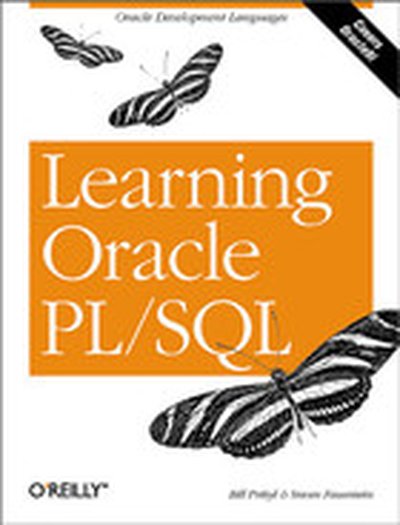
Learning Oracle PL/SQL

PL/SQL, Oracle's programming language for stored procedures, delivers a world of possibilities for your database programs. PL/SQL supplements the standard relational database language, SQL, with a wide range of procedural features, including loops, IF-THEN statements, advanced data structures, and rich transactional control--all closely integrated with the Oracle database server. Knowing where to start with Oracle's procedural language is not always obvious to a newcomer, especially considering the language's feature set and the sheer size of the official documentation (not to mention Oracle's ever-increasing number of pre-built PL/SQL programs). But Learning Oracle PL/SQL offers the signposts and guidance you need to come up to speed on the language, delivered in a manageable number of pages while covering all the essentials. Topics include: PL/SQL--what is it, and why use it? Why use PL/SQL instead of Java? Syntax and examples of all core language constructs Creating, using, and reusing stored procedures, functions, and packages Building web-based applications using PL/SQL features available "out of the box" (such as PL/SQL Server Pages) Securing PL/SQL programs against attack Benefits of third-party developer tools and integrated development environments Connecting PL/SQL to email, Java, and the Internet Meticulously crafted with all-new examples downloadable from examples.oreilly.com/learnoracle, the book addresses language features available in all versions of Oracle, from Oracle7 to Oracle8i to Oracle9i. Learning Oracle PL/SQL was written by PL/SQL experts Bill Pribyl and Steven Feuerstein, whose easy-to-read style and attention to detail has made other O'Reilly books (such as the bestselling Oracle PL/SQL Programming) very popular among Oracle developers worldwide. Learning Oracle PL/SQL is meant for a wide range of target audiences, including both beginning programmers and those already experienced with other programming languages. Whether you are a new developer, a crossover programmer from another database system, or a new database administrator who needs to learn PL/SQL, this book will get you well on your way. It is the perfect introduction to Oracle PL/SQL Programming, also by Pribyl and Feuerstein.