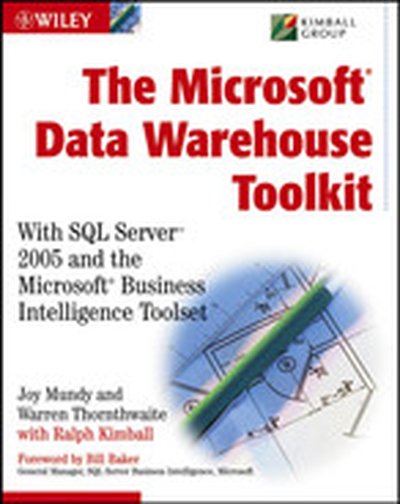
This groundbreaking book is the first in the Kimball Toolkit series to be product-specific. Microsoft’s BI toolset has undergone significant changes in the SQL Server 2005 development cycle. SQL Server 2005 is the first viable, full-functioned data warehouse and business intelligence platform to be offered at a price that will make data warehousing and business intelligence available to a broad set of organizations. This book is meant to offer practical techniques to guide those organizations through the myriad of challenges to true success as measured by contribution to business value. Building a data warehousing and business intelligence system is a complex business and engineering effort. While there are significant technical challenges to overcome in successfully deploying a data warehouse, the authors find that the most common reason for data warehouse project failure is insufficient focus on the business users and business problems. In an effort to help people gain success, this book takes the proven Business Dimensional Lifecycle approach first described in best selling The Data Warehouse Lifecycle Toolkit and applies it to the Microsoft SQL Server 2005 tool set. Beginning with a thorough description of how to gather business requirements, the book then works through the details of creating the target dimensional model, setting up the data warehouse infrastructure, creating the relational atomic database, creating the analysis services databases, designing and building the standard report set, implementing security, dealing with metadata, managing ongoing maintenance and growing the DW/BI system. All of these steps tie back to the business requirements. Each chapter describes the practical steps in the context of the SQL Server 2005 platform. Intended Audience The target audience for this book is the IT department or service provider (consultant) who is: Planning a small to mid-range data warehouse project; Evaluating or planning to use Microsoft technologies as the primary or exclusive data warehouse server technology; Familiar with the general concepts of data warehousing and business intelligence. The book will be directed primarily at the project leader and the warehouse developers, although everyone involved with a data warehouse project will find the book useful. Some of the book’s content will be more technical than the typical project leader will need; other chapters and sections will focus on business issues that are interesting to a database administrator or programmer as guiding information. The book is focused on the mass market, where the volume of data in a single application or data mart is less than 500 GB of raw data. While the book does discuss issues around handling larger warehouses in the Microsoft environment, it is not exclusively, or even primarily, concerned with the unusual challenges of extremely large datasets. About the Authors JOY MUNDY has focused on data warehousing and business intelligence since the early 1990s, specializing in business requirements analysis, dimensional modeling, and business intelligence systems architecture. Joy co-founded InfoDynamics LLC, a data warehouse consulting firm, then joined Microsoft WebTV to develop closed-loop analytic applications and a packaged data warehouse. Before returning to consulting with the Kimball Group in 2004, Joy worked in Microsoft SQL Server product development, managing a team that developed the best practices for building business intelligence systems on the Microsoft platform. Joy began her career as a business analyst in banking and finance. She graduated from Tufts University with a BA in Economics, and from Stanford with an MS in Engineering Economic Systems. WARREN THORNTHWAITE has been building data warehousing and business intelligence systems since 1980. Warren worked at Metaphor for eight years, where he managed the consulting organization and implemented many major data warehouse systems. After Metaphor, Warren managed the enterprise-wide data warehouse development at Stanford University. He then co-founded InfoDynamics LLC, a data warehouse consulting firm, with his co-author, Joy Mundy. Warren joined up with WebTV to help build a world class, multi-terabyte customer focused data warehouse before returning to consulting with the Kimball Group. In addition to designing data warehouses for a range of industries, Warren speaks at major industry conferences and for leading vendors, and is a long-time instructor for Kimball University. Warren holds an MBA in Decision Sciences from the University of Pennsylvania's Wharton School, and a BA in Communications Studies from the University of Michigan. RALPH KIMBALL, PH.D., has been a leading visionary in the data warehouse industry since 1982 and is one of today's most internationally well-known authors, speakers, consultants, and teachers on data warehousing. He writes the "Data Warehouse Architect" column for Intelligent Enterprise (formerly DBMS) magazine.