
talk-data.com talk-data.com

Topic

oracle database solutions

3

tagged

Activity Trend

1 peak/qtr
2020-Q1 2026-Q1

Activities

3 activities · Newest first

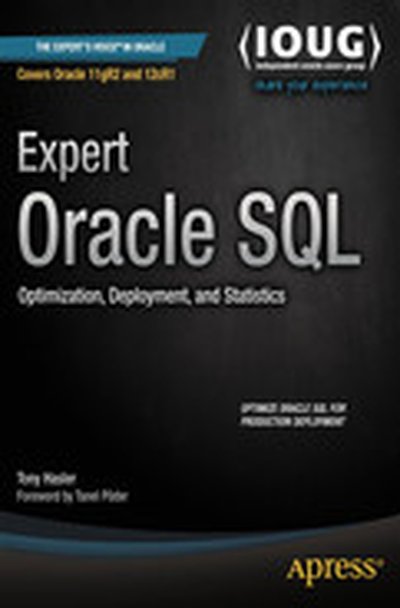
Expert Oracle SQL

Expert Oracle SQL: Optimization, Deployment, and Statistics is about optimizing individual SQL statements, especially on production database systems. This Oracle-specific book begins by assuming you have already identified a particular SQL statement and are considering taking steps to improve its performance. The book describes a systematic process by which to diagnose a problem statement, identify a fix, and to implement that fix safely in a production system. You'll learn not only to improve performance when it is too slow, but also to stabilize performance when it is too variable. You'll learn about system statistics and how the Cost-Based Optimizer uses them to determine a suitable execution plan for a given statement. That knowledge provides the foundation from which to identify the root cause, and to stabilize and improve performance. Next after identifying a problem and the underlying root cause is to put in place a solution. Expert Oracle SQL: Optimization, Deployment, and Statistics explains how to apply various remedies such as changing the SQL statement, adding hints, changing the physical design, and more, and how they can be brought to bear on fixing a problem once and for all. Rolling a change out smoothly is an important topic when dealing with tuning and optimization. Expert Oracle SQL: Optimization, Deployment, and Statistics does not let you down in this critical area. The book contains two chapters of good information from an experienced professional on how to safely deploy changes into production so that your systems remaining running and available throughout the deployment process. Describes a systematic approach to tuning Oracle SQL Explains how things are supposed to work, what can go wrong, and how to fix it Takes you through the steps needed to stabilize performance in your production systems What you'll learn Determine the root cause of poor performance in a SQL statement Decipher each line of an execution plan and how it relates to its source SQL statement Know the various options and transformations available for the Cost-Based Optimizer Interpret the diagnostic data from Active Session History, SQL Performance Monitor, and from other sources Apply optimizer hints, SQL profiles, and SQL baselines when they are best used, and avoid them otherwise Manage object statistics used by the optimizer to ensure efficient execution plans
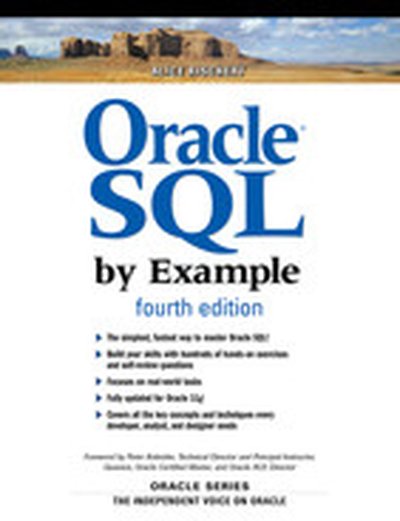
Oracle SQL By Example

“The book...has enough depth for even a seasoned professional to pick up enough tips to pay back the price of the book many times over.” –Dr. Paul Dorsey, President, Dulcian, Inc., Oracle Magazine PL/SQL Developer of the Year 2007, and President Emeritus, New York Oracle Users Group “This is a fascinating guide into the world of Oracle SQL with an abundance of well-collected examples. Without a doubt, this book is helpful to beginners and experts alike who seek alternative ways to resolve advanced scenarios.”–Oleg Voskoboynikov, Ph.D., Database Architect The World’s #1 Hands-On Oracle SQL Workbook–Fully Updated for Oracle 11 g Crafted for hands-on learning and tested in classrooms worldwide, this book illuminates in-depth every Oracle SQL technique you’ll need. From the simplest query fundamentals to regular expressions and with newly added coverage of Oracle’s powerful new SQL Developer tool, you will focus on the tasks that matter most. Hundreds of step-by-step, guided lab exercises will systematically strengthen your expertise in writing effective, high-performance SQL. Along the way, you’ll acquire a powerful arsenal of useful skills–and an extraordinary library of solutions for your real-world challenges with Oracle SQL. Coverage includes 100% focused on Oracle SQL for Oracle 11 g, today’s #1 database platform–not “generic” SQL! Master all core SQL techniques including every type of join such as equijoins, self joins, and outer joins Understand Oracle functions in depth, especially character, number, date, timestamp, interval, conversion, aggregate, regular expressions, analytical, and more Practice all types of subqueries, such as correlated and scalar subqueries, and learn about set operators and hierarchical queries Build effective queries and learn fundamental Oracle SQL Developer and SQL*Plus skills Make the most of the Data Dictionary and create tables, views, indexes, and sequences Secure databases using Oracle privileges, roles, and synonyms Explore Oracle 11 g’s advanced data warehousing features Learn many practical tips about performance optimization, security, and architectural solutions Avoid common pitfalls and understand and solve common mistakes For every database developer, administrator, designer, or architect, regardless of experience!

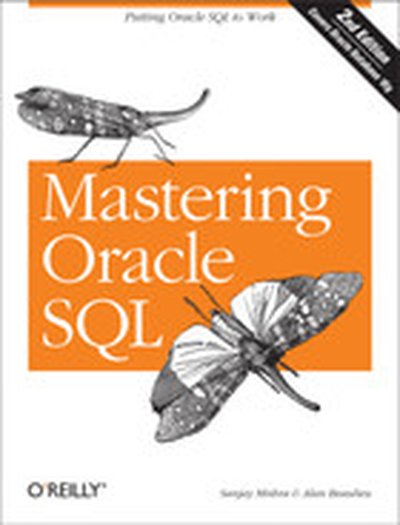
Mastering Oracle SQL, 2nd Edition

The vast majority of Oracle SQL books discuss some syntax, provide the barest rudiments of using Oracle SQL, and perhaps include a few simple examples. It might be enough to pass a survey course, or give you some buzz words to drop in conversation with real Oracle DBAs. But if you use Oracle SQL on a regular basis, you want much more. You want to access the full power of SQL to write queries in an Oracle environment. You want a solid understanding of what's possible with Oracle SQL, creative techniques for writing effective and accurate queries, and the practical, hands-on information that leads to true mastery of the language. Simply put, you want useful, expert best practices that can be put to work immediately, not just non-vendor specific overview or theory.Updated to cover the latest version of Oracle, Oracle 10g, this edition of the highly regarded Mastering Oracle SQL has a stronger focus on technique and on Oracle's implementation of SQL than any other book on the market. It covers Oracle s vast library of built-in functions, the full range of Oracle SQL query-writing features, regular expression support, new aggregate and analytic functions, subqueries in the SELECT and WITH clauses, multiset union operators, enhanced support for hierarchical queries: leaf and loop detection, and the CONNECT_BY_ROOT operator, new partitioning methods (some introduced in Oracle9i Release 2), and the native XML datatype, XMLType. Mastering Oracle SQL, 2nd Edition fills the gap between the sometimes spotty vendor documentation, and other books on SQL that just don't explore the full depth of what is possible with Oracle-specific SQL. For those who want to harness the untapped (and often overlooked) power of Oracle SQL, this essential guide for putting Oracle SQL to work will prove invaluable.