talk-data.com talk-data.com

Topic

postgis

7

tagged

Activity Trend

1 peak/qtr
2020-Q1 2026-Q1

Activities

7 activities · Newest first

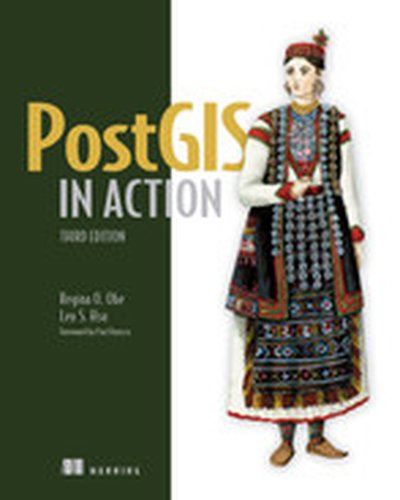
PostGIS in Action, Third Edition

In PostGIS in Action, Third Edition you will learn: An introduction to spatial databases Geometry, geography, raster, and topology spatial types, functions, and queries Applying PostGIS to real-world problems Extending PostGIS to web and desktop applications Querying data from external sources using PostgreSQL Foreign Data Wrappers Optimizing queries for maximum speed Simplifying geometries for greater efficiency PostGIS in Action, Third Edition teaches readers of all levels to write spatial queries for PostgreSQL. You’ll start by exploring vector-, raster-, and topology-based GIS before quickly progressing to analyzing, viewing, and mapping data. This fully updated third edition covers key changes in PostGIS 3.1 and PostgreSQL 13, including parallelization support, partitioned tables, and new JSON functions that help in creating web mapping applications. About the Technology PostGIS is a spatial database extender for PostgreSQL. It offers the features and firepower you need to take on nearly any geodata task. PostGIS lets you create location-aware queries with a few lines of SQL code, then build the backend for mapping, raster analysis, or routing application with minimal effort. About the Book PostGIS in Action, Third Edition shows you how to solve real-world geodata problems. You’ll go beyond basic mapping, and explore custom functions for your applications. Inside this fully updated edition, you’ll find coverage of new PostGIS features such as PostGIS Window functions, parallelization of queries, and outputting data for applications using JSON and Vector Tile functions. What's Inside Fully revised for PostGIS version 3.1 and PostgreSQL 13 Optimize queries for maximum speed Simplify geometries for greater efficiency Extend PostGIS to web and desktop applications About the Reader For readers familiar with relational databases and basic SQL. No prior geodata or GIS experience required. About the Authors Regina Obe and Leo Hsu are database consultants and authors. Regina is a member of the PostGIS core development team and the Project Steering Committee. Quotes The best introduction I’ve seen for engineers who want to get ramped up quickly and build advanced GIS applications. - Ikechukwu Okonkwo, Orum.io A wealth of information that showcases how powerful PostGIS is. - Luis Moux-Dominguez, EMO An extraordinary book for the world of GIS. Truly learned a lot! - DeUndre’ Rushon, DigiDiscover LLC Gives you insight into how best to provide map services for a wide audience. - Marcus Brown, Enel Green Power
PostGIS Cookbook - Second Edition

PostGIS Cookbook provides a thorough introduction to working with spatial data in the PostgreSQL environment using PostGIS. The book covers topics such as importing and exporting geographic data, analyzing vector and raster data, database optimization, and building GIS web applications. By the end, you'll be equipped to fully leverage PostGIS for spatial data projects. What this Book will help me do Efficiently import and export geographic data between PostGIS and other platforms. Apply PostGIS functions for advanced vector data analysis and visualization. Manipulate and optimize spatial data for better performance and robustness. Integrate PostGIS with Python for spatial data scripting. Develop GIS web applications leveraging PostGIS and Open Geospatial standards. Author(s) The authors of PostGIS Cookbook are experienced professionals and active contributors to the spatial database community. Vincent Mather, Pedro Wightman, Thomas Kraft, and their co-authors bring extensive software engineering and geo-computing expertise to the text. Their hands-on approach ensures practicality and relevance to current technologies. Who is it for? This book is ideal for developers and GIS professionals who want to enhance their spatial data handling skills using PostGIS. Whether you're a beginner to spatial databases or looking to extend your PostgreSQL knowledge, this book offers practical solutions and advanced techniques for spatial data management and analysis.

Adjustment Computations, 6th Edition

The definitive guide to bringing accuracy to measurement, updated and supplemented Adjustment Computations is the classic textbook for spatial information analysis and adjustment computations, providing clear, easy-to-understand instruction backed by real-world practicality. From the basic terms and fundamentals of errors to specific adjustment computations and spatial information analysis, this book covers the methodologies and tools that bring accuracy to surveying, GNSS, GIS, and other spatial technologies. Broad in scope yet rich in detail, the discussion avoids overly-complex theory in favor of practical techniques for students and professionals. This new sixth edition has been updated to align with the latest developments in this rapidly expanding field, and includes new video lessons and updated problems, including worked problems in STATS, MATRIX, ADJUST, and MathCAD. All measurement produces some amount of error; whether from human mistakes, instrumentation inaccuracy, or environmental features, these errors must be accounted and adjusted for when accuracy is critical. This book describes how errors are identified, analyzed, measured, and corrected, with a focus on least squares adjustment—the most rigorous methodology available. Apply industry-standard methodologies to error analysis and adjustment Translate your skills to the real-world with instruction focused on the practical Master the fundamentals as well as specific computations and analysis Strengthen your understanding of critical topics on the Fundamentals in Surveying Licensing Exam As spatial technologies expand in both use and capability, so does our need for professionals who understand how to check and adjust for errors in spatial data. Conceptual knowledge is one thing, but practical skills are what counts when accuracy is at stake; Adjustment Computations provides the real-world training you need to identify, analyze, and correct for potentially crucial errors.

Mastering PostGIS

"Mastering PostGIS" is your guide to unlocking the powerful capabilities of the PostGIS spatial database system. Across 328 pages, this book takes you through the essentials of spatial data handling, from importing, analyzing, and exporting datasets to building fully-functional GIS applications. You'll explore concepts such as spatial querying, data types, and integrating PostGIS with powerful tools like GeoServer and OpenLayers. What this Book will help me do Understand the fundamentals of PostGIS and its role in GIS workflows. Gain hands-on experience in SQL-based spatial queries and data manipulation. Develop the ability to integrate PostGIS with web platforms like Node.js, GeoServer, and OpenLayers. Discover strategies for spatial data ETL (Extract, Transform, Load) processes and live updates. Build scalable, efficient GIS applications leveraging PostGIS's capabilities. Author(s) George Silva, None Mikiewicz, and Michal Mackiewicz None are experts in GIS systems and database technologies with years of experience working with spatial databases such as PostGIS. Passionate about imparting practical knowledge, they provide clear, hands-on examples in every chapter to help you master spatial database solutions. Who is it for? This book is perfect for GIS developers and analysts looking to deepen their knowledge of PostGIS. If you aim to enhance your skills in designing GIS applications or performing spatial data analysis, this is your ideal resource. Prior experience with PostgreSQL and a basic installation of PostGIS are recommended for readers.

PostGIS in Action, Second Edition

PostGIS in Action, Second Edition teaches readers of all levels to write spatial queries that solve real-world problems. It first gives you a background in vector-, raster-, and topology-based GIS and then quickly moves into analyzing, viewing, and mapping data. This second edition covers PostGIS 2.0 and 2.1 series, PostgreSQL 9.1, 9.2, and 9.3 features, and shows you how to integrate with other GIS tools. About the Technology About the Book Processing data tied to location and topology requires specialized know-how. PostGIS is a free spatial database extender for PostgreSQL, every bit as good as proprietary software. With it, you can easily create location-aware queries in just a few lines of SQL code and build the back end for a mapping, raster analysis, or routing application with minimal effort. PostGIS in Action, Second Edition teaches you to solve real-world geodata problems. It first gives you a background in vector-, raster-, and topology-based GIS and then quickly moves into analyzing, viewing, and mapping data. You'll learn how to optimize queries for maximum speed, simplify geometries for greater efficiency, and create custom functions for your own applications. You'll also learn how to apply your existing GIS knowledge to PostGIS and integrate with other GIS tools. Familiarity with relational database and GIS concepts is helpful but not required. What's Inside An introduction to spatial databases Geometry, geography, raster, and topology spatial types, functions, and queries Applying PostGIS to real-world problems Extending PostGIS to web and desktop applications Updated for PostGIS 2.x and PostgreSQL 9.x About the Reader About the Authors Regina Obe and Leo Hsu are database consultants and authors. Regina is a member of the PostGIS core development team and the Project Steering Committee. Quotes A huge body of information distilled into a concise guide. - From the Foreword by Paul Ramsey, Chair PostGIS Steering Committee A more-than-worthy update to "the" definitive book on PostGIS. - Jonathan DeCarlo, Bentley Systems, Inc. The most comprehensive guide to spatial data on PostgreSQL. - Sergio Arbeo, codecantor.com Provides the science and the tools needed to create innovative applications for the new digital age. - Guy Ndjeng, NTSP

PostGIS in Action

PostGIS in Action teaches readers of all levels to write spatial queries that solve real-world problems. It first gives you a background in vector-based GIS and then quickly moves into analyzing, viewing, and mapping data. You'll learn how to optimize queries for maximum speed, simplify geometries for greater efficiency, and create custom functions for your own applications. The book covers PostgreSQL 8.4, 9.0, and 9.1 features and shows you how to integrate with other GIS tools. About the Technology PostGIS is an open source spatial database extender for PostgreSQL. It equals or surpasses proprietary alternatives, allowing you to create location-aware queries with just a few lines of SQL code, and provides a back-end for mapping applications with minimal effort. About the Book What's Inside An introduction to spatial databases Geometry types, functions, and queries Applying PostGIS to real-world problems Extending PostGIS to web and desktop applications About the Reader Familiarity with relational database concepts is helpful but not required. About the Authors Regina Obe and Leo Hsu are database consultants. Regina is a member of the PostGIS core development team and the Project Steering Committee. They are hosts of BostonGIS.com and PostgresOnLine.com. Quotes From the forward: A concise guide that's truly one of a kind. - Paul Ramsey, Chair, PostGIS Steering Committee An elegant introduction to a difficult domain. - Mark Leslie, LISAsoft Pty Ltd The ultimate PostGIS tour guide. - Brent Wood, NIWA Will give you the Aha! moment you've been waiting for. - Jeff Addison, Southgate Software Ltd Want to get the most out of PostGIS? This is required reading for you. - James Fee, WeoGeo.com

Spatial Databases

Spatial Databases is the first unified, in-depth treatment of special techniques for dealing with spatial data, particularly in the field of geographic information systems (GIS). This book surveys various techniques, such as spatial data models, algorithms, and indexing methods, developed to address specific features of spatial data that are not adequately handled by mainstream DBMS technology. The book also reviews commercial solutions to geographic data handling: ArcInfo, ArcView, and Smallworld GISs; and two extensions to the relational model, PostgreSQL and Oracle Spatial. The authors examine these underlying GIS technologies, assess their strengths and weaknesses, and consider specific uses for which each product is best suited. * Examines the strengths of various query languages and approaches to query processing. * Explains the use of computational geometry in spatial databases GISs, providing necessary background and an in-depth look at key algorithms. * Covers spatial access methods, including the R-tree and several space-driven structures, and is filled with dozens of helpful illustrations.