talk-data.com talk-data.com

Topic

xquery

7

tagged

Activity Trend

1 peak/qtr
2020-Q1 2026-Q1

Activities

7 activities · Newest first

XQuery, 2nd Edition

The W3C XQuery 3.1 standard provides a tool to search, extract, and manipulate content, whether it's in XML, JSON or plain text. With this fully updated, in-depth tutorial, you’ll learn to program with this highly practical query language. Designed for query writers who have some knowledge of XML basics, but not necessarily advanced knowledge of XML-related technologies, this book is ideal as both a tutorial and a reference. You’ll find background information for namespaces, schemas, built-in types, and regular expressions that are relevant to writing XML queries.

XQuery

With the XQuery 1.0 standard, you finally have a tool that will make it much easier to search, extract and manipulate information from XML content stored in databases. This in-depth tutorial not only walks you through the XQuery specification, but also teaches you how to program with this widely anticipated query language. XQuery is for query writers who have some knowledge of XML basics, but not necessarily advanced knowledge of XML-related technologies. It can be used both as a tutorial, by reading cover to cover, and as a reference, by using the comprehensive index and appendixes. Either way, you will find the background knowledge in namespaces, schemas, built-in types and regular expressions that is relevant to writing XML queries. This book provides: A high-level overview and quick tour of XQuery Information to write sophisticated queries, without being bogged down by the details of types, namespaces, and schemas Advanced concepts for users who want to take advantage of modularity, namespaces, typing and schemas Guidelines for working with specific types of data, such as numbers, strings, dates, URIs and processing instructions A complete alphabetical reference to the built-in functions and types You will also learn about XQuery's support for filtering, sorting, and grouping data, as well as how to use FLWOR expressions, XPath, and XQuery tools for extracting and combining information. With this book, you will discover how to apply all of these tools to a wide variety of data sources, and how to recombine information from multiple sources into a single final output result. Whether you're coming from SQL, XSLT, or starting from scratch, this carefully paced tutorial takes you through the final 1.0 standard in detail.

XQuery: The XML Query Language

“An excellent, early look at the emerging XML Query standard. The chapters on surprises and gotchas alone are worth the price of admission!” — Ashok Malhotra, Architect, Microsoft “XQuery is the most important XML standard to emerge in recent years, and is a language with which anyone using XML on a regular basis should become acquainted. Michael Brundage's accessible introduction to XQuery provides enough information on all aspects of the standard, including its dark corners, to allow any XML developer to jump right in and start coding.” — Damien Fisher, Kernel Team Member, Soda Technologies Pty Ltd “This book does an excellent job of distilling the essentials of XQuery in an understandable, straightforward and easily digestable manner. This book has already become an indispensible part of my library and is a welcome addition to my XML repertoire.” — Dare Obasanjo, Program Manager, Microsoft Corporation “Simply put, the emerging XQuery standard adds enormous value to XML data and this book is your key to unlocking that value. Here in one stop you will find an accessible introduction to XQuery and a complete reference. Practitioners will particularly value the sections on XQuery idioms and surprises where Michael shares his tricks of the trade.” — Dave Van Buren, Project Manager, Jet Propulsion Laboratory “It’s both a stupendous reference on XQuery and a good read. Michael writes with verve, authority, and an eminently readable style. What a rare delight to discover all this, and in a technical book too! When the sequel comes along, sign me up.” — Howard Katz, Owner, Fatdog Software Inc., Editor, XQuery from the Experts (Addison-Wesley, 2003) From corporate IT departments to academic institutions, XML has become the language of choice for storing and transmitting data across diverse application domains. XQuery, an XML Query Language invented by the World Wide Web Consortium, offers a powerful, standardized way to query all of that XML-encapsulated information. With its ability to integrate XML and non-XML data, XQuery seems poised to do for XML what SQL has done for relational data. Written by the Technical Lead for XML query processing at Microsoft, is an invaluable resource for XQuery novices and experts alike. For those new to XQuery, this example-rich text serves as a tutorial that brings readers quickly up to speed on XQuery's data model, type system, and core language features. More experienced XML and database developers will find an excellent reference on the nuances of various expressions, as well as a guide to using XQuery to accomplish specific tasks. XQuery: The XML Query Language Drawing on his experiences using XQuery, Michael Brundage offers an objective, inside look at this emerging technology. His unique perspective translates into an accessible and authoritative guide for readers using XML for documents, Web services, or databases. Key coverage includes: Data model and type system Path navigation Iteration, construction, arithmetic, text processing, type operators and user-defined functions Information beyond the standard—such as a look at update languages, performance benchmarks, query optimization, XQuery style, and much, much more Hundreds of examples The future of XQuery The appendixes provide in-depth information on XQuery's type system, core expressions, built-in functions, regular expressions, and grammar. Meanwhile, the companion Web site offers downloadable source code for all of the examples in the book, the latest on the XQuery standard, answers to readers' questions, XQuery tips and strategies, and more. will show developers, programmers, and database administrators how a single line of this deep and powerful new language can accomplish the equivalent of hundreds of lines written in C, C#, Java, and other general-purpose programming languages. XQuery


XQuery Kick Start

XQuery Kick Start delivers a concise introduction to the XQuery standard, and useful implementation advice for developers needing to put it into practice. The book starts by explaining the role of XQuery in the XML family of specifications, and its relationship with XPath. The authors then explain the specification in detail, describing the semantics and data model, before moving to examples using XQuery to manipulate XML databases and document storage systems. Later chapters discuss Java implementations of XQuery and development tools that facilitate the development of Web sites with XQuery. This book is up to date with the latest XQuery specifications, and includes coverage of new features for extending the XQuery language.

XQuery from the Experts: A Guide to the W3C XML Query Language

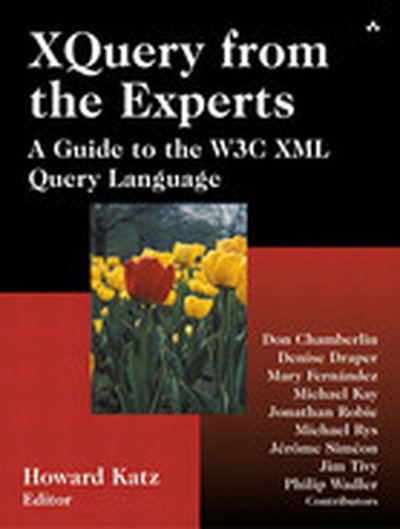
"The individual perspectives on the concepts behind the XQuery language offered by XQuery from the Experts will be of great value to those who are seeking to understand the implications, opportunities, and challenges of XQuery as they design future information systems based on XML." —Michael Champion, Advisory Research and Development Specialist, Software AG XQuery answers the growing need for a functional XML search and transformation standard. Backed by the full weight of the World Wide Web Consortium (W3C), XQuery is being extremely well received by the IT community worldwide. The first major XML language that takes advantage of the benefits of strong typing provided by XML Schema, XQuery has the versatility to manipulate both XML and non-XML data and provides a valuable connection between the world of XML and relational databases. In , select members of the W3C's XML Query working group come together to discuss every facet of XQuery. From Jonathan Robie's introductory "XQuery: A Guided Tour" to Mary Mary Fernández, Jérôme Siméon, and Philip Wadler's "Introduction to the Formal Semantics," XQuery is revealed in a way that both novice programmers and industry experts can appreciate. XQuery from the Experts Edited by long-time XML expert and programmer Howard Katz, coverage ranges from strictly technical chapters to comparative essays such as Michael Kay's "XQuery, XPath, and XSLT," which explores the common ancestry of all three languages, and Don Chamberlin's "Influences on the Design of XQuery," which details the process behind XQuery's design. Key coverage includes: Denise Draper on "Mapping Between XML and Relational Data" Michael Rys exploring "Integrating XQuery and Relational Database Systems" Jim Tivy's analysis of "A Native XML DBMS" Mary Mary Fernández, Jérôme Siméon, and Philip Wadler, presenting "Static Typing in XQuery" Information presented in both a tutorial and a reference framework for use by XML professionals of any level For IT managers, professionals, programmers, or anyone involved with XML, is an invaluable resource. XQuery from the Experts 0321180607B07212003

Xlib Reference Manual for Version 11 of the X Window System

A complete programmer's reference for X library functions, which is the lowest level of programming interface to X. Reference pages for each Xlib function A permuted index to the Xlib functions reference pages for each event type Description of macros A listing of the standard color name database Alphabetical index and description of structures Alphabetical index and description of defined symbols A list of keysyms and their meanings, including sample characters A list and illustration of the standard cursor font A list of standard fonts with illustration of each font A function group index, for finding the right routine for a particular task Single-page reference aids for the GC and window attributes This reference manual provides reference pages for each Xlib function, a permuted index to the Xlib functions, reference pages for each event type, description of macros, a listing of the standard color database, an alphabetic index and description of structures and defined symbols, a list of keysyms and their meanings, a list and illustration of the standard cursor font, an illustrated list of the standard fonts, a function group index, for finding the right routine for a particular task, and single-page reference aids for the GC and window attributes.