Comment l'IA est utilisée pour lutter contre les cancers rares ?
L’Institut Curie s’appuie sur l’intelligence artificielle pour résoudre de nombreux cas de cancers rares, longtemps restés sans réponse. 🔬
Event
Activities tracked
97
Sessions & talks
Showing 51–75 of 97 · Newest first
L’Institut Curie s’appuie sur l’intelligence artificielle pour résoudre de nombreux cas de cancers rares, longtemps restés sans réponse. 🔬
The exponential growth of video data presents significant challenges for effective content discovery. Traditional keyword search falls short when dealing with visual nuances. This talk addresses the design and implementation of a robust system for large-scale, multi-modal video retrieval, enabling search across petabytes of data using diverse inputs like text descriptions (e.g., appearance, actions) and query images (e.g., faces). We will explore an architecture combining efficient batch preprocessing for feature extraction (including person detection, face/CLIP-style embeddings) with optimized vector database indexing. Attendees will learn about strategies for managing massive datasets, optimizing ML inference pipelines for speed and cost-efficiency (touching upon lightweight models and specialized runtimes), and building interactive systems that bridge pre-computed indexes with real-time analysis capabilities for enhanced insights.
Découvrez comment agir dès aujourd’hui lors de notre démo session à Big Data & IA Paris.
Comment utiliser l'IA pour évaluer la conformité d'une application à l'AI Act.
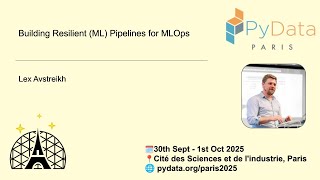
This talk explores the disconnect between MLOps fundamental principles and their practical application in designing, operating and maintaining machine learning pipelines. We’ll break down these principles, examine their influence on pipeline architecture, and conclude with a straightforward, vendor-agnostic mind-map, offering a roadmap to build resilient MLOps systems for any project or technology stack. Despite the surge in tools and platforms, many teams still struggle with the same underlying issues: brittle data dependencies, poor observability, unclear ownership, and pipelines that silently break once deployed. Architecture alone isn't the answer — systems thinking is.
We'll use concrete examples to walk through common failure modes in ML pipelines, highlight where analogies fall apart, and show how to build systems that tolerate failure, adapt to change, and support iteration without regressions.
Topics covered include: - Common failure modes in ML pipelines - Modular design: feature, training, inference - Built-in observability, versioning, reuse - Orchestration across batch, real-time, LLMs - Platform-agnostic patterns that scale
Key takeaways: - Resilience > diagrams - Separate concerns, embrace change - Metadata is your backbone - Infra should support iteration, not block it

L'alliance entre un leader de l'assurance française et un pionnier de l'IA vocale souveraine.
Découvrez comment Risk Hunter vous permet de maîtriser votre GRC et cybersécurité grâce à notre plateforme AI Driven Innovante.
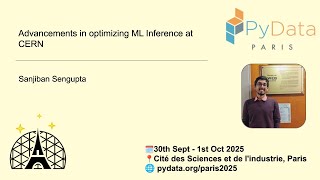
At CERN- the European Organization for Nuclear Research, machine learning is applied across a wide range of scenarios, from simulations and event reconstruction to classifying interesting experimental events, all while handling data rates in the order of terabytes per second. As a result, beyond developing complex models, CERN also requires highly optimized mechanisms for model inference.
From the ML4EP team at CERN, we have developed SOFIE (System for Optimized Fast Inference code Emit), an open-source tool designed for fast inference on ML models with minimal dependencies and low latency. SOFIE is under active development, driven by feedback not only from high-energy physics researchers but also from the broader scientific community.
With upcoming upgrades to CERN’s experiments expected to increase data generation, we have been investigating optimization methods to make SOFIE even more efficient in terms of time and memory usage, while improving its accessibility and ease of integration with other software stacks.
In this talk, we will introduce SOFIE and present novel optimization strategies developed to accelerate ML inference and reduce resource overhead.
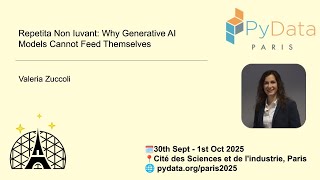
As AI floods the digital landscape with content, what happens when it starts repeating itself? This talk explores model collapse, a progressive erosion where LLMs and image generators loop on their own results, hindering the creation of novel output.
We will show how self-training leads to bias and loss of diversity, examine the causes of this degradation, and quantify its impact on model creativity. Finally, we will also present concrete strategies to safeguard the future of generative AI, emphasizing the critical need to preserve innovation and originality.
By the end of this talk, attendees will gain insights into the practical implications of model collapse, understanding its impact on content diversity and the long-term viability of AI.
Session de démo sur comment créer des agents IA en quelques clicks pour plusieurs cas d’usage : Compliance, IT, RH, support client, Ventes,
Plongez dans l’ère des opérations IT intelligentes où l’IA anticipe, décide et agit en temps réel.
IA Générative pour la CDC et par Probayes : révolutionnez les réponses aux organismes de formation, optimisant temps et précision
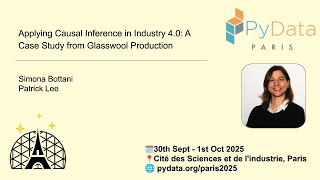
Causal inference offers a principled way to estimate the effects of interventions—a critical need in industrial settings where decisions directly impact costs and performance. This talk presents a case study from Saint-Gobain, in collaboration with Inria, where we applied causal inference methods to production and quality data to reduce raw material usage without compromising product quality. We’ll walk through each step of a causal analysis: building a causal graph in collaboration with domain experts, identifying confounders, working with continuous treatments, and using open-source tools such as DoWhy, EconML, and DAGitty. The talk is aimed at data scientists with basic ML experience, looking to apply causal thinking to real-world, non-academic problems.
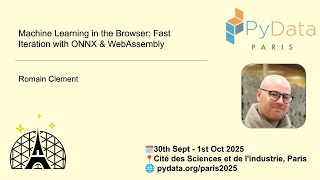
Deploying ML models doesn’t have to mean spinning up servers and writing backend code. This talk shows how to run machine learning inference directly in the browser—using ONNX and WebAssembly—to go from prototype to interactive demo in minutes, not weeks.
Concevoir la nouvelle application DATA ou IA que vous avez imaginée, parfaitement opérationnelle
Bien menée, la gouvernance devient moteur : les Data Contracts (ODCS) rendent pipelines data/IA précis, fiables & conformes, sans blocages.
Comment éviter l’effet POC et faire de l’IA un vrai levier de performance ? Stratégie, méthode et retours d’expérience au programme 🚀
nAIxt = plateforme de dév. et d'orchestration d'Agents IA d'ILLUIN, pour concevoir, déployer et surveiller des Agents IA, du POC à la Prod.