talk-data.com talk-data.com

Event

PyData Paris 2025

2025-09-01 – 2025-10-02 PyData

Activities tracked

5

Filtering by: API ×

Sessions & talks

Showing 1–5 of 5 · Newest first

Search within this event →
CoSApp: an open-source library to design complex systems

CoSApp: an open-source library to design complex systems

2025-10-01 Watch
talk

CoSApp, for Collaborative System Approach, is a Python library dedicated to the simulation and design of multi-disciplinary systems. It is primarily intended for engineers and system architects during the early stage of industrial product design. The API of CoSApp is focused on simplicity and explicit declaration of design problems. Special attention is given to modularity; a very flexible mechanism of solver assembly allows users to construct complex, customized simulation workflows. This presentation aims at presenting the key features of the framework.

https://cosapp.readthedocs.io https://gitlab.com/cosapp/cosapp

Documents Meet LLMs: Tales from the Trenches

Documents Meet LLMs: Tales from the Trenches

2025-10-01 Watch
talk

Processing documents with LLMs comes with unexpected challenges: handling long inputs, enforcing structured outputs, catching hallucinations, and recovering from partial failures. In this talk, we’ll cover why large context windows are not a silver bullet, why chunking is deceptively hard and how to design input and output that allow for intelligent retrial. We'll also share practical prompting strategies, discuss OCR and parsing tools, compare different LLMs (and their cloud APIs) and highlight real-world insights from our experience developing production GenAI applications with multiple document processing scenarios.

ActiveTigger: A Collaborative Text Annotation Research Tool for Computational Social Sciences

ActiveTigger: A Collaborative Text Annotation Research Tool for Computational Social Sciences

2025-09-30 Watch
talk

The exponential growth of textual data—ranging from social media posts and digital news archives to speech-to-text transcripts—has opened new frontiers for research in the social sciences. Tasks such as stance detection, topic classification, and information extraction have become increasingly common. At the same time, the rapid evolution of Natural Language Processing, especially pretrained language models and generative AI, has largely been led by the computer science community, often leaving a gap in accessibility for social scientists.

To address this, we initiated since 2023 the development of ActiveTigger, a lightweight, open-source Python application (with a web frontend in React) designed to accelerate annotation process and manage large-scale datasets through the integration of fine-tuned models. It aims to support computational social science for a large public both within and outside social sciences. Already used by a dynamic community in social sciences, the stable version is planned for early June 2025.

From a more technical prospect, the API is designed to manage the complete workflow from project creation, embeddings computation, exploration of the text corpus, human annotation with active learning, fine-tuning of pre-trained models (BERT-like), prediction on a larger corpus, and export. It also integrates LLM-as-a-service capabilities for prompt-based annotation and information extraction, offering a flexible approach for hybrid manual/automatic labeling. Accessible both with a web frontend and a Python client, ActiveTigger encourages customization and adaptation to specific research contexts and practices.

In this talk, we will delve into the motivations behind the creation of ActiveTigger, outline its technical architecture, and walk through its core functionalities. Drawing on several ongoing research projects within the Computational Social Science (CSS) group at CREST, we will illustrate concrete use cases where ActiveTigger has accelerated data annotation, enabled scalable workflows, and fostered collaborations. Beyond the technical demonstration, the talk will also open a broader reflection on the challenges and opportunities brought by generative AI in academic research—especially in terms of reliability, transparency, and methodological adaptation for qualitative and quantitative inquiries.

The repository of the project : https://github.com/emilienschultz/activetigger/

The development of this software is funded by the DRARI Ile-de-France and supported by Progédo.

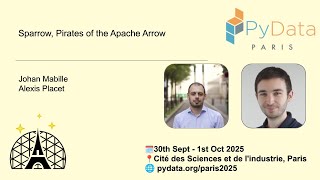
Sparrow, Pirates of the Apache Arrow

Sparrow, Pirates of the Apache Arrow

2025-09-30 Watch
talk

Sparrow is a lightweight C++20 idiomatic implementation of the Apache Arrow memory specification. Designed for compatibility with the Arrow C data interface, Sparrow enables seamless data exchange with other libraries supporting the Arrow format. It also offers high-level APIs, ensuring interoperability with standard modern C++ algorithms.

A Hitchhiker's Guide to the Array API Standard Ecosystem

A Hitchhiker's Guide to the Array API Standard Ecosystem

2025-09-30 Watch
talk

The array API standard is unifying the ecosystem of Python array computing, facilitating greater interoperability between code written for different array libraries, including NumPy, CuPy, PyTorch, JAX, and Dask.

But what are all of these "array-api-" libraries for? How can you use these libraries to 'future-proof' your libraries, and provide support for GPU and distributed arrays to your users? Find out in this talk, where I'll guide you through every corner of the array API standard ecosystem, explaining how SciPy and scikit-learn are using all of these tools to adopt the standard. I'll also be sharing progress updates from the past year, to give you a clear picture of where we are now, and what the future holds.