

talk-data.com talk-data.com

Holden Karau

Speaker

Holden Karau

2

talks

Holden is a transgender Canadian open source developer with a focus on Apache Spark, and related "big data" tools. By day (and night, go go startup life) she works on brining large language models and other AI tools to help healthcare users deal with insurance through https://www.fighthealthinsurance.com & https://www.fightpaperwork.com.

She is the co-author of Learning Spark, High Performance Spark, and a few others. She is a committer and PMC on Apache Spark. She was tricked into the world of big data while trying to improve search and recommendation systems and has long since forgotten her original goal.

Bio from: Small Data SF 2025

Frequent Collaborators

Filtering by: O'Reilly Data Science Books ×

Filter by Event / Source

Talks & appearances

Showing 2 of 9 activities

Search activities →
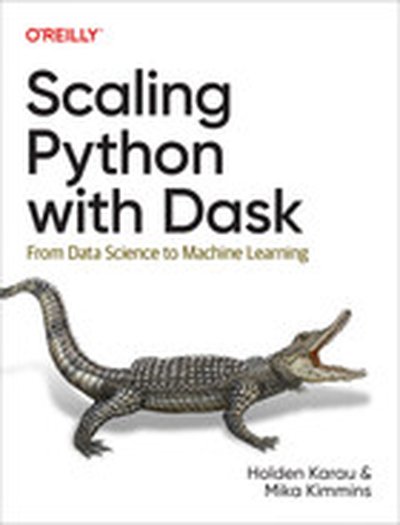
Scaling Python with Dask

Modern systems contain multi-core CPUs and GPUs that have the potential for parallel computing. But many scientific Python tools were not designed to leverage this parallelism. With this short but thorough resource, data scientists and Python programmers will learn how the Dask open source library for parallel computing provides APIs that make it easy to parallelize PyData libraries including NumPy, pandas, and scikit-learn. Authors Holden Karau and Mika Kimmins show you how to use Dask computations in local systems and then scale to the cloud for heavier workloads. This practical book explains why Dask is popular among industry experts and academics and is used by organizations that include Walmart, Capital One, Harvard Medical School, and NASA. With this book, you'll learn: What Dask is, where you can use it, and how it compares with other tools How to use Dask for batch data parallel processing Key distributed system concepts for working with Dask Methods for using Dask with higher-level APIs and building blocks How to work with integrated libraries such as scikit-learn, pandas, and PyTorch How to use Dask with GPUs
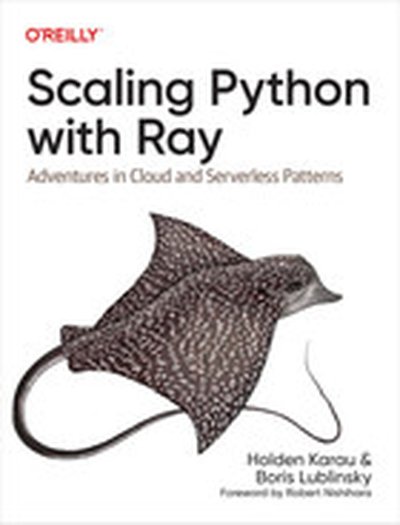
Scaling Python with Ray

Serverless computing enables developers to concentrate solely on their applications rather than worry about where they've been deployed. With the Ray general-purpose serverless implementation in Python, programmers and data scientists can hide servers, implement stateful applications, support direct communication between tasks, and access hardware accelerators. In this book, experienced software architecture practitioners Holden Karau and Boris Lublinsky show you how to scale existing Python applications and pipelines, allowing you to stay in the Python ecosystem while reducing single points of failure and manual scheduling. Scaling Python with Ray is ideal for software architects and developers eager to explore successful case studies and learn more about decision and measurement effectiveness. If your data processing or server application has grown beyond what a single computer can handle, this book is for you. You'll explore distributed processing (the pure Python implementation of serverless) and learn how to: Implement stateful applications with Ray actors Build workflow management in Ray Use Ray as a unified system for batch and stream processing Apply advanced data processing with Ray Build microservices with Ray Implement reliable Ray applications