talk-data.com talk-data.com

Topic

data-models

116

tagged

Activity Trend

1 peak/qtr
2020-Q1 2026-Q1

Activities

116 activities · Newest first

Data Modeling of Financial Derivatives: A Conceptual Approach

Written in plain English and based on successful client engagements, Data Modeling of Financial Derivatives: A Conceptual Approach introduces new and veteran data modelers, financial analysts, and IT professionals to the fascinating world of financial derivatives. Covering futures, forwards, options, swaps, and forward rate agreements, finance and modeling expert Robert Mamayev shows you step-by-step how to structure and describe financial data using advanced data modeling techniques. The book introduces IT professionals, in particular, to various financial and data modeling concepts that they may not have seen before, giving them greater proficiency in the financial language of derivatives—and greater ability to communicate with financial analysts without fear or hesitation. Such knowledge will be especially useful to those looking to pick up the necessary skills to become productive right away working in the financial sector. Financial analysts reading this book will come to grips with various data modeling concepts and therefore be in better position to explain the underlying business to their IT audience. Data Modeling of Financial Derivatives—which presumes no advanced knowledge of derivatives or data modeling—will help you: Learn the best entity–relationship modeling method out there—Barker's CASE methodology—and its application in the financial industry Understand how to identify and creatively reuse data modeling patterns Gain an understanding of financial derivatives and their various applications Learn how to model derivatives contracts and understand the reasoning behind certain design decisions Resolve derivatives data modeling complexities parsimoniously so that your clients can understand them intuitively Packed with numerous examples, diagrams, and techniques, this book will enable you to recognize the various design patterns that you are most likely to encounter in your professional career and apply them successfully in practice. Anyone working with financial models will find it an invaluable tool and career booster. What you'll learn You will learn how to: Recognize and identify financial derivatives Reuse data modeling patterns and apply them to create something new Data model simple and complex options Data model SWAPS Data model futures and forward contracts Who this book is for Data modelers, financial analysts, IT professionals, and anyone with an interest in data modeling and business analysis.
Structural Dynamic Analysis with Generalized Damping Models: Identification

Since Lord Rayleigh introduced the idea of viscous damping in his classic work "The Theory of Sound" in 1877, it has become standard practice to use this approach in dynamics, covering a wide range of applications from aerospace to civil engineering. However, in the majority of practical cases this approach is adopted more for mathematical convenience than for modeling the physics of vibration damping. Over the past decade, extensive research has been undertaken on more general "non-viscous" damping models and vibration of non-viscously damped systems. This book, along with a related book Structural Dynamic Analysis with Generalized Damping Models: Analysis, is the first comprehensive study to cover vibration problems with general non-viscous damping. The author draws on his considerable research experience to produce a text covering: parametric senistivity of damped systems; identification of viscous damping; identification of non-viscous damping; and some tools for the quanitification of damping. The book is written from a vibration theory standpoint, with numerous worked examples which are relevant across a wide range of mechanical, aerospace and structural engineering applications.

The Handbook of Financial Modeling: A Practical Approach to Creating and Implementing Valuation Projection Models

The ability to create and understand financial models that assess the valuation of a company, the projects it undertakes, and its future earnings/profit projections is one of the most valued skills in corporate finance. However, while many business professionals are familiar with financial statements and accounting reports, few are truly proficient at building an accurate and effective financial model from the ground up. That's why, in The Financial Modeling Handbook, Jack Avon equips financial professionals with all the tools they need to precisely and effectively monitor a company's assets and project its future performance. Based on the author's extensive experience building models in business and finance—and teaching others to do the same— The Handbook of Financial Modeling takes readers step by step through the financial modeling process, starting with a general overview of the history and evolution of financial modeling. It then moves on to more technical topics, such as the principles of financial modeling and the proper way to approach a financial modeling assignment, before covering key application areas for modeling in Microsoft Excel. Designed for intermediate and advanced modelers who wish to expand and enhance their knowledge, The Handbook of Financial Modeling also covers: The accounting and finance concepts that underpin working financial models; How to approach financial issues and solutions from a modeler's perspective; The importance of thinking about end users when developing a financial model; How to plan, design, and build a fully functional financial model; And more. A nuts-to-bolts guide to solving common financial problems with spreadsheets, The Handbook of Financial Modeling is a one-stop resource for anyone who needs to build or analyze financial models. What you'll learn Key financial modeling principles, including best practices, principles around calculations, and the importance of producing clean, clear financial models How to design and implement a projection model that allows the user to change inputs quickly for sensitivity testing The proper way to approach a financial modeling assignment, from project planning all the way through to the documentation of the model's findings and effectiveness How to model in Microsoft Excel, including how to set up an Excel environment, how to format worksheets, and the correct application of various modeling formulae The skills and knowledge they need to become more proficient financial modelers and differentiate themselves from their professional competitors. Who this book is for Written in a clear, concise manner and filled with screen grabs that will facilitate readers' comprehension of the financial modeling process, The Handbook of Financial Modeling is appropriate for intermediate to advanced financial modelers who are looking to learn how to enhance their modeling proficiency.

Business Models for the Data Economy

You're sitting on a pile of interesting data. How do you transform that into money? It's easy to focus on the contents of the data itself, and to succumb to the (rather unimaginative) idea of simply collecting and reselling it in raw form. While that's certainly profitable right now, you'd do well to explore other opportunities if you expect to be in the data business long-term. In this paper, we'll share a framework we developed around monetizing data. We'll show you how to think beyond pure collection and storage, to move up the value chain and consider longer-term opportunities.

Model Free Adaptive Control

The book summarizes theory and applications of data-driven model-free adaptive control (MFAC) which is different from the traditional adaptive control. The traditional unmodeled dynamics do not exist in MFAC framework. In addition, MFAC is suitable for many practical applications since it is easily implemented and has strong robustness. By reading this book, readers become familiar with MFAC in a short time, and can quickly carry out their independent research and applications.

Mastering Financial Modeling: A Professional’s Guide to Building Financial Models in Excel

All the precision of financial modeling--and none of the complexity Evidence-based decision making is only as good as the external evidence on which it is based. Financial models uncover potential risks on a company’s balance sheet, but the complexity of these instruments has limited their effectiveness. Now, Mastering Financial Modeling offers a simplified method for building the fast and accurate financial models serious evidencebased decision makers need. What sets this practical guide apart is its "learning-on-the-job" approach. Unlike other books that teach modeling in a vacuum, this superior method uses a diverse collection of case studies to convey each step of the building process. "Learning on the job" connects the dots between the proper Excel formulas and functions and the real-world situations where you want to use them. By learning through association, you can absorb the information quickly and have it ready to use when you need it. The book starts right off on building models--from creating a standalone cash flow model through integrating it with an income statement and balance sheet. Along the way, you will master the skill set you need to build advanced financial models. With only a basic knowledge of accounting and finance, individual investors and financial professionals alike can: Create a core model and customize it for companies in most industries Understand every working component of a financial model and what each one tells you about a company Format cells and sheets in Excel for easily repeatable modeling Written with the practitioner in mind, Mastering Financial Modeling shows you how to ensure your model is ready for real-world application by safeguarding it against modeling errors. It covers a full array of Excel's builtin auditing and testing tools and illustrates how to build customized error-checking tools of your own to catch the inaccuracies that typically fall through the cracks. Get the most out of your data with Mastering Financial Modeling. Mastering Financial Modeling brings the power of financial models down to earth and puts it in the hands of investors, bankers, and private equity professionals who don't have a passion for crunching numbers. Nowhere else can you get step-by-step instruction on building these valuable tools from an elite World Bank investment officer. Starting from the ground up, Eric Soubeiga shows you how to interpret and build financial models in Microsoft Excel that will accurately assess any company’s valuation and profit potential. Even if you have unsuccessfully tried financial modeling in the past, this book will reach you because it associates every lesson to the business world you work in daily. Chapter by chapter, you will master financial modeling, and in the end, you will: Command authority over building every aspect of a financial model Be capable of explaining the accounting and finance concepts behind the mechanics of modeling Confidently determine a company’s ability to generate cash flows for its capital investors with discounted cash flow (DCF) modeling Execute powerful spreadsheet calculations in Excel Most importantly, as a decision maker, the insight you bring to the table through your sophisticated understanding and application of financial modeling will benefit every stakeholder. See what leading professionals around the world already know-- Mastering Financial Modeling is the most comprehensive guide on the market for designing, building, and implementing valuation projection models. What it does from there is up to you.

Data Model Patterns

This is the digital version of the printed book (Copyright © 1996). Learning the basics of a modeling technique is not the same as learning how to use and apply it. To develop a data model of an organization is to gain insights into its nature that do not come easily. Indeed, analysts are often expected to understand subtleties of an organization's structure that may have evaded people who have worked there for years. Here's help for those analysts who have learned the basics of data modeling (or "entity/relationship modeling") but who need to obtain the insights required to prepare a good model of a real business. Structures common to many types of business are analyzed in areas such as accounting, material requirements planning, process manufacturing, contracts, laboratories, and documents. In each chapter, high-level data models are drawn from the following business areas: The Enterprise and Its World The Things of the Enterprise Procedures and Activities Contracts Accounting The Laboratory Material Requirements Planning Process Manufacturing Documents Lower-Level Conventions

Agent-Based Modeling and Simulation with Swarm

A thorough overview of multi-agent simulation and supporting tools, this book provides the methodology for a multi-agent-based modeling approach that integrates computational techniques such as artificial life, cellular automata, and bio-inspired optimization. It shows how this type of simulation is used to acquire an understanding of complex systems and artificial life. The author carefully explains how to construct a simulation program for various applications. Swarm-based software and source codes are available on his website.

Structural Equation Modeling with Mplus

Modeled after Barbara Byrne’s other best-selling structural equation modeling (SEM) books, this practical guide reviews the basic concepts and applications of SEM using M plus Versions 5 & 6. The author reviews SEM applications based on actual data taken from her own research. Using non-mathematical language, it is written for the novice SEM user. With each application chapter, the author "walks" the reader through all steps involved in testing the SEM model including: an explanation of the issues addressed illustrated and annotated testing of the hypothesized and post hoc models explanation and interpretation of all M plus input and output files important caveats pertinent to the SEM application under study a description of the data and reference upon which the model was based the corresponding data and syntax files available under "Supplementary Material" below The first two chapters introduce the fundamental concepts of SEM and important basics of the M plus program. The remaining chapters focus on SEM applications and include a variety of SEM models presented within the context of three sections: Single-group analyses, Multiple-group analyses, and other important topics, the latter of which includes the multitrait-multimethod, latent growth curve, and multilevel models. Intended for researchers, practitioners, and students who use SEM and M plus, this book is an ideal resource for graduate level courses on SEM taught in psychology, education, business, and other social and health sciences and/or as a supplement for courses on applied statistics, multivariate statistics, intermediate or advanced statistics, and/or research design. Appropriate for those with limited exposure to SEM or M plus, a prerequisite of basic statistics through regression analysis is recommended.

Business Models For Dummies

Write a business model? Easy. Business Models For Dummies helps you write a solid business model to further define your company's goals and increase attractiveness to customers. Inside, you'll discover how to: make a value proposition; define a market segment; locate your company's position in the value chain; create a revenue generation statement; identify competitors, complementors, and other network effects; develop a competitive strategy; and much more. Shows you how to define the purpose of a business and its profitability to customers Serves as a thorough guide to business modeling techniques Helps to ensure that your business has the very best business model possible If you need to update a business model due to changes in the market or maturation of your company, Business Models For Dummies has you covered.

Computer Modeling for Injection Molding: Simulation, Optimization, and Control

This book covers a wide range of applications and uses of simulation and modeling techniques in polymer injection molding, filling a noticeable gap in the literature of design, manufacturing, and the use of plastics injection molding. The authors help readers solve problems in the advanced control, simulation, monitoring, and optimization of injection molding processes. The book provides a tool for researchers and engineers to calculate the mold filling, optimization of processing control, and quality estimation before prototype molding.

Business Model Design and Learning

So many of us have asked ourselves—what’s a business model? What’s a good business model? This book has all the answers—it explains what a business model is, what you have to do to get one, and what to do about the one you’ve already got. To be successful, your business model must be focused sharply on your customer. And you must think strategically about how to use your business model if you want to gain an advantage over your competitors. Whether an aspiring entrepreneur or a practicing manager who wants to create new business model, or a manager and leader who wants to understand, refine, and even reinvent a current model, this book will help with the creation, the delivery, and the capture of value. Business models describe the value proposition to the customer, the system that must be in place to create that value, and the logics needed to capture a reasonable share of that value for the _ rm. This book shows that the core of every business model is an agreement with your customers. If they don’t get the value they are seeking, you won’t either.

Encyclopedia of Financial Models I

An essential reference dedicated to a wide array of financial models, issues in financial modeling, and mathematical and statistical tools for financial modeling The need for serious coverage of financial modeling has never been greater, especially with the size, diversity, and efficiency of modern capital markets. With this in mind, the Encyclopedia of Financial Models, 3 Volume Set has been created to help a broad spectrum of individuals—ranging from finance professionals to academics and students—understand financial modeling and make use of the various models currently available. Incorporating timely research and in-depth analysis, the Encyclopedia of Financial Models is an informative 3-Volume Set that covers both established and cutting-edge models and discusses their real-world applications. Edited by Frank Fabozzi, this set includes contributions from global financial experts as well as academics with extensive consulting experience in this field. Organized alphabetically by category, this reliable resource consists of three separate volumes and 127 entries—touching on everything from asset pricing and bond valuation models to trading cost models and volatility—and provides readers with a balanced understanding of today's dynamic world of financial modeling. This 3-Volume Set contains coverage of the fundamentals and advances in financial modeling and provides the mathematical and statistical techniques needed to develop and test financial models Emphasizes both technical and implementation issues, providing researchers, educators, students, and practitioners with the necessary background to deal with issues related to financial modeling Each volume includes a complete table of contents and index for easy access to various parts of the encyclopedia Financial models have become increasingly commonplace, as well as complex. They are essential in a wide range of financial endeavors, and this 3-Volume Set will help put them in perspective.

Encyclopedia of Financial Models II

An essential reference dedicated to a wide array of financial models, issues in financial modeling, and mathematical and statistical tools for financial modeling The need for serious coverage of financial modeling has never been greater, especially with the size, diversity, and efficiency of modern capital markets. With this in mind, the Encyclopedia of Financial Models, 3 Volume Set has been created to help a broad spectrum of individuals—ranging from finance professionals to academics and students—understand financial modeling and make use of the various models currently available. Incorporating timely research and in-depth analysis, the Encyclopedia of Financial Models is an informative 3-Volume Set that covers both established and cutting-edge models and discusses their real-world applications. Edited by Frank Fabozzi, this set includes contributions from global financial experts as well as academics with extensive consulting experience in this field. Organized alphabetically by category, this reliable resource consists of three separate volumes and 127 entries—touching on everything from asset pricing and bond valuation models to trading cost models and volatility—and provides readers with a balanced understanding of today's dynamic world of financial modeling. This 3-Volume Set contains coverage of the fundamentals and advances in financial modeling and provides the mathematical and statistical techniques needed to develop and test financial models Emphasizes both technical and implementation issues, providing researchers, educators, students, and practitioners with the necessary background to deal with issues related to financial modeling Each volume includes a complete table of contents and index for easy access to various parts of the encyclopedia Financial models have become increasingly commonplace, as well as complex. They are essential in a wide range of financial endeavors, and this 3-Volume Set will help put them in perspective.

Business Models and Strategic Management

Finally, a book comes along that provides a unique yet simple and powerful approach to understand the business model and the critical role strategic management has in supporting it. Its value is in business model thinking. It brings you a combination of the best contributions of academe and industry that will help build business model-centric organizations. Inside, you’ll learn about strategy from a business model perspective. What does that mean? It means that you’ll first have to think rigorously about your value proposition; your current or future competencies; and your revenue streams and cost structure before developing, adopting, or modifying your strategies. What is the difference between a business model and a strategy? A business model is how a company operates, and a strategy is how a company competes. When the basis of competition changes because a new model disrupts the economics in the industry, it requires an adjustment in business models before any new strategy can work. This book adds a business model level to the traditional strategic management process that is more consistent with current “real-world” practices in strategic thinking and analysis. It takes you deeper into the intricacies of what constitutes a business model and how current strategy derives from it, and offers 7 modules that will show you the key components to manage your business model, to help conduct business model analysis, and to assess the financial viability of a business model, just to name a few.

Body Area Communications: Channel Modeling, Communication Systems, and EMC

Providing an introduction to the fundamentals of body area communications, this book covers the key topics of channel modeling, modulation and demodulation, and performance evaluation A systematic introduction to body area networks (BAN), this book focuses on three major parts: channel modeling, modulation/demodulation communications performance, and electromagnetic compatibility considerations. The content is logically structured to lead readers from an introductory level through to in-depth and more advanced topics. Provides a concise introduction to this emerging topic based on classroom-tested materials Details the latest IEEE 802.15.6 standard activities Moves from very basic physics, to useful mathematic models, and then to practical considerations Covers not only EM physics and communications, but also biological applications Topics approached include: link budget, bit error rate performance, RAKE and diversity reception; SAR analysis for human safety evaluation; and modeling of electromagnetic interference to implanted cardiac pacemakers Provides Matlab and Fortran programs for download from the Companion Website

Encyclopedia of Financial Models III

An essential reference dedicated to a wide array of financial models, issues in financial modeling, and mathematical and statistical tools for financial modeling The need for serious coverage of financial modeling has never been greater, especially with the size, diversity, and efficiency of modern capital markets. With this in mind, the Encyclopedia of Financial Models, 3 Volume Set has been created to help a broad spectrum of individuals—ranging from finance professionals to academics and students—understand financial modeling and make use of the various models currently available. Incorporating timely research and in-depth analysis, the Encyclopedia of Financial Models is an informative 3-Volume Set that covers both established and cutting-edge models and discusses their real-world applications. Edited by Frank Fabozzi, this set includes contributions from global financial experts as well as academics with extensive consulting experience in this field. Organized alphabetically by category, this reliable resource consists of three separate volumes and 127 entries—touching on everything from asset pricing and bond valuation models to trading cost models and volatility—and provides readers with a balanced understanding of today's dynamic world of financial modeling. This 3-Volume Set contains coverage of the fundamentals and advances in financial modeling and provides the mathematical and statistical techniques needed to develop and test financial models Emphasizes both technical and implementation issues, providing researchers, educators, students, and practitioners with the necessary background to deal with issues related to financial modeling Each volume includes a complete table of contents and index for easy access to various parts of the encyclopedia Financial models have become increasingly commonplace, as well as complex. They are essential in a wide range of financial endeavors, and this 3-Volume Set will help put them in perspective.

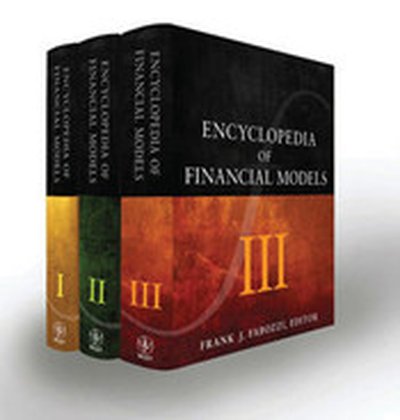
Encyclopedia of Financial Models, 3 Volume Set

An essential reference dedicated to a wide array of financial models, issues in financial modeling, and mathematical and statistical tools for financial modeling The need for serious coverage of financial modeling has never been greater, especially with the size, diversity, and efficiency of modern capital markets. With this in mind, the Encyclopedia of Financial Models, 3 Volume Set has been created to help a broad spectrum of individuals—ranging from finance professionals to academics and students—understand financial modeling and make use of the various models currently available. Incorporating timely research and in-depth analysis, the Encyclopedia of Financial Models is an informative 3-Volume Set that covers both established and cutting-edge models and discusses their real-world applications. Edited by Frank Fabozzi, this set includes contributions from global financial experts as well as academics with extensive consulting experience in this field. Organized alphabetically by category, this reliable resource consists of three separate volumes and 127 entries—touching on everything from asset pricing and bond valuation models to trading cost models and volatility—and provides readers with a balanced understanding of today's dynamic world of financial modeling. This 3-Volume Set contains coverage of the fundamentals and advances in financial modeling and provides the mathematical and statistical techniques needed to develop and test financial models Emphasizes both technical and implementation issues, providing researchers, educators, students, and practitioners with the necessary background to deal with issues related to financial modeling Each volume includes a complete table of contents and index for easy access to various parts of the encyclopedia Financial models have become increasingly commonplace, as well as complex. They are essential in a wide range of financial endeavors, and this 3-Volume Set will help put them in perspective.