talk-data.com talk-data.com

Topic

regression-analysis

27

tagged

Activity Trend

1 peak/qtr
2020-Q1 2026-Q1

Activities

27 activities · Newest first

Regression for Economics

Regression analysis is the most commonly used statistical method in the world. Although few would characterize this technique as simple, regression is in fact both simple and elegant. The complexity that many attribute to regression analysis is often a reflection of their lack of familiarity with the language of mathematics. But regression analysis can be understood even without a mastery of sophisticated mathematical concepts. This book provides the foundation and will help demystify regression analysis using examples from economics and with real data to show the applications of the method. The concepts related to regression analysis are explained in a way that is comprehensible to those whose mathematical skills are not matching that of the expert level, and uses Microsoft Excel to obtain regression results. What hinders peoples’ comprehension of regression analysis is the difficulty many have in understanding mathematical symbols and derivations. By removing this obstacle, this book enables the logical reader to learn regression without possessing superior mathematical skills.

Regression Analysis

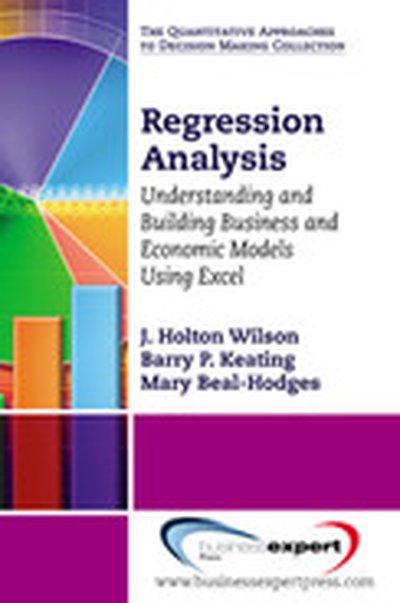
The technique of regression analysis is used so often in business and economics today that an understanding of its use is necessary for almost everyone engaged in the field. This book will teach you the essential elements of building and understanding regression models in a business/economic context in an intuitive manner. The authors take a non-theoretical treatment that is accessible even if you have a limited statistical background. It is specifically designed to teach the correct use of regression, while advising you of its limitations and teaching about common pitfalls. This book describes exactly how regression models are developed and evaluated —where real data is used, instead of contrived textbook-like problems. Completing this book will allow you to understand and build basic business/economic models using regression analysis. You will be able to interpret the output of those models and you will be able to evaluate the models for accuracy and shortcomings. Even if you never build a model yourself, at some point in your career it is likely that you will find it necessary to interpret one; this book will make that possible. Included are instructions for using Microsoft Excel to build business/economic models using regression analysis with an appendix using screen shots and step-by-step instructions.

Introduction to Linear Regression Analysis, 5th Edition

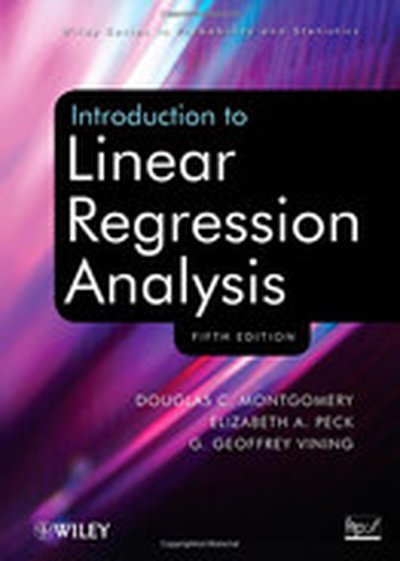
Praise for the Fourth Edition "As with previous editions, the authors have produced a leading textbook on regression." —Journal of the American Statistical Association A comprehensive and up-to-date introduction to the fundamentals of regression analysis Introduction to Linear Regression Analysis, Fifth Edition continues to present both the conventional and less common uses of linear regression in today's cutting-edge scientific research. The authors blend both theory and application to equip readers with an understanding of the basic principles needed to apply regression model-building techniques in various fields of study, including engineering, management, and the health sciences. Following a general introduction to regression modeling, including typical applications, a host of technical tools are outlined such as basic inference procedures, introductory aspects of model adequacy checking, and polynomial regression models and their variations. The book then discusses how transformations and weighted least squares can be used to resolve problems of model inadequacy and also how to deal with influential observations. The Fifth Edition features numerous newly added topics, including: A chapter on regression analysis of time series data that presents the Durbin-Watson test and other techniques for detecting autocorrelation as well as parameter estimation in time series regression models Regression models with random effects in addition to a discussion on subsampling and the importance of the mixed model Tests on individual regression coefficients and subsets of coefficients Examples of current uses of simple linear regression models and the use of multiple regression models for understanding patient satisfaction data. In addition to Minitab, SAS, and S-PLUS, the authors have incorporated JMP and the freely available R software to illustrate the discussed techniques and procedures in this new edition. Numerous exercises have been added throughout, allowing readers to test their understanding of the material, and a related FTP site features the presented data sets, extensive problem solutions, software hints, and PowerPoint slides to facilitate instructional use of the book. Introduction to Linear Regression Analysis, Fifth Edition is an excellent book for statistics and engineering courses on regression at the upper-undergraduate and graduate levels. The book also serves as a valuable, robust resource for professionals in the fields of engineering, life and biological sciences, and the social sciences.

Logistic Regression Using SAS, 2nd Edition

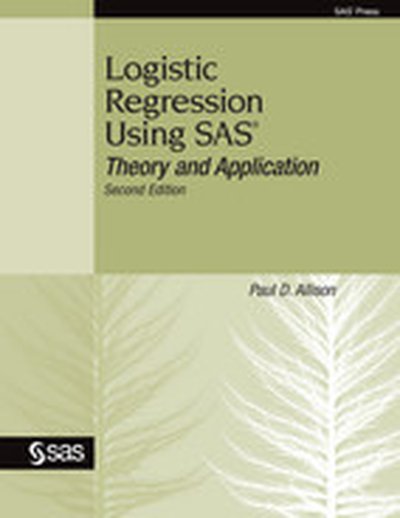
If you are a researcher or student with experience in multiple linear regression and want to learn about logistic regression, Paul Allison's Logistic Regression Using SAS: Theory and Application, Second Edition, is for you! Informal and nontechnical, this book both explains the theory behind logistic regression, and looks at all the practical details involved in its implementation using SAS. Several real-world examples are included in full detail. This book also explains the differences and similarities among the many generalizations of the logistic regression model. The following topics are covered: binary logistic regression, logit analysis of contingency tables, multinomial logit analysis, ordered logit analysis, discrete-choice analysis, and Poisson regression. Other highlights include discussions on how to use the GENMOD procedure to do loglinear analysis and GEE estimation for longitudinal binary data. Only basic knowledge of the SAS DATA step is assumed. The second edition describes many new features of PROC LOGISTIC, including conditional logistic regression, exact logistic regression, generalized logit models, ROC curves, the ODDSRATIO statement (for analyzing interactions), and the EFFECTPLOT statement (for graphing nonlinear effects). Also new is coverage of PROC SURVEYLOGISTIC (for complex samples), PROC GLIMMIX (for generalized linear mixed models), PROC QLIM (for selection models and heterogeneous logit models), and PROC MDC (for advanced discrete choice models).

This book is part of the SAS Press program.

Applied Survival Analysis: Regression Modeling of Time to Event Data, 2nd Edition

THE MOST PRACTICAL, UP-TO-DATE GUIDE TO MODELLING AND ANALYZING TIME-TO-EVENT DATA—NOW IN A VALUABLE NEW EDITION Since publication of the first edition nearly a decade ago, analyses using time-to-event methods have increase considerably in all areas of scientific inquiry mainly as a result of model-building methods available in modern statistical software packages. However, there has been minimal coverage in the available literature to9 guide researchers, practitioners, and students who wish to apply these methods to health-related areas of study. Applied Survival Analysis, Second Edition provides a comprehensive and up-to-date introduction to regression modeling for time-to-event data in medical, epidemiological, biostatistical, and other health-related research. This book places a unique emphasis on the practical and contemporary applications of regression modeling rather than the mathematical theory. It offers a clear and accessible presentation of modern modeling techniques supplemented with real-world examples and case studies. Key topics covered include: variable selection, identification of the scale of continuous covariates, the role of interactions in the model, assessment of fit and model assumptions, regression diagnostics, recurrent event models, frailty models, additive models, competing risk models, and missing data. Features of the Second Edition include: Expanded coverage of interactions and the covariate-adjusted survival functions The use of the Worchester Heart Attack Study as the main modeling data set for illustrating discussed concepts and techniques New discussion of variable selection with multivariable fractional polynomials Further exploration of time-varying covariates, complex with examples Additional treatment of the exponential, Weibull, and log-logistic parametric regression models Increased emphasis on interpreting and using results as well as utilizing multiple imputation methods to analyze data with missing values New examples and exercises at the end of each chapter Analyses throughout the text are performed using Stata® Version 9, and an accompanying FTP site contains the data sets used in the book. Applied Survival Analysis, Second Edition is an ideal book for graduate-level courses in biostatistics, statistics, and epidemiologic methods. It also serves as a valuable reference for practitioners and researchers in any health-related field or for professionals in insurance and government.

Regression Analysis by Example, 4th Edition

The essentials of regression analysis through practical applications Regression analysis is a conceptually simple method for investigating relationships among variables. Carrying out a successful application of regression analysis, however, requires a balance of theoretical results, empirical rules, and subjective judgement. Regression Analysis by Example, Fourth Edition has been expanded and thoroughly updated to reflect recent advances in the field. The emphasis continues to be on exploratory data analysis rather than statistical theory. The book offers in-depth treatment of regression diagnostics, transformation, multicollinearity, logistic regression, and robust regression. This new edition features the following enhancements: Chapter 12, Logistic Regression, is expanded to reflect the increased use of the logit models in statistical analysis A new chapter entitled Further Topics discusses advanced areas of regression analysis Reorganized, expanded, and upgraded exercises appear at the end of each chapter A fully integrated Web page provides data sets Numerous graphical displays highlight the significance of visual appeal Regression Analysis by Example, Fourth Edition is suitable for anyone with an understanding of elementary statistics. Methods of regression analysis are clearly demonstrated, and examples containing the types of irregularities commonly encountered in the real world are provided. Each example isolates one or two techniques and features detailed discussions of the techniques themselves, the required assumptions, and the evaluated success of each technique. The methods described throughout the book can be carried out with most of the currently available statistical software packages, such as the software package R.