talk-data.com talk-data.com

Topic

relational-databases

503

tagged

Activity Trend

1 peak/qtr
2020-Q1 2026-Q1

Activities

Showing filtered results

Filtering by: O'Reilly Data Engineering Books ×
Microsoft® SQL Server High Availability

Offers example-based coverage for various high availability solutions. High availability is becoming an increasingly important topic for database administrators, data architects and system architects. Covers choosing, planning, implementing and administering a high availability solution along with the business justifications. Paul Bertucci has over 20 years of database experience including consulting for numerous Fortune 500 companies.

DB2 II: Performance Monitoring, Tuning and Capacity Planning Guide

This IBM Redbooks publication provides an overview of DB2 Information Integrator V8.2 key performance drivers; best practices to achieve optimal performance; and guidelines for monitoring a DB2 Information Integrator environment for capacity planning, problem diagnosis, and problem resolution. This publication documents procedures for monitoring existing DB2 II implementations for the purposes of capacity planning. It also documents a methodology for routine and exception monitoring of a DB2 II environment for performance problem determination; and describes some commonly encountered performance problem scenarios and the step-by-step approach used in problem determination and resolution.

DB2 Integrated Cluster Environment Deployment Guide

The IBM DB2 Integrated Cluster Environment for Linux is a completely integrated, high-performance, and pre-tested solution that incorporates best-of-breed software, hardware, and services. This IBM Redbooks publication provides you with the technical details of the DB2 Integrated Cluster Environment. We begin with a general overview of DB2 Integrated Cluster Environment and the fundamentals of DB2 in a Linux cluster environment, followed by a discussion of hardware options for cluster ingredients that constitute DB2 Integrated Cluster Environment and considerations for their selection. We cover the planning and database design considerations for building a DB2 partitioned database that is both flexible and scalable and provide the implementation details of DB2 Linux clusters. This publication also cover the new autonomic features of DB2 UDB V8.2 and system tools monitoring. It describes components and possible configurations of a high-availability solution and provides implementation details of a failover protection in an DB2 Integrated Cluster Environment. At the end, we discuss scalability in the DB2 Integrated Cluster Environment, including some guidance in planning for the growth of a business and database. We also examine a number of scaling strategies in more detail and provide the steps involved in scaling a database.

DB2 UDB V8.2 on the Windows Environment

IBM DB2 Universal Database Version 8.2 is another significant jump in DBRM technology. It delivers new features to address the ever-increasing demands and requirements of information management customers. This IBM Redbooks publication is an update of DB2 UDB Exploitation of the Windows Environment (SG24-6893), with a focus on DB2 UDB Version 8.2 functions and features. We illustrate, step-by-step, the installation and migration processes. The new autonomic computing technology that makes the DBA’s job easier is described in detail. The new security features and their integration with the Windows environment are discussed intensively. This book covers the new performance and monitoring enhancements of Version 8.2. New, exciting high availability functions are described in detail. Further, we discuss aspects of DB2 application development with .NET 2003 and Java and provide programming details using ADO.NET, CLR, and Java.

PHP and MySQL Web Development, Third Edition

A new edition of this title is available, ISBN-10: 0672329166 ISBN-13: 9780672329166 We've taken the best and made it even better. The third edition of the best-selling PHP and MySQL Web Development has been updated to include material and code on MySQL 5, PHP 5 and on PHPs object model and validation. Through a clear, practical approach, you will learn to develop secure, dynamic websites by integrating and implementing the PHP scripting language and the MySQL database system. Real-world examples and working sample projects will give you a strong foundation on which to start building your own websites, complete with features such as SSL, shopping carts and payment systems. The accompanying CD includes the source code from each example in the book, the entire book in PDF format, and source code and binaries for PHP 5, MySQL 5 and Apache. Readers have called PHP and MySQL Web Development call it the best technical book they've ever read, but don't take their word for it. Find out for yourself!

Patterns: Information Aggregation and Data Integration with DB2 Information Integrator

This IBM Redbooks publication documents and prototypes the role of DB2 Information Integrator technologies and architecture in IBM's Patterns for e-business using a typical customer insight e-business scenario. It is aimed at an audience of IT architects and data integration professionals responsible for developing e-business solutions that integrate processes and data from multiple distributed heterogeneous systems. This publication provides an overview of IBM’s Patterns for e-business, and the DB2 Information Integration architecture. It also describes the various application and runtime patterns identified to date for Information Aggregation and Data Integration, as defined in "Patterns for e-business". Using a typical customer insight e-business scenario, this publication documents the step-by-step patterns approach to implementing the e-business solution. At each level in the hierarchy, each available pattern is evaluated and chosen before drilling down to the next lower layer where the pattern evaluation and selection process is repeated. The final drill down leads to product selection and implementation information.

MySQL® Administrator's Guide

If you are not already one of the 4 million plus users of the MySQL database, you will want to become one after reading this book. MySQL Administrator's Guide is the official guide to installing, administering and working with MySQL 5.0 and MySQL databases. Starting with the basics, you will learn to store, manage and retrieve data in a MySQL database and to eventually manipulate the code behind MySQL 5.0 to customize your database. With the clear examples and tips provided in this comprehensive learning guide, you can become a MySQL expert in no time.

Microsoft® SQL Server™ 2005 Reporting Services Step by Step

Your hands-on guide to learning Microsoft SQL Server Reporting Services, Microsoft’s customizable reporting solution for business data analysis. Reporting Services is a powerful tool for business intelligence, so an understanding of the essentials—how to architect a report, as well as how to install and program Reporting Services—is key to harnessing the full benefits of SQL Server. This step-by-step tutorial shows you how to get started, how to use the report project wizard, how to think about and access data, and how to build queries. It also walks you through the creation of charts and visual layouts to enable maximum visual understanding of the data analysis. Interactivity features (enhanced in SQL Server 2005) and security are also covered in detail. With STEP BY STEP, you work at your own pace through hands-on, learn-by-doing exercises. Whether you’re a beginning programmer or new to this version of the technology, you’ll understand the fundamental techniques for using Reporting Services. A companion CD includes data sets and sample code.

DB2 for Linux on iSeries: Implementation Guide

This IBM Redbooks publication discusses DB2 UDB for Linux on iSeries. We provide the installation and configuration steps for DB2 UDB for Linux on iSeries. We also present connectivity scenarios between OS/400 resources and Linux resources. With V8.1, DB2 UDB for Linux is available for running in a Linux partition on an IBM eServer iSeries system. Linux is one of the fastest growing operating systems in the industry today. Linux is quickly becoming a key enabler for e-business applications that are demanding more robust local database capabilities. Applications running in the Linux partition can certainly leverage DB2 UDB for iSeries through a variety of interfaces (DB2 Connect, JDBC, ODBC), and this is an excellent choice to leverage the low administration overhead, autonomic computing, and security benefits provided by DB2’s tight integration with OS/400. DB2 for Linux is an excellent choice to support Linux (or other client/server) applications when there is a need to have local data storage within the Linux application environment or to leverage specific features of DB2 UDB V8 such as Federated Database or Microsoft .NET Framework support.

DB2 UDB ESE V8 non-DPF Performance Guide for High Performance OLTP and BI

This IBM Redbooks publication provides detailed information on implementing high performance OLTP and BI applications in DB2 UDB ESE V8 environments involving AIX and Windows 2000 platforms. It is aimed at a target audience of DB2 application developers and database administrators (DBAs). We provide an overview of the architecture of a DB2 UDB V8 non-DPF environment from a performance perspective, and describe key performance drivers in OLTP, BI, and mixed workload environments. This book’s primary focus is a single partition (non-DPF) environment, and we provide best practices to achieve optimal application and system performance in OLTP, BI, and mixed workload environments. Finally, we discuss some of the commonly encountered problems faced by a DBA when managing a DB2 environment, and describe techniques for problem diagnosis using typical problem scenarios.

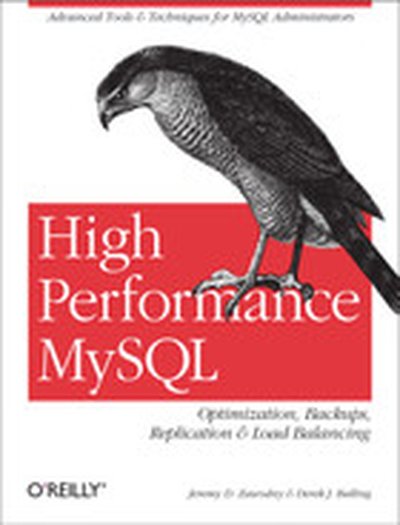
High Performance MySQL

As users come to depend on MySQL, they find that they have to deal with issues of reliability, scalability, and performance--issues that are not well documented but are critical to a smoothly functioning site. This book is an insider's guide to these little understood topics.Author Jeremy Zawodny has managed large numbers of MySQL servers for mission-critical work at Yahoo!, maintained years of contacts with the MySQL AB team, and presents regularly at conferences. Jeremy and Derek have spent months experimenting, interviewing major users of MySQL, talking to MySQL AB, benchmarking, and writing some of their own tools in order to produce the information in this book.In High Performance MySQL you will learn about MySQL indexing and optimization in depth so you can make better use of these key features. You will learn practical replication, backup, and load-balancing strategies with information that goes beyond available tools to discuss their effects in real-life environments. And you'll learn the supporting techniques you need to carry out these tasks, including advanced configuration, benchmarking, and investigating logs.Topics include: A review of configuration and setup options Storage engines and table types Benchmarking Indexes Query Optimization Application Design Server Performance Replication Load-balancing Backup and Recovery Security

Sams Teach Yourself PHP, MySQL® and Apache All in One

A new edition of the best selling book that covers three popular open-source tools in one complete Starter Kit package. Revised and updated to reflect major changes in new versions of PHP, MySQL, and PHP 5. Carefully steps the reader through the basic set up of PHP, MySQL, and Apache, and shows how to combine these technologies to quickly create simple interactive Web applications. CD-ROM allows the reader to install a safe, foolproof learning environment for either a Windows or Linux-based PC.

MySQL Tutorial

A concise introduction to the fundamentals of working with MySQL. MySQL is an open-source relational database management system that is rapidly growing in popularity. Known for its speed, reliability, and ease of use, MySQL has proven itself to be particularly well suited both for beginners and for experienced developers to create sophisticated database-backed Web sites and applications. MySQL Tutorial is a clear, concise introduction to the fundamental concepts and techniques of working with MySQL. It teaches the beginning MySQL user how to create and administer powerful databases that can be used at home, at work, and on the Web. Whether you are a novice to databases or a technical professional looking to find out more about how MySQL works, MySQL Tutorial efficiently guides you through the information you need in order to get started with MySQL and quickly become proficient.

Implementing EDI Solutions

This IBM Redbooks publication introduces the reader to the world of EDI. In addition to general terms about EDI, it also introduces a number of products in this area. WebSphere Data Interchange is discussed as the translation engine to map EDI documents to and from documents in other formats. This book also introduces two communication products that use Internet technologies: iSoft’s P2PAgent and Trading Partner Interchange. In addition to product introductions, the book describes several implementation scenarios in a multi-partner and multi-product environment. Besides a network where trading partners only use iSoft’s P2PAgent, we also look at a setup where trading partners use a combination of the two products. For each communication product, we investigate several integration options with internal applications and other middleware. We discuss the integration options with the translation product WebSphere Data Interchange and with the process integration product WebSphere BI Interchange Server. The integration technique can be file-based or messaging-based. Finally, we take a look at options to combine the flexibility of the Internet with the reliability of value-added networks. When Internet connectivity is temporarily not available, a trading partner has the ability to use Expedite to dial into IBM’s network and send or receive EDI documents. By exploiting the recycle mechanics in iSoft's P2PAgent, we can implement a solution that provides a highly available connection between trading partners. For more up-to-date information about WebSphere B2B, please refer to the following books: Please note that the additional material referenced in the text is not available from IBM.

DB2® Version 8: The Official Guide

IBM DB2 Universal Database v8.1.2 will help you access any information, from any application, from anywhere in your organization, anytime—and do it all more easily and cost-effectively than you ever thought possible. Now, in DB2 Version 8: The Official Guide, a team of IBM DB2 experts shows experienced DB2 professionals exactly how to make the most of DB2 Version 8 in any environment—Linux®, UNIX®, or Windows®. The authors draw on extensive personal experience helping customers implement state-of-the-art DB2 solutions, and unparalleled access to the IBM DB2 development team. They offer detailed, never-before-published technical guidance for the key challenges you'll face in delivering high-performance DB2 databases, e-business infrastructure, and enterprise integration solutions. Coverage includes: Simplifying management with the Configuration Advisor, HealthCenter(, and Memory Visualizer Integrating the enterprise via Federated Web Services and the DB2 enhanced XML productivity tools Maximizing database scalability, availability, and robustness Using multidimensional data clustering and other integrated business intelligence tools Integrating with IBM WebSphere and Microsoft software development tools Leveraging key improvements in DB2 SQL functionality The accompanying CD-ROM contains a complete trial version of IBM® DB2® Universal Database Personal Edition Version 8.1, for Windows® Operating Environments, Evaluation Copy, plus the DB2 demonstration program for trying out the various SQL commands on your own machine. If you're an experienced DB2 professional who's ready to take DB2 Version 8 to the max, DB2 Version 8: The Official Guide is the book you've been searching for.

DB2 Cube Views: A Primer

Business Intelligence and OLAP systems are no longer limited to the privileged few business analysts: they are being democratized by being shared with the rank and file employee demanding a Relational Database Management System (RDBMS) that is more OLAP-aware. DB2 Cube Views and its cube model provide DB2 the ability to address multidimensional analysis and become an actor in the OLAP world. This IBM Redbooks publication focuses on the innovative technical functionalities of IBM DB2 Cube Views V8.1 to store multidimensional metadata in DB2 catalog; to build automatically model-based summary tables to speed up query performance; and to provide an advanced API to allow other Business Intelligence partners’ tools to benefit from both metadata exchange and improved query performance. This book positions the new functionalities and their benefits, so you can understand and evaluate their applicability in your own Business Intelligence and OLAP system environment. It provides information and examples to help you to get started planning and implementing the new functionalities.

Scaling DB2 UDB on Windows Server 2003

As organizations strive to do more with less, DB2 Universal Database v8.1 on Windows Server 2003 brings unprecedented enterprise-class scalability to 32-bit and 64-bit Intel platforms. Supporting both vertical (scale up) and horizontal (scale out) scaling, DB2 UDB v8.1 represents over a decade of industry proven scalability with both non-clustered and clustered database architectures. This IBM Redbooks publication is designed as an informative guide to scaling DB2 UDB V8.1 with Windows Server 2003. It is intended for database and system administrators who need both an introduction and detailed information on scaling DB2 UDB on Windows Server 2003. We begin with an overview to scalability including the goals, measurements, and common approaches. We introduce the scalability features of DB2 UDB, Windows Server 2003, and the IBM xSeries Servers followed by some design considerations for scaling. We dedicate an entire chapter to running DB2 UDB on 64-bit Windows including installation, configuration, and 64-bit migration techniques. We discuss scaling up and how to leverage large memory support in a 32-bit environments. Finally, we include a chapter on scaling out including adding logical and physical database partitions.

Sams Teach Yourself DB2® Universal Database™ in 21 Days, Second Edition

Marketshare for DB2 has been growing steadily over the past 5 years and with the recent release of DB2 Universal Database V8, the product has never had more momentum. Not only is the product used in every company on the Fortune 500, but it is becoming very popular in the small to medium sized businesses as well. Sams Teach Yourself DB2 Universal Database in 21 Days, Second Edition, focuses on performing tasks using the graphical interfaces and wizards that are provided with DB2 on the Windows platform. (DB2 also runs on z/OS, OS/400, AIX, Linux, HP-UX, and Sun Solaris.) Readers are guided through performing all the commonly used tasks to run DB2, including installing DB2, setting up DB2, creating databases and tables, populating the database with data, accessing the data, ensuring the database is tuned for performance. This book differs from the competition in that it provides examples and scenarios making it very easy for the reader to learn complicated tasks. It gives them everything they need for the commonly used tasks in a simple to understand manner. Quizzes and exercises strengthen the knowledge gained and ensure concepts are learned rather than memorized.