
Secure more B2B business faster by effectively measuring and mapping your key stakeholder relationships to better leverage these in the B2B buying process.
 talk-data.com
Topic
83
tagged
Secure more B2B business faster by effectively measuring and mapping your key stakeholder relationships to better leverage these in the B2B buying process.
Artificial intelligence (AI) enables computers and machines to mimic the perception, learning, problem-solving, and decision-making capabilities of the human mind. AI development is made possible by the availability of large amounts of data and the corresponding development and wide availability of computer systems that can process all that data faster and more accurately than humans can. What happens if you infuse AI with a world-class database management system, such as IBM Db2®? IBM® has done just that with Db2 AI for z/OS (Db2ZAI). Db2ZAI is built to infuse AI and data science to assist businesses in the use of AI to develop applications more easily. With Db2ZAI, the following benefits are realized: Data science functionality Better built applications Improved database performance (and DBA's time and efforts are saved) through simplification and automation of error reporting and routine tasks Machine learning (ML) optimizer to improve query access paths and reduce the need for manual tuning and query optimization Integrated data access that makes data available from various vendors including private cloud providers. This IBM Redpaper® publication helps to simplify your installation by tailoring and configuration of Db2 AI for z/OS®. It was written for system programmers, system administrators, and database administrators.
IBM® Db2® Analytics Accelerator is a workload optimized appliance add-on to IBM DB2® for IBM z/OS® that enables the integration of analytic insights into operational processes to drive business critical analytics and exceptional business value. Together, the Db2 Analytics Accelerator and DB2 for z/OS form an integrated hybrid environment that can run transaction processing, complex analytical, and reporting workloads concurrently and efficiently. With IBM DB2 Analytics Accelerator for z/OS V7, the following flexible deployment options are introduced: Accelerator on IBM Integrated Analytics System (IIAS): Deployment on pre-configured hardware and software Accelerator on IBM Z®: Deployment within an IBM Secure Service Container LPAR For using the accelerator for business-critical environments, the need arose to integrate the accelerator into High Availability (HA) architectures and Disaster Recovery (DR) processes. This IBM Redpaper™ publication focuses on different integration aspects of both deployment options of the IBM Db2 Analytics Accelerator into HA and DR environments. It also shares best practices to provide wanted Recovery Time Objectives (RTO) and Recovery Point Objectives (RPO). HA systems often are a requirement in business-critical environments and can be implemented by redundant, independent components. A failure of one of these components is detected automatically and their tasks are taken over by another component. Depending on business requirements, a system can be implemented in a way that users do not notice outages (continuous availability), or in a major disaster, users notice an outage and systems resume services after a defined period, potentially with loss of data from previous work. IBM Z was strong for decades regarding HA and DR. By design, storage and operating systems are implemented in a way to support enhanced availability requirements. IBM Parallel Sysplex® and IBM Globally Dispersed Parallel Sysplex (IBM GDPS®) offer a unique architecture to support various degrees of automated failover and availability concepts. This IBM Redpaper publication shows how IBM Db2 Analytics Accelerator V7 can easily integrate into or complement existing IBM Z topologies for HA and DR. If you are using IBM Db2 Analytics Accelerator V5.1 or lower, see IBM Db2 Analytics Accelerator: High Availability and Disaster Recovery, REDP-5104.
Consist Advanced Development Solution (ConsistADS) is an end-to-end conversion solution that conversion and transparency methods for migrating to IBM® DB2® for z/OS® software. The solution includes DB2 for z/OS and several DB2 tools as part of the package. This IBM Redpaper™ publication explains the Natural and Adabas conversion to DB2 for z/OS by using ConsistADS. It includes prerequisite technical assessment requirements and conversion challenges. It also describes a real customer conversion scenario that was provided by the IBM Business Partners that facilitated these conversions for customers. Originally published in 2015, this paper has been updated in 2020 to include additional information about ConsistADS.
IBM® Db2® Mirror for i provides a new solution for continuous availability for an IBM i environment based on an active-active clustering design that uses a low-latency communication protocol for synchronous database replication. With Db2 Mirror, IBM i customers can benefit from continuous application availability for both planned and unplanned outages. Db2 Mirror can help reduce or eliminate application downtime for regular maintenance operations such as program temporary fix (PTF) installations, operating system (OS) upgrades, or for planned server outages. This IBM Redpaper publication provides a broad overview and understanding of this new solution by covering its architecture, positioning, planning, and implementation aspects. It provides an introduction reference for a seller or technical specialist audience to become familiar with the new Db2 Mirror solution.
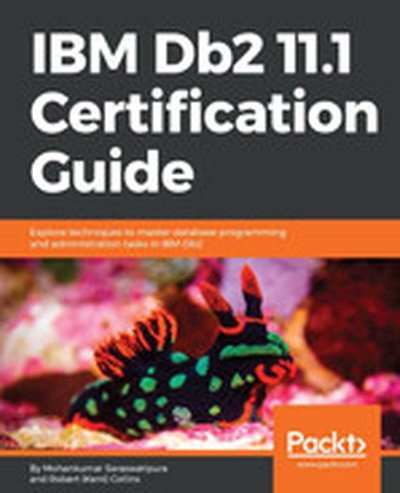
Delve into the IBM Db2 11.1 Certification Guide to comprehensively prepare for the IBM C2090-600 exam and master database programming and administration tasks in Db2 environments. Across its insightful chapters, this guide provides practical steps, expert guidance, and over 150 practice questions aimed at ensuring your success. What this Book will help me do Master Db2 server management, including configuration and maintenance tasks, to ensure optimized performance. Implement advanced features such as BLU Acceleration and Db2 pureScale to enhance database functionality. Gain expertise in security protocols, including data encryption and integrity enforcement, for secure database environments. Troubleshoot common Db2 issues using advanced diagnostic tools like db2pd and dsmtop, improving efficiency and uptime. Develop skills in creating and altering database objects, enabling robust database design and management. Author(s) The authors, None Collins and None Saraswatipura, are seasoned database professionals with vast experience in administering and optimizing Db2 environments. Their expertise in guiding students and professionals shines through in the accessible language and practical approach of the book. They bring a blend of theoretical and hands-on insights to ensure learners not only understand but also apply the knowledge effectively. Who is it for? This book is ideal for database administrators, architects, and application developers who are pursuing certification in Db2. It caters to readers with basic Db2 understanding seeking to advance their skills. Whether you're aiming for professional growth or practical expertise, this guide serves your goals by covering certification essentials while enriching your practical knowledge.
IBM Db2® for z/OS® is well known as the gold-standard information steward. Deep synergy with the z/OS operating system and System Z platform provides support for the highest transaction volumes with the ultimate levels of availability. Just like any high-performance engine, occasional maintenance or upgrades are needed to maintain peak performance and to incorporate new features. Those that demand the highest standards and protection of their production environments know that you want to test changes outside of production first. It is common to have development or test environments for application development and verification. What about applying Db2 maintenance or performing migrations to new version or release levels? Sure, you probably perform these activities outside of production first, but are these environments similar enough to production to surface the same results as those you might encounter in production? Your production Db2 Catalog & Directory often has a different mix and complexity of objects, which were created at different levels of Db2, that can span decades of time. The best test of these activities is against your production system, but this is the system that we want to protect. How can we accomplish this? Clone it! Skeleton cloning produces a specific kind of clone, which provides a replica of the portions of your Db2 production environment that are needed to complete your testing. You can use the skeleton clone to find issues before they occur in production. This process allows you to refine maintenance steps in a safe environment and to minimize potential downtime when performing the same steps in a production system. This IBM® Redpaper™ publication gives a high-level overview of the IBM Db2 Cloning Tool and includes specific use cases for the tool. It also details the skeleton cloning process, which you can use to test migration, function levels, and maintenance, and includes demo examples that show a Db2 11 to 12 migration test using skeleton cloning.
The scope of this IBM® Redpaper™ publication is to provide a high-level overview of automatic storage table spaces, table space maps, table space extent maps, and physically unbalanced data across automatic storage table space containers (that is, data skew). The objective of this paper is to investigate causes of data skew and make suggestions for how to resolve it. This paper is for Database Administrators (DBAs) of IBM Db2®; the DBAs should have general Db2 knowledge and skills. The environment used for the creation of this document is Db2 Version 11.1, and an IBM AIX® operating system. This document is based on results of testing various scenarios.
Abstract Business Intelligence (BI) is a broad term that relates to applications that analyze data to understand and act on the key metrics that drive profitability in an enterprise. Key to analyzing that data is providing fast, easy access to it while delivering it in formats or tools that best fit the needs of the user. At the core of any BI solution are user query and reporting tools that provide intuitive access to data supporting a spectrum of users from executives to “power users,” from spreadsheet aficionados to the external Internet consumer. IBM® DB2® Web Query for i offers a set of modernized tools for a more robust, extensible, and productive reporting solution than the popular IBM Query for System i® tool (also known as IBM Query/400). IBM DB2 Web Query for i preserves investments in the reports that are developed with Query/400 by offering a choice of importing definitions into the new technology or continuing to run existing Query/400 reports as is. But, it also offers significant productivity and performance enhancements by leveraging the latest in DB2 for i query optimization technology. The DB2 Web Query for i product is a web-based query and report writing product that offers enhanced capabilities over the IBM Query for iSeries product (also commonly known as Query/400). IBM DB2 Web Query for i includes Query for iSeries technology to assist customers in their transition to DB2 Web Query. It offers a more modernized, Java based solution for a more robust, extensible, and productive reporting solution. DB2 Web Query provides the ability to query or build reports against data that is stored in DB2 for i (or Microsoft SQL Server) databases through browser-based user interface technologies: Build reports with ease through the web-based, ribbon-like InfoAssist tool that leverages a common look and feel that can extend the number of personnel that can generate their own reports. Simplify the management of reports by significantly reducing the number of report definitions that are required through the use of parameter driven reports. Deliver data to users in many different formats, including directly into spreadsheets, or in boardroom-quality PDF format, or viewed from the browser in HTML. Leverage advanced reporting functions, such as matrix reporting, ranking, color coding, drill-down, and font customization to enhance the visualization of DB2 data. DB2 Web Query offers features to import Query/400 definitions and enhance their look and functions. By using it, you can add OLAP-like slicing and dicing to the reports or view reports in disconnected mode for users on the go. This IBM Redbooks® publication provides a broad understanding of what can be done with the DB2 Web Query product. This publication is a companion of DB2 Web Query Tutorials, SG24-8378, which has a group of self-explanatory tutorials to help you get up to speed quickly.
IBM® DB2® 12 for z/OS® delivers key innovations that increase availability, reliability, scalability, and security for your business-critical information. In addition, DB2 12 for z/OS offers performance and functional improvements for both transactional and analytical workloads and makes installation and migration simpler and faster. DB2 12 for z/OS also allows you to develop applications for the cloud and mobile devices by providing self-provisioning, multitenancy, and self-managing capabilities in an agile development environment. DB2 12 for z/OS is also the first version of DB2 built for continuous delivery. This IBM Redbooks® publication introduces the enhancements made available with DB2 12 for z/OS. The contents help database administrators to understand the new functions and performance enhancements, to plan for ways to use the key new capabilities, and to justify the investment in installing or migrating to DB2 12.
IBM® DB2® Query Management Facility™ for z/OS® provides a zero-footprint, mobile-enabled, highly secure business analytics solution. IBM QMF™ V11.2.1 offers many significant new features and functions in keeping with the ongoing effort to broaden its usage and value to a wider set of users and business areas. In this IBM Redbooks® publication, we explore several of the new features and options that are available within this new release. This publication introduces TSO enhancements for QMF Analytics for TSO and QMF Enhanced Editor. A chapter describes how the QMF Data Service component connects to multiple mainframe data sources to accomplish the consolidation and delivery of data. This publication describes how self-service business intelligence can be achieved by using QMF Vision to enable self-service dashboards and data exploration. A chapter is dedicated to JavaScript support, demonstrating how application developers can use JavaScript to extend the capabilities of QMF. Additionally, this book describes methods to take advantage of caching for reduced CPU consumption, wider access to information, and faster performance. This publication is of interest to anyone who wants to better understand how QMF can enable in-place analytics with live enterprise data.
Procedures, triggers, and user-defined functions (UDFs) are the key database software features for developing robust and distributed applications. IBM Universal Database™ for i (IBM DB2® for i) supported these features for many years, and they were enhanced in V5R1, V5R2, and V5R3 of IBM® OS/400® and V5R4 of IBM i5/OS™. This IBM Redbooks® publication includes several of the announced features for procedures, triggers, and UDFs in V5R1, V5R2, V5R3, and V5R4. This book includes suggestions, guidelines, and practical examples to help you effectively develop IBM DB2 for i procedures, triggers, and UDFs. The following topics are covered in this book: External stored procedures and triggers Java procedures (both Java Database Connectivity (JDBC) and Structured Query Language for Java (SQLJ)) External triggers External UDFs This publication also offers examples that were developed in several programming languages, including RPG, COBOL, C, Java, and Visual Basic, by using native and SQL data access interfaces. This book is part of the original IBM Redbooks publication, Stored Procedures, Triggers, and User-Defined Functions on DB2 Universal Database for iSeries, SG24-6503-02, that covered external procedures, triggers, and functions, and also SQL procedures, triggers, and functions. All of the information that relates to external routines was left in this publication. All of the information that relates to SQL routines was rewritten and updated. This information is in the new IBM Redbooks publication, SQL Procedures, Triggers, and Functions on IBM DB2 for i, SG24-8326. This book is intended for anyone who wants to develop IBM DB2 for i procedures, triggers, and UDFs. Before you read this book, you need to know about relational database technology and the application development environment on the IBM i server.
Structured Query Language (SQL) procedures, triggers, and functions, which are also known as user-defined functions (UDFs), are the key database features for developing robust and distributed applications. IBM® DB2® for i supported these features for many years, and they are enhanced in IBM i versions 6.1, 7.1, and 7.2. DB2 for i refers to the IBM DB2 family member and relational database management system that is integrated within the IBM Power operating system that is known as IBM i. This IBM Redbooks® publication includes several of the announced features for SQL procedures, triggers, and functions in IBM i versions 6.1, 7.1, and 7.2. This book includes suggestions, guidelines, and practical examples to develop DB2 for i SQL procedures, triggers, and functions effectively. This book covers the following topics: Introduction to the SQL/Persistent Stored Modules (PSM) language, which is used in SQL procedures, triggers, and functions SQL procedures SQL triggers SQL functions This book is for IBM i database engineers and data-centric developers who strive to provide flexible, extensible, agile, and scalable database solutions that meet business requirements in a timely manner. Before you read this book, you need to know about relational database technology and the application development environment on the IBM Power Systems™ with the IBM i operating system.
Dynamic organizations want to accelerate growth while reducing costs. To do so, they must speed the deployment of business applications and adapt quickly to any changes in priorities. Organizations require an IT infrastructure to be easy, efficient, and versatile. The VersaStack solution by Cisco and IBM® can help you accelerate the deployment of your datacenters. It reduces costs by more efficiently managing information and resources while maintaining your ability to adapt to business change. The VersaStack solution combines the innovation of Cisco Unified Computing System (Cisco UCS) Integrated Infrastructure with the efficiency of the IBM Storwize® storage system. The Cisco UCS Integrated Infrastructure includes the Cisco UCS, Cisco Nexus and Cisco MDS switches, and Cisco UCS Director. The IBM Storwize V7000 storage system enhances virtual environments with its Data Virtualization, IBM Real-time Compression™, and IBM Easy Tier® features. These features deliver extraordinary levels of performance and efficiency. The VersaStack solution is Cisco Application Centric Infrastructure (ACI) ready. Your IT team can build, deploy, secure, and maintain applications through a more agile framework. Cisco Intercloud Fabric capabilities help enable the creation of open and highly secure solutions for the hybrid cloud. These solutions accelerate your IT transformation while delivering dramatic improvements in operational efficiency and simplicity. Cisco and IBM are global leaders in the IT industry. The VersaStack solution gives you the opportunity to take advantage of integrated infrastructure solutions that are targeted at enterprise applications, analytics, and cloud solutions. The VersaStack solution is backed by Cisco Validated Designs (CVDs) to provide faster delivery of applications, greater IT efficiency, and less risk. This IBM Redbooks® publication is aimed at experienced storage administrators that are tasked with deploying a VersaStack solution with IBM DB2® High Availability (DB2 HA), IBM Spectrum™ Protect, and IBM Spectrum Control™.
Transforming data from operational data models to purpose-oriented data structures has been commonplace for the last decades. Data transformations are heavily used in all types of industries to provide information to various users at different levels. Depending on individual needs, the transformed data is stored in various different systems. Sending operational data to other systems for further processing is then required, and introduces much complexity to an existing information technology (IT) infrastructure. Although maintenance of additional hardware and software is one component, potential inconsistencies and individually managed refresh cycles are others. For decades, there was no simple and efficient way to perform data transformations on the source system of operational data. With IBM® DB2® Analytics Accelerator, DB2 for z/OS is now in a unique position to complete these transformations in an efficient and well-performing way. DB2 for z/OS completes these while connecting to the same platform as for operational transactions, helping you to minimize your efforts to manage existing IT infrastructure. Real-time analytics on incoming operational transactions is another demand. Creating a comprehensive scoring model to detect specific patterns inside your data can easily require multiple iterations and multiple hours to complete. By enabling a first set of analytical functionality in DB2 Analytics Accelerator, those dedicated mining algorithms can now be run on an accelerator to efficiently perform these modeling tasks. Given the speed of query processing on an accelerator, these modeling tasks can now be performed much quicker compared to traditional relational database management systems. This speed enables you to keep your scoring algorithms more up-to-date, and ultimately adapt more quickly to constantly changing customer behaviors. This IBM Redbooks® publication describes the new table type that is introduced with DB2 Analytics Accelerator V4.1 PTF5 that enables more efficient data transformations. These tables are called accelerator-only tables, and can exist on an accelerator only. The tables benefit from the accelerator performance characteristics, while maintaining access through existing DB2 for z/OS application programming interfaces (APIs). Additionally, we describe the newly introduced analytical capabilities with DB2 Analytics Accelerator V5.1, putting you in the position to efficiently perform data modeling for online analytical requirements in your DB2 for z/OS environment. This book is intended for technical decision-makers who want to get a broad understanding about the analytical capabilities and accelerator-only tables of DB2 Analytics Accelerator. In addition, you learn about how these capabilities can be used to accelerate in-database transformations and in-database analytics in various environments and scenarios, including the following scenarios: Multi-step processing and reporting in IBM DB2 Query Management Facility™, IBM Campaign, or Microstrategy environments In-database transformations using IBM InfoSphere® DataStage® Ad hoc data analysis for data scientists In-database analytics using IBM SPSS® Modeler
IBM® DB2® Version 11.1 for z/OS® (DB2 11 for z/OS or just DB2 11 throughout this book) is the fifteenth release of DB2 for IBM MVS™. The DB2 11 environment is available either for new installations of DB2 or for migrations from DB2 10 for z/OS subsystems only. This IBM Redbooks® publication describes enhancements that are available with DB2 11 for z/OS. The contents help database administrators to understand the new extensions and performance enhancements, to plan for ways to use the key new capabilities, and to justify the investment in installing or migrating to DB2 11. Businesses are faced with a global and increasingly competitive business environment, and they need to collect and analyze ever increasing amounts of data (Figure 1). Governments also need to collect and analyze large amounts of data. The main focus of this book is to introduce recent DB2 capability that can be used to address challenges facing organizations with storing and analyzing exploding amounts of business or organizational data, while managing risk and trying to meet new regulatory and compliance requirements. This book describes recent extensions to DB2 for z/OS in V10 and V11 that can help organizations address these challenges.
IBM® DB2® for IBM z/OS® helps lower the cost of managing data by automating administration, increasing storage efficiency, improving performance, and simplifying the deployment of virtual appliances. By automating tasks such as memory allocation, storage management, and business policy maintenance, DB2 is able to perform many management tasks itself, freeing up Database Administrators to focus on new projects. This IBM Redbooks® publication introduces autonomics for DB2 for z/OS. IBM provides several different components that, when combined, can create an autonomic database environment. All these respective components cover certain aspects of autonomics, which can collaborate into one coherent solution. In our evolution of autonomics and the need to move to smarter systems there has been a bigger drive to the concept of "Active" versus "Passive" autonomics. With the inclusion of the IBM Management Console for IMS™ and DB2 for z/OS and the Autonomics Director, it is now easier than ever to make that transition by leveraging the strength of the DB2 Utilities Solution Pack for z/OS all in one standardized and centralized interface. This publication guides you through the business reasons for adopting autonomic solutions, and provides step-by-step guidance to implement these capabilities in your DB2 for z/OS configuration. This publication is of interest primarily to DB2 Database Administrators and DB2 Systems Programmers, and for anyone looking to understand the benefits of DB2 autonomic solutions.
BLU Acceleration is a new technology that has been developed by IBM® and integrated directly into the IBM DB2® engine. BLU Acceleration is a new storage engine along with integrated run time (directly into the core DB2 engine) to support the storage and analysis of column-organized tables. The BLU Acceleration processing is parallel to the regular, row-based table processing found in the DB2 engine. This is not a bolt-on technology nor is it a separate analytic engine that sits outside of DB2. Much like when IBM added XML data as a first class object within the database along with all the storage and processing enhancements that came with XML, now IBM has added column-organized tables directly into the storage and processing engine of DB2. This IBM Redbooks® publication shows examples on an IBM Power Systems™ entry server as a starter configuration for small organizations, and build larger configurations with IBM Power Systems larger servers. This publication takes you through how to build a BLU Acceleration solution on IBM POWER® having SAP Landscape integrated to it. This publication implements SAP NetWeaver Business Warehouse Systems as part of the scenario using another DB2 Feature called Near-Line Storage (NLS), on IBM POWER virtualization features to develop and document best recommendation scenarios. This publication is targeted towards technical professionals (DBAs, data architects, consultants, technical support staff, and IT specialists) responsible for delivering cost-effective data management solutions to provide the best system configuration for their clients' data analytics on Power Systems.
This IBM® Redbooks® publication will help you install, configure, and use IBM InfoSphere® Optim™ Workload Replay (InfoSphere Workload Replay), a web-based tool that lets you capture real production SQL workload data and then replay the workload data in a pre-production environment. With InfoSphere Workload Replay, you can set up and run realistic tests for enterprise database changes without the need to create a complex client and application infrastructure to mimic your production environment. The publication goes through the steps to install and configure the InfoSphere Workload Replay appliance and related database components for IBM DB2® for Linux, UNIX, and Windows and for DB2 for IBM z/OS®. The capture, replay, and reporting process, including user ID and roles management, is described in detail to quickly get you up and running. Ongoing operations, such as appliance health monitoring, starting and stopping the product, and backup and restore in your day-to-day management of the product, extensive troubleshooting information, and information about how to integrate InfoSphere Workload Replay with other InfoSphere products are covered in separate chapters.
Over the last few years, IBM® IMS™ and IMS tools have been modernizing the interfaces to IMS and the IMS tools to bring them more in line with the current interface designs. As the mainframe software products are becoming more integrated with the Windows and mobile environments, a common approach to interfaces is becoming more relevant. The traditional 3270 interface with ISPF as the main interface is no longer the only way to do some of these processes. There is also a need to provide more of a common looking interface so the tools do not have a product-specific interface. This allows more cross product integration. Eclipse and web-based interfaces being used in a development environment, tooling using those environments provides productivity improvements in that the interfaces are common and familiar. IMS and IMS tools developers are making use of those environments to provide tooling that will perform some of the standard DBA functions. This book will take some selected processes and show how this new tooling can be used. This will provide some productivity improvements and also provide a more familiar environment for new generations DBAs. Some of the functions normally done by DBA or console operators can now be done in this eclipse-based environment by the application developers. This means that the need to request these services from others can be eliminated. This IBM Redbooks® publication examines specific IMS DBA processes and highlights the new IMS and IMS tools features, which show an alternative way to accomplish those processes. Each chapter highlights a different area of the DBA processes like: PSB creation Starting/stopping a database in an IMS system Recovering a database Cloning a set of databases