
talk-data.com talk-data.com

Event

PyData Seattle 2025

2025-11-07 – 2025-11-09 PyData

Activities tracked

5

Filtering by: LLM ×

Sessions & talks

Showing 1–5 of 5 · Newest first

Search within this event →

LLMs, Chatbots, and Dashboards: Visualize and Analyze Your Data with Natural Language

2025-11-09
talk

LLMs have a lot of hype around them these days. Let’s demystify how they work and see how we can put them in context for data science use. As data scientists, we want to make sure our results are inspectable, reliable, reproducible, and replicable. We already have many tools to help us in this front. However, LLMs provide a new challenge; we may not always be given the same results back from a query. This means trying to work out areas where LLMs excel in, and use those behaviors in our data science artifacts. This talk will introduce you to LLMs, the Chatlas packages, and how they can be integrated into a Shiny to create an AI-powered dashboard (using querychat). We’ll see how we can leverage the tasks LLMs are good at to better our data science products.
Building a Deep Research Agentic Workflow

2025-11-09
talk
LLM

OpenAI and Gemini's Deep Research offerings are a great way to get a detailed research report on a topic.

In this beginner friendly tutorial, we’ll walk through building a simple lightweight agent workflow to perform deep research.

Prompt Variation as a Diagnostic Tool: Exposing Contamination, Memorization, and True Capability in LLMs

2025-11-08
talk
LLM

Prompt variation isn't just an engineering nuisance, it's a window into fundamental LLM limitations. When a model's accuracy drops from 95% to 75% due to minor rephrasing, we're not just seeing brittleness; we're potentially exposing data contamination, spurious correlations, and shallow pattern matching. This talk explores prompt variation as a powerful diagnostic tool for understanding LLM reliability. We discuss how small changes in format, phrasing, or ordering can cause accuracy to collapse revealing about models memorizing benchmark patterns or learning superficial correlations rather than robust task representations. Drawing from academic and industry research, you will learn to distinguish between LLM's true capability and memorization, identify when models are pattern-matching rather than reasoning, and build evaluation frameworks that expose these vulnerabilities before deployment.

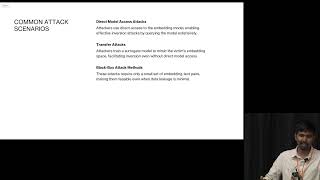
Securing Retrieval-Augmented Generation: How to Defend Vector Databases Against 2025 Threats

Securing Retrieval-Augmented Generation: How to Defend Vector Databases Against 2025 Threats

2025-11-08 Watch
talk

Modern LLM applications rely heavily on embeddings and vector databases for retrieval-augmented generation (RAG). But in 2025, researchers and OWASP flagged vector databases as a new attack surface — from embedding inversion (recovering sensitive training text) to poisoned vectors that hijack prompts. This talk demystifies these threats for practitioners and shows how to secure your RAG pipeline with real-world techniques like encrypted stores, anomaly detection, and retrieval validation. Attendees will leave with a practical security checklist for keeping embeddings safe while still unlocking the power of retrieval.

Evaluation is all you need

Evaluation is all you need

2025-11-08 Watch
talk

LLM apps fail without reliable, reproducible evaluation. This talk maps the open‑source evaluation landscape, compares leading techniques (RAGAS, Evaluation Driven Development) and frameworks (DeepEval, Phoenix, LangFuse, and braintrust), and shows how to combine tests, RAG‑specific evals, and observability to ship higher‑quality systems. Attendees leave with a decision checklist, code patterns, and a production‑ready playbook.