talk-data.com talk-data.com

Event

PyData Seattle 2025

2025-11-07 – 2025-11-09 PyData

Activities tracked

5

Filtering by: API ×

Sessions & talks

Showing 1–5 of 5 · Newest first

Search within this event →

How to make datamap web-apps of embedding vectors via open source tooling

2025-11-09
talk

Datamaps are ML-powered visualizations of high-dimensional data, and in this talk the data is collections of embedding vectors. Interactive datamaps run in-browser as web-apps, potentially without any code running on the web server. Datamap tech can be used to visualize, say, the entire collection of chunks in a RAG vector database.

The best-of-breed tools of this new datamap technique are liberally licensed open source. This presentation is an introduction to building with those repos. The maths will be mentioned only in passing; the topic here is simply how-to with specific tools. Talk attendees will be learning about Python tools, which produce high-quality web UIs.

DataMapPlot is the premiere tool for rendering a datamap as a web-app. Here is a live demo thereof: https://connoiter.com/datamap/cff30bc1-0576-44f0-a07c-60456e131b7b

00-25: Intro to datamaps 25-45: Pipeline architecture 45-55: demos touring such tools as UMAP, HDBSCAN, DataMapPlot, Toponomy, etc. 55-90: Group coding

A Google account is required to log in to Google Colab, where participants can run the workshop notebooks. A Hugging Face API key (token) is needed to download Gemma models.
Building Inference Workflows with Tile Languages

Building Inference Workflows with Tile Languages

2025-11-08 Watch
talk

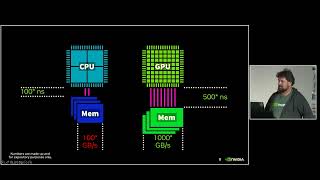
The world of generative AI is expanding. New models are hitting the market daily. The field has bifurcated between model training and model inference. The need for fast inference has led to numerous Tile languages to be developed. These languages use concepts from linear algebra and borrow common numpy apis. In this talk we will show how tiling works and how to build inference models from scratch in pure Python with embedded tile languages. The goal is to provide attendees with a good overview that can be integrated in common data pipelines.

Building Agents with Agent Bricks and MCP

Building Agents with Agent Bricks and MCP

2025-11-08 Watch
talk
Denny Lee (Databricks)

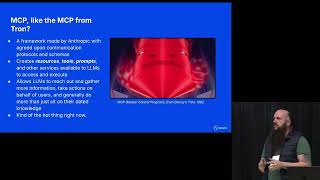
Want to create AI agents that can do more than just generate text? Join us to explore how combining Databricks' Agent Bricks with the Model Context Protocol (MCP) unlocks powerful tool-calling capabilities. We'll show you how MCP provides a standardized way for AI agents to interact with external tools, data and APIs, solving the headache of fragmented integration approaches. Learn to build agents that can retrieve both structured and unstructured data, execute custom code and tackle real enterprise challenges.

There and back again... by ferry or I-5?

There and back again... by ferry or I-5?

2025-11-08 Watch
talk

Living on Washington State’s peninsula offers endless beauty, nature, and commuting challenges. In this talk, I’ll share how I built an agentic AI system that creates and compares optimal routes to the mainland, factoring in ferry schedules, costs, driving distances, and live traffic. Originally a testbed for the Model Context Protocol (MCP) framework, this project now manages my travel schedule, generates expense estimates, and sends timely notifications for events. I’ll give a comprehensive overview of MCP, show how to quickly turn ideas into working agentic AI, and discuss practical integration with real-world APIs. Attendees will leave with actionable insights and a roadmap for building their own agentic AI solutions.

Real-TIme Context Engineering for Agents

Real-TIme Context Engineering for Agents

2025-11-07 Watch
talk

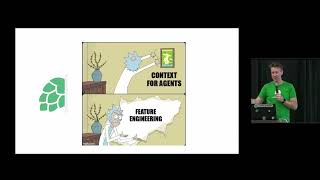
Agents need timely and relevant context data to work effectively in an interactive environment. If an agent takes more than a few seconds to react to an action in a client applicatoin, users will not perceive it as intelligent - just laggy.

Real-time context engineering involves building real-time data pipelines to pre-process application data and serve relevant and timely context to agents. This talk will focus on how you can leverage application identifiers (user ID, session ID, article ID, order ID, etc) to identify which real-time context data to provide to agents. We will contrast this approach with the more traditional RAG approach of using vector indexes to retrieve chunks of relevent text using the user query. Our approach will necessitate the introduction of the Agent-to-Agent protocol, an emerging standard for defining APIs for agents.

We will also demonstrate how we provide real-time context data from applications inside Python agents using the Hopsworks feature store. We will walk through an example of an interactive application (TikTok clone).