

talk-data.com talk-data.com

Alix Tiran-Cappello

Speaker

Alix Tiran-Cappello

2

talks

Filter by Event / Source

Talks & appearances

2 activities · Newest first

Search activities →
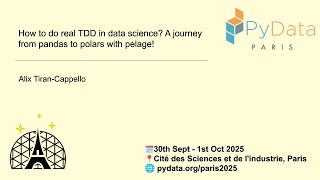
How to do real TDD in data science? A journey from pandas to polars with pelage!

In the world of data, inconsistencies or inaccuracies often presents a major challenge to extract valuable insights. Yet the number of robust tools and practices to address those issues remain limited. Particularly, the practice of TDD remains quite difficult in data science, while it is a standard among classic software development, also because of poorly adapted tools and frameworks.

To address this issue we released Pelage, an open-source Python package to facilitate data exploration and testing, which relies on Polars intuitive syntax and speed. Pelage empowers data scientists and analysts to facilitate data transformation, enhance data quality and improve code clarity.

We will demonstrate, in a test-first approach, how you can use this library in a meaningful data science workflow to gain greater confidence for your data transformations.

See website: https://alixtc.github.io/pelage/

Scaling machine learning at large organizations like Renault Group presents unique challenges, in terms of scales, legal requirements, and diversity of use cases. Data scientists require streamlined workflows and automated processes to efficiently deploy models into production. We present an MLOps pipeline based on python Kubeflow and GCP Vertex AI API designed specifically for this purpose. It enables data scientists to focus on code development for pre-processing, training, evaluation, and prediction. This MLOPS pipeline is a cornerstone of the AI@Scale program, which aims to roll out AI across the Group.

We choose a Python-first approach, allowing Data scientists to focus purely on writing preprocessing or ML oriented Python code, also allowing data retrieval through SQL queries. The pipeline addresses key questions such as prediction type (batch or API), model versioning, resource allocation, drift monitoring, and alert generation. It favors faster time to market with automated deployment and infrastructure management. Although we encountered pitfalls and design difficulties, that we will discuss during the presentation, this pipeline integrates with a CI/CD process, ensuring efficient and automated model deployment and serving.

Finally, this MLOps solution empowers Renault data scientists to seamlessly translate innovative models into production, and smoothen the development of scalable, and impactful AI-driven solutions.