
talk-data.com talk-data.com

C

Speaker

Cameron Cyr

2

talks

guest

Frequent Collaborators

Filter by Event / Source

Talks & appearances

2 activities · Newest first

Search activities →
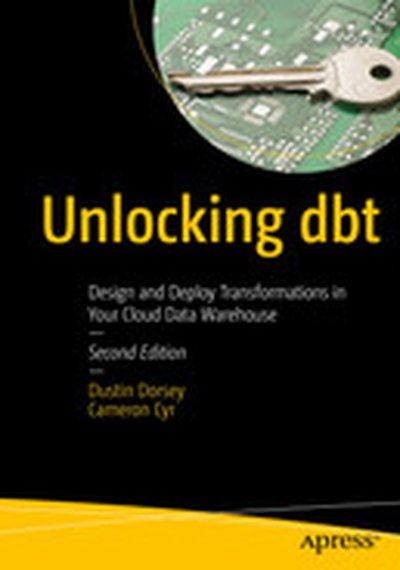
Unlocking dbt: Design and Deploy Transformations in Your Cloud Data Warehouse

Master the art of data transformation with the second edition of this trusted guide to dbt. Building on the foundation of the first edition, this updated volume offers a deeper, more comprehensive exploration of dbt’s capabilities—whether you're new to the tool or looking to sharpen your skills. It dives into the latest features and techniques, equipping you with the tools to create scalable, maintainable, and production-ready data transformation pipelines. Unlocking dbt, Second Edition introduces key advancements, including the semantic layer, which allows you to define and manage metrics at scale, and dbt Mesh, empowering organizations to orchestrate decentralized data workflows with confidence. You’ll also explore more advanced testing capabilities, expanded CI/CD and deployment strategies, and enhancements in documentation—such as the newly introduced dbt Catalog. As in the first edition, you’ll learn how to harness dbt’s power to transform raw data into actionable insights, while incorporating software engineering best practices like code reusability, version control, and automated testing. From configuring projects with the dbt Platform or open source dbt to mastering advanced transformations using SQL and Jinja, this book provides everything you need to tackle real-world challenges effectively. What You Will Learn Understand dbt and its role in the modern data stack Set up projects using both the cloud-hosted dbt Platform and open source project Connect dbt projects to cloud data warehouses Build scalable models in SQL and Python Configure development, testing, and production environments Capture reusable logic with Jinja macros Incorporate version control with your data transformation code Seamlessly connect your projects using dbt Mesh Build and manage a semantic layer using dbt Deploy dbt using CI/CD best practices Who This Book Is For Current and aspiring data professionals, including architects, developers, analysts, engineers, data scientists, and consultants who are beginning the journey of using dbt as part of their data pipeline’s transformation layer. Readers should have a foundational knowledge of writing basic SQL statements, development best practices, and working with data in an analytical context such as a data warehouse.

Summary

The dbt project has become overwhelmingly popular across analytics and data engineering teams. While it is easy to adopt, there are many potential pitfalls. Dustin Dorsey and Cameron Cyr co-authored a practical guide to building your dbt project. In this episode they share their hard-won wisdom about how to build and scale your dbt projects.

Announcements

Hello and welcome to the Data Engineering Podcast, the show about modern data management Data projects are notoriously complex. With multiple stakeholders to manage across varying backgrounds and toolchains even simple reports can become unwieldy to maintain. Miro is your single pane of glass where everyone can discover, track, and collaborate on your organization's data. I especially like the ability to combine your technical diagrams with data documentation and dependency mapping, allowing your data engineers and data consumers to communicate seamlessly about your projects. Find simplicity in your most complex projects with Miro. Your first three Miro boards are free when you sign up today at dataengineeringpodcast.com/miro. That’s three free boards at dataengineeringpodcast.com/miro. Introducing RudderStack Profiles. RudderStack Profiles takes the SaaS guesswork and SQL grunt work out of building complete customer profiles so you can quickly ship actionable, enriched data to every downstream team. You specify the customer traits, then Profiles runs the joins and computations for you to create complete customer profiles. Get all of the details and try the new product today at dataengineeringpodcast.com/rudderstack You shouldn't have to throw away the database to build with fast-changing data. You should be able to keep the familiarity of SQL and the proven architecture of cloud warehouses, but swap the decades-old batch computation model for an efficient incremental engine to get complex queries that are always up-to-date. With Materialize, you can! It’s the only true SQL streaming database built from the ground up to meet the needs of modern data products. Whether it’s real-time dashboarding and analytics, personalization and segmentation or automation and alerting, Materialize gives you the ability to work with fresh, correct, and scalable results — all in a familiar SQL interface. Go to dataengineeringpodcast.com/materialize today to get 2 weeks free! Data lakes are notoriously complex. For data engineers who battle to build and scale high quality data workflows on the data lake, Starburst powers petabyte-scale SQL analytics fast, at a fraction of the cost of traditional methods, so that you can meet all your data needs ranging from AI to data applications to complete analytics. Trusted by teams of all sizes, including Comcast and Doordash, Starburst is a data lake analytics platform that delivers the adaptability and flexibility a lakehouse ecosystem promises. And Starburst does all of this on an open architecture with first-class support for Apache Iceberg, Delta Lake and Hudi, so you always maintain ownership of your data. Want to see Starburst in action? Go to dataengineeringpodcast.com/starburst and get $500 in credits to try Starburst Galaxy today, the easiest and fastest way to get started using Trino. Your host is Tobias Macey and today I'm interviewing Dustin Dorsey and Cameron Cyr about how to design your dbt projects

Interview

Introduction How did you get involved in the area of data management? What was your path to adoption of dbt?

What did you use prior to its existence? When/why/how did you start using it?

What are some of the common challenges that teams experience when getting started with dbt?

How does prior experience in analytics and/or software engineering impact those outcomes?

You recently wrote a book to give a crash course in best practices for dbt. What motivated you to invest that time and effort?

What new lessons did you learn about dbt in the process of writing the book?

The introduction of dbt is largely res