talk-data.com talk-data.com

J

Speaker

Jeff Carpenter

5

talks

author

Frequent Collaborators

Filter by Event / Source

Talks & appearances

5 activities · Newest first

Search activities →
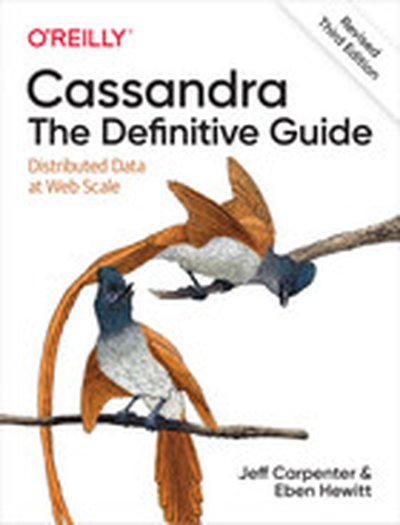
Cassandra: The Definitive Guide, (Revised) Third Edition, 3rd Edition

Imagine what you could do if scalability wasn't a problem. With this hands-on guide, you'll learn how the Cassandra database management system handles hundreds of terabytes of data while remaining highly available across multiple data centers. This revised third edition--updated for Cassandra 4.0 and new developments in the Cassandra ecosystem, including deployments in Kubernetes with K8ssandra--provides technical details and practical examples to help you put this database to work in a production environment. Authors Jeff Carpenter and Eben Hewitt demonstrate the advantages of Cassandra's nonrelational design, with special attention to data modeling. Developers, DBAs, and application architects looking to solve a database scaling issue or future-proof an application will learn how to harness Cassandra's speed and flexibility. Understand Cassandra's distributed and decentralized structure Use the Cassandra Query Language (CQL) and cqlsh (the CQL shell) Create a working data model and compare it with an equivalent relational model Design and develop applications using client drivers Explore cluster topology and learn how nodes exchange data Maintain a high level of performance in your cluster Deploy Cassandra onsite, in the cloud, or with Docker and Kubernetes Integrate Cassandra with Spark, Kafka, Elasticsearch, Solr, and Lucene
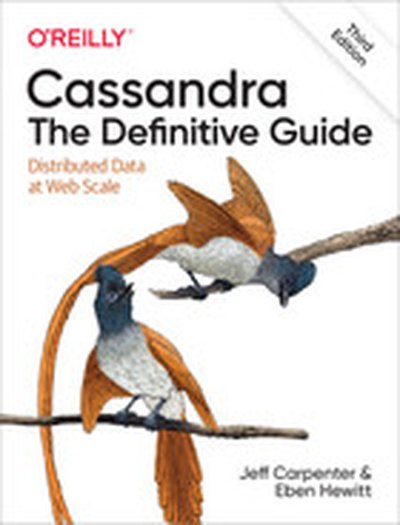
Cassandra: The Definitive Guide, 3rd Edition

Imagine what you could do if scalability wasn't a problem. With this hands-on guide, you’ll learn how the Cassandra database management system handles hundreds of terabytes of data while remaining highly available across multiple data centers. This third edition—updated for Cassandra 4.0—provides the technical details and practical examples you need to put this database to work in a production environment. Authors Jeff Carpenter and Eben Hewitt demonstrate the advantages of Cassandra’s nonrelational design, with special attention to data modeling. If you’re a developer, DBA, or application architect looking to solve a database scaling issue or future-proof your application, this guide helps you harness Cassandra’s speed and flexibility. Understand Cassandra’s distributed and decentralized structure Use the Cassandra Query Language (CQL) and cqlsh—the CQL shell Create a working data model and compare it with an equivalent relational model Develop sample applications using client drivers for languages including Java, Python, and Node.js Explore cluster topology and learn how nodes exchange data

Data modeling with Cassandra

In this lesson, you’ll learn how to design data models for Cassandra, including a data modeling process and notation. To apply this knowledge, we’ll design the data model for a sample application. This will help show how all the parts fit together. Along the way, we’ll use a tool to help us manage our CQL (Cassandra Query Language) scripts. What you’ll learn—and how you can apply it You will learn common patterns and antipatterns for data modeling in Cassandra. This lesson will cover the concepts around data modeling and will compare a Cassandra data model with an equivalent relational database model. You’ll learn about defining queries and about logical and physical database modeling. You’ll learn how to optimize your model for performance, and finally you’ll learn how to implement your model schema using CQL. This lesson is for you because… You are an application developer or architect who wants to learn how data is stored and processed in Cassandra. You are a database administrator who wants to learn about Cassandra. Prerequisites Helpful but not essential to have a basic understanding of relational vs. distributed databases. Helpful but not essential to understand Cassandra Query Language, CQL. Materials or downloads needed in advance None

Optimizing Cassandra performance

In this lesson, we look at how to tune Cassandra to improve performance. There are a variety of settings in the configuration file and on individual tables. Although the default settings are appropriate for many use cases, there might be circumstances in which you need to change them. We’ll look at how and why to make these changes. We also see how to use the cassandra-stress test tool that ships with Cassandra to generate load against Cassandra and quickly see how it behaves under stress test circumstances. We can then tune Cassandra appropriately and feel confident that we’re ready to deploy to a production environment. What you’ll learn—and how you can apply it You’ll learn how to monitor and analyze Cassandra performance. You’ll learn about Cassandra features such as caching, memtables, commit logs, SStables, hinted handoff, compaction, and threading to improve responsiveness, consistency, and speed and reduce data loss. We’ll also look at timeout properties and JVM settings. This lesson is for you because… You are a developer, database administrator, or architect who wants to learn how to tune Cassandra. Prerequisites Understanding of Cassandra architecture and data model. If you want to run cassandra-stress Cassandra installed with a running Cassandra cluster. Materials or downloads needed A Cassandra cluster if you want to run cassandra-stress

Cassandra: The Definitive Guide, 2nd Edition

Imagine what you could do if scalability wasn't a problem. With this hands-on guide, you’ll learn how the Cassandra database management system handles hundreds of terabytes of data while remaining highly available across multiple data centers. This expanded second edition—updated for Cassandra 3.0—provides the technical details and practical examples you need to put this database to work in a production environment. Authors Jeff Carpenter and Eben Hewitt demonstrate the advantages of Cassandra’s non-relational design, with special attention to data modeling. If you’re a developer, DBA, or application architect looking to solve a database scaling issue or future-proof your application, this guide helps you harness Cassandra’s speed and flexibility. Understand Cassandra’s distributed and decentralized structure Use the Cassandra Query Language (CQL) and cqlsh—the CQL shell Create a working data model and compare it with an equivalent relational model Develop sample applications using client drivers for languages including Java, Python, and Node.js Explore cluster topology and learn how nodes exchange data Maintain a high level of performance in your cluster Deploy Cassandra on site, in the Cloud, or with Docker Integrate Cassandra with Spark, Hadoop, Elasticsearch, Solr, and Lucene