talk-data.com talk-data.com

J

Speaker

John L. Viescas

4

talks

author

Filter by Event / Source

Talks & appearances

4 activities · Newest first

Search activities →
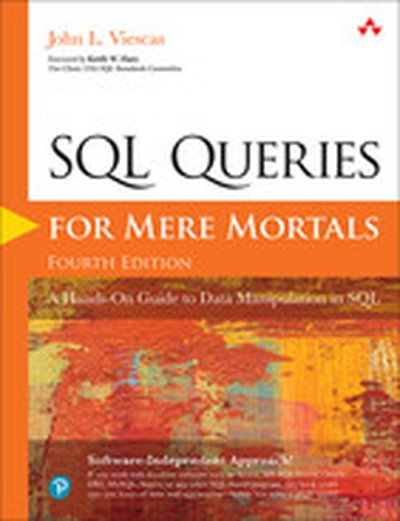
SQL Queries for Mere Mortals: A Hands-On Guide to Data Manipulation in SQL, 4th Edition

The #1 Easy, Common-Sense Guide to SQL Queries—Updated with More Advanced Techniques and Solutions Foreword by Keith W. Hare, Vice Chair, USA SQL Standards Committee SQL Queries for Mere Mortals has earned worldwide praise as the clearest, simplest tutorial on writing effective queries with the latest SQL standards and database applications. Now, author John L. Viescas has updated this hands-on classic with even more advanced and valuable techniques. Step by step, Viescas guides you through creating reliable queries for virtually any current SQL-based database. He demystifies all aspects of SQL query writing, from simple data selection and filtering to joining multiple tables and modifying sets of data. Building on the basics, Viescas shows how to solve challenging real-world problems, including applying multiple complex conditions on one table, performing sophisticated logical evaluations, and using unlinked tables to think “outside the box.” In two brand-new chapters, you learn how to perform complex calculations on groups for sophisticated reporting, and how to partition data into windows for more flexible aggregation. Practice all you want with downloadable sample databases for today’s versions of Microsoft Office Access, Microsoft SQL Server, and the open source MySQL and PostgreSQL databases. Whether you’re a DBA, developer, user, or student, there’s no better way to master SQL. Coverage includes: Getting started: understanding what relational databases are, and ensuring that your database structures are sound SQL basics: using SELECT statements, creating expressions, sorting information with ORDER BY, and filtering data using WHERE Summarizing and grouping data with GROUP BY and HAVING clauses Drawing data from multiple tables: using INNER JOIN, OUTER JOIN, and UNION operators, and working with subqueries Modifying data sets with UPDATE, INSERT, and DELETE statements Advanced queries: complex NOT and AND, conditions, if-then-else using CASE, unlinked tables, driver tables, and more NEW! Using advanced GROUP BY keywords to create subtotals, roll-ups, and more NEW! Applying window functions to answer more sophisticated questions, and gain deeper insight into your data Software-Independent Approach! If you work with database software such as Access, MS SQL Server, Oracle, DB2, MySQL, Ingres, or any other SQL-based program, this book could save you hours of time and aggravation—before you write a single query! .
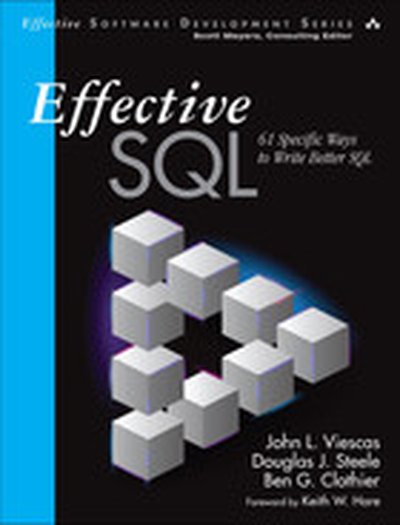
Effective SQL: 61 Specific Ways to Write Better SQL, First Edition

“Given the authors’ reputations, I expected to be impressed. I was blown away! . . . Most SQL books sit on my shelf. This one will live on my desk.” –Roger Carlson, Microsoft Access MVP (2006-2015) “Rather than stumble around reinventing wheels or catching glimpses of the proper approaches, do yourself a favor: Buy this book.” —Dave Stokes, MySQL Community Manager, Oracle Corporation brings together practical solutions and insights so you can solve complex problems with SQL and design databases that simplify data management in the future. It’s the only modern book that brings together advanced best practices and realistic example code for all of these versions of SQL: IBM DB2, Microsoft Access, Microsoft SQL Server, MySQL, Oracle Database, and PostgreSQL. Effective SQL Drawing on their immense experience as world-class database consultants and instructors, the authors identify 61 proven approaches to writing better SQL. Wherever SQL versions vary, the authors illuminate the key nuances, so you can get the most out of whatever version you prefer. This full-color guide provides clear, practical explanations; expert tips; and plenty of usable code. Going far beyond mere syntax, it addresses issues ranging from optimizing database designs to managing hierarchies and metadata. If you already know SQL’s basics, this guide will help you become a world-class SQL problem-solver. Craft better logical data models, and fix flawed models Implement indexes that improve query performance Handle external data from sources you don’t control Extract and aggregate the information you need, as efficiently as possible Write more flexible subqueries Analyze and retrieve metadata using your database platform of choice Use Cartesian Products and Tally Tables to solve problems you can’t address with conventional JOINs Model hierarchical data: managing SQL’s tradeoffs and shortcomings

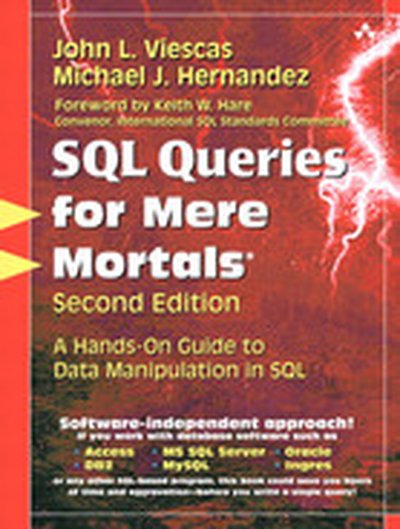
SQL Queries for Mere Mortals: A Hands-On Guide to Data Manipulation in SQL, Second Edition

Unless you are working at a very advanced level, this is the only SQL book you will ever need. The authors have taken the mystery out of complex queries and explained principles and techniques with such clarity that a "Mere Mortal" will indeed be empowered to perform the superhuman. Do not walk past this book! --Graham Mandeno, Database Consultant provides a step-by-step, easy-to-read introduction to writing SQL queries. It includes hundreds of examples with detailed explanations. This book provides the tools you need to understand, modify, and create SQL queries SQL Queries for Mere Mortals --Keith W. Hare, Convenor, ISO/IEC JTC1 SC32 WG3--the International SQL Standards Committee I learned SQL primarily from the first edition of this book, and I am pleased to see a second edition of this book so that others can continue to benefit from its organized presentation of the language. Starting from how to design your tables so that SQL can be effective (a common problem for database beginners), and then continuing through the various aspects of SQL construction and capabilities, the reader can become a moderate expert upon completing the book and its samples. Learning how to convert a question in English into a meaningful SQL statement will greatly facilitate your mastery of the language. Numerous examples from real life will help you visualize how to use SQL to answer the questions about the data in your database. Just one of the "watch out for this trap" items will save you more than the cost of the book when you avoid that problem when writing your queries. I highly recommend this book if you want to tap the full potential of your database. --Kenneth D. Snell, Ph.D., Database Designer/Programmer I don't think they do this in public schools any more, and it is a shame, but do you remember in the seventh and eighth grades when you learned to diagram a sentence? Those of you who do may no longer remember how you did it, but all of you do write better sentences because of it. John Viescas and Mike Hernandez must have remembered because they take everyday English queries and literally translate them into SQL. This is an important book for all database designers. It takes the complexity of mathematical Set Theory and of First Order Predicate Logic, as outlined in E. F. Codd's original treatise on relational database design, and makes it easy for anyone to understand. If you want an elementary- through intermediate-level course on SQL, this is the one book that is a requirement, no matter how many others you buy. --Arvin Meyer, MCP, MVP Even in this day of wizards and code generators, successful database developers still require a sound knowledge of Structured Query Language (SQL, the standard language for communicating with most database systems). In this book, John and Mike do a marvelous job of making what's usually a dry and difficult subject come alive, presenting the material with humor in a logical manner, with plenty of relevant examples. I would say that this book should feature prominently in the collection on the bookshelf of all serious developers, except that I'm sure it'll get so much use that it won't spend much time on the shelf! -- Doug Steele, Microsoft Access Developer and author Over the last several decades, SQL has evolved from a language known only to computer specialists to a widely used international standard of the computer industry. The number of new applications deployed each year using SQL now totals in the millions. If you are accessing corporate information from the Internet or from an internal network, you are probably using SQL. This new edition of helps new users learn the foundations of SQL queries, and is an essential reference guide for intermediate and advanced users. SQL Queries for Mere Mortals The accompanying CD contains five sample databases used for the example queries throughout the book in four different formats: Microsoft SQL Server 2000 and later, Microsoft Access 2000 and later, MySQL version 5.0 and later, and SQL scripts that can be used with most other implementations of the language.