talk-data.com talk-data.com

Saket Saurabh

Speaker

Saket Saurabh

5

talks

CEO AWS

Saket Saurabh is the Co-founder & CEO of Nexla, an Enterprise-grade Data Integration platform that helps scale Data Engineering through automation and collaboration. An engineer by background, Saket spent his formative years coding device drivers at Nvidia for new business initiatives including mobile, automotive, and console gaming. He is a repeat entrepreneur having taken his mobile ad-serving startup through acquisition and IPO as he helped build one of the largest real-time ad exchanges in the world. Saket’s passion for scale-out compute and data led him to start Nexla where his mission is to empower every data user with ready-to-use data for Operational, Analytical, and AI+GenAI use cases. Saket is a thought leader in the areas of Data Products, Data Fabric architecture, and Data for GenAI applications.

Bio from: Data Universe 2024

Frequent Collaborators

Filter by Event / Source

Talks & appearances

5 activities · Newest first

Search activities →

In this episode, I sit down with Saket Saurabh (CEO of Nexla) to discuss the fundamental shift happening in the AI landscape. The conversation is moving beyond the race to build the biggest foundational models and towards a new battleground: context. We explore what it means to be a "model company" versus a "context company" and how this changes everything for data strategy and enterprise AI.

Join us as we cover: Model vs. Context Companies: The emerging divide between companies building models (like OpenAI) and those whose advantage lies in their unique data and integrations. The Limits of Current Models: Why we might be hitting an asymptote with the current transformer architecture for solving complex, reliable business processes. "Context Engineering": What this term really means, from RAG to stitching together tools, data, and memory to feed AI systems. The Resurgence of Knowledge Graphs: Why graph databases are becoming critical for providing deterministic, reliable information to probabilistic AI models, moving beyond simple vector similarity. AI's Impact on Tooling: How tools like Lovable and Cursor are changing workflows for prototyping and coding, and the risk of creating the "-10x engineer." The Future of Data Engineering: How the field is expanding as AI becomes the primary consumer of data, requiring a new focus on architecture, semantics, and managing complexity at scale.

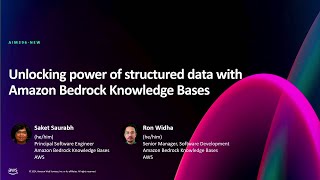
AWS re:Invent 2024-Unlocking power of structured data with Amazon Bedrock Knowledge Bases-AIM396-NEW

In this chalk talk, learn how the new structured data retrieval capability in Amazon Bedrock Knowledge Bases is empowering organizations to unlock the value of their structured data. The fully managed solution with a natural language to SQL (NL2SQL) module removes the complexity, empowering developers to send natural language queries about their data and receive SQL queries, result sets, or narrative responses—all through a simple API call. Discover how your organization can harness the power of structured data to build the next generation of intelligent applications.

Learn more: AWS re:Invent: https://go.aws/reinvent. More AWS events: https://go.aws/3kss9CP

Subscribe: More AWS videos: http://bit.ly/2O3zS75 More AWS events videos: http://bit.ly/316g9t4

About AWS: Amazon Web Services (AWS) hosts events, both online and in-person, bringing the cloud computing community together to connect, collaborate, and learn from AWS experts. AWS is the world's most comprehensive and broadly adopted cloud platform, offering over 200 fully featured services from data centers globally. Millions of customers—including the fastest-growing startups, largest enterprises, and leading government agencies—are using AWS to lower costs, become more agile, and innovate faster.

AWSreInvent #AWSreInvent2024

GenAI can look deceptively easy when it comes to showing a cool demo, but can prove incredibly hard to productionalize. This session will cover the challenges behind industrializing GenAI applications in the enterprise, and the approaches engineers are taking to meet these challenges. Attendees will get to take a look under the hood to see how Data Engineering and Integration techniques can help us go from simple demos to production grade applications with consistently high quality results.  

We will explore how Retrieval Augmented Generation (RAG) workflows go from naive to advanced. Techniques discussed will cover a typical GenAI application flow with topics including multiple and hybrid models, refined data processing, data security, getting transparency in results, combining structured and unstructured data, and putting it all together to get high performance and cost effective outcomes. Attendees will leave the session with a framework to understand proposed solutions from their teams and ask the right questions to test if a solution can become industrial-grade.

Summary Gartner analysts are tasked with identifying promising companies each year that are making an impact in their respective categories. For businesses that are working in the data management and analytics space they recognized the efforts of Timbr.ai, Soda Data, Nexla, and Tada. In this episode the founders and leaders of each of these organizations share their perspective on the current state of the market, and the challenges facing businesses and data professionals today.

Announcements

Hello and welcome to the Data Engineering Podcast, the show about modern data management When you’re ready to build your next pipeline, or want to test out the projects you hear about on the show, you’ll need somewhere to deploy it, so check out our friends at Linode. With their managed Kubernetes platform it’s now even easier to deploy and scale your workflows, or try out the latest Helm charts from tools like Pulsar and Pachyderm. With simple pricing, fast networking, object storage, and worldwide data centers, you’ve got everything you need to run a bulletproof data platform. Go to dataengineeringpodcast.com/linode today and get a $100 credit to try out a Kubernetes cluster of your own. And don’t forget to thank them for their continued support of this show! Atlan is a collaborative workspace for data-driven teams, like Github for engineering or Figma for design teams. By acting as a virtual hub for data assets ranging from tables and dashboards to SQL snippets & code, Atlan enables teams to create a single source of truth for all their data assets, and collaborate across the modern data stack through deep integrations with tools like Snowflake, Slack, Looker and more. Go to dataengineeringpodcast.com/atlan today and sign up for a free trial. If you’re a data engineering podcast listener, you get credits worth $3000 on an annual subscription Have you ever had to develop ad-hoc solutions for security, privacy, and compliance requirements? Are you spending too much of your engineering resources on creating database views, configuring database permissions, and manually granting and revoking access to sensitive data? Satori has built the first DataSecOps Platform that streamlines data access and security. Satori’s DataSecOps automates data access controls, permissions, and masking for all major data platforms such as Snowflake, Redshift and SQL Server and even delegates data access management to business users, helping you move your organization from default data access to need-to-know access. Go to dataengineeringpodcast.com/satori today and get a $5K credit for your next Satori subscription. Your host is Tobias Macey and today I’m interviewing Saket Saurabh, Maarten Masschelein, Akshay Deshpande, and Dan Weitzner about the challenges facing data practitioners today and the solutions that are being brought to market for addressing them, as well as the work they are doing that got them recognized as "cool vendors" by Gartner.

Interview

Introduction How did you get involved in the area of data management? Can you each describe what you view as the biggest challenge facing data professionals? Who are you building your solutions for and what are the most common data management problems are you all solving? What are different components of Data Management and why is it so complex? What will simplify this process, if any? The report covers a lot of new data management terminology – data governance, data observability, data fabric, data mesh, DataOps, MLOps, AIOps – what does this all mean and why is it important for data engineers? How has the data management space changed in recent times? Describe the current data management landscape and any key developments. From your perspective, what are the biggest challenges in the data management space today? What modern data management features are lacking in existing databases? Gartner imagines a future where data and analytics leaders need to be prepared to rely on data manage


Summary The technological and social ecosystem of data engineering and data management has been reaching a stage of maturity recently. As part of this stage in our collective journey the focus has been shifting toward operation and automation of the infrastructure and workflows that power our analytical workloads. It is an encouraging sign for the industry, but it is still a complex and challenging undertaking. In order to make this world of DataOps more accessible and manageable the team at Nexla has built a platform that decouples the logical unit of data from the underlying mechanisms so that you can focus on the problems that really matter to your business. In this episode Saket Saurabh (CEO) and Avinash Shahdadpuri (CTO) share the story behind the Nexla platform, discuss the technical underpinnings, and describe how their concept of a Nexset simplifies the work of building data products for sharing within and between organizations.

Announcements

Hello and welcome to the Data Engineering Podcast, the show about modern data management When you’re ready to build your next pipeline, or want to test out the projects you hear about on the show, you’ll need somewhere to deploy it, so check out our friends at Linode. With their managed Kubernetes platform it’s now even easier to deploy and scale your workflows, or try out the latest Helm charts from tools like Pulsar and Pachyderm. With simple pricing, fast networking, object storage, and worldwide data centers, you’ve got everything you need to run a bulletproof data platform. Go to dataengineeringpodcast.com/linode today and get a $100 credit to try out a Kubernetes cluster of your own. And don’t forget to thank them for their continued support of this show! Schema changes, missing data, and volume anomalies caused by your data sources can happen without any advanced notice if you lack visibility into your data-in-motion. That leaves DataOps reactive to data quality issues and can make your consumers lose confidence in your data. By connecting to your pipeline orchestrator like Apache Airflow and centralizing your end-to-end metadata, Databand.ai lets you identify data quality issues and their root causes from a single dashboard. With Databand.ai, you’ll know whether the data moving from your sources to your warehouse will be available, accurate, and usable when it arrives. Go to dataengineeringpodcast.com/databand to sign up for a free 30-day trial of Databand.ai and take control of your data quality today. We’ve all been asked to help with an ad-hoc request for data by the sales and marketing team. Then it becomes a critical report that they need updated every week or every day. Then what do you do? Send a CSV via email? Write some Python scripts to automate it? But what about incremental sync, API quotas, error handling, and all of the other details that eat up your time? Today, there is a better way. With Census, just write SQL or plug in your dbt models and start syncing your cloud warehouse to SaaS applications like Salesforce, Marketo, Hubspot, and many more. Go to dataengineeringpodcast.com/census today to get a free 14-day trial. Your host is Tobias Macey and today I’m interviewing Saket Saurabh and Avinash Shahdadpuri about Nexla, a platform for powering data operations and sharing within and across businesses

Interview

Introduction How did you get involved in the area of data management? Can you describe what Nexla is and the story behind it? What are the major problems that Nexla is aiming to solve?

What are the components of a data platform that Nexla might replace?

What are the use cases and benefits of being able to publish data sets for use outside and across organizations? What are the different elements involved in implementing DataOps? How is the Nexla platform implemented?

What have been the most comple engineering challenges? How has the architecture changed or evolved since you first began working on it? What are some of the assumpt